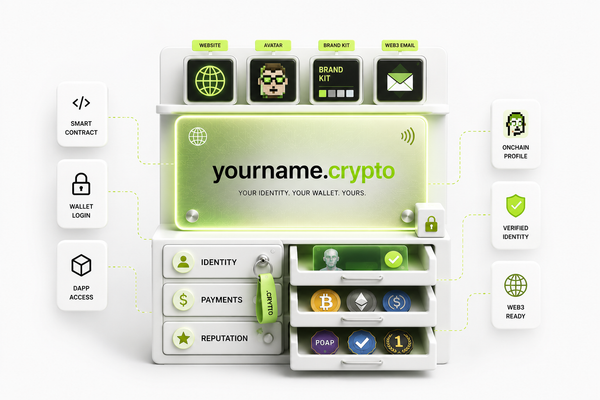
15 Ways to Utilize Freename Web3 Domain for Business Projects
Explore 15 creative uses for businesses in the decentralized web.

If you've spent any time in the crypto space lately, you've probably heard the term "Web3" thrown around a lot. But beyond the buzzwords, there's something genuinely practical happening and it involves the way we think about domain names.
In the traditional internet world, owning a domain means paying annual renewal fees, dealing with registrars, and hoping your chosen name doesn't get snatched up by someone else. Web3 flips that model on its head. Enter freenames blockchain-based domain names that you own outright, with no renewal costs, no middlemen, and no expiration date hanging over your head.
The opportunities here go well beyond just saving money on hosting. Freenames can reshape how businesses handle branding, customer engagement, digital identity, and even credentialing. Before we get into the 15 ways to use them, let's look at where the Web3 market actually stands today.
A Quick Look at the Web3 Market
The Web3 space isn't a niche experiment anymore. North America leads the charge, accounting for 34% of the global Web3 market. Europe follows at 24%, and the Asia-Pacific region holds 18% though it's worth noting that Asia saw a remarkable 706% surge in cryptocurrency involvement during the 2020 fiscal year alone. The Middle East and Africa collectively account for 14%, while South America holds the remaining 10%.
In other words, this is a global movement, and businesses that understand how to operate within it now will have a real head start.
15 Innovative Ways to Use Web3 Freenames for Business
1. Human-Readable Payment Addresses
Anyone who has tried to send cryptocurrency knows the anxiety of staring at a 42-character wallet address and wondering if they typed it correctly. One wrong character and your funds are gone.
Freenames solve this. Instead of copying and pasting a string of random characters, you can simply send crypto to something like "sarah.crypto" or "gamestop.coin." These human-readable addresses work across multiple cryptocurrencies, including Ethereum and Bitcoin, making transactions faster, simpler, and far less stressful for both businesses and customers.
2. Encrypted and Private Email
Most people don't think twice about handing out their Gmail address until they're drowning in spam or worried about data privacy. Freenames offer a cleaner alternative.
By linking a Web3 domain to an "@ud.me" email address, you create a private alias that forwards messages to your regular inbox without revealing your actual email address. Your customers and partners see a professional, branded address. Your real contact information stays protected. And you only have one inbox to manage no extra accounts, no complicated setup.
3. Leaderboard Names for Gaming
Here's one that's especially relevant for gaming companies and game developers. Crypto wallet addresses are notoriously ugly long, random strings of characters that mean nothing to other players.
Using a feature called "reverse resolution," Web3 platforms can display a player's freename something like "NinjaMike.game" instead of their wallet address on in-game leaderboards and social features. It's a small change that makes a big difference. Players feel recognized, communities form around real identities, and the gaming experience feels more human. Platforms like Snook have already started integrating this kind of functionality, and it's likely to become a standard expectation in blockchain gaming.
4. Decentralized Websites
Right now, even if you own your domain name, the website itself lives on servers controlled by a hosting company. If they go down, your site goes down. If they decide to terminate your account, your site disappears.
Freenames, combined with the InterPlanetary File System (IPFS) a decentralized, peer-to-peer file storage protocol let you build a website that no single company controls. Your content is distributed across a network, linked to your NFT domain, and accessible as long as the network exists. Browsers like Brave already support this model, and over 30,000 decentralized websites have already been built this way.
5. Digital Identity
Every social media platform Twitter, Facebook, Instagram gives you a profile. But here's the thing: you don't own it. The platform does. They can restrict it, suspend it, or shut it down entirely, and there's not much you can do about it.
A freename functions as a self-owned digital identity. Think of it as a portable online profile one that you fully control where you can store contact information, personal data, and even digital assets like NFTs. No platform can lock you out because no platform owns it. For businesses, this is a powerful way to build a brand presence that's truly independent.
6. Gaming and Metaverse Login
Managing a different username and password for every game, virtual world, and metaverse platform is exhausting. Web3 freenames offer a solution: a single, unified login that works across multiple platforms.
With a domain like "CosmicExplorer.game," players can move between different virtual environments while maintaining a consistent identity that their friends and communities recognize. For game developers and metaverse builders, this creates a smoother onboarding experience and reduces friction for users who are tired of creating new accounts everywhere they go.
7. DeFi Login
Decentralized finance (DeFi) applications are powerful, but they're not always user-friendly. Most require users to set up new credentials for each platform, which creates a fragmented and confusing experience.
Freenames simplify this by acting as a universal key. A domain like "FinanceWiz.crypto" can be used to log into multiple DeFi apps securely, with the user controlling exactly what information each app can access. It's a more intuitive experience for end users and for businesses building DeFi products, offering this kind of streamlined login can be a meaningful competitive advantage.
8. Digital Business Cards
Paper business cards get lost, go out of date, and end up in recycling bins. A Web3 freename-powered digital business card doesn't have any of those problems.
Instead of handing someone a card, you share your freename. Anyone who looks it up can see your name, photo, website, portfolio, and contact information all in one place, always current because you can update it at any time. It's a professional, modern alternative that's especially well-suited to industries where staying current and tech-savvy matters.
9. Digital Collectibles
This one might surprise you: some freenames are genuinely valuable as digital collectibles. Because they're NFTs non-fungible tokens representing verified, unique digital ownership no two freenames are identical. Premium domains in the Web3 space can appreciate significantly over time, similar to how rare domain names on the traditional internet became valuable as the web grew.
For businesses, this opens up an interesting angle. Acquiring strategically named Web3 domains early especially ones tied to your brand, industry, or target audience could prove to be a smart long-term investment, not just a practical tool.
10. Brand Identity in the Web3 Space
There's a reason tech-forward companies put their social media handles front and center. Online presence signals credibility and community membership.
In Web3, displaying your freename say, "[YourBrand].crypto" on your website, Twitter profile, or marketing materials sends a clear signal: you're not just observing the Web3 revolution, you're participating in it. There's even a term for actively building in the Web3 world "BUIDL" and using a freename is one of the most straightforward ways to show you're part of that culture. For brands trying to reach crypto-native audiences, this kind of authenticity matters a lot.
11. Education Credentials
The traditional resume has a verification problem. Anyone can claim a certification or degree, and actually checking those credentials takes real effort.
Web3 freenames offer a more elegant solution. Platforms like BitDegree have already started issuing digital certificates and badges directly linked to users' freename profiles. Completing a course earns you a verifiable digital badge permanently attached to your domain, visible to anyone you choose to share it with. For educational institutions, training programs, and professional certification bodies, this is a much more trustworthy and user-friendly way to issue and display credentials.
12. Badges and Community Recognition
Beyond formal education, Web3 freenames can host a whole ecosystem of community-issued badges digital trophies that recognize meaningful contributions to crypto projects, open-source development, or community governance.
Because these badges are stored on-chain, they're permanent and publicly verifiable. Projects and DAOs (decentralized autonomous organizations) can design their own custom badges to recognize and reward supporters and contributors. For businesses running loyalty programs or community-driven initiatives, this is a genuinely creative way to acknowledge and incentivize participation.
13. Reputation Management
In the physical world, your reputation follows you. In Web3, it hasn't always been easy to carry your track record from one platform to another until now.
A freename can serve as a living portfolio of your Web3 activity: NFT projects you've contributed to, domains you've accumulated, communities you've been part of, and milestones you've hit. It's a transparent, verifiable reputation profile that's visible to anyone in the ecosystem. For businesses and freelancers alike, this kind of portable reputation is increasingly valuable in a space where trust is everything.
14. Humanity Verification
One of the persistent challenges in the digital world is proving you're a real person without sacrificing your privacy. Web3 freenames address this through a feature called Humanity Check.
When you enable Humanity Check, participating apps and websites can confirm that you're a verified human not a bot without accessing any of your personal information. No name, no email, no address. Just proof of personhood. For businesses offering exclusive features or rewards to verified users, this is a powerful tool that balances security with user privacy.
15. Tipping and Micro-Payments
Finally, freenames make it dramatically easier to send and receive small cryptocurrency payments whether that's tipping a content creator, paying for a freelance service, or rewarding community contributions.
Instead of dealing with complex wallet addresses, senders simply use a readable domain like "GamerGirl.crypto." The transaction is straightforward, the risk of error is minimal, and the experience feels far more like sending a payment on a modern app than navigating a blockchain. For businesses operating in creator economies or community-driven platforms, this removes a significant barrier to adoption.
Final Thoughts
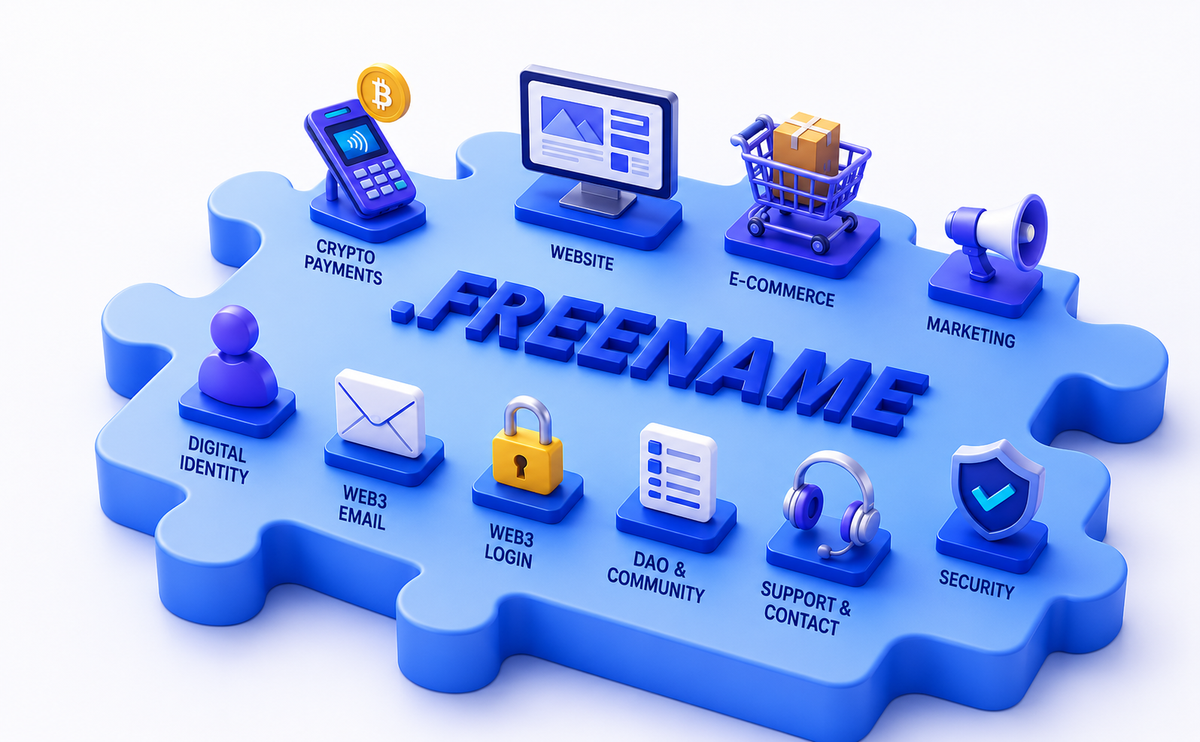
Web3 freenames are more than a cost-saving alternative to traditional domains. They're a versatile toolkit one that can simplify payments, strengthen brand identity, protect user privacy, build community, and create new revenue opportunities all at once.
As the Web3 ecosystem continues to mature, the businesses that take time to understand and experiment with these tools now will be better positioned to lead when decentralized technology becomes mainstream. Whether you're building a brand-new blockchain startup or an established company looking to expand into Web3, freenames are a practical, low-barrier place to start.
The decentralized internet is being built right now. The only real question is whether your business will be part of shaping it.