How Solana Domains Can Tell Your Brand Story in the Web3 Era
Unlock the potential of Solana domains for your brand! Discover how these unique identifiers can tell your brand story in the exciting world of Web3.

Your domain name is doing more work than you might realize.
It's not just a web address it's the first impression your brand makes online, the foundation of your digital identity, and a signal to every person who types it or clicks it about what kind of company or creator you are. In the traditional web, choosing the right domain name has always been a strategic decision. In Web3, that decision carries even more weight.
Solana domains human-readable .sol addresses built on one of the fastest blockchains in the world are giving brands, creators, developers, and everyday users a new way to establish their presence in the decentralized internet. And the numbers suggest people are paying attention: as of February 2024, over 600,000 Solana domain names have already been registered, according to Bonfida, the leading Solana name service provider.
That's not a niche experiment anymore. That's a movement.
What Is the Solana Name Service, and Why Does It Exist?
The Solana Name Service (SNS) was built to solve a problem that anyone who's used crypto has run into: wallet addresses are terrible for humans.
A typical Solana wallet address looks something like 7xKXtg2CW87d97TXJSDpbD5jBkheTqA83TZRuJosgAsU 44 characters of letters and numbers that are impossible to memorize, painful to share, and terrifying to type manually. One wrong character and a transaction goes somewhere it shouldn't, with no way to get it back.
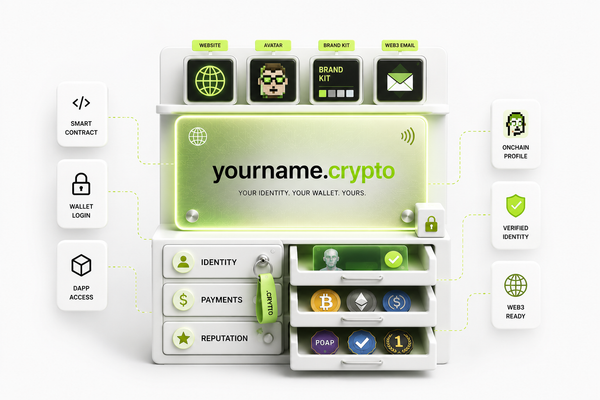
SNS provides a decentralized, cost-effective way to map readable domain names expressed as .sol to on-chain data. That on-chain data can be a Solana wallet address, an IPFS content identifier, photos, text, or other information stored on the blockchain. In its most practical application, a .sol domain is a clean, memorable alias that points to your wallet address so instead of sharing that 44-character string, you share jimmy.sol or yourbrand.sol.
But SNS is about more than payment convenience. It's about identity. In the metaverse and the broader Web3 ecosystem, your .sol domain is your handle your recognizable presence in a decentralized world that doesn't have a Facebook or Google managing your profile for you.
There's also a meaningful technical advantage: decentralized domain names eliminate a common vulnerability in Web3 applications. Many decentralized apps (dApps) depend on traditional, centralized domain names which creates a single point of failure. If that domain gets taken down or censored, the application goes with it. A .sol domain hosted alongside an IPFS or Arweave-based website creates a fully decentralized system that's significantly harder to censor or disrupt.
What Makes Solana the Right Blockchain for This?
Not all blockchains are created equal, and understanding what makes Solana stand out helps explain why building a domain identity there is worth considering.
Solana was founded by Anatoly Yakovenko and is built around a core insight: you can have fast transactions without sacrificing decentralization if you design the architecture correctly. Most blockchains force a trade-off between speed and security. Solana's approach is to engineer around that trade-off rather than accept it.
Here's how it works under the hood:
Proof-of-History is Solana's signature innovation. It functions like a cryptographic clock assigning a verifiable timestamp to each transaction on the network, creating a continuous historical record that validators can reference without having to communicate constantly with each other. This dramatically speeds up the consensus process and is the primary reason Solana can process transactions at the speeds it does.
Proof-of-Stake consensus works alongside Proof-of-History. Validators lock up ("stake") their SOL tokens to participate in the network, and they're incentivized to behave honestly bad actors get penalized through a process called slashing, where a portion of their staked tokens is forfeited. This keeps the network secure and accountable without requiring the energy-intensive mining that older blockchains rely on.
Tower BFT is Solana's version of Byzantine Fault Tolerance consensus a mechanism that ensures transactions are validated and recorded in a secure, decentralized way even if some nodes on the network behave incorrectly or maliciously.
Parallel processing is what really separates Solana's performance from most competitors. Rather than processing transactions one at a time, Solana breaks them into smaller tasks and handles multiple simultaneously. The result is a network capable of processing roughly 50,000 transactions per second at a cost of about $0.00025 per transaction numbers that put it in a different category from both Ethereum and Cardano in terms of raw throughput.
For domain names specifically, this speed and cost profile matters. Registering, transferring, and interacting with .sol domains happens quickly and cheaply on Solana which is exactly what you want when you're using a domain as a living piece of your digital infrastructure rather than just a static web address.
How .sol Domains Differ From ENS and Twitter Handles
It's worth taking a moment to understand how Solana domains compare to the other naming systems people often encounter in Web3.
Versus ENS (.eth domains): Ethereum Name Service is the most widely used blockchain domain system, and it's a strong product. The key differences come down to cost, speed, and expiration. ENS domains are built on Ethereum, which means gas fees can be significant especially during periods of high network congestion. ENS domains also expire and require renewal. .sol domains, by contrast, are built on Solana's low-cost, high-speed infrastructure, don't expire, and are often sold by auction for competitive names. The trade-off is that ENS has broader name recognition and deeper integration across the Ethereum ecosystem, which remains larger overall.
Versus Twitter handles through SNS: SNS actually supports both Twitter handle mapping and .sol domain names, but they work differently. A Twitter handle can only be claimed through SNS by the account's actual owner you have to tweet your wallet address and authenticate the transaction with that same wallet. An oracle verifies that the public key in the tweet matches the signer. It's a clever verification system, but it requires a public, identifiable Twitter account which means giving up your privacy.
.sol domain names serve a similar identity function without requiring any personal information or social media presence. You get the recognizability of a named address without tying it to a real-world identity. For users who value privacy, that distinction matters.
One important technical note about .sol domains: unlike NFTs, a .sol domain is technically a Solana account managed by the Name Service Program not an asset you own in the same way you own an NFT in your wallet. The actual ownership lives within the smart contract. This is worth understanding if you're thinking about the long-term portability of your domain.
Solana's Broader Ecosystem: Why It's a Strong Platform to Build On
Your .sol domain doesn't exist in isolation it's part of a rapidly expanding ecosystem of applications, projects, and communities built on Solana. Understanding the depth of that ecosystem helps you understand why establishing a presence there is strategically valuable.
Solana currently hosts over 350 projects spanning DeFi, NFTs, and Web3 applications. The NFT space on Solana is particularly vibrant projects like Degenerate Ape Academy and Solana Monkey Business have built substantial communities on the platform, and marketplaces like Solanart and Metaplex give creators and collectors a full-featured environment for minting, buying, and selling digital assets.
On the DeFi side, Solana's SPL token program supports a wide range of financial applications, and the Wormhole bridge allows assets to move between Solana and Ethereum connecting Solana to the broader multi-chain ecosystem rather than keeping it siloed.
The platform also supports SOL, its native cryptocurrency, which gives the ecosystem its own economy. SOL has experienced significant price volatility ranging from $11 to $38 during 2022 alone but the underlying network activity and developer engagement have remained strong through market cycles, which is a better signal of long-term health than token price alone.
For brand builders and creators, this ecosystem depth means that a .sol domain connects you to a real, active community not just a technical namespace.
How to Register Your .sol Domain
The process is genuinely accessible, even for people who are relatively new to crypto. Here's how it works from start to finish.
Step 1: Choose your platform. Bonfida's naming service at naming.bonfida.org is the primary and most trusted platform for .sol domain registration. It's the official SNS interface, and it's where most users should start.
Step 2: Search for availability. Use the search bar to check whether the domain name you want is available. Think carefully about your choice your .sol domain is your identity in the Solana ecosystem, so pick something that reflects your brand or personal presence accurately. Short, memorable names go quickly.
Step 3: Connect your wallet. Click "Connect Wallet" in the upper right corner. The platform will detect compatible wallets automatically. Phantom, Solflare, Trust Wallet, and Coin98 are all fully supported. Enter your password and authorize the connection.
Step 4: Add your domain to the cart and review storage options. Once you've found your domain, add it to your cart. Before checking out, pay attention to the storage option. The default is 1kB, which covers most standard use cases. If you're planning to use your domain for more advanced purposes like hosting a decentralized website via IPFS consider upgrading to 10kB. This choice is permanent, so think it through before finalizing.
Step 5: Complete the purchase. Standard registration costs 20 USDC plus a small SOL gas fee. If you hold Bonfida's FIDA token, paying with FIDA may offer a discount worth checking at the time of registration. Review your order, click "Complete Purchase," and confirm the transaction in your wallet.
Once the transaction processes, your domain is registered and linked to your wallet address. You can verify ownership on Bonfida's platform or by looking up your wallet on any Solana block explorer and checking the "Domains" tab.
A few bonus tips worth noting:
Secure your traditional .com domain alongside your .sol domain. A complete digital identity covers both the Web2 and Web3 versions of your brand name especially important if you're a business that operates in both spaces.
Act on good names sooner rather than later. The .sol namespace is still young enough that genuinely great names are available, but that window is narrowing. Names with five or more characters start at $20. Shorter names cost significantly more and the shortest, most memorable names are being claimed regularly.
Real Brands Already Using .sol Domains
The most persuasive argument for any new technology is seeing real organizations use it effectively. Here are three examples worth paying attention to.
Phantom Wallet — one of the most widely used cryptocurrency wallets in the Solana ecosystem uses its .sol domain as a primary access point for users. For a wallet product, this is a natural fit: it reinforces brand trust within the Solana community, makes the product more discoverable to Solana-native users, and signals that the company is deeply integrated with the ecosystem it serves rather than just adjacent to it.
Bonfida — as the organization that built and maintains SNS not only uses its own .sol domain but actively promotes the technology to its users. By championing .sol adoption while operating as a leading example of it, Bonfida strengthens its own brand credibility while contributing to the broader ecosystem's growth. It's a smart alignment of product and brand.
Metaplex — the premier platform for creating and selling NFTs on Solana uses its .sol domain to extend its brand presence across the ecosystem. For an NFT platform, a Solana-specific domain is a natural fit: it signals commitment to the Solana blockchain, makes the platform more recognizable to Solana-native users, and reinforces its positioning as a leading player in Solana's NFT space.
What these three examples have in common is a clear strategic logic: the .sol domain isn't just a technical address it's a brand signal. It tells the Solana community that you're a real participant, not just passing through.
What a .sol Domain Does for Your Brand
Let's bring this back to the practical question: what does registering a .sol domain actually do for your brand?
It builds credibility in the Web3 space. A .sol domain tells the Solana community that you've made a deliberate commitment to this ecosystem. In a space where credibility is earned through demonstrated participation rather than claimed through marketing, that signal matters.
It future-proofs your digital identity. The internet is moving toward decentralization gradually, unevenly, but unmistakably. Brands that establish their presence in Web3 now, while the ecosystem is still developing, will be better positioned when decentralized web technologies become mainstream. Your .sol domain is that stake in the ground.
It makes your brand more accessible. A memorable .sol domain is easier to share, easier to find, and easier to remember than a raw wallet address. For anyone in your audience who's already participating in the Solana ecosystem, your .sol domain is a direct, friction-free connection point.
It expands what your brand can do online. Linked to decentralized applications, payment systems, NFT collections, and community tools, a .sol domain turns your digital identity into functional infrastructure not just a name, but a platform for everything you build in Web3.
The Bottom Line
Your domain name has always been more than just an address. In Web3, it's your identity, your credibility, and your connection to a community that's building the next version of the internet.
Solana domains offer a compelling combination: the speed and low cost of one of the highest-performing blockchains available, permanent ownership with no renewal fees, privacy by default, and integration with a thriving ecosystem of applications and communities.
Over 600,000 people and organizations have already claimed their corner of the Solana namespace. The brands doing it thoughtfully choosing names that reflect their identity, integrating their .sol domain into their broader digital strategy, and building genuine presence in the Solana community are the ones that will look prescient when this technology becomes standard.
The decentralized web has a long way to go before it's fully mainstream. But the infrastructure being built right now .sol domains, .eth domains, .polygon domains, .dao domains, and endless domains emerging across different blockchain ecosystems is laying the foundation for what comes next. Your domain name is where that foundation starts.