How .wallet Domains Are Revolutionizing Digital Payments in 2025
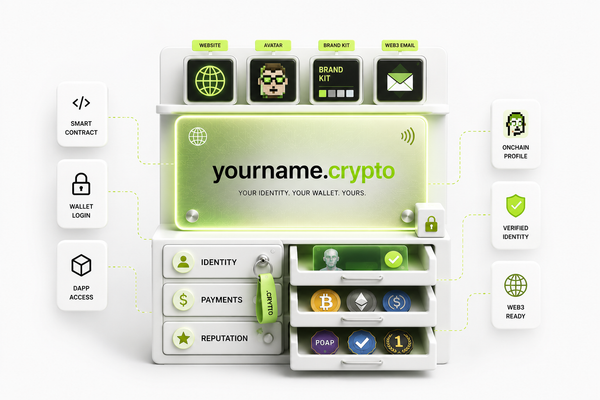
.wallet domains in 2025 revolutionize digital payments, offering secure, user-friendly solutions for transactions in the decentralized Web3 world.

Sending money should be simple. And in many ways, it has gotten simpler over the years. You can tap your phone at a checkout counter, split a dinner bill through an app, or wire funds internationally without setting foot in a bank. But underneath all of that convenience, the infrastructure is still largely the same: centralized institutions sitting in the middle of every transaction, collecting fees, adding delays, and holding control over your money.
Blockchain technology has been working to change that for years. But one of its persistent usability problems has been the wallet address, those long, intimidating strings of letters and numbers that make crypto transactions feel technical and error-prone even for people who understand what they're doing.
.wallet domains solve that problem directly. They replace complex wallet addresses with simple, memorable names, making blockchain payments as intuitive as sending an email. In 2025, they're becoming one of the most practical tools in the Web3 ecosystem, and this blog covers everything you need to know about them.
What Are .wallet Domains?
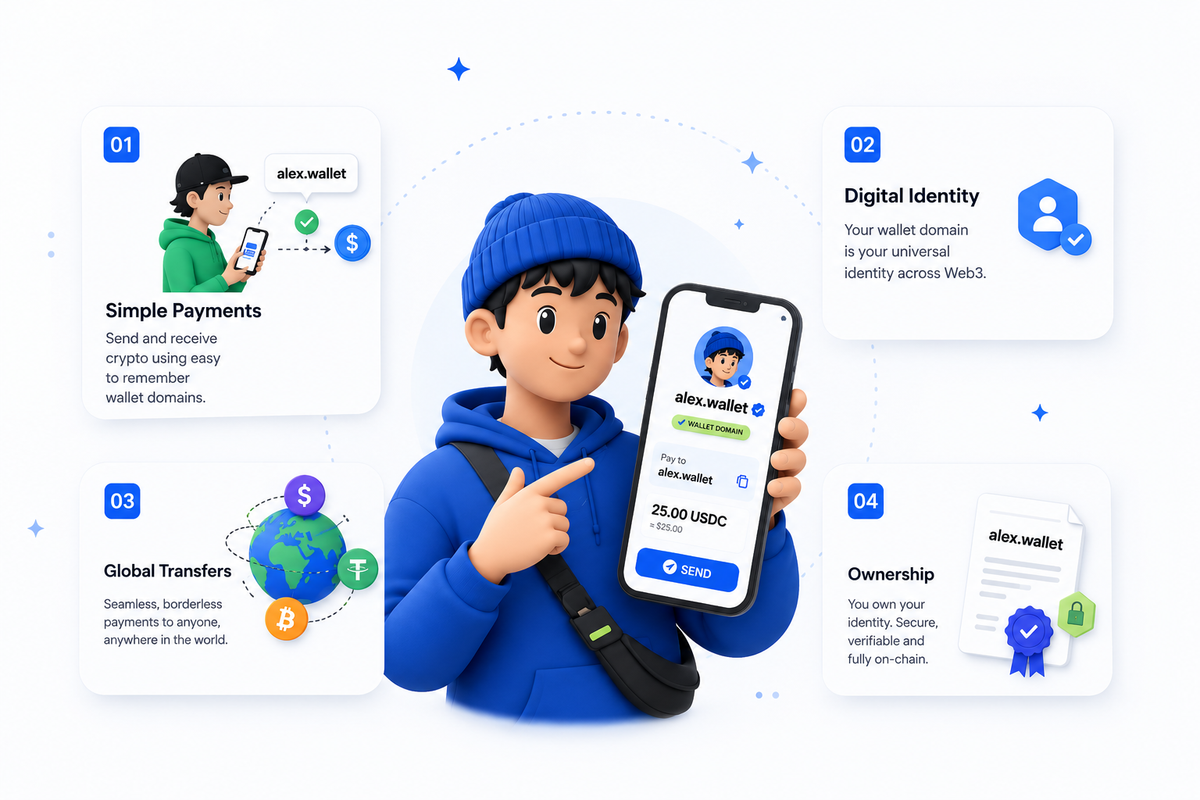
A .wallet domain is a blockchain-based identifier designed specifically for digital payments. Instead of sharing a wallet address like 1A8z...3Xk9 every time someone needs to send you money, you share something like John.wallet. Clean, memorable, and far less likely to result in a costly typo.
Like other blockchain domains, .wallet domains are decentralized. You own them outright, without any registrar or central authority holding the keys. But what makes .wallet domains distinct from other blockchain domain types is their specific focus on payment functionality. While domains like .x are built for broad decentralized identity across multiple blockchains, and .sol domains are tailored to the Solana ecosystem, .wallet domains are optimized for one primary purpose: making digital payments simpler, safer, and more accessible.
They integrate directly with blockchain wallets and decentralized applications, functioning as a user-friendly alias that the underlying blockchain infrastructure recognizes and routes correctly. The technical complexity stays in the background where it belongs, and the user experience becomes something anyone can work with.
Compared to traditional payment methods, the advantages are substantial. Credit card payments and bank transfers run through centralized systems that charge fees at multiple points and take days to settle. .wallet domains enable direct, peer-to-peer transactions that settle in minutes, with significantly lower costs and no middleman taking a cut.
Why Wallet Addresses Are Such a Problem
Before diving into what .wallet domains can do, it's worth understanding the problem they're solving because it's more significant than it might seem.
A typical blockchain wallet address looks something like this: 1A8z4bXk2...3Xk9mQp7. Every character matters. One wrong letter or number, and your funds go somewhere else, with no way to get them back. There's no fraud department to call, no reversal process, no safety net. The transaction is final.
This creates real anxiety for anyone using blockchain payments, and it's one of the main reasons crypto adoption has been slower among everyday users than the technology's potential would suggest. People are understandably hesitant to use a payment system where a single typo can mean losing money permanently.
.wallet domains remove that anxiety entirely. When you send funds to Alice.wallet, you're working with a human-readable name that's easy to verify, easy to share, and easy to remember. The risk of costly errors drops dramatically, and the whole experience becomes approachable rather than intimidating.
This matters not just for individual users but for the broader adoption of blockchain technology. Usability barriers are adoption barriers. Anything that makes blockchain payments feel more like the payment experiences people are already comfortable with accelerates the transition to Web3.
Security That's Built In, Not Bolted On
Digital payment security is something most people take for granted until something goes wrong. Traditional payment systems have layers of fraud detection, dispute resolution, and liability protection that users rarely think about. But those protections come with tradeoffs, including centralized control, data collection, and the ongoing vulnerability of large databases that store millions of users' financial information.
Blockchain-based .wallet domains approach security differently. The protection isn't layered on top of a centralized system. It's built into the architecture itself.
Every transaction made through a .wallet domain is recorded on the blockchain, creating a tamper-proof, permanent record that no single party can alter. The decentralized nature of the system means there's no central database to hack and no single point of failure that an attacker can target.
Phishing is one of the most common and damaging threats in digital payments. Attackers create fake payment addresses or clone interfaces to trick users into sending funds to the wrong destination. .wallet domains significantly reduce this risk because each domain is tied to a unique, verifiable record on the blockchain. Anyone can check that Shop.wallet is the legitimate payment address for a specific business, and the verification happens through the blockchain itself rather than through a company's security team.
For businesses, this translates into real credibility. A company accepting payments through ShopName.wallet is sending a clear signal to customers that their transactions are protected. For individuals, it means being able to share a payment address publicly without creating the kind of vulnerability that sharing a raw wallet address might.
How People Are Using .wallet Domains in 2025
The practical applications span a wide range of payment scenarios, and they're all united by the same core benefit: making blockchain payments work better for real people.
Peer-to-peer payments are the most straightforward use case. Friends splitting expenses, family members sending money to each other, and individuals paying for services from independent contractors. In all of these situations, the friction of traditional crypto payments, finding the right address, double-checking every character, and hoping nothing goes wrong, is replaced by the simplicity of just using a name. John.wallet receives the payment, the blockchain confirms it, and the transaction is done.
E-commerce payments are becoming increasingly important as more businesses look to accept cryptocurrency. The challenge has always been that asking a customer to copy and paste a wallet address into a checkout flow introduces friction and error risk that most merchants aren't willing to accept. .wallet domains change that by giving businesses a professional, memorable payment address that integrates cleanly into existing checkout experiences. A customer paying DigitalStore.wallet has a clear, verifiable destination and a much smoother payment experience than they would navigating raw wallet addresses.
Cross-border remittances are an area where the impact is particularly significant. International wire transfers through traditional banking channels are expensive and slow. Fees can consume a meaningful percentage of the amount being sent, and settlement can take multiple business days. Blockchain payments using .wallet domains are processed in minutes and at a fraction of the cost, with no bank intermediaries extracting fees along the way. For a freelancer in one country receiving payment from a client in another, or for someone sending money home to family abroad, the difference is tangible and immediate.
DeFi platforms benefit as well. Decentralized finance involves a lot of interactions with wallet addresses, whether depositing into liquidity pools, accessing lending protocols, or managing staking positions. Replacing the raw addresses with .wallet domains makes these platforms more accessible to users who are new to DeFi, lowering one of the significant barriers to entry for a sector that has enormous potential but has historically been difficult for non-technical users to navigate.
Crypto tipping is another growing use case that .wallet domains handle particularly well. Content creators, NFT artists, streamers, and independent writers can share a .wallet domain publicly as their tip address. Creator.wallet is easy to remember, easy to share, and easy to use, which means supporters are more likely to actually follow through on tipping rather than abandoning the process because the address looks too complicated.
Getting Your .wallet Domain Through Endless Domains
Securing a .wallet domain is straightforward through Endless Domains, a dedicated marketplace for blockchain-based domains built with Web3 users in mind.
The platform makes the process accessible regardless of your technical background. You search for the domain name you want, register it through a secure transaction, and it's yours. From that point, you can link it to your blockchain wallet, integrate it with the dApps you use, and start sharing it as your payment address.
What Endless Domains brings to this is a combination of simplicity and reliability. The interface is built for ease of use, the registration process doesn't require deep technical knowledge, and the platform ensures that your domain works correctly within the broader Web3 ecosystem from the moment you register it. Whether you're an individual setting up a personal payment address or a business building a professional payment presence in Web3, Endless Domains provides the tools to make it happen.
Taking Control of Your Digital Payment Future
The way we pay for things is going through a genuine transformation. Centralized systems that worked reasonably well for the twentieth century are showing their limitations as commerce becomes more global, more digital, and more decentralized.
.wallet domains represent one of the clearest and most practical steps toward a payment infrastructure that's faster, cheaper, more secure, and actually owned by the people using it. They take the most significant usability barrier in blockchain payments, the complexity of wallet addresses, and replace it with something that feels natural and trustworthy.
The technology is ready. The platforms are in place. And the case for making the move is straightforward. Whether you're an individual who wants a cleaner way to receive crypto payments, a creator looking to make it easier for supporters to send tips, or a business ready to expand into Web3 commerce, a .wallet domain is the most direct way to get there.
Explore your options with Endless Domains and take the first step toward a payment experience that actually belongs to you.