The Top 5 NFT Domain Marketplaces Right Now
NFTs have given rise to the all-new NFT domain marketplaces by penetrating the domain field.
If you've been paying attention to the crypto space over the last few years, you already know that NFTs blew the doors open on how we think about digital ownership. What started with digital art and collectables has quietly moved into territory that feels even more consequential domain names.
NFT domains, also called Web3 domains, are changing how people claim their corner of the internet. And with a growing number of marketplaces competing for your attention, it helps to understand what you're actually buying before you spend a dime.
This guide breaks it all down what NFT domains are, why they matter, what to look for in a marketplace, and which platforms are worth your time.
What Is an NFT Domain, Exactly?
Let's start simple. A traditional domain name like yoursite.com is something you rent. You pay a registrar every year to keep it. If you miss a payment, violate their terms, or get caught in a legal dispute, you can lose it. The registrar holds the real power, not you.
An NFT domain flips that model entirely. Instead of renting, you own it outright, permanently, as a Non-Fungible Token stored in your crypto wallet. Because it lives on a blockchain, it's not controlled by any company, government, or central authority. No one can seize it, suspend it, or quietly change its records without your permission.
The most common extensions you'll encounter are .eth, .crypto, .nft, .wallet, .bitcoin, and .sol though new ones are launching regularly as the ecosystem matures.
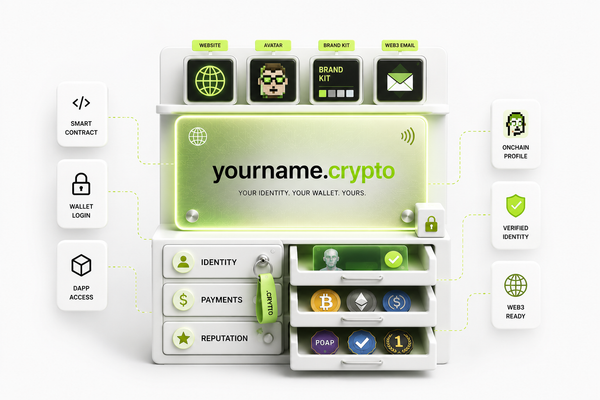
Beyond just being a web address, NFT domains also function as human-readable crypto wallet addresses. So instead of telling someone to send funds to 0x7f3A9B2e5cD8f..., you can just say yourname.crypto. It's cleaner, less error-prone, and honestly just easier for everyone involved.
Why Do NFT Domains Matter?
Fair question. The internet already has a domain system that works well enough. So why does any of this matter?
Ownership that's actually yours. A traditional domain name is closer to a lease agreement than actual ownership. An NFT domain, backed by blockchain technology, functions more like a title deed. The ownership record is public, immutable, and verifiable by anyone. No registrar can pull the rug out from under you.
No middlemen. In the traditional domain world, registrars sit between you and your domain. They handle renewals, transfers, disputes, and access. NFT domains remove that layer entirely. Transfers happen directly between wallets. There's no approval process, no waiting period, and no third party taking a cut of every transaction.
Scarcity creates real value. Just like a rare .com domain can sell for millions, premium NFT domains derive value from their uniqueness. Because blockchain technology makes every domain verifiably one-of-a-kind, scarcity isn't manufactured it's built into the system itself.
Censorship resistance. Because NFT domains can point to websites hosted on decentralized networks like IPFS or Arweave, the content isn't sitting on a server that can be switched off. That makes these domains genuinely difficult to censor or deplatform a meaningful feature for journalists, activists, and anyone operating in politically sensitive environments.
Key Features You Should Understand Before Buying
Before you jump into any NFT domain marketplace, it's worth knowing what you're actually getting.
Blockchain security. NFT domains are built on tamper-resistant blockchains. Ethereum is the most established, but Solana, Polygon, and Binance Smart Chain all host their own domain ecosystems. The blockchain your domain lives on affects your transaction costs, speed, and which wallets and apps support it.
Customizable content. Your NFT domain isn't just a static address. You can point it to a personal website, a decentralized application (dApp), a blog, a portfolio essentially anything you'd attach a traditional domain to, plus Web3-native uses that traditional domains can't support.
Interoperability. The better NFT domain systems are designed to work across multiple blockchain networks, not just the one they were minted on. This matters because the Web3 ecosystem is fragmented you want a domain that can travel with you as the landscape evolves.
Transferability. NFT domains can be bought, sold, and traded just like any other NFT. That creates an actual secondary market, which means your domain could appreciate in value over time or you could flip it for a profit if you snag the right name early.
What You Can Actually Do With an NFT Domain
The use cases go further than most people initially assume.
Build a digital identity. An NFT domain can serve as your unified Web3 identity linked to your portfolio, your social profiles, your NFT collection, and your DeFi activity. Think of it as a username for the decentralized internet.
Host a decentralized website. Pair your domain with decentralized storage, and you've got a website that doesn't depend on any single company to stay online. No hosting bills, no server outages, no takedown notices.
Stake your claim in the metaverse. NFT domains are increasingly functioning as virtual real estate. Brands and individuals are buying up domain names in metaverse ecosystems the same way people bought .com domains in the 1990s speculating that digital land will be worth something significant as these platforms grow.
Monetize through leasing or resale. If you own a premium NFT domain a short, memorable, or highly relevant name you can rent it out or sell it outright. A healthy secondary market already exists, and it's growing.
The NFT Domain Marketplace: What It Is and How It's Evolved
An NFT domain marketplace is a platform where users can buy, sell, and trade these domains. Powered by blockchain technology, these marketplaces offer transparent transactions, verified ownership, and in the best cases a straightforward user experience that doesn't require you to have a computer science degree to navigate.
The market started as a niche corner of the crypto world and has expanded rapidly. Ethereum remains the dominant blockchain for NFT domains, but Solana and Binance Smart Chain have carved out significant portions of the ecosystem. As blockchain technology has matured, so has the tooling wallets, browsers, and apps are increasingly built with NFT domain support baked in.
Premium domain names have also started selling for serious money, which has drawn in a wave of investors alongside the early adopters who were there for the technology itself.
What to Look for When Choosing a Marketplace
Not all NFT domain marketplaces are created equal. Here's what to evaluate before committing to a platform:
User experience. If the interface is confusing or clunky, the whole process becomes unnecessarily stressful. The best platforms make it easy to search, filter, preview, and purchase even if you're fairly new to Web3.
Blockchain compatibility. Each blockchain comes with its own tradeoffs in terms of transaction fees, speed, and ecosystem support. Make sure the marketplace operates on a blockchain that aligns with your wallet setup and how you plan to use the domain.
Token standard support. Different blockchains use different NFT token standards (ERC-721, ERC-1155, etc.). Confirm that the marketplace's token standards will work with the apps and wallets you're already using.
Security. You're dealing with assets that have real monetary value. Look for platforms that have a strong security track record, transparent smart contract audits, and a reputation they've actually earned not just claimed.
Community and reputation. A marketplace with an active, vocal community is usually a good sign. Check forums, Discord servers, and review sites. If a platform has a history of disputes or poor customer support, you'll find out quickly.
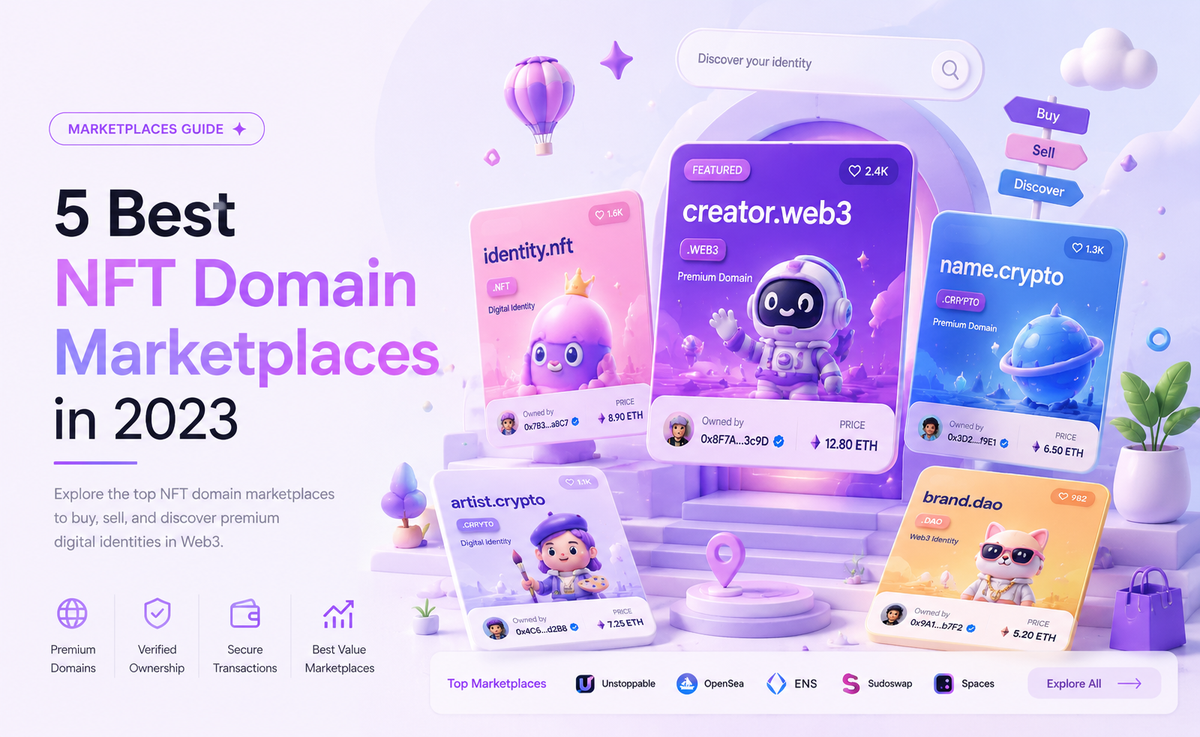
The Top 5 NFT Domain Marketplaces Right Now
1. Endless Domains
Endless Domains is one of the more polished platforms in the space, built specifically for users who want a straightforward experience without sacrificing features. With over 1 million registered domains and a growing user base, it's become a reliable option for both first-time buyers and experienced investors.
What sets it apart is the depth of its ecosystem integration Endless Domains connects with 20+ decentralized apps and protocols, making it easier to actually use your domain across the Web3 landscape, not just own it.
What makes it worth considering:
- A curated selection of top-level NFT domains across multiple categories
- Clean, intuitive interface that works well for newcomers and veterans alike
- Advanced search with filters for keywords, categories, and price ranges
- Secure, blockchain-verified transactions with transparent ownership records
- Integration with 20+ dApps and protocols for real cross-ecosystem utility
2. Ethereum Name Service (ENS)
ENS is the original and still one of the most widely used blockchain domain systems. It maps human-readable names directly to Ethereum wallet addresses, which means your .eth domain works wherever Ethereum is supported and Ethereum is supported almost everywhere.
ENS domains are natively compatible with a broad range of wallets, browsers, and applications, which gives them a practical edge over newer, less-established alternatives.
What makes it worth considering:
- Deep integration with the Ethereum ecosystem works out of the box with most major wallets
- Supports decentralized, censorship-resistant website hosting
- Compatible with existing DNS names you may already own
- Broadly supported across wallets, browsers, and dApps
3. Unstoppable Domains
Unstoppable Domains has become one of the most recognizable names in the NFT domain space, largely due to its aggressive expansion of supported top-level domains and its focus on user accessibility. It offers extensions like .crypto, .nft, .wallet, and several others, with support for over 275 coins and tokens.
The platform has done solid work on browser and application compatibility, which matters a lot in a space where most mainstream browsers still don't natively support blockchain domains.
What makes it worth considering:
- Wide variety of domain name extensions to choose from
- Supports 275+ cryptocurrencies and tokens
- User-friendly interface suitable for people new to Web3
- Compatible with a growing list of apps and browsers
4. Quik
Quik has carved out a niche in the metaverse corner of the NFT domain market, specializing in domains designed for virtual worlds and gaming ecosystems. If you're interested in metaverse real estate specifically, Quik has some extensions like .metaverse, .vr, and .doge that you won't find many other places.
The platform also has a royalty model that rewards creators: if someone resells a domain originally minted on Quik, the original minter earns a 5–10% royalty on the sale. It's a nice touch that aligns incentives between the platform and its users.
What makes it worth considering:
- Exclusive metaverse-focused domain extensions
- Royalty rewards of 5–10% on secondary sales of domains you originally minted
- Transparent, blockchain-secured transactions
- Distinctive, well-designed interface that's easy to navigate
5. OpenSea
OpenSea is the largest general-purpose NFT marketplace in the world, and it also happens to be one of the best places to find NFT domains on the secondary market. Unlike the platforms above, OpenSea doesn't mint new domains instead, it's where already-minted domains from ENS, Unstoppable Domains, Decentraland, and others get bought and sold.
If you're looking for a rare or premium domain that's no longer available through its original marketplace, OpenSea is where you go to find it.
What makes it worth considering:
- Access to already-minted domains from multiple ecosystems in one place
- Rare and high-value domains that have sold out on primary platforms
- Works with most major decentralized wallets
- Familiar, user-friendly interface with a long track record
What Does the Future Look Like?
The NFT domain market is still early-stage, but the trajectory is clear. As blockchain technology becomes more accessible and mainstream browsers begin natively supporting these domains, the friction of using them will drop significantly. That's when adoption is likely to accelerate beyond the crypto-native crowd.
A few things to watch:
Broader adoption. As Web3 becomes more mainstream, NFT domains will likely shift from a niche tool to a standard part of how people establish their digital presence similar to how having a .com became expected for businesses in the early 2000s.
Expanded use cases. We're already seeing NFT domains show up in gaming, metaverse real estate, and decentralized social media. Those use cases will deepen as the platforms supporting them grow.
More competition between marketplaces. The NFT domain space is competitive, and that competition is good for users. Expect better user experiences, lower fees, and more features as platforms fight for market share.
Final Thoughts
NFT domains aren't just a crypto gimmick. They represent a meaningful shift in how digital ownership works moving from a system where you're always dependent on a third party to one where the domain is genuinely yours.
That said, the space is still maturing. Browser support is limited, the user experience can be rough for newcomers, and the legal frameworks around blockchain domains are still catching up. Going in with realistic expectations will serve you better than going in with pure hype.
If you're ready to explore, the platforms above Endless Domains, ENS, Unstoppable Domains, Quik, and OpenSea are the most established places to start. Do your research, understand what you're buying, and pick a domain that actually means something to you or your brand.
The decentralized internet is being built right now. An NFT domain might just be your address on it.