What Is the Blockchain Domain Name System? How It Works and Why It Matters
In this article, we will explore the blockchain domain name system, their functions, benefits, and disadvantages. Let’s dive in.

Up until now, Web2 domains were known to manage digital identities and addresses. However, the emergence of blockchain technology and Web3 has revolutionized how we register and manage domain names. The blockchain domain name system is a groundbreaking approach to managing online identities and addresses in the Web3 digital landscape. By eliminating traditional centralized authorities, this system creates a decentralized environment for online interactions.
In this article, we will explore the blockchain domain name system, their functions, benefits, and disadvantages. Let’s dive in.
What is a Blockchain Domain Name System?
The Blockchain Domain Name System, or Blockchain DNS, leverages the principles of blockchain technology to revolutionize the traditional DNS system. Traditional DNS operates under centralized control, making it prone to hacking, censorship, and other risks.
In contrast, a blockchain DNS operates on a decentralized network and uses a distributed network of nodes. These nodes maintain a ledger containing all domain name registrations and transfers. This results in a more secure and censorship-resistant system. The improved blockchain system offers enhanced privacy, security, and domain name management.
How Does a Blockchain Domain Name System Work?
In a blockchain DNS, the records of domain names are stored on a public blockchain, with each domain name having a distinct blockchain address. Every transaction, such as domain name registration, updates, or transfers, is logged as a transaction on the blockchain.
When a user initiates a domain name request, the blockchain DNS searches the blockchain ledger to identify the corresponding address and resolve the domain. Thanks to the blockchain’s immutable nature and distribution among multiple nodes, domain name records remain secure from tampering and alterations.
Functions of Blockchain Domain Name System
Integrating blockchain technology with DNS offers several important functions to the users. These functions include:
1. Secure Web Browsing
Blockchain DNS offers secure and private web browsing. This safeguards the user’s online activities from surveillance and data breaches.
2. Decentralized Websites
With blockchain DNS, developers can create decentralized websites and applications that resist censorship and function independently of traditional infrastructure.
3. Permanent Domain Ownership
The blockchain domain name system maintains verifiable and permanent domain ownership records. This eliminates the chances of domain hijacking or unauthorized modifications to DNS records.
4. Decentralized Domain Name Resolution
Another crucial function of blockchain DNS is to offer decentralized domain name resolution. A blockchain domain name system operates on a network of distributed nodes, with each node having a complete copy of the blockchain ledger. This allows them to verify and resolve domain name requests without reliance on a single central authority.
5. Protection Against DNS Attacks
A blockchain domain name system uses the power of blockchain technology, which is a secure and shared database. This helps stop attacks like Distributed Denial of Service (DDoS) on the system.
With blockchain DNS, there is no central spot that can be attacked, making it difficult for attackers to disrupt the system. Since the records are stored on a public, decentralized network, it is challenging for any single entity to block or remove them.
6. Decentralized Distribution of Content
It has the potential to streamline decentralized content distribution, enabling individuals and organizations to share and host content directly from their devices. This reduces dependence on centralized servers. The feature is particularly useful for decentralized applications and file sharing.
Benefits of Blockchain Domain Name System
Blockchain DNS offers several benefits that can improve the security, privacy, and reliability of domain name management on the internet. These benefits include:
1. Improved Security and Integrity of Data
One of the most important benefits of blockchain DNS for the finance sector is enhanced data security and integrity. Financial institutions can store their domain name records on a secure, permanent blockchain. This ensures their digital assets and transactions are safe from tampering and fraudulent activities.
Furthermore, blockchain technology’s cryptographic security features provide additional protection against cyberattacks. It improves the trust and reliability of financial services, offering peace of mind to both institutions and their clients.
2. Simplified Payment Transactions
Integrating blockchain-based payment systems with the DNS represents a significant leap in simplifying payments and transactions. It allows for a streamlined, more efficient process that removes the necessity for intermediaries like banks or payment processors. As a result, transaction costs are reduced, making the process more cost-effective.
Additionally, blockchain technology’s cryptographic security measures provide a highly secure environment for financial interactions, safeguarding sensitive data from cyber threats.
3. Enhanced Transparency and Auditability
Blockchain technology records every transaction, from domain name registrations to financial dealings, on a ledger that all network participants can view. This increased transparency makes it difficult to manipulate or conceal any transaction. As a result, it reduces fraudulent activities and corrupt practices.
Furthermore, the permanent nature of blockchain records simplifies verifying transactions for auditors. This improves the accuracy of financial audits.
4. Reducing Risk Failures
Blockchain domain name system offers an effective solution to reduce the risk of single-point failure in financial systems. The traditional DNS systems have a central setup, which means they can be easily attacked or stop working if something goes wrong at the centre. However, blockchain DNS spreads the data across several nodes, making it resilient to technical failures. If something goes wrong with one node, the system keeps on working.
The feature can be especially useful for financial companies that require uninterrupted access to their services.
5. Seamless Collaboration and Interoperability
One of the key advantages of blockchain DNS is its ability to promote interoperability among various blockchain networks. It creates an environment where different blockchain platforms can easily communicate and collaborate. This interoperability streamlines data sharing, transactions, and interactions between different parts of the blockchain ecosystem.
It is important for the widespread adoption of blockchain technology across industries. Moreover, it enables smoother integration of blockchain solutions into existing infrastructure.
Disadvantages of the Blockchain Domain Name System
While blockchain DNS offers numerous advantages, it also comes with certain disadvantages and challenges:
- Scalability: Blockchain networks, including blockchain DNS, can face scalability issues as they grow. Handling several transactions and domain name resolutions can lead to slower processing times and increased resource requirements, hindering widespread adoption.
- Regulatory Challenges: The decentralized nature of blockchain can create regulatory challenges. It may be difficult to apply traditional regulatory frameworks to blockchain DNS. Using blockchain can give rise to issues like consumer protection and anti-money laundering.
- Costs: Setting up and integrating blockchain DNS into the IT infrastructure can be costly. It can include transaction fees associated with registering domain names or conducting transactions on the blockchain.
- Adoption Barriers: Adopting blockchain DNS may face resistance from established institutions and industries with a vested interest in traditional DNS systems. This may be due to a lack of technical expertise, perceived risks, or resistance to change. Convincing these entities to transition to blockchain-based systems can be challenging.
Closing Thoughts
The blockchain DNS reveals a technology with significant potential to revolutionize the domain name service industry. Its advantages, such as enhanced security, transparency, and resistance to censorship, hold the promise of improving the integrity and accessibility of online services.
However, it is essential to address the challenges, including scalability issues, complexity, and regulatory concerns, for widespread adoption. Despite these disadvantages, blockchain DNS continues to evolve as a promising technology to transform domain name management. If you've spent any time in the crypto world, you've probably dealt with wallet addresses. Long, ugly strings of letters and numbers that are nearly impossible to memorize and terrifying to type manually. One wrong character and your funds vanish into the void.
That frustration is exactly what blockchain domains are trying to solve, and they're doing a lot more than just cleaning up wallet addresses.
But before we get into the exciting stuff, let's start with the basics.
The Internet Has a Naming Problem (That Most People Don't Think About)
Every website you visit, Google, Reddit, your favorite news outlet, has an IP address underneath it. Something like 192.168.1.1. The Domain Name System (DNS) is what translates a human-friendly name like google.com into that number so your browser knows where to go.
It works. It's been working for decades. But it has a fundamental flaw: it's centralized. A handful of authorities control who owns what, and they can suspend, redirect, or revoke a domain name if they choose to. Governments can order takedowns. Registrars can make mistakes. Servers can go down.
Blockchain DNS is the answer to that flaw.
So What Exactly Is a Blockchain Domain Name System?
A blockchain DNS works the same way as traditional DNS; at its core, it maps a readable name to a destination. But instead of storing those records on centrally controlled servers, it stores them on a public blockchain.
That means no single company, government, or authority owns the records. They're maintained across a distributed network of nodes, each holding a complete copy of the ledger. To change a record, you'd have to alter every copy simultaneously, which is, for all practical purposes, impossible.
The result is a naming system that's more resistant to censorship, harder to hack, and owned outright by the person who registered it.
Common blockchain domain extensions you'll see in the wild:
- .crypto (Unstoppable Domains)
- .eth (Ethereum Name Service)
- .sol (Bonfida, Solana ecosystem)
- .nft, .wallet, .bitcoin, and more are emerging regularly
How Does It Actually Work?
Here's what happens behind the scenes when you register and use a blockchain domain:
Step 1—You register the domain. You purchase it through a provider like Endless Domains, Unstoppable Domains, or ENS. Unlike traditional domains, many blockchain domains are a one-time purchase with no annual renewal fees.
Step 2 — It gets minted as an NFT. Your domain is issued as a non-fungible token on a blockchain. That NFT lives in your crypto wallet (MetaMask, Phantom, etc.) and serves as proof of ownership. You do not control it, nor are you a registrar.
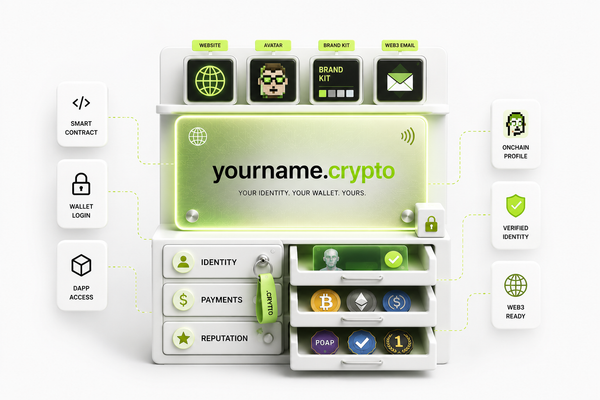
Step 3 — You map it to your wallet. You link the domain to your cryptocurrency wallet address (or multiple addresses). Now, instead of sending funds to 0x7f3A9B2e5cD8f..., someone can just send to yourname.crypto. Clean, simple, hard to mess up.
Step 4 — Resolution happens on-chain. When someone types your blockchain domain into a compatible wallet or browser, the system queries the blockchain, verifies the record across decentralized nodes, and resolves the destination. No central DNS server is involved.
The major players run on different blockchains. Unstoppable Domains runs on Polygon, ENS runs on Ethereum, and Bonfida runs on Solana, but the underlying logic is the same across all of them.
What Can You Actually Do With a Blockchain Domain?
This is where it gets interesting. Blockchain domains aren't just a novelty they have real, practical applications already being used today.
Simplified Crypto Payments
This is the most immediate use case for most people. Human-readable wallet addresses solve a genuine pain point. Sending $200 in ETH to Alex.eth is far less stressful than triple-checking a 42-character hex string.
Hosting Decentralized Websites
Blockchain domains can point to websites stored on decentralized networks like IPFS (InterPlanetary File System) or Arweave. Because the files are distributed across thousands of nodes, there's no single server to shut down. These sites are significantly more resistant to takedowns, deplatforming, and censorship.
Web3 Digital Identity
Think of a blockchain domain as your username for the decentralized internet. You can attach it to your NFT collection, your DeFi activity, your gaming profile , your decentralized social media account, ll from one readable name. It's the Web3 equivalent of a universal login.
Community and Brand Identity
DAOs, NFT projects, and Web3 communities use blockchain domains like projectname.eth or creator.crypto to establish identity and credibility. Some forward-thinking individuals also buy premium blockchain domains as speculative digital assets, similar to how early .com domain investing worked.
The Real Benefits Beyond the Marketing
A lot of the coverage around blockchain DNS leans heavily on buzzwords. Let's talk about what the benefits actually mean in practice.
Security that doesn't rely on trusting anyone. Because records are stored on an immutable blockchain, they can't be silently altered by a registrar, hacked through a centralized server, or suspended by an authority. The cryptographic structure makes tampering extraordinarily difficult.
You actually own it. With traditional domains, you're renting. Miss a renewal payment, violate a terms of service, or run into a legal dispute, and your domain can be taken. With a blockchain domain stored as an NFT in your wallet, ownership is direct and persistent.
No single point of failure. If one node in the network goes down, the rest keep running. For businesses or services that can't afford downtime, this resilience is genuinely valuable, especially compared to traditional DNS servers that can and do go offline.
Transparent ownership records. Every registration, transfer, and update is logged publicly on the blockchain. Anyone can verify who owns what, when they got it, and how it changed hands. That kind of auditability is hard to fake.
Interoperability across Web3. A single blockchain domain can connect to your Ethereum wallet, your Solana address, your NFT marketplace , your DeFi dashboard, and your blockchain game character. It functions as a unified identity layer across an otherwise fragmented ecosystem.
The Limitations That Don't Get Talked About Enough
Here's where most blockchain DNS articles fall short: they gloss over the real obstacles. Let's be honest about them.
Most browsers still can't read blockchain domains natively. Chrome, Safari, Edge none of them resolve .eth or .crypto out of the box. You need a browser extension, a Web3-enabled browser like Brave, or a centralized gateway. That's a significant friction point for anyone who isn't already in the crypto world.
The learning curve is steeper than it sounds. Setting up a blockchain domain means understanding private keys, gas fees, wallet security, NFT mechanics, and on-chain transactions. For a non-technical user, that's a lot to absorb before you can even get started.
"Private" isn't quite accurate. Blockchain transactions are publicly visible. While you might not attach your name to a wallet, your activity is traceable on-chain. Anyone determined enough can piece together a fairly detailed picture of your transactions. Blockchain DNS doesn't make you anonymous; it just removes one type of identifying information from the registration process.
Losing wallet access means losing your domain permanently. With a traditional registrar, you can usually recover an account through email verification or customer support. With a blockchain domain, if you lose your private key or get hacked and drained, recovery options are extremely limited. Self-custody is powerful, but it comes with serious responsibility.
Trademark and legal disputes are unresolved. What happens if someone registers nike.crypto before Nike does? Traditional DNS has the UDRP (Uniform Domain-Name Dispute-Resolution Policy), an established process for resolving these situations. Blockchain DNS has no equivalent universal framework yet. This is a real gap that's going to matter more as adoption grows.
Cost and scalability. Gas fees on busy networks like Ethereum can make registration and updates expensive. And as blockchain DNS scales to handle millions of queries, processing speed becomes a genuine engineering challenge, one that hasn't been fully solved yet.
Is Blockchain DNS Going to Replace the Traditional Internet?
Not anytime soon and probably not in the way most people imagine.
The more realistic picture is coexistence. Traditional DNS will continue to handle the vast majority of internet traffic because it works, it's universal, and it requires nothing from end users. Blockchain DNS will grow as the infrastructure of the decentralized web serving wallets, dApps, decentralized storage, and Web3 identities.
Think of it less as a revolution and more as a new layer being added on top of the internet we already have.
Final Thoughts
Blockchain DNS is one of those technologies that's genuinely useful but genuinely overhyped at the same time. The core value proposition, permanent, user-owned, censorship-resistant domain names that double as Web3 identities, is real and meaningful.
But the path to mainstream adoption is still long. Browser compatibility needs to improve. The user experience needs to become dramatically simpler. Legal frameworks need to catch up. And the average person needs a reason to care beyond the crypto community.
Projects like Ethereum Name Service, Unstoppable Domains, and Endless Domains are doing the real work of pushing this forward. The technology is solid. The ecosystem is growing. But we're still in the early innings, and anyone who tells you otherwise is probably trying to sell you a .crypto domain.