The Evolution of Anime Domains: Why ".Anime" is the Future
.anime domains: The future of online anime? Explore how this dedicated domain extension could connect fans, empower creators, and shape the future of the anime web.

If you had told someone in 1960s Japan that their black-and-white animated TV shows would one day inspire billions of fans across every continent, they probably would have laughed. Yet here we are. Anime has gone from a scrappy post-war art form to one of the most powerful cultural exports the world has ever seen and it shows absolutely no signs of slowing down.
But anime's evolution isn't just about better animation or bigger budgets. It's also reshaping the internet itself, sparking conversations about dedicated online spaces like .anime domains that could forever change how fans connect, create, and celebrate this art form. Let's take the full journey.
Where It All Began: Anime's Humble Origins
To understand where anime is today, you have to go back to post-World War II Japan. The country was rebuilding not just its cities, but its sense of identity. Art and storytelling became powerful tools for that rebuilding, and animation was no exception.
Enter Osamu Tezuka, the man widely regarded as the "Godfather of Anime." His creation, Astro Boy (1963), became a cultural touchstone. The animation was simple by today's standards limited movement, basic linework, black-and-white visuals but the heart behind it was anything but simple. Astro Boy told stories of hope, resilience, and the relationship between humanity and technology. For a country still healing from war, those themes hit deep.
Early anime was primarily made for children, leaning heavily into science fiction and fantasy. The stories were optimistic and morally clear. They weren't trying to be complex they were trying to inspire. And for a generation of young Japanese kids watching on tiny screens, they did exactly that.
The Golden Age: When Anime Found Its Voice (1970s–1990s)
The 1970s marked a turning point. As animation technology improved, so did ambition. Studios could now produce smoother movement, more dynamic scenes, and visually rich worlds. The audience for anime expanded rapidly and the stories expanded with it.
This era gave us mecha anime, a genre defined by giant robots and high-stakes battles. Mazinger Z became a phenomenon, launching an entire subculture of robot-obsessed fans. Sports anime also took off, with Captain Tsubasa inspiring generations of soccer players worldwide (yes, actual professional athletes have credited the show for sparking their love of the sport).
But the most significant shift was storytelling. Anime stopped being just for kids. It started wrestling with ideas that even adults found challenging war, identity, grief, existential dread. Akira (1988) redefined what animation could look like and what it could say. Neon Genesis Evangelion (1995) broke every conventional rule of the mecha genre and left audiences genuinely unsettled in the best possible way.
By the late 1990s, it was undeniable: anime wasn't a children's medium. It was a storytelling medium, full stop.
The Modern Era: Digital, Global, and Unstoppable (2000s–Present)
Then came the digital revolution, and everything changed again.
Digital animation tools allowed studios to create visuals that simply weren't possible with hand-drawn cels. Color became richer. Motion became more fluid. The sheer visual scale of modern anime is staggering watch the opening scenes of Demon Slayer: Kimetsu no Yaiba and try not to have your jaw drop. The water effects, the lighting, the character movement it looks less like animation and more like a living painting.
The internet changed things too. Streaming platforms like Crunchyroll brought anime to fans in countries where it previously had zero mainstream presence. Suddenly, a teenager in Brazil, a college student in Germany, and a working professional in the United States could all watch the same episode on the same night and argue about it in the same online forums.
Genre diversity exploded as well. You want a wholesome slice-of-life show about girls forming a band? K-On! has you covered. You want a psychological thriller that will keep you up at night questioning your own moral compass? Death Note is waiting. Horror, romance, isekai, historical drama, sports, cooking there's an anime for essentially every human interest at this point.
Fan culture grew into something massive and creative in its own right. Cosplay went from a niche hobby to an international art form. Anime conventions fill convention centers in cities across the world. Online communities on Reddit, Discord, Twitter, TikTok have created a 24/7 global conversation about anime that never really stops.
Anime's influence now extends well beyond animation. Video games, fashion brands, music, and even advertising have all borrowed heavily from anime aesthetics. It's no longer a subculture. It's culture.
A New Frontier: The Rise of .Anime Domains
So what's next for this massive, passionate global community? One of the most fascinating developments on the horizon has nothing to do with animation technology it has to do with the internet itself.
The concept of .anime domains has been generating serious buzz, and for good reason.
Traditional domain extensions like .com and .org were never designed with niche communities in mind. They're generic, broad, and frankly, a little boring. A dedicated .anime domain extension would do something genuinely new: it would signal, instantly and unmistakably, that a website is part of the anime world.
Imagine browsing to celestial.anime for fantasy anime reviews, or studiovolta.anime for an indie animation studio's portfolio. The domain itself tells you exactly what you're getting before you've read a single word. For a community as passionate and specific as anime fans, that kind of clarity is valuable.
Companies like Endless Domains are already exploring this space, working on .anime and .manga extensions that could give fans and creators a truly dedicated online identity.
What .Anime Domains Could Mean for Fans and Creators
For Fans
The most immediate benefit is discoverability. Right now, finding quality anime content online involves a lot of sifting through generic search results. A world with .anime domains could include dedicated directories think of it like a specialized search engine where every result is guaranteed to be relevant to the anime community.
There's also something more personal at play: belonging. Anime fans are passionate, and that passion often comes with a desire to identify publicly as part of this community. A .anime domain is a signal to other fans, to the wider world that says this is my world, and I'm proud to be in it.
For Creators
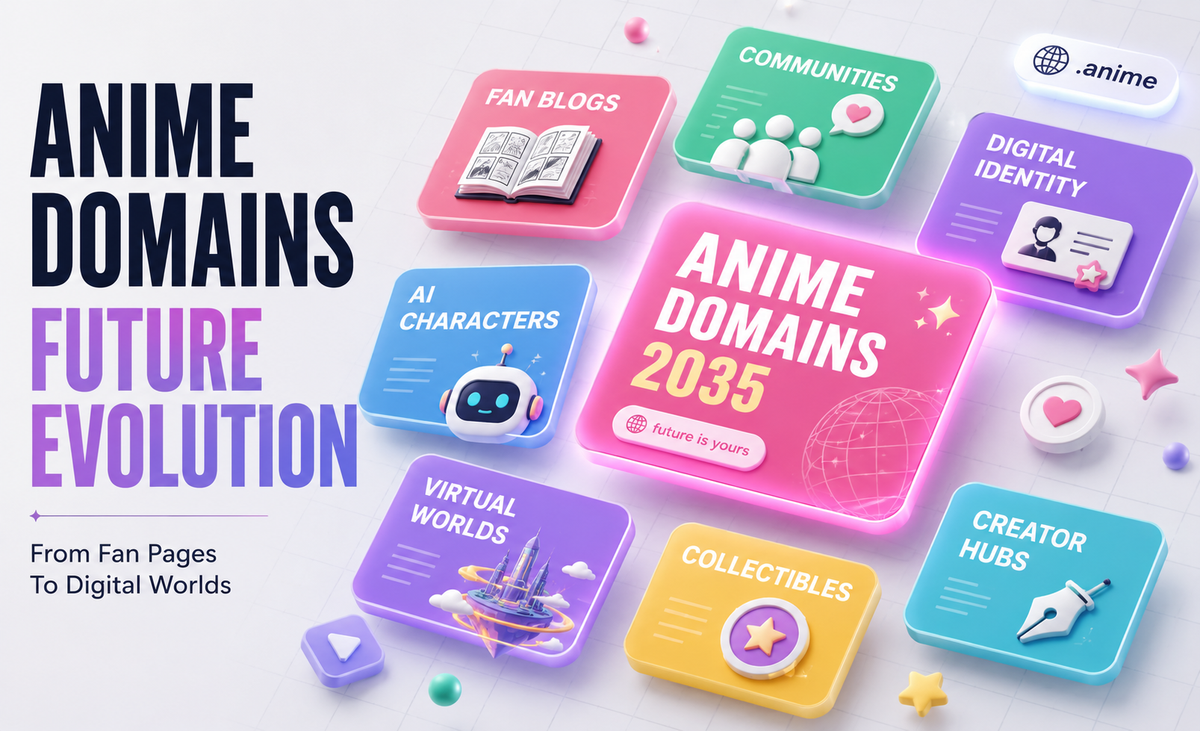
For animators, voice actors, cosplayers, reviewers, and fan artists, a .anime domain offers something priceless: a memorable, targeted online identity. In a crowded digital landscape, standing out matters. A domain like [yourcreatorname].anime is both self-explanatory and community-aligned in a way that [yourcreatorname].com simply isn't.
Businesses in the anime industry studios, merchandise retailers, convention organizers benefit too. A .anime domain instantly establishes credibility and connection to the community in a way that generic domain extensions never could.
The Tech Behind It: Blockchain and Portable Identities
Here's where things get really interesting.
Some of the most forward-thinking proposals around .anime domains involve blockchain technology. Rather than being controlled by a single central authority, blockchain-based domains would be decentralized meaning users would have genuine ownership and control over their online identities.
Endless Domains is among the companies exploring this model for .anime and .manga extensions. The vision is compelling: a .anime domain that functions as a portable identity across the entire anime ecosystem. Connect it to your streaming accounts, your fan forums, your digital wallet, your social profiles all under one consistent, community-rooted identity.
The security implications are meaningful too. Blockchain-based ownership means more transparency and less risk of having your domain taken away arbitrarily. Your corner of the anime internet would actually be yours.
Could a .Anime Metaverse Be Next?
It sounds like something straight out of Sword Art Online, but the idea of a dedicated .anime metaverse isn't as far-fetched as it might seem.
If .anime domains take off, they could serve as the foundation for a virtual world built specifically for anime fans a space where you could attend virtual screenings, explore 3D recreations of iconic anime locations, and interact with other fans from around the world, all anchored by your .anime identity.
Monetization possibilities in such a space would be real too: virtual merchandise stores, exclusive content locked to .anime domain holders, online conventions that don't require a plane ticket. The infrastructure for this kind of ecosystem is closer than most people realize, and platforms like Endless Domains are actively thinking about what it could look like.
Challenges Worth Acknowledging
None of this is guaranteed, and it's worth being honest about the hurdles.
Who controls the registry? If a central authority owns and manages .anime domains, there's a risk of fees, restrictions, and gatekeeping. A decentralized model solves this but comes with its own technical complexity.
Global inclusivity is another real concern. Anime is deeply rooted in Japanese culture, but its fanbase is global and diverse. How do .anime domains accommodate fans from regions with different languages, animation traditions, and cultural contexts? This is a conversation the community will need to have.
The timeline is still unclear. As of now, there's no official launch date for .anime domains. Acquisition processes haven't been announced. It's exciting territory, but it's still developing and fans should stay informed through reliable sources like Endless Domains for updates.
Finally, alternatives already exist. .moe domains have been around for a while and serve a similar purpose for anime and manga communities. They're not identical to what .anime would offer, but they're proof that community-specific domains can work.
The Bigger Picture
Step back and look at what's really happening here. Anime started as a modest, technologically limited art form made for Japanese children in the 1960s. It grew through decades of creative risk-taking, technological advancement, and genuine human storytelling into a global phenomenon that shapes fashion, gaming, music, and culture on every continent.
And now, the community that formed around it is so large, so passionate, and so active that it's driving innovation in how we organize the internet itself.
.Anime domains aren't just a cool idea for nerds. They represent something bigger: the recognition that online spaces should be as specialized and community-driven as the real-world communities they serve. The anime fandom didn't wait for the mainstream internet to catch up to it it's building its own infrastructure.
That's a very anime thing to do, honestly.
Final Thoughts
Whether you've been watching anime since the Dragon Ball Z days or you just discovered Jujutsu Kaisen last week, you're part of something that's been building for over 60 years. The art form has evolved dramatically, the community has grown beyond anything its founders could have imagined, and the digital landscape supporting it is on the verge of its own evolution.
Keep an eye on Endless Domains and the broader conversation around .anime and .manga domain extensions. This is one frontier where the community itself gets to shape what comes next and if anime history has taught us anything, it's that when fans are passionate about something, remarkable things tend to happen.