Bitcoin Price Rising: How it Will Impact Web3 Domains
Bitcoin's surge: Web3 domains next? Discover how BTC's rise could reshape the future of decentralized online identities.

As of April 1, 2024, Bitcoin (BTC) is trading at around $69,726 down just over 1% on the day. But zoom out, and the picture looks very different. Bitcoin has climbed more than 64% in 2024 alone, and its total market capitalization still sits at a staggering $1.37 trillion. For a lot of people watching the crypto market, that kind of resilience says everything.
Bitcoin isn't just the most traded and most valuable cryptocurrency in the world it's the one that started it all. Unlike the dollars and euros backed by governments and central banks, Bitcoin runs on a decentralized network that no single authority controls. Some see it as the future of money. Others are more skeptical. But what's harder to argue with is its impact not just on finance, but on the emerging world of Web3.
From Zero to Billions: Bitcoin's Wild Price Journey
Bitcoin's price history reads like a thriller. When it launched in 2009, it was worth essentially nothing. The mysterious creator known as Satoshi Nakamoto mined the very first block, and the world barely noticed.
By early 2011, Bitcoin reached parity with the US dollar for the first time a milestone that attracted a new wave of investors. Within months, the price climbed past $30. Then came the inevitable correction, and the cycle that Bitcoin fans would come to know well: surge, crash, recover, repeat.
In 2013, BTC briefly broke $1,000 before a major exchange hack and regulatory crackdowns in China pulled it back down. Then came 2017 the year Bitcoin became a household name. It surged to nearly $20,000, only to crash hard in 2018 during what became known as the "crypto winter."
But Bitcoin came back. By late 2020 it had surpassed its previous record, and in 2021 it hit a new all-time high of over $64,799. From virtually worthless in 2009 to a 9,000,000% gain by 2020 the long-term trajectory is hard to ignore, even if the short-term volatility can be nerve-wracking.
What Cryptocurrencies Actually Do Inside Web3
To understand why Bitcoin matters beyond trading, you have to understand its role in Web3 the next generation of the internet built on decentralization and user ownership.
In Web3, cryptocurrencies like Bitcoin serve as native currency. They let users send and receive money directly, cutting out banks and payment processors entirely. That means faster transactions, lower fees, and fewer middlemen taking a cut.
Beyond payments, crypto plays several other roles in the Web3 ecosystem:
Storing value
Many cryptocurrencies, Bitcoin included, are designed with a hard cap on supply. Bitcoin will never exceed 21 million coins. That scarcity is intentional it's modeled after gold, and it's a big reason why people treat Bitcoin as a store of value rather than just spending money.
Rewarding participation
Web3 platforms often distribute crypto tokens to users who contribute whether that's creating content, providing liquidity on decentralized exchanges (DEXs), or participating in governance decisions.
Fueling development
When there's money to be made building on a blockchain, developers show up. Cryptocurrency incentives drive the creation of decentralized apps (dApps) and the broader infrastructure of Web3.
According to DappRadar, DEX transaction volume skyrocketed in 2021 a clear sign that crypto's role in Web3 is growing fast.
How Bitcoin Actually Works: Blockchain, Mining, and Digital Scarcity
At its core, Bitcoin functions like digital cash but with a transparency layer that traditional banking simply doesn't have.
Every Bitcoin transaction is recorded on a public ledger called the blockchain. Anyone can access and verify it. There are no banks involved, no central clearinghouse just a peer-to-peer network where users transact directly using digital wallets tied to cryptographic keys.
Here's what makes it secure:
- Public ledger: Every transaction is recorded and visible on the blockchain. Nothing gets hidden.
- Peer-to-peer: No middlemen. You send Bitcoin directly to someone else's wallet.
- Cryptographic keys: Only the rightful owner can access their Bitcoin. Without the private key, there's no access.
- Fixed supply: There will only ever be 21 million Bitcoin built into the code from day one.
Bitcoin is created through a process called mining. Miners computers competing around the world use enormous computing power to solve complex math problems (called cryptographic hashing). The first miner to crack the puzzle gets to add a new block to the blockchain and earns a reward in newly created Bitcoin.
New blocks are added roughly every 10 minutes. And every four years or so, the reward miners receive gets cut in half a built-in mechanism called the "halving" that gradually slows the creation of new Bitcoin and keeps the supply scarce over time.
A Rising Bitcoin: What It Means for Web3 Domains
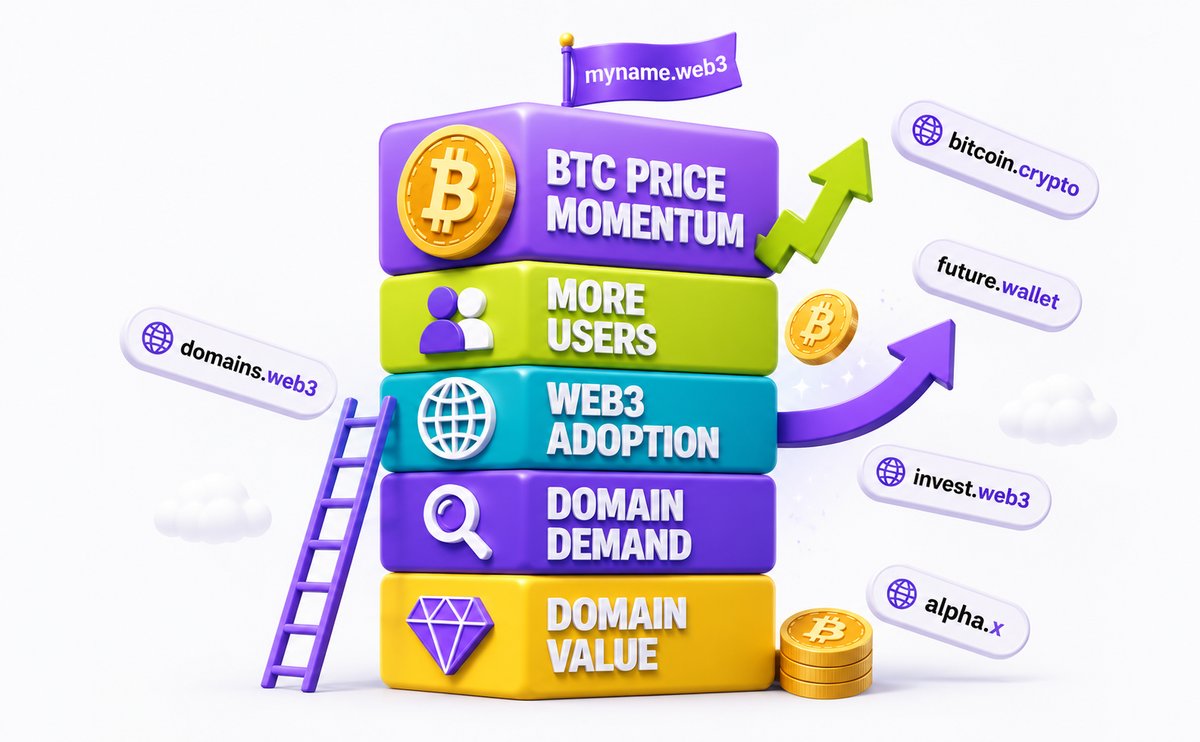
Web3 domains are decentralized alternatives to traditional website addresses think of them as usernames for the blockchain era. And like most things in the crypto world, their value is closely tied to the broader market's health. Here's how a rising Bitcoin price could reshape this space:
More investment, more adoption
When Bitcoin climbs, it tends to lift investor sentiment across the entire crypto ecosystem. That makes people more willing to explore newer, riskier investments including Web3 domains. A bull market in Bitcoin often translates to increased interest in buying, trading, and holding decentralized domain names.
Stronger faith in blockchain security
Bitcoin's blockchain underpins many Web3 projects. When BTC's price rises, it often signals growing confidence in the underlying technology including the security and transparency that make Web3 domains appealing in the first place.
Higher costs
Here's the flip side. If Bitcoin's value rises sharply, so does the cost of transactions on its network. That can make registering or trading Web3 domains more expensive, putting them out of reach for everyday users.
New use cases emerge
Rising prices attract developers who want to build on top of the momentum. We could see Bitcoin-powered Web3 domains integrated with DeFi platforms, used for metaverse identity management, or woven into NFT ecosystems creating a much richer and more interconnected user experience.
Volatility cuts both ways
A sharp drop in Bitcoin's price could cool investor enthusiasm for Web3 domains just as quickly as a surge inflated it. The key to the long-term health of the Web3 domain market lies in building genuine utility products and services people actually want to use not just riding Bitcoin's coattails.
Bitcoin's Bigger Vision: Beyond Digital Cash
Here's where things get genuinely exciting. Bitcoin doesn't have to be just a currency. The infrastructure already exists to build much more on top of it.
Think about what's possible: Bitcoin-powered payments on decentralized finance platforms, frictionless purchases of digital collectibles (NFTs), loyalty programs that bypass corporate middlemen. Major companies like Starbucks and Amazon have already started exploring Web3 strategies using other blockchains but Bitcoin, with its unmatched security and global trust, could be a powerful alternative.
The explosive growth of Ordinals unique digital assets inscribed directly onto the Bitcoin blockchain hints at the appetite for this kind of innovation. Technologies like zero-knowledge rollups (zk-rollups) could take things even further, enabling fast, cheap, and energy-efficient Bitcoin payments at global scale.
A Web3 ecosystem built on Bitcoin could democratize finance in ways we've never seen putting banking-like services in the hands of anyone with an internet connection, regardless of where they live or what bank will take them.
Bitcoin's secure smart contract capabilities could even be applied to voting systems, making elections more transparent, tamper-resistant, and accessible.
The Honest Challenges Ahead
None of this is guaranteed, and Bitcoin faces real competition.
Its biggest vulnerability is a reluctance to move quickly. While Ethereum has built a sprawling ecosystem of smart contracts, DeFi protocols, and developer tools, Bitcoin has historically focused narrowly on financial transactions. That gap has pushed many talented developers toward platforms that offer more flexibility and faster innovation cycles.
Bitcoin does have some catching up to do on smart contract functionality but it's not standing still. The Taproot upgrade, for example, opened meaningful new doors for more complex Bitcoin transactions. Still, the crypto community needs to actively develop and promote these capabilities if Bitcoin is going to compete for developer attention.
Bitcoin Exchanges and the Web3 Revolution
Bitcoin exchanges have evolved well beyond simple trading platforms. Today, they're critical infrastructure for the Web3 economy.
Exchanges create liquidity the lifeblood of DeFi. Without a vibrant, liquid marketplace for digital assets, decentralized finance can't function. Exchanges make it easy to buy, sell, and move assets in and out of the ecosystem.
Decentralized exchanges (DEXs) take this a step further. Instead of relying on a central company to match buyers and sellers, DEXs use smart contracts to automate trading directly between users' wallets. It's more transparent, more secure, and far more aligned with the core principles of Web3.
Beyond trading, major exchanges are integrating with NFT marketplaces, DAOs (decentralized autonomous organizations), and other Web3 technologies transforming themselves into comprehensive portals for the decentralized internet.
That said, exchanges still face real hurdles: regulatory uncertainty, security vulnerabilities, and the ongoing challenge of scaling to meet demand. These aren't small problems, but they're also opportunities for the kind of innovation that pushes the entire ecosystem forward.
Final Thoughts
Bitcoin is more than just a number on a price chart. It's infrastructure, it's ideology, and increasingly, it's the backbone of a new kind of internet. A rising Bitcoin price can draw fresh investment into Web3 domains, boost confidence in blockchain technology, and accelerate the development of tools that make the decentralized web more useful for everyday people.
But Bitcoin's long-term impact will come down to something simpler than price: whether the people building on it can turn its unmatched security and global trust into products and services the world actually wants to use. If they can, the ceiling is high.