The Rise of Blockchain-Based Email with Web3 Domains in 2025
Experience the next generation of email with Web3 domains. Secure, private, and decentralized communication is finally here.

Email is one of those technologies we all rely on without thinking too much about. It just works, most of the time, and that familiarity makes it easy to overlook how fundamentally broken the underlying system actually is.
Think about what your inbox looks like on any given day. Spam that somehow makes it through the filters. Phishing attempts designed to look like legitimate messages from your bank or your employer. Newsletters you never signed up for. And somewhere underneath all of that noise, the actual emails you need. The experience has become so normalized that most people have simply accepted it as the cost of using email.
But the problems run deeper than a cluttered inbox. Every email you send and receive passes through servers owned by companies whose business models depend on collecting and leveraging your data. You don't own your email address in any meaningful sense. The platform does. And if they change their terms, get breached, or decide your account violates some policy, your access disappears along with everything in it.
Web3 is building a different model. And at the intersection of blockchain technology and decentralized identity sits one of the most interesting developments in digital communication: blockchain-based email powered by Web3 domains. This blog explores what that means, why it matters, and where it's headed.
What's Actually Wrong with Traditional Email
Before looking at the solution, it's worth being clear about the problem, because the issues with traditional email go beyond the everyday annoyances most of us have learned to live with.
Spam and phishing
Despite decades of filtering improvements, unwanted and malicious emails still consume enormous amounts of time and create genuine security risks. Phishing attacks in particular have become increasingly sophisticated, with fraudulent emails that convincingly mimic legitimate sources to steal login credentials, financial information, and personal data. For individuals and businesses alike, a single successful phishing attack can be devastating.
Data breaches
Data breaches are a more serious underlying problem. Centralized email providers store massive amounts of user data on their servers, and those servers are attractive targets for cybercriminals. The history of major email-related data breaches is long and well-documented. Every time a provider gets compromised, the private correspondence, contact lists, and sensitive information of millions of users are exposed. The centralized architecture that makes traditional email convenient is the same architecture that makes it vulnerable.
Limited user control
Limited user control is perhaps the most underappreciated issue. When you use a traditional email service, you're operating within a system someone else controls. Your data gets collected, analyzed, and used in ways that are often unclear, even when you read the privacy policy carefully. Your ability to actually control who sees your information, how it gets used, and what happens to it if you decide to leave the platform is severely limited. You're essentially renting space in someone else's infrastructure and accepting their terms as the price of admission.
Dependence on centralized servers
Dependence on centralized servers creates a single point of failure that affects everyone using the system when something goes wrong. Server outages, cyberattacks, or even government interference can disrupt email access at scale, with users having no recourse because they don't control the infrastructure their communication depends on.
These aren't new problems, and incremental improvements to centralized systems have addressed them only partially. The architecture itself is the issue, and fixing it requires a different approach.
Web3 Domains: A Different Kind of Digital Identity
To understand how blockchain-based email works, it helps to first understand what Web3 domains actually are and how they differ from the domain names most people are familiar with.
A traditional domain like yourbusiness.com is registered through a centralized registrar and governed by organizations like ICANN. You pay annual fees to maintain it, and it exists under the rules and oversight of those centralized bodies. Change in policy, nonpayment, or a legal dispute can result in losing access to a domain you've built your business around.
Web3 domains work differently. They're built on blockchain technology, which means they're stored on a decentralized network rather than a centralized registry. When you register a Web3 domain like yourname.eth or yourbrand.crypto, that domain belongs to you in a genuine, verifiable sense. It's recorded on the blockchain as your property, and no central authority can revoke it, suspend it, or alter its ownership without your consent.
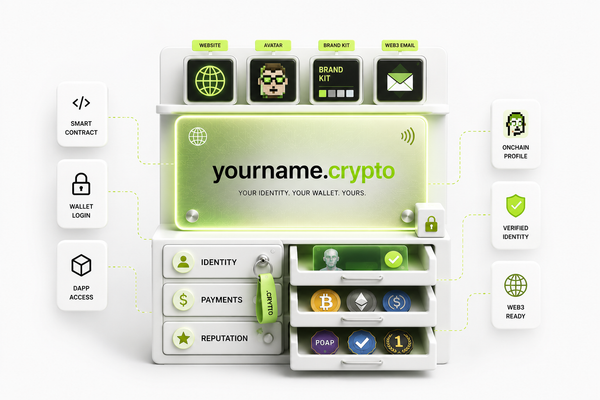
Beyond ownership, Web3 domains are functional in ways traditional domains aren't. They can be linked directly to cryptocurrency wallets, eliminating the need for traditional usernames and passwords in certain Web3 applications. They can serve as verifiable identities across decentralized platforms. And increasingly, they're being used as the basis for a new kind of email address, one that inherits all the security and ownership properties of the underlying domain.
Platforms like Endless Domains are making Web3 domain registration accessible to a much broader audience, offering a range of domain extensions and a user-friendly interface that doesn't require technical expertise to navigate. The barriers to owning a Web3 domain have dropped significantly, which matters a great deal for adoption.
How Blockchain Technology Transforms Email
The case for blockchain-based email starts with the fundamental architectural difference between decentralized and centralized systems.
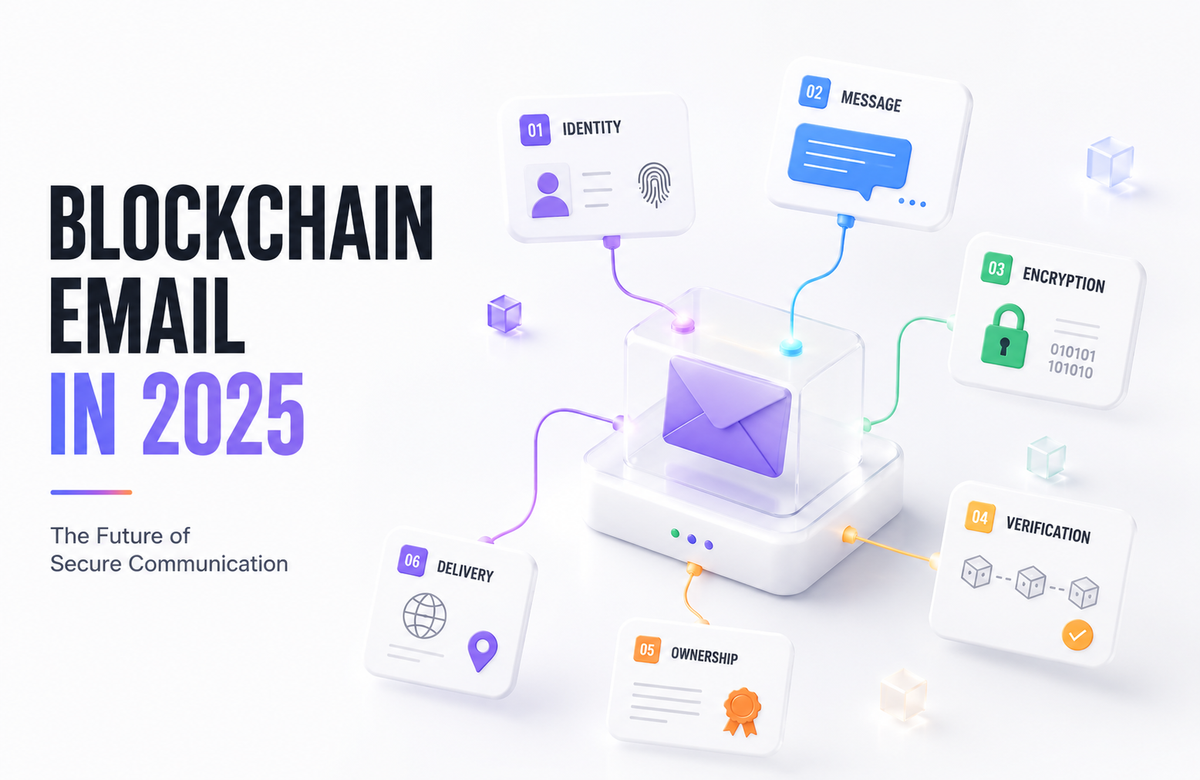
Traditional email relies on centralized servers that store your messages, manage your account, and handle every aspect of delivery. That centralization creates the vulnerabilities described earlier. Blockchain-based email distributes that infrastructure across a network of nodes, eliminating the single point of failure that makes traditional systems so vulnerable to outages and attacks.
On the security side, blockchain technology enables end-to-end encryption that is more robust and more verifiable than what traditional email providers offer. Email data stored on a blockchain is cryptographically secured, meaning that unauthorized access and tampering become significantly harder. The transparency of the blockchain means that security properties can be independently verified rather than just trusted on the basis of a company's assurances.
Privacy gets a meaningful upgrade as well. Blockchain-based email systems can be built to enable selective data disclosure, where users control exactly what information is shared with whom and for what purpose. Instead of your email provider having broad access to your correspondence for advertising and data analysis purposes, a blockchain-based system can be architected so that your messages are accessible only to you and your intended recipients.
Spam and phishing become significantly harder to execute in a blockchain-based email environment. Because senders can be verified through their blockchain identity, the kind of anonymous spoofing that enables most phishing attacks is much more difficult. Filtering can be applied at the identity level rather than trying to analyze message content after the fact, which is both more effective and more privacy-preserving.
User control is perhaps the most transformative change. In a blockchain-based email system, users own their inbox in a way that has no equivalent in traditional email. They control their spam filters, their contact permissions, and their data. They can switch platforms without losing their email address or their message history. And they're not dependent on any single company's decisions about how their communication infrastructure should be managed.
Web3 Domains and Blockchain Email: Better Together
The real power emerges when you combine Web3 domains with blockchain-based email infrastructure.
A Web3 domain like johndoe.eth or mybusiness.crypto can serve as the basis for a personalized email address, something like john@johndoe.eth or contact@mybusiness.crypto. This is more than a cosmetic improvement over generic email addresses. It's a fundamentally different kind of identifier, one that is verifiable on the blockchain, owned by the user, and resistant to the spoofing attacks that make phishing so effective.
For personal branding, this combination is compelling. A professional with a Web3 domain-based email address presents a more credible, technically sophisticated identity in the decentralized space. For businesses operating in Web3 ecosystems, it signals legitimacy and commitment to the values of security and decentralization that their customers and partners care about.
The organizational possibilities are also interesting. A Web3 domain can serve as a hub for multiple email identities, separating personal, professional, and project-specific communication under a single domain that the user controls. Instead of juggling accounts on different platforms with different privacy implications, everything operates under one blockchain-verified identity.
Decentralized email networks become possible when Web3 domains are used as the foundation for communication. Groups, communities, and organizations can establish direct communication channels that don't rely on any third-party email provider, enabling more private and censorship-resistant exchange within those networks. This is particularly valuable for organizations operating in environments where communication freedom is limited or where the sensitivity of the work demands a higher level of privacy than traditional email can provide.
The Challenges That Still Need to Be Solved
Being honest about where blockchain-based email currently stands requires acknowledging some real obstacles to widespread adoption.
Scalability and transaction costs
Scalability and transaction costs are the most significant technical challenges. Blockchain networks, particularly those using proof-of-work consensus mechanisms, can struggle with high transaction volumes, and the fees associated with blockchain operations can be meaningful for frequent everyday use, like email. Layer 2 solutions and more efficient consensus mechanisms are making progress on this front, but it's still an area that needs further development before blockchain-based email can compete with traditional systems at scale.
User education
User education is a practical barrier that shouldn't be underestimated. The concepts underlying Web3 domains and blockchain-based email are genuinely new to most people, and the user interfaces for interacting with these systems are still less polished than what people expect from email services they've been using for decades. Broader adoption requires not just better technology but better onboarding, clearer explanations, and experiences that feel familiar enough that people don't have to think too hard about the underlying mechanics.
Integration with existing infrastructure
Integration with existing infrastructure is the third major challenge. Email is deeply embedded in how businesses, governments, and individuals operate. A blockchain-based email system that can't communicate with traditional email creates a fragmented experience that most users won't accept. Building bridges between the new decentralized infrastructure and existing systems is essential for adoption and requires collaboration across the industry.
These challenges are real, but they're the kinds of challenges that get solved as technology matures and as the developer community grows around a promising space. None of them is a fundamental objection to the approach. They're engineering problems with engineering solutions.
Taking Control of Your Digital Communication
The trajectory of blockchain-based email and Web3 domains points toward a future where people have genuine control over how they communicate online, not just the illusion of control that centralized platforms offer.
For individuals, that means an email experience that's actually private, actually secure, and actually yours. For businesses, it means a communication infrastructure that doesn't create the data exposure and compliance risks that come with depending on centralized platforms. For communities and organizations that operate in sensitive or restricted environments, it means communication channels that are resilient against interference in ways that traditional email simply cannot be.
We're not there yet in terms of mainstream adoption, but the foundation is being built, and Web3 domains are a meaningful part of that foundation. Platforms like Endless Domains are making it straightforward to establish your presence in this space now, before widespread adoption drives up demand and drives up the cost of premium domain names.
The email system most of us use today was built for a different era, and it shows. The question isn't whether something better is possible. It's how quickly the better alternative becomes the standard. Registering a Web3 domain is one of the simplest and most practical ways to position yourself on the right side of that shift.