How Does Web3 in Supply Chain Management Enhance Transparency and Efficiency with Blockchain?
Supply chain management (SCM) is the backbone of global trade, ensuring goods and services flow seamlessly from origin to destination. However, traditional supply chains face persistent issues such as inefficiencies, fraud, and a lack of transparency. Enter blockchain and Web3, which are transformin

Supply chains are the backbone of global commerce. Every time you order a product online, buy groceries at the store, or pick up a prescription at the pharmacy, you're benefiting from a complex web of suppliers, manufacturers, shippers, and retailers working in sync or at least trying to. The reality is that traditional supply chains are riddled with inefficiencies, blind spots, and vulnerabilities that cost businesses billions of dollars every year.
That's where blockchain and Web3 come in. These technologies aren't just buzzwords they're quietly reshaping how goods move around the world by introducing transparency, automation, and accountability into a system that has long been overdue for a serious upgrade.
The Real Problems with Traditional Supply Chain Management
Before we talk about solutions, it helps to understand just how broken the current system can be.
1. Nobody Can See the Full Picture
Transparency is arguably the biggest problem in traditional supply chain management. Think about how many hands a product passes through before it reaches you: raw material suppliers, manufacturers, freight forwarders, customs brokers, distributors, and retailers. Each of these parties typically manages its own data in its own system, and those systems rarely talk to each other.
The result? Information silos. A manufacturer might have no idea that their shipment is stuck at customs until it's already days late. A retailer may not know a key component is backordered until it disrupts their entire production schedule. These gaps in visibility don't just cause delays they create accountability problems that are hard to untangle after the fact.
2. Global Complexity Creates Constant Friction
Modern supply chains are global by nature, and that brings an enormous amount of complexity. A single product might source components from a dozen countries, pass through multiple shipping providers, and navigate the customs regulations of several different governments each with its own documentation requirements and timelines.
When each party involved uses different software and different standards, coordinating smoothly becomes a real challenge. Miscommunication is common, and even a minor documentation error can cause a customs delay that ripples through the entire chain.
3. Manual Processes Slow Everything Down
Despite all the technology available today, many supply chain operations still rely heavily on manual processes. Paperwork, phone calls, and email chains are still standard in many industries and they're slow. A single missing document can hold up a shipment at customs for days. Manual invoice verification takes time. And every step that requires a human to review and approve something is a potential bottleneck.
4. Counterfeiting and Fraud Are Real Threats
In industries like pharmaceuticals, luxury goods, and electronics, counterfeit products are a serious and growing problem. When goods pass through multiple intermediaries, it becomes increasingly difficult to verify their authenticity. Weak tracking systems create openings for counterfeit products to slip into the supply chain undetected, which not only costs companies money but can also put consumers at risk.
How Blockchain Works And Why It Matters for Supply Chains
At its core, a blockchain is a distributed ledger a shared record book that's maintained across a network of computers rather than stored in one central location. Every transaction or update is recorded in a "block," which is then linked to the one before it, forming a chain. Once data is written to the blockchain, it can't be altered or deleted. That immutability is what makes it such a powerful tool for supply chains.
When all participants in a supply chain manufacturers, suppliers, shippers, customs agencies, and retailers are working from the same shared ledger, the information silos that cause so many problems start to disappear. Everyone sees the same data in real time, and no single party controls it.
Smart Contracts: Automating the Boring (and Important) Stuff
One of the most practical applications of blockchain in supply chains is the use of smart contracts. These are self-executing agreements written directly into code on the blockchain. The terms of the contract are predefined, and when the specified conditions are met, the contract executes automatically no middleman required.
Here's a simple example: a smart contract could be set up to automatically release payment to a supplier the moment a shipment is confirmed as delivered. No waiting for someone to manually verify the delivery, process the invoice, and approve the payment. It all happens instantly, reducing delays and cutting out the administrative overhead that typically adds days or weeks to payment cycles.
Smart contracts also reduce the risk of fraud and human error, since there's no human judgment involved in executing the agreed-upon terms.
Tracking and Traceability from Source to Shelf
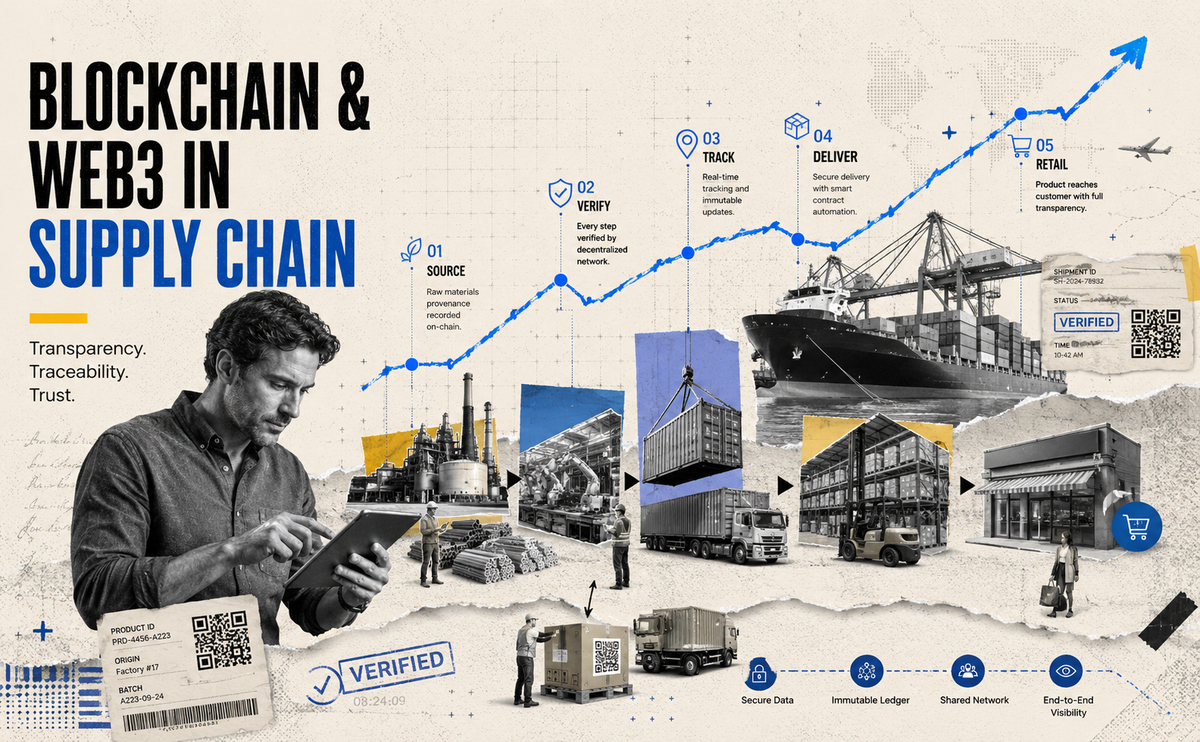
Blockchain's combination of transparency and immutability makes it ideal for tracking goods throughout their entire journey. From the moment raw materials are sourced to the moment a finished product lands in a customer's hands, every step can be recorded on the blockchain.
This level of real-time traceability means that if something goes wrong, a shipment is delayed, a batch of products is recalled, or a supplier fails to deliver, everyone can see exactly where the breakdown occurred. There's no finger-pointing or lengthy investigation needed. The record is already there.
Tokenization: Turning Physical Goods into Digital Assets
Tokenization is another powerful concept that blockchain brings to supply chains. In simple terms, tokenization means representing a real-world asset a shipment of goods, a raw material inventory, or a piece of equipment as a digital token on the blockchain.
Each token represents ownership or a stake in that physical item, making it far easier to track, transfer, and manage. When a shipment moves from one party to another, ownership can be transferred digitally in real time, eliminating the mountain of paperwork that traditionally accompanies each handoff. This not only speeds up the process but also reduces the errors that come with manual record-keeping.
What Blockchain Actually Fixes
End-to-End Visibility for Everyone
Because all authorized participants in a blockchain-based supply chain share access to the same ledger, everyone from the manufacturer to the final retailer can see the status and location of goods at any given moment. When a shipment is delayed, all stakeholders are notified immediately, which allows for faster responses and better decision-making.
This kind of real-time, shared visibility is something traditional supply chain systems simply can't deliver at least not without significant coordination and infrastructure investment.
An Unchangeable Audit Trail
Every transaction recorded on a blockchain is permanent. That makes blockchain an incredibly valuable tool for auditing and accountability. If a defect is found in a batch of products, the blockchain record can trace it back to its exact point of origin which batch, which supplier, which shipment. Businesses can address problems faster and with much greater precision than they could by combing through spreadsheets and email chains.
Breaking Down Information Silos
Instead of each party in the supply chain maintaining its own isolated database, blockchain creates a shared platform where data flows freely between all authorized participants. Updates are reflected in real time for everyone, which eliminates the lag and confusion that happens when different parties are working from different and often outdated information.
Building Trust Across the Entire Chain
Trust is foundational to any business relationship, and it's particularly important in complex supply chains involving dozens of parties across multiple countries. Blockchain builds that trust by giving every participant access to the same verified, tamper-proof data.
Consumers benefit too. With blockchain, it's possible to give shoppers the ability to scan a product and see its complete history where it was made, what it's made from, and every step it took to reach the shelf. That kind of transparency can be a powerful differentiator for brands that take quality and ethics seriously.
Making Supply Chains More Efficient
Automation Cuts Costs and Delays
Smart contracts automate many of the tasks that currently require human intervention tracking shipments, updating inventory levels, processing payments, and generating documentation. By eliminating the need for intermediaries like brokers and clearing agents, businesses can dramatically speed up transactions and reduce operational costs.
Faster Payments, Less Paperwork
International trade has always been burdened by paperwork. Invoices, bills of lading, certificates of origin, customs declarations the list goes on, and each document needs to be verified before the next step can proceed. Blockchain digitizes all of this, allowing documents to be verified instantly through the shared ledger. Suppliers get paid faster. Customs clearance moves more quickly. And the administrative burden on everyone involved drops significantly.
Real-Time Logistics Intelligence
With blockchain-enabled real-time tracking, logistics companies can monitor shipments from departure to delivery with unprecedented accuracy. This visibility supports better route optimization, more accurate delivery estimates, and faster responses when disruptions occur whether it's a weather delay, a port strike, or a vehicle breakdown.
Fewer Errors, Less Fraud
Because blockchain data is immutable and automatically verified, the opportunities for fraud and human error are significantly reduced. Nobody can quietly alter a delivery record or manipulate a financial transaction without it being immediately detectable. This protects businesses, suppliers, and consumers alike.
The Honest Challenges of Adopting Blockchain
Blockchain isn't a magic solution, and it would be dishonest to present it as one. There are real challenges that businesses need to grapple with before they can fully benefit from this technology.
Scalability Is Still a Work in Progress
Global supply chains generate millions of transactions every day. Current blockchain platforms, especially public ones like Ethereum, aren't always equipped to handle that volume quickly and cheaply. High transaction fees and slower processing speeds can make widespread adoption impractical for some use cases. That said, blockchain technology is evolving fast, and newer platforms are designed with scalability in mind.
Legacy Systems Don't Play Nicely with Blockchain
Most established businesses run their supply chain operations on Enterprise Resource Planning (ERP) systems and other legacy platforms that were built long before blockchain existed. Integrating blockchain with these systems is technically complex and often expensive. It requires careful planning, skilled developers, and sometimes a significant overhaul of existing IT infrastructure.
The Upfront Investment Is Real
Deploying a blockchain solution isn't cheap. Beyond the technology itself, businesses need to train their teams, update their workflows, and often hire specialized talent to manage the transition. For small and mid-sized businesses in particular, these upfront costs can be a significant barrier.
People Resist Change Especially Complicated Change
Even when the business case for blockchain is clear, getting people on board can be an uphill battle. Employees and stakeholders who are comfortable with existing systems may be skeptical or resistant to change. Overcoming this requires more than just a technology rollout it requires genuine cultural change, supported by clear communication, effective training, and leadership that champions the transition.
What the Future Looks Like
Cross-Chain Interoperability and DeFi
As blockchain technology matures, two trends are particularly exciting for supply chains. The first is cross-chain interoperability, the ability for different blockchain networks to communicate and share data with each other. This will make it much easier to coordinate across supply chains that span multiple platforms and ecosystems.
The second is decentralized finance, or DeFi. In a supply chain context, DeFi opens the door to innovative financing options like smart contract-based lending, which can give smaller suppliers access to liquidity they might otherwise struggle to obtain through traditional banking channels. Cutting out financial intermediaries also speeds up payment processing and lowers transaction costs across the board.
Blockchain as a Sustainability Tool
Sustainability is no longer just a nice-to-have for businesses it's a competitive necessity. Consumers and regulators alike are demanding greater accountability around where products come from and how they're made. Blockchain is uniquely positioned to support sustainability goals by providing an immutable record of a product's entire lifecycle including whether raw materials were ethically sourced, whether production processes met environmental standards, and how much carbon was emitted at each stage.
This kind of verifiable transparency gives businesses the tools to make credible sustainability claims, and it gives consumers the confidence to trust those claims.
Building More Resilient Supply Chains
The COVID-19 pandemic exposed just how fragile global supply chains can be. When a single link in the chain breaks, whether it's a factory shutdown, a port closure, or a geopolitical disruption, the effects ripple outward in ways that are difficult to predict or control.
Blockchain can help build more resilient supply chains by giving businesses real-time visibility into potential risks before they become crises. If a supplier is at risk of going offline, the blockchain record gives companies the data they need to find alternatives quickly. The shared, transparent nature of the ledger also encourages closer collaboration among suppliers, logistics providers, and manufacturers, which means risks are identified earlier and addressed more effectively.
Final Thoughts
Blockchain and Web3 domains aren't going to solve every problem in global supply chain management overnight. But they offer something that traditional systems have never been able to provide: a single, shared, tamper-proof source of truth that every participant in the supply chain can access and trust.
The technology is still maturing, and adoption comes with real challenges around cost, complexity, and cultural change. But the trajectory is clear. As blockchain platforms become more scalable, as integration tools improve, and as more businesses build successful implementations, the case for adoption gets stronger every year.
The supply chains of the future will be faster, more transparent, more secure, and more resilient and blockchain will be a big part of the reason why.