Choosing Your Web3 Domain Name: A Strategic Guide for Your Project
Your Web3 domain name is a crucial tool for establishing your project's identity in the decentralized web. This guide helps you choose the perfect name, exploring key factors like brand alignment, simplicity, and future-proofing. With the right strategy, your Web3 domain will set your project on th

Every successful Web3 project needs a strong foundation, and your domain name is more central to that foundation than most founders and builders initially realize. It's not just an address it's your first impression, your brand signal, your community identifier, and in many cases, a long-term digital asset. Getting it right matters. Getting it wrong creates friction you'll be dealing with for years.
Think of your Web3 domain name as the compass for your project. It guides users to you, communicates what you're about before they've read a single word of your content, and establishes whether you're a credible participant in the decentralized ecosystem or just another forgettable address in a growing sea of them.
This guide walks you through everything you need to know: what makes Web3 domains different, why the name you choose matters more than you might think, and the specific principles that separate good Web3 domain choices from great ones.
What Makes Web3 Domains Different
If you've registered a traditional domain before, you understand the basics you pick a name, pay a registrar, and the name points to your website. Web3 domains work on a similar surface level but operate on fundamentally different infrastructure.
Traditional domains your .com, .net, .org addresses are controlled by centralized registrars operating under ICANN's governance framework. You rent your domain annually. The registrar can suspend it. A government can pressure the registrar to take it offline. You have limited recourse if any of these things happen, because ultimate control rests with centralized entities rather than with you.
Web3 domains are built on blockchain technology. They're issued as NFTs, stored in your crypto wallet, and governed by smart contracts rather than by any corporation or regulatory body. Once you own one, it's genuinely yours permanent, censorship-resistant, and not subject to the ongoing renewal requirements that make traditional domain ownership feel like a lease rather than ownership.
This structural difference has real implications. A Web3 domain that points to a site hosted on IPFS the decentralized file storage network creates an online presence that no single entity can take down. Content exists across a distributed network of nodes rather than on servers controlled by a hosting company that could be pressured, hacked, or simply go out of business. For projects operating in sensitive spaces, this censorship resistance is more than a philosophical point it's practical protection.
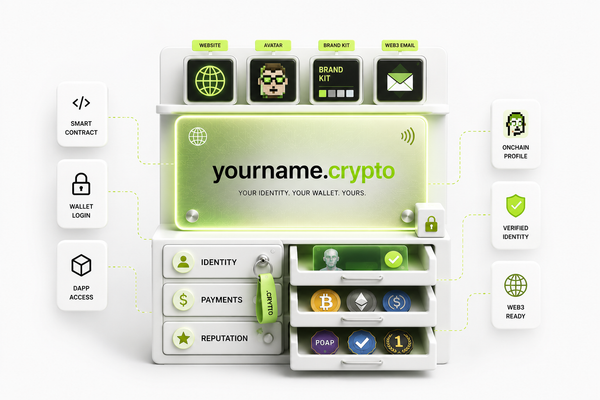
Beyond the technical differences, Web3 domains can do things traditional domains simply can't. They can serve simultaneously as your website address, your crypto wallet address, your decentralized identity profile, your login credential across Web3 applications, and an anchor for community credentials and NFT collections all under one human-readable name.
Why Your Domain Name Is Especially Important in Web3
In the traditional web, a domain name's main job is to be findable and professional. In Web3, your domain name has to work harder than that.
The decentralized web is built on a foundation of trust that operates differently from the traditional internet. In Web2, trust is established through institutional proxies verified blue checkmarks, Google's ranking signals, established brand recognition. In Web3, trust is built through community reputation, on-chain transparency, and the demonstrated commitment signaled by how seriously you've built your project's identity.
Your domain name is the first trust signal your project sends. A well-chosen name that clearly reflects your project's values, speaks the language of your target community, and demonstrates thoughtful brand building signals seriousness. A generic, forgettable, or poorly chosen name signals the opposite that you haven't thought carefully about your identity, and by extension, perhaps haven't thought carefully about your project overall.
The stakes are higher in Web3 partly because the ecosystem is filled with projects that don't last rushed launches with insufficient planning and inadequate identity infrastructure. A strong, well-considered domain name is one of the earliest ways to differentiate yourself from the noise and demonstrate that your project is worth paying attention to.
Five Strategic Foundations Before You Choose Your Name
Before generating name ideas, it's worth establishing the strategic context that should guide your choices. The best domain names aren't discovered by random brainstorming they emerge naturally from a clear project identity.
1. Get clear on your project's core purpose.
The most fundamental question you need to answer before choosing a domain name is: what exactly is this project? Is it a decentralized application solving a specific user problem? A blockchain-based infrastructure layer? A tokenized ecosystem enabling a particular type of community? A DeFi protocol? An NFT platform?
The more precisely you can articulate what your project is and what it does, the more naturally your domain name emerges. Vague projects produce vague names. Clear projects produce clear names. If you can't describe your project in one or two sentences that you'd be comfortable putting in your domain name, spend more time on the project before spending time on the name.
2. Understand the competitive landscape.
Before you get attached to any particular name or naming direction, research what's already out there. What are your direct competitors calling themselves? What naming conventions exist within your specific niche of the Web3 space? What gaps exist what positioning does nobody currently own that could be valuable?
Understanding the competitive landscape serves two purposes: it helps you avoid accidental similarity to established names (which creates confusion and potentially legal complications), and it reveals opportunities to differentiate through naming in ways your competitors have left open.
3. Make security and trust non-negotiable from day one.
Whatever name you choose, the domain's credibility will only hold up if the underlying project maintains strong security practices. This matters for naming strategy because your domain name will be the primary identifier for your project's security reputation positive or negative.
Multi-factor authentication for all admin accounts, data encryption for user information, regular smart contract audits, and transparent governance mechanisms are all security practices that your domain name will eventually be associated with. Build the security infrastructure before you build the brand and choose a name that sets expectations for trustworthiness that your security practices can actually meet.
4. Design for future adaptability.
The Web3 landscape evolves faster than almost any other technology space. Protocols that are dominant today may be eclipsed by superior alternatives tomorrow. A domain name tied too tightly to a specific technology, a specific blockchain, or a specific trend risks feeling dated as the landscape shifts around it.
Build interoperability into your thinking from the beginning. A domain name that works across blockchain networks not tied too specifically to a single chain's identity has longer strategic value than one that's explicitly chain-specific. Consider whether your name will still make sense if you expand to serve users on different blockchains, in different geographic markets, or for use cases adjacent to your initial focus.
5. Use Web3 domain aggregators to research your options.
Before committing to a name and registrar, use Web3 domain aggregators platforms that compile domain availability and pricing across multiple registrars and blockchain naming systems to research availability and compare options. These tools let you check whether your preferred names are available across different extensions, compare pricing across registrars, and discover alternatives you might not have considered.
Knowing what's available before you get emotionally attached to a specific name saves time and disappointment, and the comparison view that aggregators provide often surfaces better options than you'd identify by checking registrars one at a time.
The Core Principles of Choosing a Great Web3 Domain Name
With the strategic foundation established, here are the specific principles that separate good Web3 domain name choices from genuinely great ones.
Know exactly who you're naming for.
Your domain name exists to create immediate recognition and connection with your target audience not to impress people unfamiliar with your space, and not to satisfy your personal aesthetic preferences. The question isn't "what do I think sounds good?" It's "what will immediately resonate with the specific people I want to reach?"
Different Web3 communities have different vocabularies, different cultural references, and different identity signals. DeFi users, NFT collectors, GameFi players, DAO participants, blockchain developers each group has naming conventions and resonant references that create instant recognition. A domain name that speaks your target community's language creates an immediate sense of "this is for me" that generic names can't replicate.
For example, a platform designed for trading in-game NFT assets might consider a domain like CryptoCollectibles.xyz a name that uses familiar Web3 terminology, immediately communicates the platform's purpose, and employs an extension that the Web3 community recognizes. That specificity of targeting is worth more than broad appeal.
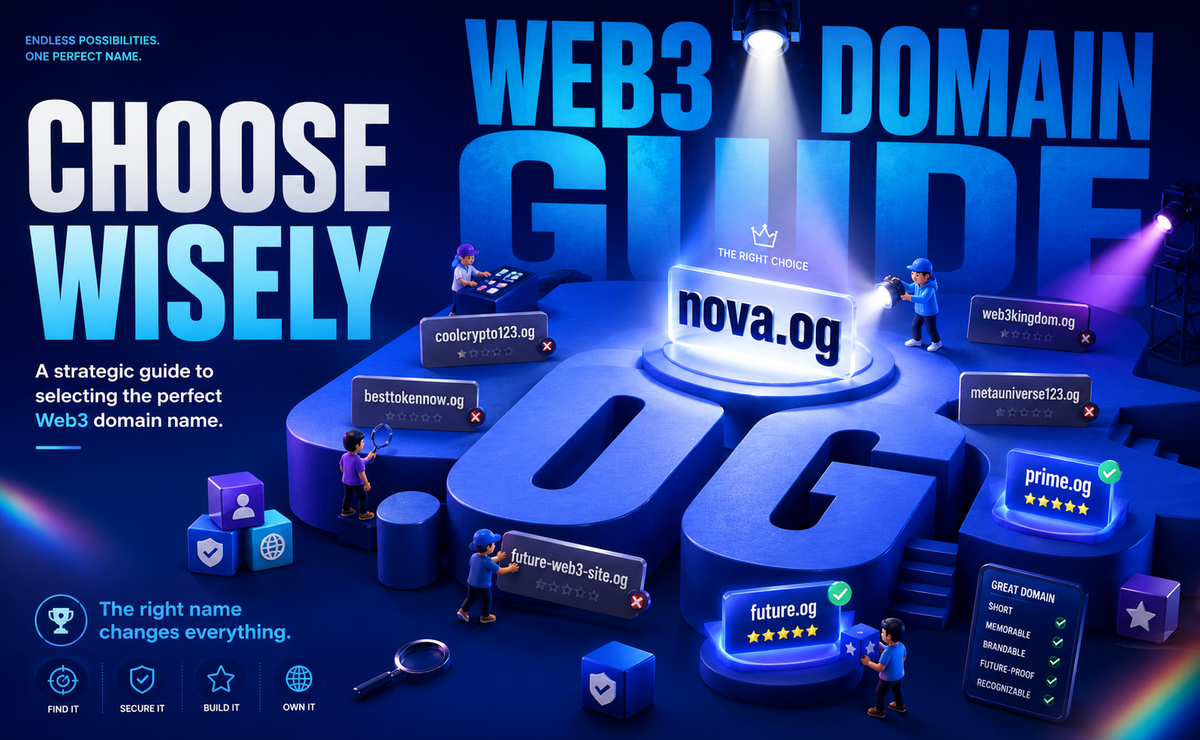
Prioritize brevity and ease of recall above almost everything else.
The most memorable domain names are almost always short. There's a reason the most valuable domains across every naming system traditional and blockchain-based are brief. Short names are easier to remember, easier to type correctly, easier to share verbally, and easier to build a visual brand around.
The practical guideline: if your domain name takes more than two seconds to say out loud, it's probably too long. If your friends ask you to repeat it when you mention it in conversation, it's definitely too long. The sweet spot is one to three words that flow together naturally and create a single memorable impression.
MetaverseMarket.eth is a good example of this principle in action. It's concise, it immediately communicates purpose, and the .eth extension signals Web3 community membership to anyone who recognizes it. The name does its job in two words.
Keep it clean no hyphens, no unnecessary numbers.
Hyphens and numbers in domain names create friction at every point of contact. They're harder to communicate verbally ("it's crypto dash market dot eth no, with a hyphen between crypto and market"). They look less professional in written contexts. They're harder to remember reliably. And they often signal hasty registration of a second-choice name rather than deliberate brand building.
If the name you want with pure words isn't available, finding a different name entirely is almost always better than adding a hyphen or a number to make a variation available. The domain you can fully commit to and communicate cleanly is more valuable than the domain that's almost right.
Use keywords strategically not mechanically.
Relevant keywords in your domain name can serve legitimate purposes: improving discoverability in search contexts, immediately communicating your project's focus to newcomers, and reinforcing your positioning within your specific Web3 niche. These are real benefits worth pursuing.
The mistake is treating keyword inclusion as the primary objective rather than a secondary consideration. A name stuffed with keywords at the expense of memorability, flow, and brand personality is worse than a name with no keywords that's genuinely distinctive. The most powerful domain names balance relevance with personality they tell you something about what the project does while also being memorable in their own right.
NFTunes.crypto is a clean example: it combines a highly recognizable Web3 term (NFT) with an evocative root word (tunes) to create something immediately descriptive and genuinely catchy. That's the balance worth aiming for.
Check availability and legal clearance before getting attached.
The disappointment of developing a strong emotional attachment to a domain name and then discovering it's already registered or that it conflicts with an existing trademark is entirely preventable. Make availability checking the first step, not the last.
Search for your preferred names across multiple registrars and blockchain naming systems before investing creative energy in them. Run a basic trademark search to verify that your name doesn't conflict with an established brand that could pursue legal action. Check social media handle availability if you want consistency across platforms. Domain names that pass all these checks are genuinely available; names that don't can save you from expensive problems later.
The Web3 Extension Question: Which TLD Should You Choose?
The extension you pair with your name .eth, .crypto, .sol, .nft, .polygon, .dao, or any other Web3 TLD is a meaningful choice that communicates community membership and ecosystem alignment.
.eth is the most widely recognized Web3 extension, powered by the Ethereum Name Service. Choosing .eth signals deep Ethereum ecosystem involvement and benefits from the highest level of mainstream recognition among Web3 TLDs. If your project is Ethereum-native, .eth is usually the natural choice.
.crypto signals a platform-agnostic Web3 identity broad enough to work across ecosystems without tying you specifically to Ethereum's community. It's a strong choice for projects that serve users across multiple blockchain networks or that want to appeal to a general Web3 audience rather than a specific chain's community.
.sol places you clearly in the Solana ecosystem, appropriate for projects built on or primarily serving the Solana community.
.nft is specifically associated with NFT projects, collections, and marketplaces a strong signal for projects whose core offering involves digital assets.
.dao communicates community governance and decentralized organization appropriate for DAOs and governance-focused projects that want to signal their organizational model through their domain.
Choose the extension that most accurately represents where your project lives and who you're building for. The extension isn't just a technical choice it's a positioning statement.
Building Your Brand Through Social Media and Community
Your Web3 domain name is the anchor of your brand identity, but its value is realized through the community and visibility you build around it. Here's how to use social media and community engagement to amplify your domain's brand value.
Build a social media strategy that's consistent with your Web3 identity.
Your social media presence should extend the brand identity your domain name establishes, not contradict it. That means the same name, the same visual identity, and the same voice across platforms creating a coherent impression whether someone finds you on Twitter, Discord, Telegram, or through your domain directly.
The key strategic elements: understand specifically where your target community spends time online and focus your energy there rather than spreading yourself thin across every platform. Set clear, measurable goals for what you want social media to accomplish community growth, awareness, user acquisition, investor relations. Create content that genuinely serves your audience rather than just promoting your project.
Consistency matters more than volume. A regular posting schedule with high-quality, relevant content builds audience trust and platform algorithms' confidence in your content more effectively than sporadic high-volume posting. Show up consistently, engage genuinely with comments and responses, and treat your social media presence as a community you're building rather than an audience you're broadcasting to.
Use influencer relationships strategically and authentically.
The Web3 community has a well-calibrated radar for inauthentic influencer relationships. Paid promotions from influencers who clearly haven't used or understood your project are often more damaging than having no influencer relationships at all they signal desperation or inauthenticity to an audience that values genuine community membership above everything.
Effective influencer strategy in Web3 is built around authentic alignment. Find voices in your specific community who genuinely find your project interesting not because you've paid them to, but because it actually solves a problem they care about or advances a vision they share. Give those people early access to features, genuine input into your development roadmap, and reasons to be genuine advocates rather than paid promoters.
The influencer relationships that work best in Web3 are the ones that look less like marketing campaigns and more like community members advocating for something they genuinely believe in. Cultivate those relationships patiently, not transactionally.
Engage with the broader ecosystem, not just your own community.
Some of the most effective brand building in Web3 happens not on your own channels but in the broader ecosystem conversations your community is already having. Joining relevant Discord servers, participating in governance discussions, contributing to forum threads, and engaging with adjacent projects' communities all build brand awareness and reputation in contexts where your target users are already active.
This isn't about self-promotion it's about being a genuine participant in the ecosystem you're building in. The projects that establish the strongest reputations in Web3 are consistently the ones that contribute to the community rather than just extracting from it. That contribution builds the kind of earned trust that no amount of paid marketing can replicate.
Common Mistakes to Avoid
A few naming and strategy mistakes come up repeatedly among Web3 projects, and they're worth knowing about in advance.
Choosing a name that's too trend-dependent is one of the most common. A name that references a specific meme, a particular market moment, or a technology flavor-of-the-month might feel cutting-edge at launch and dated within eighteen months. Aim for names that will be as relevant in five years as they are today.
Building a name around your current technical stack rather than your value proposition is another trap. If your project pivots its underlying technology and many do you don't want a name that's become a technical liability rather than a brand asset.
Skipping the trademark check because you're in Web3 is a mistake that can have real consequences. The decentralized nature of blockchain naming doesn't protect you from trademark infringement claims in legal jurisdictions. A domain name that conflicts with an established brand's trademark can result in legal challenges that undermine years of brand equity building.
Registering a name on a single blockchain when your project will eventually need cross-chain presence is a strategic limitation worth thinking through before committing. Consider where you want your project to be in three to five years, not just where it's launching.
Final Thoughts
Your Web3 domain name is one of the most important brand decisions you'll make for your project and it's one where the right approach is clear enough to apply systematically rather than just hoping for inspiration.
Start from your project's core purpose. Understand your community deeply. Choose a name that's short, memorable, legally clear, and community-resonant. Pick the extension that signals your ecosystem membership accurately. Build the brand infrastructure and social strategy to amplify what the name establishes.
The decentralized web has a long way to go before it's fully mainstream. But the projects that are building their identities thoughtfully right now with well-chosen domain names, strong community foundations, and authentic ecosystem participation will be the ones best positioned to grow with the space as it matures.
Your Web3 domain name is the compass. Choose it carefully, and it will guide your project in the right direction for years to come.