Unlocking Creativity: How .Clay Domains Are Empowering Artists in the Web3 Era
.Clay domains: Empowering artists in Web3. Own your digital presence, connect with your audience, and unlock new creative possibilities in the decentralized world.

Being an artist in the digital age is a study in contradictions.
You have more tools to create than ever before. More ways to share your work, reach an audience, and build a following. And yet, for most of that reach, you're a tenant dependent on platforms that own the relationship with your audience, take a cut of your sales, change their algorithms without warning, and can deactivate your account with no real recourse.
Instagram can suppress your posts. Spotify takes the majority of streaming revenue. Etsy changes its fee structure and you absorb the cost. NFT marketplaces take their percentage on every transaction. The pattern is consistent: someone else built the infrastructure, so someone else gets to set the terms.
.Clay domains are part of a broader shift away from that model. Built for the Web3 era, they offer artists something that sounds simple but is actually quite rare in the digital world: a space that's genuinely yours.
Here's what that means in practice and why it matters.
What Is a .Clay Domain?
A .Clay domain is a new type of domain extension designed specifically for artists, designers, and creative innovators. Unlike .com or .net extensions that carry no inherent meaning and work equally well for a dental practice or a logistics company .Clay is built around creative identity from the ground up.
In the Web3 context, that means more than just aesthetics. .Clay domains are built on blockchain technology, which changes the ownership model in a fundamental way. A traditional domain is a license you pay annually for the right to use it, and a centralized registrar maintains actual control. A .Clay domain is an asset you own outright, recorded on a decentralized ledger, with no registrar holding override authority.
Think of the difference between renting an apartment and owning a piece of land. With the apartment, your landlord can raise the rent, change the rules, or tell you to leave. With the land, it's yours. That's the ownership shift .Clay represents.
Why Web3 Changes Things for Artists Specifically
Web3 the decentralized internet built on blockchain technology isn't just a technical upgrade. For artists, it represents a fundamental renegotiation of who gets to benefit from creative work.
In the Web2 era, the platforms aggregated the value. Artists created the content; platforms built the audiences, owned the distribution channels, and captured most of the economic value generated. The creator got exposure; the platform got leverage. That arrangement made sense when there was no alternative infrastructure, but it was never a great deal for the people actually doing the creative work.
Web3 changes the infrastructure. Blockchain technology enables real digital ownership of domains, of artwork as NFTs, of community relationships. Smart contracts enable direct transactions without intermediaries. Decentralized platforms remove the single points of control that traditional platforms exploit.
For artists, this isn't abstract ideology. It translates into specific, practical changes: keeping more of your revenue, owning your relationship with your audience, having a digital home that can't be seized or censored, and building a business that belongs to you rather than to the platform you happen to be using this year.
.Clay domains are the foundation layer of that the address where all of it lives.
What .Clay Domains Actually Do for Artists
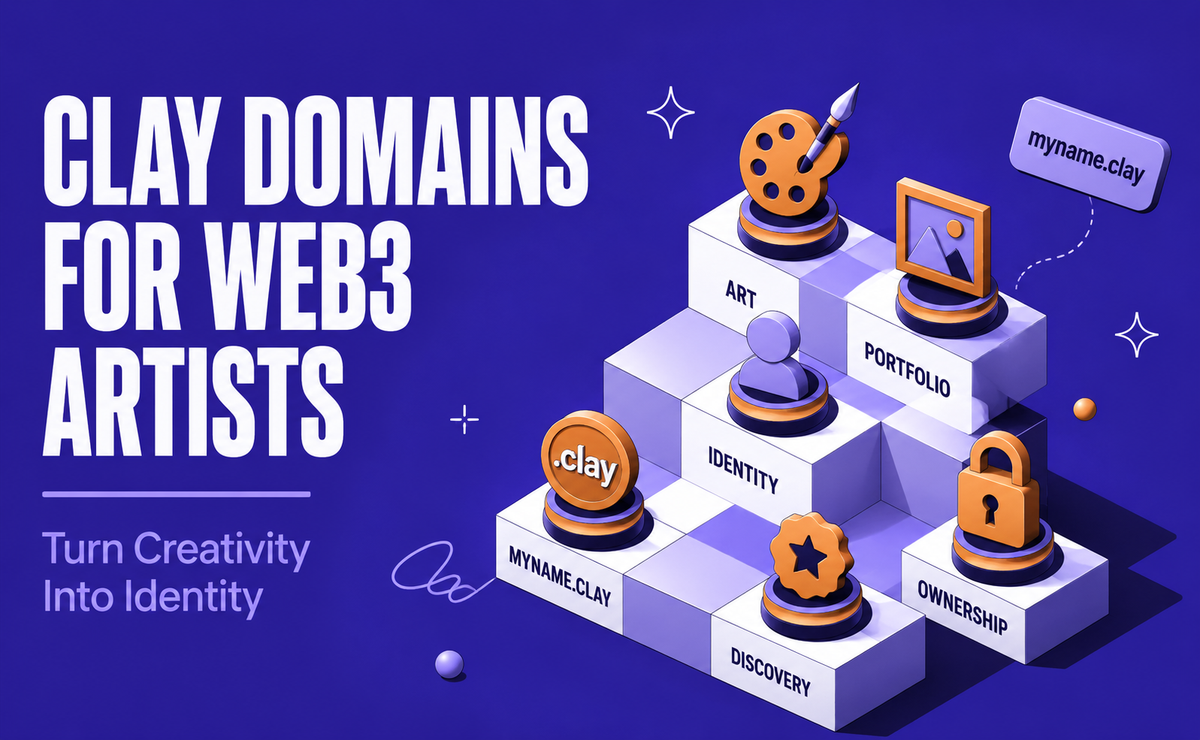
1. Build a Creative Identity That Speaks Before You Say a Word
Your domain name is the first thing people see before they visit your site. It sets expectations, signals identity, and shapes the experience before a single image or word of copy loads.
yourname.com tells people nothing beyond "this person has a website." yourname.clay immediately communicates that you're a creative that what lives here is made with intention and craft. For artists building a brand, that context matters. It's the difference between a generic storefront and a studio with a sign out front that tells you exactly what kind of work happens inside.
This isn't just about aesthetics, either. Brand coherence the alignment between what you do, what you say, and where you show up is genuinely valuable for artists trying to build loyal audiences. A .Clay domain is one more element of that coherence working in your favor from the very first touchpoint.
2. Own Your Digital Space Actually Own It
The decentralization that .Clay domains provide through blockchain technology solves a problem that most artists have encountered but rarely have a good solution for: the fragility of digital presence under centralized control.
Traditional domains can be suspended by registrars responding to legal pressure, seized by government orders, or lost when a hosting provider goes under. Even if none of those catastrophic scenarios occur, artists are always operating under terms of service they didn't write and can't meaningfully negotiate.
With a .Clay domain on the blockchain, you are the registrant in a direct, immutable sense. The record of your ownership is distributed across a decentralized network. No single entity has the authority to revoke it, alter it, or hand it to someone else without your private key. Your digital home stays yours through policy changes, platform bankruptcies, and regulatory pressure in ways that traditional domains simply can't guarantee.
For artists whose livelihoods depend on their online presence, that security is more than a nice-to-have it's foundational.
3. Monetize Directly, Without Giving Away the Margin
The traditional paths for artists to earn money online all involve significant cuts to intermediaries. Galleries take commissions. Streaming platforms pay fractions of cents. NFT marketplaces charge listing fees and transaction percentages. Print-on-demand services price their margins into every sale. By the time the money reaches the artist, it's often a small fraction of what the buyer paid.
.Clay domains change that equation by enabling direct-to-consumer transactions. When your .Clay domain is integrated with blockchain payment infrastructure, you can accept cryptocurrency directly from buyers no payment processor, no marketplace, no intermediary taking their percentage. Smart contracts can automate the transaction, verify the buyer's payment, and transfer ownership of digital work without a third party involved.
The practical result: artists keep more of what their work is worth. A collector pays $500 for a digital piece; the artist receives something close to $500, not $350 after everyone else has taken their cut. Over time, the compounding effect of that difference is substantial.
Beyond direct sales, .Clay domains enable subscription models, membership communities, and pay-per-access content all managed directly through the artist's own domain without dependence on a platform that can change its fee structure overnight.
4. Build a Real Community Around Your Work
Social media platforms offer reach, but they offer a specific and limited kind of community one that the platform owns and mediates. Your Instagram followers aren't really your followers in any durable sense. They're users of Instagram who happen to have opted into seeing your content, subject to whatever the algorithm decides to show them on any given day.
A .Clay domain can host a community that you actually control. Artist-run membership platforms, decentralized fan clubs with token-gated access, collaborative spaces where followers can interact with your work and with each other, live virtual sessions and exclusive releases all of it housed in a space where you set the rules, where you own the relationship, and where the community forms around your creative identity rather than around a platform's engagement metrics.
Some artists using .Clay domains have built exactly this kind of hub: a place where collectors get early access to new work, where fans can participate in the creative process, where people feel genuinely connected to the artist's journey rather than just consuming a content feed. That depth of connection is something social media platforms are structurally incapable of providing, because it requires the artist to be at the center rather than the platform.
5. Stand Out in Search Now and Increasingly in Web3 Discovery
The SEO implications of domain extensions are nuanced and still evolving, particularly for newer extensions like .Clay. But there are a few real advantages worth understanding.
In a search results page filled with .com addresses, a .Clay domain is visually distinctive. It signals specificity a site built for a particular community, not a generic web presence. For people who are specifically searching for artists, creative work, or handmade goods, that signal of specificity can work in your favor before they've even clicked.
More significantly, as the Web3 ecosystem matures, new discovery platforms and search tools built specifically for blockchain-based content are emerging. These platforms are increasingly designed to surface Web3-native content and a .Clay domain, as a blockchain-based creative domain, is naturally positioned to benefit from that discoverability in ways that a traditional .com simply isn't.
The artists who establish their .Clay presence now are building discoverability in a growing ecosystem rather than trying to break through the saturation of platforms that are already overcrowded.
6. Security You Can Actually Trust
Artists who sell work online, handle digital transactions, or host valuable creative content have a genuine security stake in their domain. Traditional domains are vulnerable to fraud, phishing attacks, unauthorized transfers, and hijacking schemes that can compromise an artist's reputation and revenue with devastating speed.
Blockchain-backed .Clay domains address these vulnerabilities structurally. Because ownership is recorded on a distributed ledger secured by cryptography, unauthorized changes to your domain require defeating the blockchain's security model an enormously higher bar than compromising a centralized registrar's account. Smart contract-based transactions provide the same assurance on the commerce side: the terms are coded into the agreement, execution is automatic, and there's no centralized point that a bad actor can exploit.
For an artist whose online presence represents their livelihood, that structural security is worth something real.
What Artists Are Already Building With .Clay Domains
The most convincing evidence for what .Clay domains can do isn't theoretical it's in the projects already underway.
NFT drops with direct audience relationships. Digital artists are using .Clay domains to host exclusive NFT releases outside of the crowded, competitive environment of major marketplaces. By controlling the entire experience how work is displayed, how the drop is paced, how buyers interact with the artist they create something that feels like an event rather than a transaction. Collectors come to the artist's space rather than encountering the work as one item among thousands on a generic platform.
Decentralized fan clubs for musicians. Musicians are building membership communities on their .Clay domains that offer what streaming platforms never can: genuine exclusivity. Early access to new material, direct communication with the artist, digital tokens that function as collectibles or proof of fandom all managed through blockchain infrastructure that the artist controls. This creates revenue streams that don't depend on algorithmic exposure and relationships that belong to the artist, not to the platform.
Virtual galleries that anyone can visit. Artists are hosting interactive virtual galleries on .Clay domains three-dimensional environments where visitors can explore work, read context, and purchase pieces directly. Some have extended this into live events: virtual tours narrated by the artist, meet-and-greets in digital gallery spaces, launch events for new collections. This democratizes access to art in a genuine way someone who can't travel to a physical gallery opening can still experience the work and engage with the artist.
Collaborative collectives and multi-artist platforms. Groups of artists are using .Clay domains to build shared creative spaces digital storefronts, exhibition spaces, and community hubs where each artist maintains their own section while also participating in collective projects and exhibitions. This kind of collaboration produces something none of them could build individually: a destination with breadth and depth, a reason for visitors to keep returning.
Where This Is All Going
The trajectory for .Clay domains is tied to the trajectory of Web3 more broadly which is a story of gradual infrastructure maturation, growing mainstream awareness, and expanding practical applications.
In the near term, expect .Clay domain tooling to improve significantly. More seamless integration with NFT marketplaces, better customization options, simpler onboarding for artists who aren't deeply technical these improvements are natural as the platform matures and as demand from the creative community grows.
In the medium term, the relationship between artists and their digital tools is likely to become more deeply integrated. A .Clay domain won't just be a website it'll be a hub that manages community membership, handles sales, processes licensing agreements through smart contracts, and maintains an artist's digital rights record. The boundaries between "website," "marketplace," "community platform," and "identity system" will blur, and .Clay domains will sit at the center of that convergence.
In the long term, as Web3 discovery platforms and tools mature, artists who established their .Clay presence early will find themselves with a meaningful advantage in a new kind of digital ecosystem one built around ownership and authenticity rather than algorithmic reach.
Final Thoughts
Artists have been accommodating other people's infrastructure for a long time making their work work within whatever systems the platforms provided, accepting the terms that were offered because there wasn't a real alternative.
.Clay domains represent a genuine alternative. Not a perfect one, not a complete solution to every challenge artists face online, but a meaningful shift in who holds the keys to an artist's digital home.
The ability to own your domain outright. To monetize your work without giving up margin to intermediaries. To build a community that belongs to you. To present your work in a space that signals creative identity from the first moment someone encounters it. These aren't incremental improvements on the existing model they're structural changes that put artists in a fundamentally different relationship with their digital presence.
For artists who are serious about building something durable in the digital world, .Clay domains are worth exploring now while the ecosystem is young, while premium names are still available, and while being an early mover still means something.
The creative economy is shifting. The artists who build on the right foundation during this transition will be the ones who look back in ten years and realize they made the right call.