Decentralized Finance (DeFi): The Backbone of Web3
Decentralized Finance, or DeFi, is a groundbreaking shift in the financial world. By utilizing blockchain technology, DeFi eliminates traditional financial intermediaries, offering users direct control over their assets. From trading and lending to stablecoins and liquidity mining, DeFi is at the he

For most of human history, if you wanted to borrow money, invest, or send funds across the world, you needed a bank. You needed an account, a credit score, a pile of documents, and sometimes just the luck of living in the right country. The system worked for some people. For billions of others, it was a closed door.
Decentralized Finance, or DeFi, is changing that. And it's doing so in a way that doesn't just tweak the existing system; it rebuilds it from the ground up.
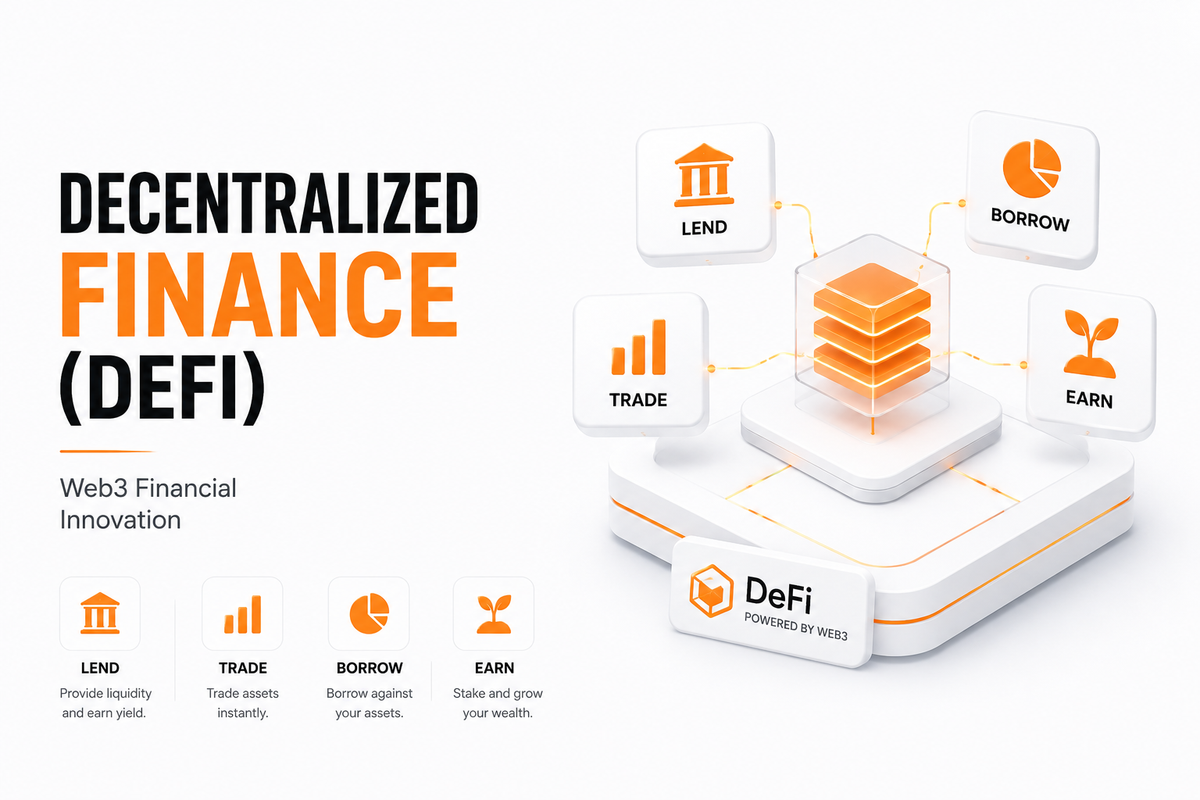
Built on blockchain technology and powered by smart contracts, DeFi lets people lend, borrow, trade, and invest directly with each other no banks, no brokers, no middlemen. It's one of the most important pillars of Web3, the next generation of the internet, and it has the potential to make financial services genuinely accessible to anyone, anywhere.
What Is DeFi, Really?
The Core Principles
DeFi isn't just a product or a platform; it's a philosophy about how financial systems should work. That philosophy rests on four principles:
Decentralization means no single institution controls the system. Transactions run on a distributed network of computers, and no one entity can dominate or manipulate it. Power is spread out by design.
Transparency means every transaction is recorded on a public blockchain. Anyone can look it up, verify it, and audit it. There's no black box, no hidden fees buried in fine print, and no wondering what's happening behind the scenes.
Openness means there are no gatekeepers. No geographic restrictions, no credit checks, no lengthy application process. If you have an internet connection, you can participate whether you're in New York or rural Nigeria.
Security means transactions are protected by cryptographic algorithms and enforced by smart contracts self-executing code that automatically carries out agreements when the right conditions are met. There's no room for human error or tampering.
How DeFi Differs from Traditional Finance
In traditional Centralized Finance (CeFi), banks and brokers sit at the center of everything. Want a loan? The bank decides if you qualify. Want to trade assets? A broker takes a cut. Want to send money internationally? Brace yourself for fees and a two-to-five business day wait.
These institutions aren't evil; they serve a real purpose. But they also restrict access, charge for their services, and operate on their own schedule. Traditional banks aren't open at 2 a.m. on a Sunday. DeFi is.
By using decentralized applications (dApps) and smart contracts, DeFi cuts out the intermediaries and lets users deal directly with each other. You can trade on a decentralized exchange without a broker. You can borrow money without walking into a bank. You can earn interest on your assets without a savings account. And you can do all of it at any hour of the day, from anywhere in the world.
The Building Blocks of DeFi
A few key components make up the DeFi ecosystem:
Decentralized Exchanges (DEXs) are platforms like Uniswap and SushiSwap where users can trade crypto directly with each other, without handing control of their funds to a central platform.
Lending platforms are protocols like Aave and Compound where users can lend their crypto and earn interest or borrow assets by putting up collateral.
Stablecoins are cryptocurrencies like USDC and DAI that are pegged to stable assets like the US dollar, giving users a way to participate in DeFi without riding the wild swings of the crypto market.
Smart contracts are the self-executing code that powers all of the above, automating financial transactions without any human intervention required.
The Technology Behind DeFi
Blockchain: The Foundation
Every DeFi transaction runs on a blockchain, a distributed ledger that records activity across a network of computers. No single person or institution controls it. Every transaction is permanent, transparent, and cryptographically secured.
What makes blockchain so important to DeFi is exactly this combination: you get transparency without sacrificing security and decentralization without sacrificing reliability. Once a transaction is recorded, it can't be altered. Anyone can verify it. And because the data lives across thousands of nodes rather than one central server, it's practically impossible to manipulate.
This is what makes DeFi fundamentally different from traditional finance. There's no central point of failure. No single institution that can freeze your account, go bankrupt, or decide you don't meet their criteria.
Smart Contracts: The Engine Room
If blockchain is the foundation, smart contracts are what make DeFi actually run.
A smart contract is a piece of code deployed on a blockchain that automatically executes when predetermined conditions are met. No lawyers, no paperwork, no waiting for someone on the other end to approve the transaction.
Here's a practical example: say you want to borrow money on a DeFi lending platform. You deposit collateral, another crypto asset, into a smart contract. The contract verifies that your collateral meets the required threshold, and if it does, it releases the loan funds to you immediately. If you default, the contract automatically liquidates your collateral to protect the lender. The whole process happens without a bank officer reviewing your file or making a judgment call.
Smart contracts are also what power decentralized exchanges. When you trade on a DEX, the smart contract holds both parties to the agreed terms and only completes the transaction when both sides have fulfilled their obligations. The result is a faster, cheaper, and more trustworthy trading experience than most centralized alternatives can offer.
Ethereum and Beyond
Ethereum was the first blockchain to support programmable smart contracts, which is why it became the home of most early DeFi applications, stablecoins, lending protocols, DEXs, and more. It's still the dominant platform in the space.
That said, Ethereum has real limitations. During periods of high demand, transaction fees (called "gas fees") can spike dramatically, pricing out smaller users. Processing speeds can also lag. That's pushed the growth of alternative blockchains like Binance Smart Chain (BSC), Solana, and Avalanche, which offer faster transactions at lower costs. The DeFi ecosystem is increasingly multi-chain, with different platforms serving different needs.
What Can You Actually Do with DeFi?
Trade on Decentralized Exchanges
Platforms like Uniswap and SushiSwap let you trade crypto directly with other users no centralized exchange required, no account creation, and no surrendering your funds to a third party. Your assets stay in your wallet until the trade executes. That's a meaningful security advantage over centralized exchanges, which have been hacked and have failed catastrophically in the past.
DEXs also tend to charge lower fees since there's no intermediary taking a cut, and they offer greater privacy since you don't need to hand over personal information to get started.
Lend and Borrow Without a Bank
Platforms like Aave and Compound have made lending and borrowing genuinely accessible without a traditional financial institution involved. If you have crypto assets sitting idle, you can lend them out and earn interest often at rates that outperform conventional savings accounts. If you need liquidity, you can borrow against your crypto holdings by posting collateral.
One important nuance: DeFi loans are typically over-collateralized, meaning you need to deposit more value than you're borrowing. This protects lenders from default risk in a market where asset values can shift quickly. It's not a perfect system, but it's a functional one, and it works entirely without a credit bureau or bank officer in sight.
Use Stablecoins for Everyday Transactions
Crypto volatility is real, and it's one of the biggest practical barriers to using digital assets for everyday payments. Stablecoins solve this problem by pegging their value to a stable asset like the US dollar. USDC and DAI, for instance, are designed to hold a steady $1.00 value regardless of what the broader crypto market is doing.
This makes stablecoins ideal for day-to-day DeFi activity lending, trading, and payments without the anxiety of watching your holdings drop 20% overnight. They're also increasingly used for cross-border payments, letting people move money internationally without going through traditional banking systems.
Earn Passive Income Through Yield Farming and Liquidity Mining
Yield farming and liquidity mining are two popular strategies for earning returns in the DeFi ecosystem.
In simple terms, you deposit your assets into a liquidity pool, which helps facilitate trades on a decentralized exchange. In return, you earn a share of the trading fees or receive native tokens from the platform. Yield farming takes this further by moving assets across multiple protocols to maximize returns.
These strategies can generate meaningful passive income, but they come with risk, particularly smart contract vulnerabilities and market volatility. They're not for everyone, but they represent a genuinely new way to put idle assets to work.
The Real Advantages and the Honest Challenges
What DeFi Gets Right
Accessibility is arguably DeFi's most powerful feature. Traditional finance has always had gatekeeper banks that require accounts, credit checks, and documentation that many people around the world simply don't have. DeFi eliminates those barriers. Anyone with a smartphone and an internet connection can access DeFi services. That's a profound shift for the estimated 1.4 billion adults globally who remain unbanked.
Transparency builds trust in a way that traditional finance rarely achieves. Every transaction is on the public ledger. You don't have to take anyone's word for it; you can verify it yourself.
Resilience is another genuine advantage. Because DeFi platforms run on decentralized networks, there's no single point of failure. No one institution can go bankrupt and take your assets down with it.
What Still Needs Work
Scalability remains a real bottleneck. Most DeFi still runs on Ethereum, and when the network gets congested, gas fees can spike to the point where small transactions simply aren't worth making. Scaling solutions, layer-2 networks, sidechains, and alternative blockchains are improving this, but it's an ongoing challenge.
Security vulnerabilities are a persistent risk. Smart contracts are only as good as the code they're built on, and bugs can be exploited by bad actors. The DeFi space has seen numerous high-profile hacks where flaws in smart contracts were used to drain liquidity pools or manipulate transactions. Better auditing practices and more rigorous testing are helping, but the risk hasn't disappeared.
Regulatory uncertainty is arguably the most significant long-term challenge. Governments around the world are trying to figure out how to regulate an industry that operates outside traditional financial frameworks. Anti-money laundering (AML) and know-your-customer (KYC) requirements are difficult to apply to pseudonymous, peer-to-peer transactions. Tax compliance is murky. The legal classification of DeFi platforms: Are they financial institutions? Technology companies? Something else entirely? remains unresolved in most jurisdictions. That uncertainty creates risk for platforms and users alike.
The Regulatory Question
DeFi's decentralized, borderless nature makes it genuinely difficult to regulate through traditional means, and that cuts both ways. On one hand, it protects users from overreach and preserves the openness that makes DeFi valuable. On the other hand, it creates real potential for misuse.
The most promising path forward probably isn't heavy-handed government oversight that stifles innovation, nor is it a complete regulatory void. There's a middle ground worth exploring: voluntary KYC solutions for higher-risk activities, smart contracts that automatically flag suspicious behavior, and regulatory frameworks designed specifically for decentralized systems rather than retrofitted from traditional finance.
Getting this balance right matters. DeFi's long-term viability depends on earning the trust of regulators and users alike, and that means taking compliance seriously without sacrificing the decentralization that makes the whole system worth building in the first place.
Why DeFi Is the Financial Layer of Web3
Web3 is often described as the user-owned internet, a version of the web where people control their own data, assets, and digital lives instead of handing that control over to large corporations. DeFi is the financial expression of that vision.
Without DeFi, Web3 would have a governance layer and an ownership layer, but no functional financial infrastructure. DeFi is what makes it possible to transact, invest, and build economic value within a decentralized ecosystem. It's the backbone that allows peer-to-peer commerce, decentralized lending, and open financial markets to actually function at scale.
The principles are the same: decentralization, transparency, openness, and user control. DeFi doesn't just complement Web3; it completes it.
Final Thoughts
DeFi is still early. The user interfaces can be clunky, the learning curve is steep for newcomers, and the risks are real. But the trajectory is clear.
As smart contract security improves, as scaling solutions bring down transaction costs, and as regulatory frameworks mature to accommodate decentralized systems, DeFi will become increasingly accessible to mainstream users, not just crypto enthusiasts. The opportunity isn't just financial innovation for its own sake. It's the chance to build a financial system that actually works for everyone: open, transparent, and not owned by anyone powerful enough to shut you out.
That's a big idea. And DeFi is how it gets built. Buy Web3 Domains With Endless Domains.