Empowering Developers: The Rise of .dev Domains in Web3
Level up your dev presence! A .dev domain is your key to the Web3 world. Let's explore why.

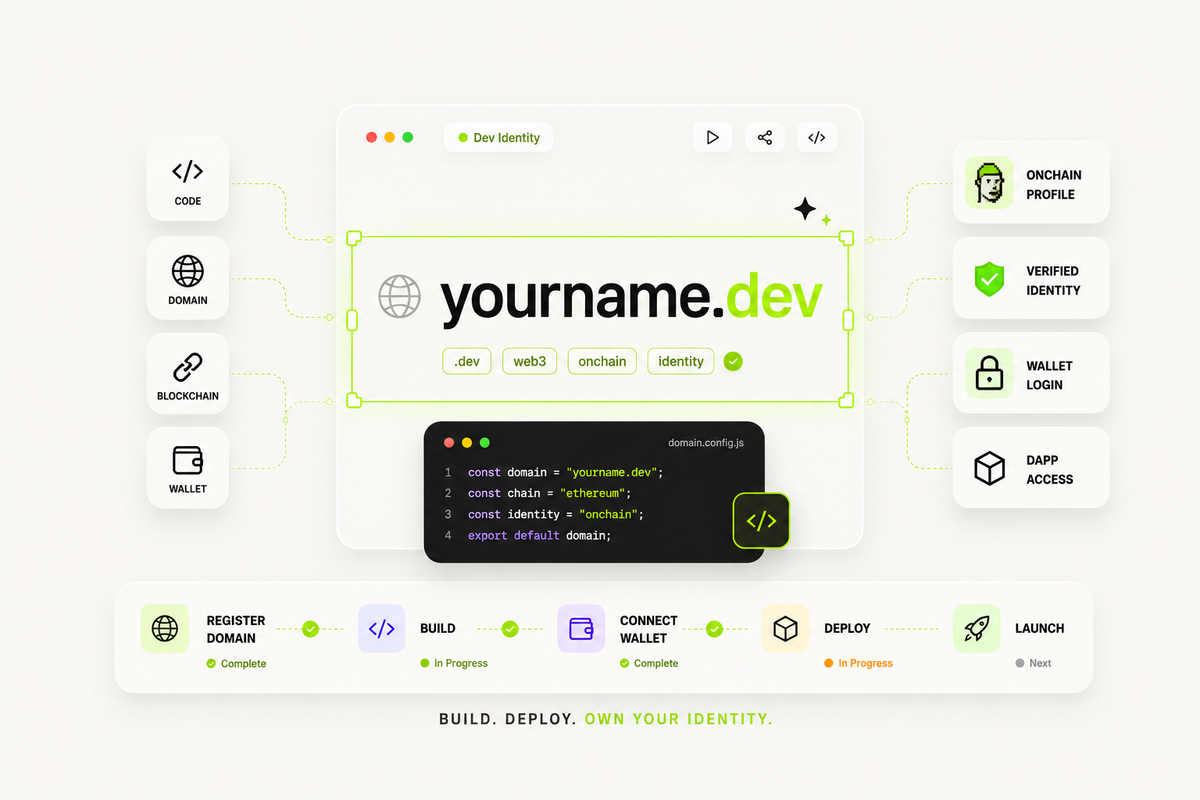
There's a quiet revolution happening on the internet, and most people outside the tech world haven't noticed it yet. As Web3 pushes the boundaries of what the internet can be decentralized, user-owned, and built on transparency developers are the ones laying the tracks. And increasingly, the best of them are staking their digital territory with a domain extension built specifically for people like them: .dev.
It's more than just a web address. It's a statement. Let's break down what .dev domains actually are, why they're gaining serious traction, and what challenges still stand in the way of widespread adoption.
So, What Exactly Is a .dev Domain?
At its core, a .dev domain is an internet address designed with developers in mind. Think of it as a digital badge that says, "I build things on the internet, and I take that seriously."
Whether you're a software engineer shipping apps, a web designer creating beautiful interfaces, or a startup launching a developer-focused product, a .dev domain immediately communicates what you're about before a visitor has even scrolled past your homepage.
But it's not purely cosmetic. .dev domains come with meaningful security features baked in from the start, which puts them in a different category than a lot of other domain extensions. More on that in a moment.
What Makes .dev Domains Different? The Features That Matter
A lot of domain extensions are interchangeable. .dev is not. Here's what sets it apart:
Built-In Security Not Optional
The most important thing to understand about .dev domains is that HTTPS encryption is mandatory. You can't run a .dev site over plain HTTP the extension simply won't allow it. Every visitor to your .dev site is automatically protected by an encrypted connection.
This isn't just a technical checkbox. It's a trust signal. When users see a .dev domain, they're interacting with a site that's been forced, by design, to take their security seriously.
Complementing this is HSTS preloading .dev domains are baked into the HSTS (HTTP Strict Transport Security) preload list that browsers reference. That means even on the very first visit, before any cookies are set or preferences saved, browsers automatically connect over HTTPS. There's no window for a downgrade attack.
DNSSEC Support
.dev domains also support DNSSEC (Domain Name System Security Extensions), which protects against a nasty class of attacks where bad actors redirect users from a legitimate domain to a malicious site. It's one of those behind-the-scenes protections that most visitors will never think about but developers building serious products absolutely should.
International Character Support
Through IDN support (Internationalized Domain Names), .dev domains can use characters from non-Latin scripts. This matters more than it might seem it opens the door for developers across the world, regardless of their native language, to build a .dev presence that feels native to them.
Clean, Memorable, and Developer-Native
There's something to be said for a domain extension that just makes sense. ".dev" is short, immediately recognizable to anyone in tech, and carries zero ambiguity about what kind of site you're running. For branding purposes, that clarity is genuinely valuable.
Who's Already Using .dev Domains And How
The best proof of any domain extension's value is how real people and organizations are actually using it. The .dev story here is pretty compelling.
Mozilla's MDN Web Docs (mdn.dev) one of the most-referenced resources in web development uses a .dev domain to host its documentation, tutorials, and references. If that's not a vote of confidence from a heavyweight in the developer community, it's hard to know what would be.
Google's web.dev platform uses its .dev domain to deliver best practices, code labs, and tools for modern web development. Google essentially built an entire developer education hub under the .dev extension.
For freelance developers and designers, .dev has become the go-to choice for portfolio sites. It immediately signals expertise to potential clients without needing to explain anything. A domain like yourname.dev says more than a long explanation ever could.
Tech startups have also embraced the extension quickly. In a competitive hiring market, a .dev domain subtly signals to engineering candidates that the company thinks like a developer and that matters more than people realize.
Open source communities have found a home in .dev too. Platforms dedicated to showcasing and collaborating on open source projects use the extension to create a natural gathering point for contributors.
University computer science departments have begun adopting .dev for research projects, online courses, and departmental sites a sign that even academic institutions recognize the credibility the extension carries in technical circles.
The Real Benefits Beyond the Surface Level
Instant Credibility in the Right Circles
When you're trying to reach developers, investors who understand tech, or potential engineering hires, a .dev domain does quiet but meaningful work. It signals that you're operating in this world, not just dabbling in it. That kind of first impression is hard to manufacture but easy to establish with the right domain.
SEO That Works Sideways
Let's be clear: using .dev doesn't automatically boost your search rankings. But it does something almost as useful it attracts the right audience. When someone searches for developer tools, APIs, or technical documentation, a .dev domain in the results reads as relevant. That relevance translates into better click-through rates and lower bounce rates, which do affect SEO over time.
A Developer Community You Actually Want to Be Part Of
The .dev extension has quietly become a signal of belonging in the developer world. Choosing it puts you in the same company as Mozilla, Google's developer tools, and thousands of serious engineers. That community association isn't just feel-good branding it can lead to real collaboration, networking, and visibility in spaces where your audience actually spends time.
Long-Term Relevance
Technology evolves fast. Some domain extensions that felt cutting-edge a decade ago now feel dated. The .dev extension is tied to a profession and a practice software development that isn't going anywhere. If anything, its relevance will only grow as the internet continues to be built by developers, for developers.
How to Get a .dev Domain: The Practical Rundown
Getting a .dev domain is straightforward. Here's how to do it without any headaches:
1. Pick a registrar. GoDaddy, Namecheap, Google Domains, and Cloudflare all offer .dev domain registration. Compare pricing and features they vary more than you'd expect.
2. Search for your name. Use the registrar's search tool. If your first choice is taken (and for short, memorable names, it often is), try variations or combinations. Think about how it'll look in an email signature and a browser tab.
3. Register and set your term. Most registrars offer one-to-ten-year terms. Registering for multiple years upfront often comes with a discount and removes the risk of forgetting to renew.
4. Add domain privacy. Unless you want your personal contact information showing up in public WHOIS lookups, add domain privacy protection. It's usually just a few dollars a year and well worth it.
5. Manage your DNS settings. After registration, you'll have access to a management panel where you can set up your DNS records, connect to a hosting provider, and configure any redirects.
One practical note: set up auto-renewal from day one. Domain expiration is one of those things that sneaks up on people, and losing a domain you've built a brand around is a genuinely painful experience that's entirely avoidable.
The Honest Truth: Challenges Worth Knowing About
.dev domains have a lot going for them, but it's worth being realistic about the friction that still exists.
Not Everyone Knows What .dev Is
Outside of tech circles, .dev is still a relatively unfamiliar extension. Some users especially those less comfortable with technology might hesitate or second-guess a .dev URL out of simple unfamiliarity. If your audience is primarily non-technical, this is worth thinking about.
Good Names Are Getting Expensive
The most desirable .dev domains short, dictionary words, common names, popular tech keywords are increasingly taken or listed at premium prices. If you're a small business or individual developer with a tight budget, this can be a real barrier. The workaround is creativity: longer names, brand-specific combinations, or less-obvious keywords can still yield great domains at standard prices.
.com Isn't Going Away
Let's be honest: .com still dominates user expectations. Many people automatically type .com at the end of any web address out of habit. For businesses trying to reach a broad general audience, .dev can feel limiting. The extension is strongest when your primary audience is in tech and less obviously compelling when you need broad consumer appeal.
Older Systems Sometimes Struggle
Some legacy software, enterprise systems, and older applications don't fully support newer TLDs. If you're building something that needs to integrate with older infrastructure, it's worth doing a quick compatibility check before committing to a .dev domain.
SEO Is Not a Shortcut
While .dev doesn't hurt SEO, it also isn't a magic boost. Building domain authority with any extension takes consistent effort good content, quality backlinks, and time. New .dev sites should go in with realistic expectations on that front.
What Needs to Happen for .dev to Reach Its Full Potential
The good news is that most of the challenges above are solvable they just require deliberate effort from the broader developer and tech community.
Awareness is the biggest lever. Tech influencers, developer advocates, and companies like Mozilla and Google are already doing a lot of this work simply by using .dev themselves. Every high-profile .dev deployment makes the extension more familiar and trustworthy to the public.
Pricing accessibility matters for community growth. Secondary markets and tiered pricing models for .dev domains would open the extension to a wider range of individual developers and small projects, which ultimately strengthens the whole ecosystem.
Technical compatibility will improve over time it generally does as new TLDs mature. Working directly with browser vendors and software providers to address known friction points would accelerate that process.
Community building is where the real momentum lives. A strong, active developer community around .dev domains sharing projects, celebrating launches, collaborating openly makes the extension more valuable for everyone in it.
Final Thoughts
The .dev domain extension isn't trying to compete with .com for universal appeal and that's actually its strength. It knows exactly what it is and who it's for. For developers building in Web3, shipping open source tools, freelancing, or launching tech startups, it offers something genuinely useful: a domain that works as hard as you do before anyone's even read your homepage.
The challenges are real but manageable. The benefits mandatory security, developer credibility, community alignment, and long-term relevance are substantial. And as the internet continues to evolve toward a more specialized, community-driven future, domain extensions that mean something specific are going to matter more, not less.
If you build things on the internet, a .dev domain deserves a serious look.