The Impact of an Ethereum Domain Name on Your Online Presence
Ethereum domains: Your Web3 identity. Explore how ENS simplifies your online presence and opens new possibilities.

Think about how many usernames you're juggling right now. There's the one you made for Twitter in 2012, a different handle on Instagram, something else entirely on Reddit, and a completely unrelated email address that ties none of them together. Your online identity isn't one thing it's a dozen fragmented pieces scattered across platforms you don't control, governed by terms of service you never fully read.
There's a better way, and it's already here. It's called the Ethereum Name Service (ENS), and if you haven't heard of it yet, you're about to understand why thousands of people are quietly staking their claim to a ".eth" domain before the rest of the world catches on.
What Exactly Is ENS?
Here's the simplest way to think about it: cryptocurrency wallet addresses are like phone numbers long, complicated strings of characters that no human being could ever memorize. The Ethereum Name Service is the phonebook.
Instead of asking someone to send funds to 0x4bC3F4F8394..., ENS lets you say "just send it to peter.eth." Clean, simple, and impossible to typo your way into sending money to the wrong person.
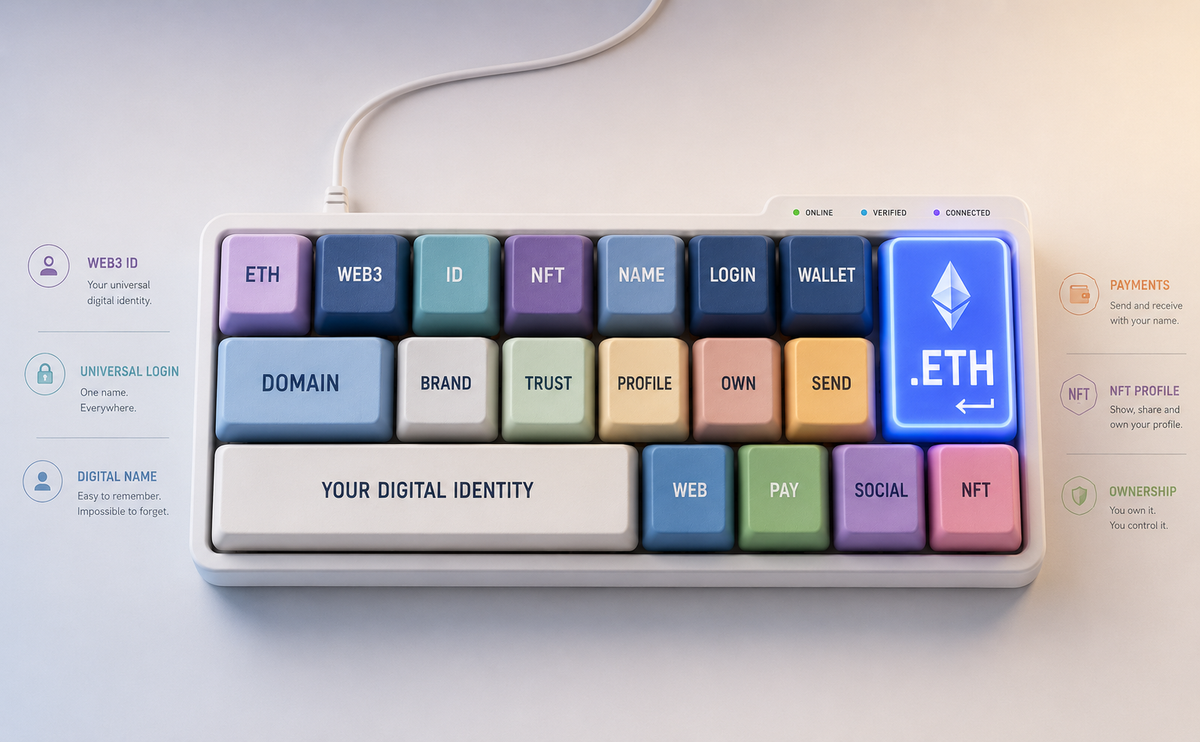
But ENS is bigger than just simplifying wallet addresses. It's a foundational piece of Web3 infrastructure a decentralized naming system built on the Ethereum blockchain that connects human-readable names to wallet addresses, websites, social profiles, and more. Think of it less like a contact in your phone and more like a universal digital passport that goes wherever you go online.
The numbers back up the momentum: over 2.7 million active ENS names are currently held by more than 663,000 participants. The ENS ecosystem already integrates with wallets like Coinbase and MyCrypto, major platforms like OpenSea and Etherscan, and browsers like Beacon and EthDNS. This isn't a niche experiment anymore it's becoming infrastructure.
Why ENS Is Different From Everything Else
You might be wondering how ENS is any different from just creating a consistent username across platforms. The difference comes down to one word: ownership.
When you create a username on Twitter or Instagram, you don't own it. The platform does. They can change your handle, suspend your account, or shut down entirely and there's nothing you can do about it. Your digital identity is rented space on someone else's property.
An ENS domain is different. Once you register "yourname.eth," it's yours. It lives on the Ethereum blockchain, not on any company's server. No platform can take it away, no corporation can change the rules on you, and no algorithm can deplatform your identity out of existence.
There's also a security dimension worth taking seriously. One of the growing use cases for ENS is something called "Sign in with Ethereum" a concept that uses your verified ENS identity as a login credential across Web3 applications. Think of it as the decentralized equivalent of "Sign in with Google," except instead of handing Google data about everywhere you log in, you're authenticating with a cryptographic identity that you control entirely.
In a world where fake accounts, impersonators, and phishing scams are rampant, having a verifiable digital identity that you actually own is more valuable than most people currently realize.
The Organic Rise of ".eth"
If you spend any time in crypto Twitter, you've probably noticed the growing number of people who've added ".eth" to their display names. What started as a signal within a niche community has quietly become one of the most authentic growth stories in Web3.
Here's what's striking about ENS adoption: it didn't grow the way most crypto projects do. There were no celebrity endorsements, no aggressive marketing campaigns, no artificially manufactured FOMO. The growth has been almost entirely organic driven by users who recognized the genuine utility of owning a portable, censorship-resistant digital identity.
Since its launch in 2017, ENS has grown steadily by doing exactly what it promised to do: making blockchain interactions more human. That kind of sustained, utility-driven adoption is rare in the crypto space, and it's one of the strongest signals that ENS isn't a passing trend.
What You Can Actually Do With a ".eth" Domain
This is where things get genuinely interesting. A ".eth" domain isn't just a pretty username it's a functional piece of your digital life. Here's what owning one actually unlocks:
Simpler crypto transactions. Send and receive cryptocurrency using your ".eth" name instead of a wallet address. No more copying and pasting 42-character strings and triple-checking every digit. If someone has an ENS domain, sending them crypto is as easy as sending an email.
A decentralized website. You can host a website directly through your ".eth" domain one that lives on the blockchain and can't be taken down by a hosting provider, deplatformed by a government, or hit with a DMCA notice from an overzealous corporation. Your site, your rules.
A unified digital identity. Link your ENS domain to your social profiles, your portfolio, your wallet addresses across multiple blockchains, and any other piece of your online presence. Instead of scattered fragments across a dozen platforms, you get one coherent identity that you actually own.
Future-proofing your presence. The internet is moving toward Web3 whether the mainstream is ready or not. Securing your ".eth" domain now is the equivalent of registering a ".com" in 1995 most people didn't understand why it mattered until it was too late to get the name they wanted.
How Google Is Making Ethereum More Accessible
One underappreciated development in the Ethereum ecosystem is that Google now allows users to search for Ethereum addresses directly in its search bar. Type in a wallet address, and Google will surface relevant information about that address transaction history, current balance, associated dApps and smart contracts all pulled from publicly available blockchain data.
This matters more than it might seem at first. It means:
Verifying transactions just got easier. Instead of navigating to a blockchain explorer, users can quickly pull up transaction details directly from Google. For anyone who's ever nervously wondered whether a transaction went through correctly, this is a meaningful quality-of-life improvement.
Trust becomes easier to establish. Before engaging in a transaction with an unknown party, you can now look up their address history in seconds. That added layer of transparency helps weed out bad actors and gives legitimate participants more credibility.
The broader point is that Ethereum is becoming easier to interact with for people who aren't technical experts and that accessibility is the single biggest factor in mainstream adoption.
Major Companies Already Building on Ethereum
Ethereum isn't just for crypto enthusiasts and DeFi traders. Some of the world's biggest companies have already committed to building on or within the Ethereum ecosystem:
Ubisoft, the French video game giant behind franchises like Assassin's Creed and Far Cry, has embraced Ethereum-based blockchain technology, partnering with blockchain game developers and launching "Rabbids Tokens" tied to their popular Raving Rabbids series.
ING, the Dutch multinational bank, has been actively exploring Ethereum for real-world financial applications including trade finance and settlement processes areas where blockchain's transparency and efficiency offer genuine competitive advantages over legacy systems.
TD Ameritrade, one of America's largest online brokers, has invested in ErisX, a CFTC-regulated exchange that enables customers to trade Ethereum and other cryptocurrencies. While they aren't building directly on the Ethereum network themselves, the investment signals clear recognition of Ethereum's growing role in the broader financial landscape.
These aren't fringe experiments. They're strategic moves by major institutions that have done their homework and decided that Ethereum is worth betting on.
Big News: GoDaddy and ENS Are Partnering
Here's a development that should get the attention of anyone who owns a traditional domain: GoDaddy, the world's largest domain registrar, has announced a partnership with ENS to make connecting a traditional domain to a crypto wallet easier than ever before.
What this means practically is that the gap between the traditional internet and the blockchain world is starting to close. If you own "yourbusiness.com" through GoDaddy, connecting it to your crypto wallet and Web3 identity is becoming a straightforward process rather than a technical obstacle. This kind of bridge between Web2 and Web3 is exactly what broader adoption needs and it's a strong signal that even the most established players in the traditional domain industry see where things are heading.
How to Register Your First ".eth" Domain
Ready to claim your piece of Web3? The process is simpler than you might expect. Here's how to get started:
Step 1: Set up a wallet and add some ETH. You'll need an Ethereum wallet MetaMask, Coinbase Wallet, and Trust Wallet are all solid options for beginners. Once your wallet is set up, add some ETH to cover the registration fee and the gas fee (the network transaction cost).
Step 2: Head to the ENS app. Navigate to https://app.ens.domains/ in your browser. If you're on mobile, you can access it through the built-in dApp browser in Trust Wallet or a similar wallet app.
Step 3: Connect your wallet. Select "Connect," choose "Browser Wallet," and follow the prompts to link your wallet to the ENS application.
Step 4: Search for your name. Type in the ".eth" name you want. The app will immediately show you whether it's available. If it is, select it and proceed.
Step 5: Complete the registration. Follow the on-screen instructions to pay the registration fee and gas fee, confirm the transaction through your wallet, and you're done. The whole process typically takes just a few minutes.
Once registered, you can link your new ".eth" domain to your Ethereum wallet address, other crypto addresses, personal content, and social profiles making it the central hub for your entire digital identity.
Why This Moment Matters
ENS domains are following a trajectory that feels a lot like the early days of the traditional internet. In the mid-1990s, most people didn't understand why anyone would need a ".com" domain. By 2000, the ones who had grabbed valuable names early were sitting on digital real estate worth millions.
The parallel isn't perfect nothing in tech ever maps cleanly onto what came before. But the underlying dynamic is the same: a new naming system is emerging, the best names are still available, and the window for getting in early is open right now but won't be forever.
What makes ENS particularly compelling is that it isn't asking anyone to learn something completely foreign. Domain names are a concept everyone already understands. ENS just applies that familiar concept to a new infrastructure one that gives users actual ownership and control instead of the illusion of it.
The internet is changing. Your digital identity doesn't have to be left behind.