What Are Flash Loans in DeFi? Understanding Instant, Collateral-Free Loans
Discover how flash loans are reshaping decentralized finance by enabling instant, collateral-free borrowing. Learn about their unique mechanics, key use cases like arbitrage and debt refinancing, and the risks involved in this revolutionary DeFi innovation.

Imagine walking into a bank, borrowing a million dollars with no collateral, using it to make a profit, paying the bank back in full, and doing all of that in about 13 seconds. Then imagine the bank having absolutely zero risk throughout the entire process.
That sounds like a financial fantasy. But in decentralized finance, it's just Tuesday.
Flash loans are one of the most genuinely novel inventions to come out of the DeFi space. They don't have a real equivalent in traditional finance. They break almost every assumption we have about how borrowing works: no collateral, no credit check, no repayment schedule. And yet, they're mathematically secure by design, because the entire process happens within a single blockchain transaction. If the loan isn't repaid before that transaction closes, the whole thing gets reversed automatically. Nothing is lost. No one gets hurt.
What makes flash loans so fascinating and so worth understanding is that they're simultaneously one of the most powerful tools available to sophisticated DeFi traders and one of the most frequently misused. They've been used to execute elegant arbitrage plays worth hundreds of thousands of dollars. They've also been used to drain liquidity pools and destabilize protocols in some of DeFi's most notorious attacks.
This blog breaks down what flash loans are, how they actually work, what people use them for, and what risks you need to understand before getting anywhere near them.
What Is a Flash Loan?
A flash loan is an uncollateralized, instant loan that must be borrowed and repaid within the same blockchain transaction. That single sentence contains several ideas that are worth unpacking individually, because they each challenge how we normally think about lending.
Uncollateralized means you don't need to put up any assets to secure the loan. In traditional finance and even in most DeFi lending, you need collateral. You need to prove you have something to lose if you don't pay back what you owe. Flash loans bypass this entirely.
"Instant" means there's no application process, no credit evaluation, and no waiting period. The loan is issued in real time, the moment you request it.
Within the same transaction is the key that makes the whole thing work. A blockchain transaction is atomic, meaning it either completes fully or it doesn't happen at all. Flash loans are built around this property. The smart contract that governs the loan requires that the borrowed amount be repaid before the transaction finalizes. If repayment doesn't happen, the entire transaction the borrowing, the actions taken with the funds, and every intermediate step gets rolled back automatically. It's as if the loan never occurred.
This is why flash loans carry essentially zero default risk for lenders. The money is never truly at risk, because the mechanics of the blockchain guarantee it comes back.
How Flash Loans Stack Up Against Traditional Loans
The differences between flash loans and conventional lending couldn't be more stark:
Traditional loans require collateral, often significant collateral. They go through an approval process that can take days or weeks. Once approved, the borrower has months or years to repay. And the lender carries real default risk throughout that entire period.
Flash loans require no collateral. They're approved instantly. They must be repaid within seconds, specifically within the time it takes for a single block to be confirmed on the blockchain. And the lender carries no meaningful default risk, because the smart contract handles everything automatically.
The trade-off is obvious: flash loans are useful only if you can do something profitable with borrowed funds in an extremely short window of time. That limits who can use them and for what, but for the right applications, they're extraordinarily powerful.
How Flash Loans Actually Work
The mechanics are cleaner than you might expect. Here's the sequence of events in a typical flash loan transaction:
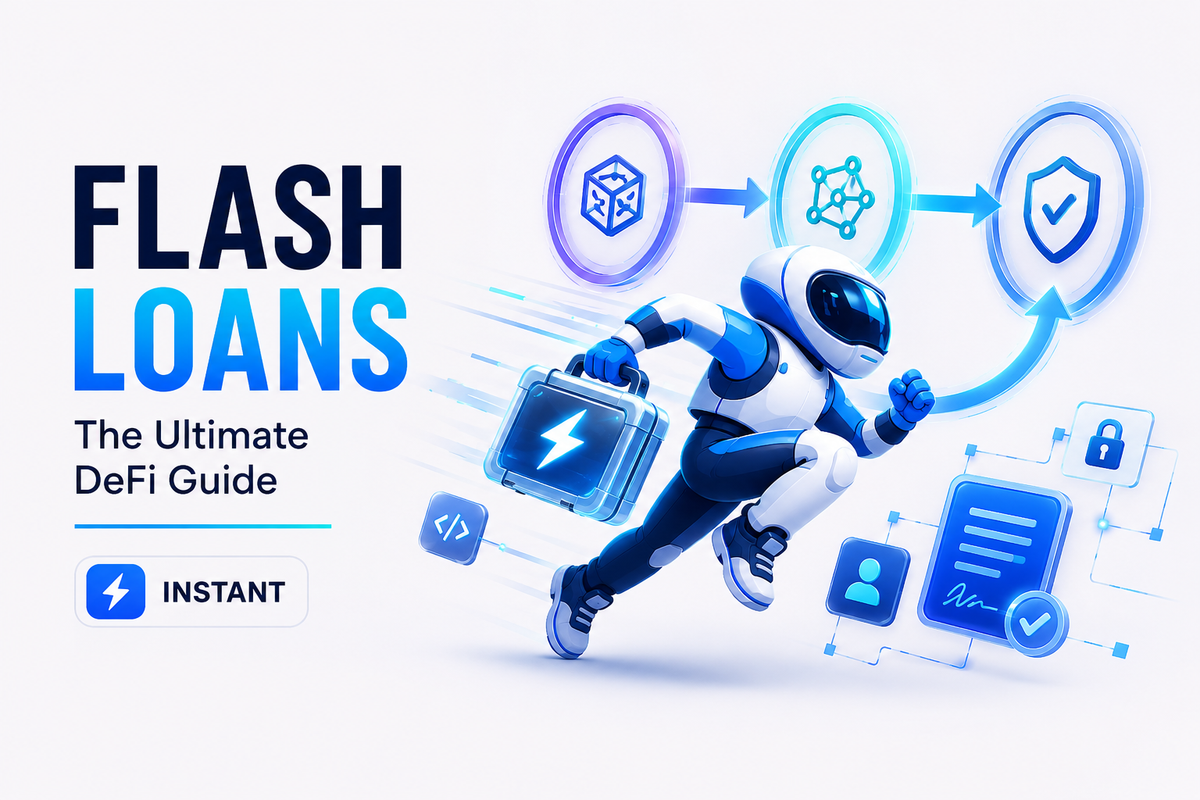
Step 1: Borrowing: The user sends a flash loan request to a DeFi platform that supports them. Aave and dYdX are the most well-known. The platform, governed by a smart contract, lends the requested amount immediately, no questions asked.
Step 2 Execution: The user deploys the borrowed funds to carry out whatever action they planned: an arbitrage trade, a debt refinancing, a liquidation, or a token swap. This all happens within the same transaction, in rapid succession.
Step 3 Repayment: Before the blockchain transaction finalizes, the user repays the full borrowed amount plus a small fee. On Aave, for example, that fee is typically around 0.09% of the borrowed amount.
Step 4: Settlement or Reversal: If repayment is successful, the transaction completes and the user keeps their profit. If repayment fails for any reason, the trade didn't work out, the math was off, and the market moved, the smart contract reverses everything. The borrowed funds return to the lender's pool. The user's attempted actions are wiped from the ledger. No harm done.
This self-correcting mechanism is what makes flash loans viable. Lenders don't need to trust borrowers, because the code enforces the agreement automatically.
What Are Flash Loans Actually Used For?
Arbitrage: The Classic Use Case
Arbitrage is the practice of exploiting price differences for the same asset across different markets. In traditional finance, arbitrage opportunities are typically captured by institutional players with significant capital on hand. In DeFi, flash loans democratize that access.
Here's a simplified example: say a particular token is trading at $100 on Uniswap and $102 on SushiSwap. A trader can use a flash loan to borrow a large amount of capital, buy the token on Uniswap at the lower price, immediately sell it on SushiSwap at the higher price, pocket the $2 difference (multiplied across however many tokens they bought), and repay the flash loan all within one transaction.
The price gap only needs to be large enough to cover transaction fees and the flash loan fee. If it is, the trader walks away with risk-free profit. If it isn't, or if the price moves before the transaction completes, the whole thing gets reversed automatically.
This is flash loans at their most elegant: fast, efficient, and entirely self-contained.
Debt Refinancing and Loan Swapping
Not everyone who uses a flash loan is trying to make a trade. Some use them to restructure their existing debt in smarter ways.
Here's a common scenario: a user has an active loan on a DeFi platform charging a high interest rate. A different platform is offering a significantly lower rate. Normally, moving that debt would require the user to have enough capital on hand to repay the first loan before opening a new one, capital they may not have sitting around.
With a flash loan, the process becomes seamless. The user borrows enough to repay the high-interest loan in full, does so instantly, opens a new loan on the lower-interest platform, uses those funds to repay the flash loan, and ends up with the same debt at a better rate. The whole restructuring happens in one transaction, with no need for additional collateral and no gap in coverage.
This is one of the most underappreciated use cases for flash loans not flashy, but genuinely useful for anyone managing DeFi debt positions.
Collateral-Free Liquidations
In DeFi lending, when a borrower's collateral falls below a required threshold, their position can be liquidated; someone else can step in to repay the loan and claim the collateral at a discount. This creates a profit opportunity, but traditionally, the liquidator needs to have the repayment capital available upfront.
Flash loans remove that requirement. A liquidator can borrow the funds needed to repay the defaulted loan, execute the liquidation, collect the discounted collateral, sell it, and repay the flash loan all in one transaction. The result is a profitable liquidation executed with zero upfront capital.
For DeFi protocols, this is actually a net positive: it means more participants can act as liquidators, which keeps the system healthier and reduces the risk of under-collateralized positions sitting unresolved.
Token Swaps and Temporary Liquidity
Flash loans can also be used to facilitate complex token swaps or provide short-term liquidity in trading strategies that require briefly holding assets in a specific configuration. A user can borrow tokens, fulfill the conditions of a particular trade or liquidity requirement, and repay all within a single transaction. It's a way of accessing the right assets at the right moment without needing to hold large reserves permanently.
The Risks, and They're Real
Flash loans are powerful, but they've also been at the center of some of DeFi's most damaging exploits. Understanding the risks isn't optional; it's essential for anyone participating in this space.
Smart Contract Vulnerabilities
Flash loans work because of smart contracts, and smart contracts are only as good as the code behind them. If a DeFi protocol has a bug or logic flaw in its smart contract, even a subtle one, a sophisticated attacker can potentially exploit it using a flash loan.
The speed and scale of flash loans amplify this risk significantly. A vulnerability that might be difficult to exploit with limited capital becomes trivially exploitable when someone can borrow millions of dollars with no upfront cost. The financial losses from smart contract exploits in DeFi have run into the hundreds of millions of dollars across the industry.
This is why rigorous smart contract auditing isn't just a nice-to-have; it's a fundamental requirement for any platform offering flash loan functionality.
Flash Loan Attacks
Flash loan attacks are a specific and particularly concerning form of market manipulation. The basic pattern works like this: an attacker borrows a massive amount of capital through a flash loan, uses it to manipulate prices on one or more DeFi platforms, artificially inflating or deflating token values, distorting liquidity pools, or exploiting weaknesses in price oracle systems, executes trades or liquidations that profit from that manipulation, and then repays the flash loan before the transaction closes.
The attacker exits with profit. The platform is left with drained liquidity, distorted prices, or both. Regular users bear the costs.
Several high-profile DeFi protocols have been hit by flash loan attacks, with losses ranging from millions to tens of millions of dollars. These attacks don't just hurt the immediate victims; they undermine broader confidence in DeFi's security and reliability.
Market Manipulation and Slippage
Even without a full-scale attack, large flash loan transactions can temporarily distort markets. Moving significant amounts of capital across decentralized exchanges in a short window can cause slippage price movement caused by the trade itself and create temporary price imbalances that affect other traders and liquidity providers. In most cases, these effects are brief and self-correcting, but they're real, and they can cost other market participants money.
How Platforms Are Responding
The DeFi industry hasn't been passive about these risks. Several mitigation strategies have become increasingly standard:
Smart contract audits: reputable platforms require independent security audits before deploying or updating contracts. Audit results are often made public, giving users transparency into what's been reviewed.
Price oracle improvements: Many flash loan attacks exploit weaknesses in price feeds. Platforms are moving toward more robust, manipulation-resistant oracle designs that make it harder to distort prices within a single transaction.
Rate limits and exposure caps: Some platforms limit the maximum size of flash loan transactions or restrict how much of a liquidity pool can be accessed at once, reducing the potential impact of any single exploit.
Decentralized governance oversight DAOs governing DeFi protocols can vote to implement additional safeguards or pause flash loan functionality if a vulnerability is discovered.
The Benefits That Make Flash Loans Worth Understanding
Despite the risks, flash loans offer genuine advantages that are hard to replicate through any other financial mechanism.
Instant access to capital is the most obvious benefit. For traders and DeFi participants who want to move quickly on an opportunity but don't have the capital on hand to act, flash loans provide a frictionless path to liquidity: no collateral, no delays, no gatekeepers.
Speed and efficiency matter enormously in DeFi, where arbitrage windows can close in seconds and market conditions shift constantly. Flash loans operate at the speed of the blockchain itself, which is fast enough to capitalize on opportunities that would be completely inaccessible through any traditional mechanism.
Democratization of sophisticated strategies is perhaps the most philosophically significant benefit. Arbitrage, liquidation, and debt restructuring were traditionally the domain of institutional players with deep pockets. Flash loans make these strategies accessible to anyone with the technical knowledge to execute them regardless of how much capital they have to start.
Near-zero lender risk means that DeFi platforms can offer flash loan services without the traditional credit risk that makes collateralized lending so restrictive. The smart contract handles enforcement automatically. The capital always comes back, or the transaction never happened.
Where Flash Loans Are Headed
Growing Adoption in DeFi
Flash loans are still relatively early in their development, but adoption is accelerating. As more DeFi platforms integrate lending protocols and automated market makers (AMMs), flash loans are becoming standard infrastructure rather than an exotic feature. Aave and dYdX have already demonstrated that there's significant demand; the question now is how that demand evolves as the ecosystem matures.
Cross-Chain Flash Loans
One of the most exciting possibilities on the horizon is cross-chain flash loan functionality. Right now, most flash loans operate within a single blockchain ecosystem, Ethereum being the most common. But as cross-chain interoperability improves, it could become possible to borrow assets on one blockchain and execute actions on another, then repay across chains in a single atomic transaction.
That would dramatically expand the range of strategies available to flash loan users, allowing them to capture opportunities across the entire multi-chain DeFi landscape rather than being limited to one network at a time.
Regulatory Attention
Flash loans haven't gone unnoticed by regulators. The high-profile attacks carried out using flash loans have drawn scrutiny from financial regulators who are trying to understand how to address market manipulation in DeFi. The challenge is significant: flash loans are decentralized, pseudonymous, and governed by code rather than institutions, all of which make traditional regulatory approaches difficult to apply.
The most likely path forward involves a combination of on-chain governance through DAOs setting community standards, self-regulatory measures by DeFi platforms, and eventually some form of regulatory guidance that addresses the specific risks of uncollateralized instant lending without undermining the broader DeFi ecosystem.
A Potential Bridge to Traditional Finance
It's worth noting that traditional financial institutions are watching developments in DeFi closely, and flash loans are no exception. The concept of instant, automated lending with zero default risk is genuinely appealing from a risk management perspective. Whether traditional banks ever adopt flash loan mechanics directly is an open question, but the possibility of hybrid products combining the stability of traditional finance with the speed and automation of DeFi is real and worth watching.
Final Thoughts
Flash loans are one of those inventions that feel like they shouldn't work, and yet they do, elegantly and reliably, when used correctly. They're a product of thinking that's native to blockchain: instead of managing risk through collateral and legal enforcement, you manage it through code and atomicity. Instead of trusting a borrower to repay, you make repayment a mathematical requirement.
The result is a financial tool with no real precedent in traditional finance, one that provides instant access to enormous capital with essentially zero cost to the lender and genuine profit opportunities for users who know how to deploy it effectively.
But flash loans also demand respect. The same properties that make them powerful instant scale, no upfront capital, and automated execution make them dangerous in the wrong hands. The history of DeFi is littered with protocols that didn't take smart contract security seriously enough, and flash loan attacks have been some of the most costly consequences of that complacency.
If you're exploring DeFi seriously, understanding flash loans is non-negotiable, not necessarily because you'll use them directly, but because they're woven into the fabric of how decentralized financial markets operate. Know how they work, know what they can do, and know what they can break.
That understanding is what separates a DeFi participant who gets blindsided by market events from one who sees them.