From .com to .eth: Why More Businesses Are Embracing ENS Domains
The Rise of .eth Domains: Numbers Tell the Story ²

Over 1.5 million .eth domains have been registered since the Ethereum Name Service launched in 2017. That's not a vanity metric; it's a clear signal that businesses, creators, developers, and investors are staking their claim in the next version of the internet, and they're doing it through blockchain-based domain names.
The global domain market is projected to grow at a compound annual rate of 5.18% through 2031. But within that broader trend, .eth domains are growing faster, attracting more attention, and generating more excitement than almost anything else in the domain space. ENS domain NFT sales alone have skyrocketed by over 12,800% year-to-date at various points in recent history a number that reflects genuine demand, not manufactured hype.
And then there's the GoDaddy-ENS partnership the world's largest traditional domain registrar formally integrating .eth domain registration into its platform. That's not a coincidence or a PR stunt. It's a structural acknowledgment that decentralized domains are becoming part of the mainstream internet infrastructure, and that the line between Web2 and Web3 is blurring faster than most people expected.
If you've been watching this space and waiting for a signal that it's time to pay attention, this is it.
What Is a .eth Domain, and How Is It Different From What You Already Have?
Let's get the fundamentals straight before diving into why .eth domains matter for your business specifically.
A .eth domain is a blockchain-based domain name built on the Ethereum network and managed by the Ethereum Name Service (ENS). On the surface, it functions similarly to a traditional domain name it's a human-readable address that represents something more complex underneath. Just as "google.com" points to a server IP address, "yourbrand.eth" points to an Ethereum wallet address, a decentralized website, or any other on-chain resource you associate with it.
But the similarities to traditional domains end pretty quickly once you look at how ownership works.
When you register a traditional domain a .com, .net, or .org you're licensing it from a registrar, under rules set by ICANN, subject to renewal requirements and the ongoing possibility of suspension or revocation. The registrar is in control. If they decide to shut down, if a government pressures them to take your domain offline, or if you simply forget to renew, your domain can disappear.
A .eth domain operates completely differently. It's recorded on the Ethereum blockchain, stored in your crypto wallet as an NFT, and governed by smart contracts rather than any central authority. Nobody at ENS can take it from you. No government can pressure a registrar to suspend it. No algorithm can decide your domain violates a terms-of-service agreement you didn't fully read. It's yours genuinely, verifiably, permanently yours as long as you choose to hold it.
Anyone can register a .eth domain regardless of location, technical background, or existing blockchain experience. That accessibility, combined with the robust security of the Ethereum blockchain, is a large part of why adoption has grown as steadily as it has.
The Numbers Behind ENS: Why This Matters Financially
Beyond the philosophical appeal of decentralized ownership, the financial picture around ENS domains is genuinely compelling.
Accounts linked to analyzed ENS domains hold significant crypto assets including over $291 million in ETH alone. Annualized revenue from ENS domain registration fees exceeds $2.3 million, with continued growth expected as shorter, premium domains attract more competitive demand.
Think about what that tells you. The people registering .eth domains aren't dabblers; they're serious participants in the Ethereum ecosystem who hold substantial digital assets and are actively building and transacting on-chain. A .eth domain, for these users, isn't a novelty; it's infrastructure.
For businesses, this creates an interesting dual opportunity: establishing a credible presence within a financially active and technically sophisticated community while also positioning themselves ahead of what appears to be significant long-term growth in the domain space overall.
Premium .eth domains, short, memorable, brand-relevant names are appreciating in value as the namespace fills up. The secondary market for ENS domain NFTs is active and growing. That investment dynamic is one more reason why securing your desired .eth domain sooner rather than later is a decision that tends to look smarter in hindsight.
What Owning a .eth Domain Actually Means for Your Business
Let's move from the abstract to the practical. What does a .eth domain concretely do for a business operating in 2024?
It establishes your brand identity in the Ethereum ecosystem. The Ethereum network hosts the majority of DeFi activity, NFT trading, and decentralized application usage in the world. Having a .eth domain puts your brand name in that ecosystem searchable, findable, and associated with a verified on-chain identity. For any business that wants to serve Web3 customers, this is table stakes.
It simplifies cryptocurrency transactions dramatically. Receiving crypto payments, processing NFT transfers, or interacting with smart contracts currently requires sharing a 42-character hexadecimal wallet address something that's both impractical and error-prone. A .eth domain replaces that with something like yourbrand.eth. The ENS system handles the translation automatically. For businesses accepting crypto, this usability improvement directly affects conversion rates.
It enables deeper blockchain integrations. This is the capability that most people don't think about until they're ready to build something. A .eth domain can serve as an alias for smart contracts, making them more accessible to users. It can link to social media handles, website URLs, and other wallet addresses across different blockchains all in one place. It can be used to manage user accounts as ENS subdomains, enabling innovative application architecture that isn't possible with traditional domain infrastructure.
It signals that your brand is building for the long term. In a space riddled with projects that disappear overnight, a business that takes the time to establish a proper .eth domain and uses it consistently communicates seriousness and commitment. For customers, investors, and partners evaluating whether your project is worth engaging with, that signal matters more than most businesses realize.
It future-proofs your online presence. As Web3 continues moving toward mainstream adoption, having claimed your brand's identity in the Ethereum namespace before the rush becomes increasingly valuable. The businesses that moved early on .com domains in the 1990s didn't always know exactly how they'd use them but they understood that reserving their name was the right move. The same logic applies to .eth today.
14 Reasons to Register Your .eth Domain
Rather than making the general case and leaving it there, let's get specific. Here are the concrete benefits that come with owning a .eth domain:
Censorship resistance. The decentralized nature of ENS means there's no central authority that can be pressured into taking your domain down. Your .eth domain is as resilient as the Ethereum network itself.
Human-readable addresses. Ethereum wallet addresses are 42-character strings that are impossible to remember and dangerous to type manually. A .eth domain replaces that with something people can actually use without anxiety.
Direct crypto transactions. Send and receive ETH, ERC-20 tokens, and other cryptocurrencies using your .eth domain directly. Compatible wallets handle the address resolution automatically.
Universal access. Anyone anywhere can register a .eth domain. No geographic restrictions, no special technical requirements, no gatekeepers deciding who qualifies.
Blockchain-grade security. Your domain is stored on the Ethereum blockchain, protected by the network's cryptographic infrastructure and immutability. It's significantly more secure than any centralized domain system.
Investment potential. .eth domains can be bought, sold, and traded on secondary markets like any other NFT. Premium names have appreciated significantly as the namespace has grown, and that trend shows no signs of reversing.
Subdomain creation. Create subdomains under your main .eth domain for different products, teams, or campaigns all organized under a single, coherent brand identity.
User-friendly management. The ENS interface makes managing your domain straightforward updating records, renewing registration, and connecting new resources are all handled through a clean, accessible interface.
Smart contract aliases. Replace complex smart contract addresses with memorable .eth aliases, making your on-chain applications dramatically more accessible to users.
Multi-wallet management. Assign distinct, memorable names to multiple crypto wallets under a single .eth domain simplifying both internal management and external sharing.
Trust building. A properly maintained .eth domain demonstrates technical competence and long-term commitment qualities that matter enormously to the Web3 audience you're trying to reach.
Superior security over traditional domains. Blockchain storage and cryptographic backing make .eth domains significantly harder to compromise than traditional domain systems, which remain vulnerable to registrar-level attacks and social engineering.
Powerful branding. A distinctive, memorable .eth domain is a branding asset that differentiates your project within the Ethereum ecosystem and signals clearly that you're a serious participant.
Secure email communication. .eth domains enable encrypted email communication directly to other .eth wallet addresses through compatible services like Mainchain a capability that doesn't exist in the traditional email infrastructure.
ENS as the All-in-One Web3 Identity Platform
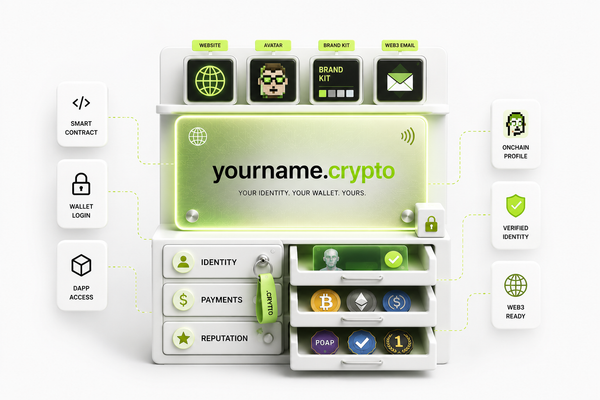
Here's where the real power of .eth domains becomes clear: they're not just domain names. They're comprehensive digital identity profiles that consolidate multiple web services into a single, unified address.
Think about everything it currently takes to run an online presence: a domain name through a registrar, hosting through a separate provider, a payment processing system, a user authentication layer, and social media presence across multiple platforms each managed separately, each with its own interface, billing, and dependencies.
ENS collapses a significant portion of that complexity into a single .eth address. Your yourbrand.eth domain can simultaneously point to your decentralized website, your Ethereum wallet for receiving payments, your social media profiles, your NFT avatar, and your smart contracts all from one address, all managed through one interface, all operating on open, decentralized infrastructure.
ENS subdomains extend this further. You can create user accounts under your domain user.yourbrand.eth enabling a Web3-native authentication and identity system for your application's users. You can manage user assets as NFTs within your platform, opening architectural possibilities that have no equivalent in traditional web infrastructure.
This consolidation isn't just convenient it's strategically valuable. Every additional service your .eth domain absorbs is one fewer third-party dependency your business is exposed to, and one fewer platform whose terms of service you're subject to.
How to Get Your .eth Domain: A Step-by-Step Guide
The registration process is more straightforward than most people expect. Here's exactly how it works.
Step 1: Get your wallet set up. You'll need a non-custodial Ethereum wallet that supports MetaMask is the most commonly used option, but Coinbase Wallet, Rainbow, and several others work equally well. Make sure you have enough ETH in the wallet to cover registration fees and gas costs. The amount needed varies based on the domain name length and how long you're registering for, but budgeting $50-100 in ETH covers most standard registrations with room to spare.
Step 2: Connect your wallet to ENS. Go to ens.domains and click "Connect" in the upper right corner. The platform will prompt you to select and connect your wallet. Follow the steps to authorize the connection this is a standard wallet connection flow that you'll recognize if you've used any other Ethereum application before.
Step 3: Search for your name. Type the .eth name you want into the search bar. If it's available, you'll see the registration options. If it's already taken, you'll see information about the current owner and when (if ever) their registration expires. Short names particularly those under five characters are mostly registered, but there are still excellent longer names available.
Step 4: Choose your registration period. ENS domains do require annual renewal fees (unlike some blockchain domains that offer one-time purchases). Fees are based on name length shorter names cost more per year. You can register for multiple years upfront, which locks in the current fee and reduces the administrative overhead of annual renewals.
Step 5: Complete registration and set up your resolver. Follow the on-screen prompts to sign the registration transaction. There's a brief waiting period built into the process to prevent front-running a mechanism that ensures fair access to in-demand names. Once your registration is confirmed, set up a resolver the component that tells ENS what your domain actually points to. Setting your Ethereum wallet address as the primary record is the essential first step; from there, you can add website URLs, social profiles, and other records as needed.
Once you've completed these steps, your .eth domain is live, linked to your wallet, and ready to use across the ENS-compatible ecosystem.
Real Brands Doing This Right
The case for .eth domains isn't purely theoretical some of the world's most recognized brands have already moved into this space and built genuinely interesting things.
Gucci created a limited-edition NFT collection that included exclusive digital artwork bundled with unique .eth-adjacent usernames for owners. It was a thoughtful minimum viable product a real experiment with metaverse engagement that maintained a clear connection to Gucci's core luxury brand identity while reaching a technically sophisticated new audience. The approach showed that Web3 initiatives don't have to be all-or-nothing gambles; they can be carefully scoped experiments that generate learning and momentum.
Budweiser acquired the beer.eth domain a statement of intent that made headlines in the crypto community and signaled the brand's serious commitment to Web3. They followed it up by launching "Budverse Cans: Heritage Edition," a collection of 1,936 unique NFTs drawing on Budweiser's rich visual history classic photography, vintage advertisements, and historical documents. Minted on Ethereum and sold through OpenSea, the collection covered transaction fees for buyers, removing a common friction point for newcomers to NFT purchasing.
Charles & Keith, the Singapore-based fashion brand, took a multi-front approach that's worth studying closely. They integrated Bitcoin and Ethereum payment options directly into their e-commerce platform a practical, customer-facing use of blockchain technology that generated significant positive press and positioned the brand as forward-thinking without requiring customers to change their shopping behavior dramatically. They also participated in Decentraland's Metaverse Fashion Week, engaging with an existing virtual community on its own terms rather than trying to build one from scratch. The result was genuine community engagement with a brand that felt like a natural fit in that environment rather than an outsider trying to extract attention.
What all three of these examples share is a common approach: they treated their Web3 initiatives as carefully scoped minimum viable products rather than bet-the-company pivots. They experimented, learned, and built credibility without compromising their core business operations or confusing their existing customers. That's the template worth following.
What Comes After the GoDaddy-ENS Partnership
The GoDaddy-ENS collaboration deserves its own moment of attention, because its implications extend well beyond the two companies involved.
When the world's largest traditional domain registrar builds native support for a blockchain naming system into its platform, it sends a clear message to the rest of the domain industry: this is where things are heading. The 20-plus million GoDaddy users who can now connect their traditional web domains to ENS represents a massive potential influx of mainstream users into the .eth ecosystem.
More importantly, it establishes a template. Binance, with its .bnb domain ecosystem. Tezos, with .tez. Arbitrum, with .arb. Other blockchain networks with their own naming systems are watching the GoDaddy-ENS partnership carefully, and the competitive pressure to form similar collaborations with traditional registrars will intensify. We're watching the infrastructure of Web3 identity become normalized in real time.
For businesses trying to decide whether to secure a .eth domain now or wait, that normalization trajectory is the most important data point. The friction of getting a .eth domain is going down. The awareness of ENS among mainstream users is going up. The window to establish your brand identity in the Ethereum namespace before the space becomes crowded is open but it's not going to stay open indefinitely.
Final Thoughts
The .eth domain space is at the same stage that .com was in the mid-1990s: genuinely useful technology that's just starting to reach mainstream awareness, with a finite namespace that's filling up and a user community that's growing fast. The brands that moved early on .com established digital identities that became enormously valuable as internet adoption accelerated. The same dynamic is playing out with .eth and the timeline is compressed.
The financial case is real: growing asset values, active secondary markets, and an ecosystem that holds billions in crypto assets. The technical case is real: censorship resistance, true ownership, multi-service integration, and blockchain-grade security. The brand case is real: credibility, differentiation, and early-mover positioning in a namespace that matters.
And the process of getting started is genuinely accessible a wallet, some ETH, a few minutes on ens.domains, and you've secured your brand's foothold in the decentralized web.
The decentralized web has a long way to go before it's fully mainstream. But the infrastructure being built right now .eth domains, .sol domains, .polygon domains, .dao domains, and endless domains emerging across different blockchain ecosystems is laying the foundation for what comes next. Your .eth domain is how your brand becomes part of that foundation.