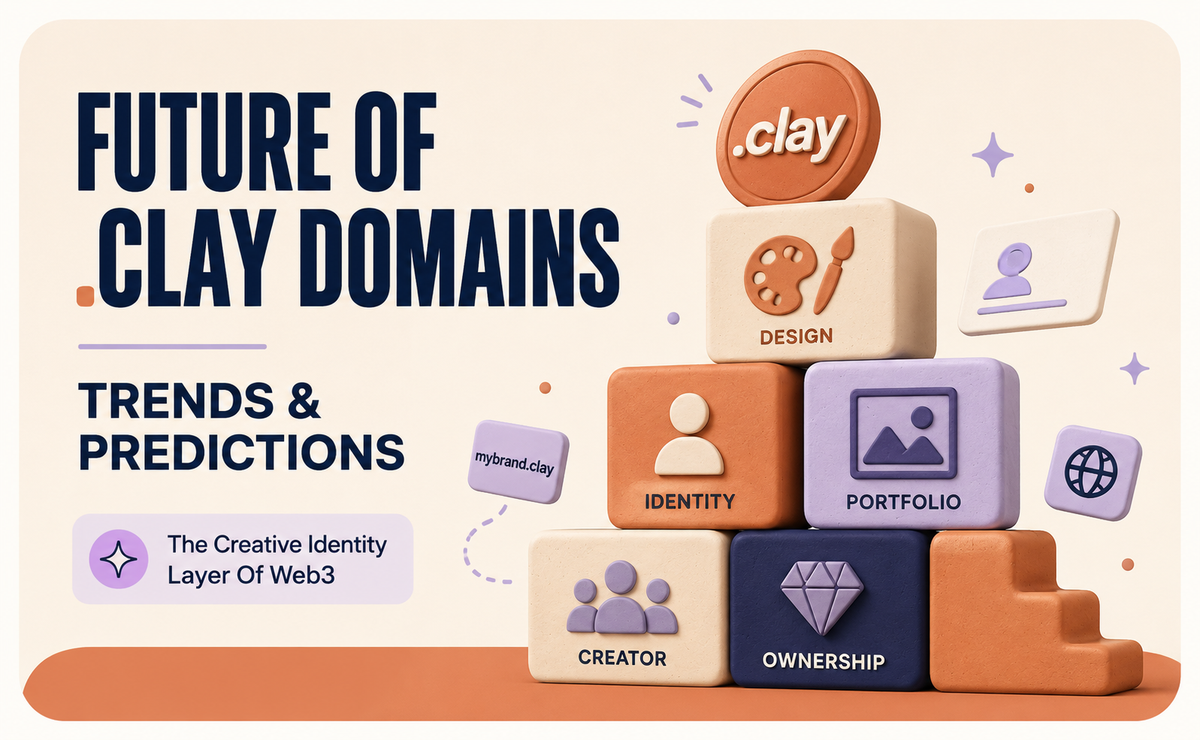
The Future of .clay: Trends and Predictions
.clay domains: Shaping the future of creativity. Explore the trends and predictions for this innovative domain and its role in the evolving digital world.

Every artist, designer, and maker knows the frustration of trying to find a domain name that feels right.
You think of something clever something that captures what you do, who you are, what your work is about and then you search for it with a .com extension and find it's either taken, parked by a domain investor demanding thousands of dollars, or available only in a form that requires awkward hyphens and misspellings. You settle for something functional but forgettable, and your online presence starts with a compromise.
.clay is trying to fix that not just by offering another extension to try, but by building a domain space that means something specific. If your work involves creativity, craft, and making things, a .clay domain signals that before a visitor even sees a single page of your website. It's a declaration of identity, not just a web address.
Here's a thorough look at where .clay is now, where it's heading, and what it could realistically become.
What Makes .clay Different From Just Another Domain Extension
The internet has expanded well beyond .com, .org, and .net. There are now extensions for specific industries, locations, purposes, and communities .design, .tech, .studio, .art, among dozens of others. Most of them are fine. Very few of them are distinctive.
.clay is different in a specific way: it functions as a cultural signal as much as a technical one. When someone lands on a website ending in .clay, they already have a sense of what they're about to encounter something handmade, original, creative, and intentional. That context shapes the experience from the first moment.
That distinction matters more than it might seem. In a crowded digital landscape where first impressions are formed in seconds, the domain name itself is part of the story a website tells. .com says "generic business presence." .clay says "this person makes things and cares about craft."
For artists, designers, ceramicists, sculptors, illustrators, photographers, musicians, and the many other creative disciplines that fall under a broad definition of making .clay offers a home that reflects their identity rather than just their address.
Where .clay Stands Right Now
The .clay domain is still in its early growth phase, but the adoption patterns that are emerging are meaningful. The people and businesses choosing it aren't using it as a fallback when their preferred .com was unavailable they're choosing it deliberately because of what it represents.
A few clear usage patterns have taken shape:
Creative portfolios are the most natural fit. Artists and designers using .clay to host their portfolios get a domain that reinforces their brand the moment someone reads it. yourname.clay immediately communicates creative identity in a way that yourname.com simply doesn't.
Small creative businesses pottery studios, independent jewelry makers, ceramics shops, craft collectives are using .clay to establish brand identities that align with what they sell. A handmade ceramics shop with a .clay domain is telling a coherent story across every touchpoint. That kind of alignment between brand identity and domain choice is genuinely valuable.
Creative agencies and studios are using .clay to differentiate themselves from the sea of generic .com agencies. In a market where every boutique design firm is competing for attention, a distinctive domain is one more signal that says "we think differently."
Artist collectives and online communities are building shared spaces under .clay, creating collaborative hubs where creatives can share work, give feedback, and support each other's practices.
None of these use cases is enormous yet. But the quality of early adoption tends to matter more than the quantity and the people choosing .clay are using it thoughtfully, which creates a foundation of credibility that generic domain extensions don't have.
The Trends Driving .clay Forward
Creatives Are Rethinking Their Online Identity
There's a broader shift happening in how artists and makers think about their digital presence. The era of just being findable on Instagram and hoping the algorithm works in your favor has started to lose its appeal. Platform dependency building an audience on a service that can change its rules, throttle your reach, or disappear altogether has left too many creators in vulnerable positions.
Owning your domain, hosting your own portfolio, building a presence that belongs to you rather than to a platform: these ideas have gained significant momentum. .clay fits squarely into that shift. It offers creative professionals a home base that they control, under a name that reinforces who they are.
E-Commerce for Handmade and Artisanal Goods Is Growing
The market for handmade, one-of-a-kind goods has expanded substantially over the past several years. Buyers are actively seeking alternatives to mass-produced products things made with care, by real people, with distinctive character. That consumer appetite is real and growing.
For the makers serving that market, .clay is a natural fit. A ceramicist selling hand-thrown bowls, a jewelry maker offering custom pieces, a textile artist selling limited-edition prints all of them benefit from a domain that immediately signals the artisanal nature of their work.
Boutique craft shops are using .clay to reach customers who are specifically looking for handmade goods rather than factory-produced alternatives. Freelance creatives offering design, illustration, and content creation services are finding that a .clay domain helps them stand out in a crowded market by reinforcing their creative identity. Digital marketplaces for handcrafted goods are gravitating toward .clay to create curated shopping experiences that feel consistent with the quality and originality of what they sell.
Online Creative Communities Are Finding Their Footing
Some of the most interesting things happening in the .clay ecosystem aren't individual portfolios or storefronts they're communities. Artist collectives, mentorship networks, collaborative studios, and learning communities are building shared spaces under .clay that bring creatives together in ways that go beyond just displaying work.
These communities are developing platforms where members can share works-in-progress and get genuine feedback, where experienced practitioners mentor newer ones, and where geographically dispersed artists can build real working relationships. The .clay domain provides these spaces with an identity that immediately communicates their purpose to visitors and potential members.
This community dimension might be the most underappreciated growth driver for .clay. Creative people are social they benefit enormously from connection, collaboration, and shared context. A domain that signals "this is a space for makers" does real work in attracting the right people.
Technology Is Expanding What .clay Can Do
The creative industries have always been early adopters of new tools, and the technologies emerging in the broader digital landscape are opening up possibilities for .clay that go well beyond traditional websites.
AI as a Creative Collaborator
Artificial intelligence is increasingly being used by artists and designers not to replace creative work, but to extend it. AI tools that generate variations on a concept, help organize and present a portfolio, curate personalized experiences for website visitors, or automate the administrative work around selling creative work are all genuinely useful for the kinds of people gravitating toward .clay.
For a .clay website, AI integration might look like a dynamic portfolio that learns what individual visitors engage with and surfaces more of it. Or an AI-assisted design studio that lets potential clients experiment with custom requests before committing to a project. These aren't hypothetical they're capabilities available today, and the creative community is already using them.
Augmented and Virtual Reality for Immersive Showcases
This is where .clay's potential gets genuinely exciting. Sculpture, ceramics, and three-dimensional craft are categories that have always suffered in translation to flat digital photos. The experience of a hand-thrown ceramic bowl is physical its weight, texture, and form lose something when reduced to a product image.
AR changes that calculus meaningfully. A sculptor hosting an AR experience on their .clay website could let visitors point their phone at a corner of their living room and see what a specific piece would look like in that space. A ceramics artist could let potential buyers visualize a custom mug on their kitchen shelf before ordering. A jewelry designer could show how a piece sits on the body.
VR goes further still. A .clay domain could host a fully immersive virtual studio where visitors walk through a space, pick up and examine pieces, and experience creative work the way it was meant to be experienced in three dimensions. Virtual pottery classes where participants feel like they're sitting at a wheel alongside an instructor anywhere in the world aren't a distant future scenario. The technology exists now. What's needed is the creative willingness to use it, and the .clay community has that in abundance.
Blockchain for Ownership and Transactions
For artists selling work online, the question of trust and transparency is always present. Buyers want to know a piece is authentic, that the transaction is secure, and that the artist is fairly compensated. Artists want confidence that their intellectual property is protected and that they're not losing significant revenue to intermediaries.
Blockchain technology addresses both sides of that equation. Recording .clay domain ownership on a blockchain creates a verifiable, tamper-resistant record that protects creators from domain theft and disputes. Smart contracts enable direct transactions between artists and buyers the terms are coded into the agreement itself, payment is automatic when conditions are met, and neither party needs to trust an intermediary to execute the deal.
For digital art sales in particular, blockchain verification of authenticity and provenance is becoming standard practice. A .clay domain integrated with blockchain infrastructure could serve as both a storefront and a certificate of authenticity a coherent, trusted space where creative work is sold with full transparency about origin and ownership.
IoT and 3D Printing: Where Digital and Physical Meet
Two technologies that might seem unrelated to domain names are quietly opening up interesting possibilities for .clay: the Internet of Things and 3D printing.
A ceramics studio with IoT-connected equipment could link directly to its .clay website, sharing live updates a kiln firing in real time, environmental readings from the studio, progress on a commissioned piece. That kind of behind-the-scenes access creates a storytelling opportunity that builds genuine connection between maker and audience.
3D printing is enabling a new category of work that sits at the intersection of traditional craft and digital fabrication. Artists designing complex forms that would be impossible to create by hand, then printing them in ceramic-compatible materials, are pushing the boundaries of what the medium can be. A .clay website is a natural home for showcasing this kind of work and potentially offering custom pieces to clients who can submit design specifications and receive a finished, fabricated object.
Honest Predictions for Where .clay Is Heading
The future of any niche domain extension depends on a combination of factors that are partly within the community's control and partly not. Here's a realistic assessment of the range of outcomes.
The Best Case
.clay achieves broad recognition as the definitive domain for the creative community not just ceramicists and sculptors, but the full spectrum of makers, designers, artists, and craft-oriented businesses. Strong partnerships with creative platforms, arts institutions, and maker communities drive widespread adoption. Technological integrations VR galleries, blockchain transactions, AI-assisted portfolios make .clay websites genuinely more capable than equivalent .com sites in ways that matter to their users. The domain becomes not just a web address but a cultural institution, the way that certain platforms became synonymous with specific communities.
The Most Likely Case
Steady, meaningful growth over the next five to ten years. .clay establishes a strong niche identity and a loyal core community of creative professionals who choose it deliberately and evangelize it within their networks. Adoption in e-commerce for handmade goods and artisanal products grows as the market for those goods continues to expand. Technology integrations happen incrementally, adding genuine value without requiring a dramatic technological leap. The domain never becomes universal, but it becomes well-known and respected within creative circles which is a genuinely valuable outcome.
The Challenging Case
Growth stalls because awareness never reaches critical mass outside of early adopters. Established domains and incumbent creative platforms maintain their dominance. Without sufficient marketing investment and platform partnerships, .clay remains known to a small group of enthusiasts but fails to penetrate the broader creative market. The domain exists but never achieves the cultural resonance needed to make it a first-choice option for most artists and makers.
The difference between these outcomes will be determined largely by community building, strategic partnerships, and the quality of the story told about what .clay stands for.
The Real Obstacles That Need Honest Attention
No assessment of .clay's future is complete without acknowledging the challenges that are standing between its current state and its potential.
Awareness is the biggest barrier. The default for most people building an online presence is still .com, because it's what they know and what they assume their audience expects. Changing that default requires sustained education and compelling reasons to choose differently not just once, but consistently over time.
Credibility perception is real. Some potential users and their clients still associate .com with legitimacy and newer extensions with something less established. This perception is shifting, but it hasn't fully shifted yet. Creative professionals who work with clients need to feel confident that a .clay domain won't raise eyebrows in a professional context.
Technical compatibility isn't universal. Not every email platform, business tool, or online service has caught up with the expanding landscape of TLDs. Occasional compatibility issues an email client that doesn't recognize a .clay address, a directory that doesn't accept the extension create friction that discourages adoption.
These are solvable problems, but they require active effort rather than passive hope.
Why Now Is Actually the Right Time
The creative economy is bigger than it's ever been. More people are making things, selling things, building communities around craft and art and design than at any previous point in history. Remote work has expanded the pool of people pursuing creative work as a primary career. The market for handmade and artisanal goods is growing. The appetite for authentic, human-made experiences in a world saturated with AI-generated content is, if anything, intensifying.
All of that creates genuine demand for exactly what .clay represents: a digital space that's specifically for makers, that signals craft and creativity, and that belongs to a community rather than to the generic commercial internet.
The artists, designers, and creative entrepreneurs who establish themselves under .clay now while the domain is still in its growth phase, while premium names are still available, while the community is still being formed will have an advantage that later adopters won't. Being early to the right community isn't just strategically smart. In creative fields, where authenticity and originality matter enormously, it's a genuine signal of values.