Future of Decentralized Domains
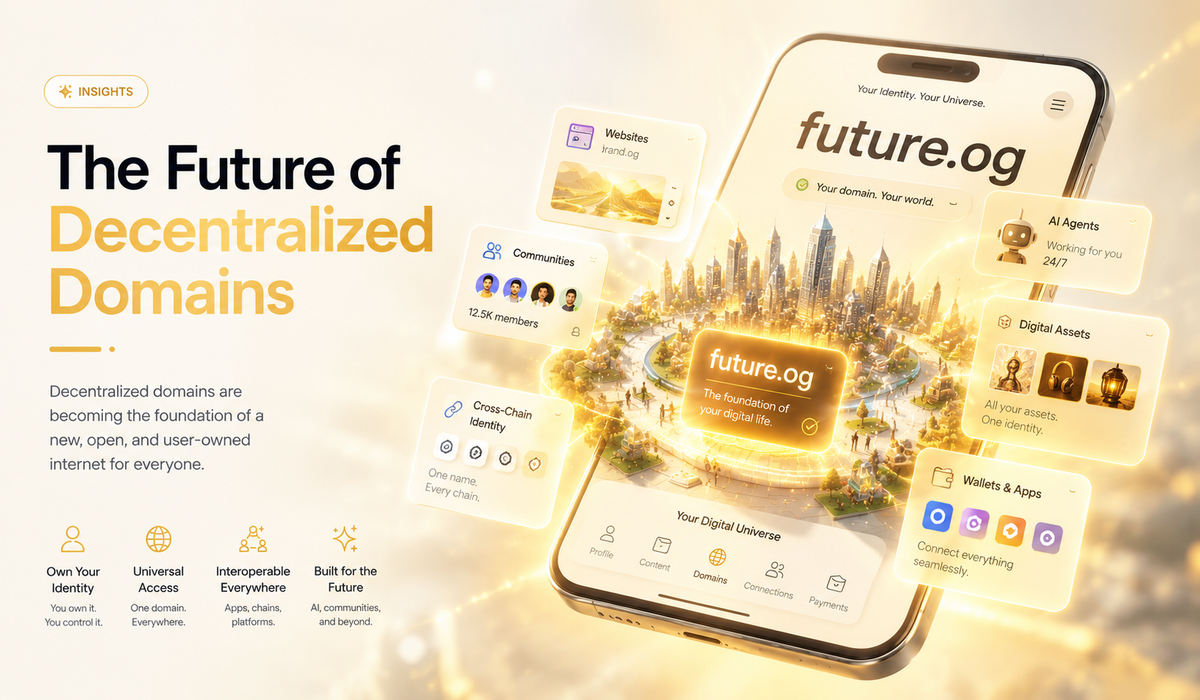
Decentralized Domains offer numerous advantages when compared to conventional and centralized domains.

Here's a situation most people have run into at least once: you finally land on the perfect domain name for your business or project, head over to a registrar to register it, and find out it's already taken. Or worse, it's being held by a squatter who wants ten times what it's worth. The traditional domain system, for all its familiarity, has always had these kinds of frustrating limitations baked in.
But there's a bigger problem underneath the surface-level annoyances. Traditional domains are controlled by centralized registrars, which means a corporation or a government can pressure those registrars to take your domain down. Your online presence, in the traditional web, is never fully yours. You're always operating at someone else's discretion.
Decentralized domains exist to change that and they're gaining serious momentum. Here's what you need to know.
How We Got Here: A Brief History of Decentralized Domains
Decentralized domains didn't appear out of nowhere. They're the product of nearly a decade of experimentation, iteration, and growing demand for an alternative to the centralized domain name system.
It started in 2014 with Namecoin a cryptocurrency that doubled as the first blockchain-based naming system, allowing users to register and control domain names without a central authority. A year later, BitDNS built a decentralized DNS system on top of the Bitcoin blockchain, adding data immutability and censorship resilience to the mix.
The real breakthrough came in 2017, when the Ethereum Name Service (ENS) launched on the Ethereum blockchain. ENS allowed users to register human-readable domain names like apple.eth that mapped directly to Ethereum wallet addresses and decentralized services. It was intuitive, practical, and built on the most widely used smart contract platform in the world. ENS quickly became the most popular decentralized domain system, and it remains the gold standard today.
Since 2018, the space has expanded significantly. New protocols like Handshake, Unstoppable Domains, and Skycoin have entered the picture, each offering their own capabilities and approaches. Cross-chain projects like Polkadot and Chainlink are working toward seamless communication between domains on different blockchains. Registration numbers have grown steadily across multiple protocols. The ecosystem is still maturing, but the trajectory is unmistakably upward.
Why Decentralized Domains? The Core Case
Before getting into the technical details, it's worth stepping back and asking the fundamental question: why does any of this matter? What's actually broken about the current system?
Quite a bit, as it turns out.
You don't really own your traditional domain.
When you register a .com, you're licensing it from a registrar, under rules set by ICANN, subject to legal pressures from governments and corporations. If a registrar decides to suspend your domain, or a government orders them to, your website disappears. You have limited recourse and no true ownership.
Traditional domains expose your personal data.
Register a conventional domain and your name, address, and contact information end up in the WHOIS directory a publicly accessible database that's been the source of countless data breaches, phishing attacks, and targeted harassment campaigns. Privacy protection services exist, but they're an extra cost and still managed by a third party.
Centralized systems are single points of failure.
If a registrar's servers go down, get hacked, or experience an outage, your domain goes with them. The centralized nature of traditional DNS infrastructure creates vulnerabilities that are inherent to the model not bugs that can be fixed with a patch.
Decentralized domains address all three of these problems at the architecture level.
Five Reasons to Take Decentralized Domains Seriously
1. Genuine censorship resistance.
In a decentralized domain system, there is no central authority to pressure. No registrar to call. No single point of control that a government or corporation can leverage to take your domain offline. Your domain exists on a distributed network of nodes, and as long as that network operates, your domain operates with it.
2. Stronger security by design.
Centralized servers are targets. A sufficiently motivated attacker can go after a traditional registrar's infrastructure and cause real damage. Decentralized domains distribute that attack surface across an entire network, making it exponentially harder to compromise any individual domain. There's no central database to breach.
3. Real privacy.
When you register a decentralized domain, your personal information isn't logged in any public directory. There's no WHOIS equivalent exposing your details to anyone with an internet connection. For individuals and businesses handling sensitive information or simply for anyone who values their privacy online this is a meaningful structural advantage.
4. True ownership.
With a decentralized domain, the domain lives in your crypto wallet. Nobody can revoke it, suspend it, or transfer it without your authorization. You're not renting from a registrar you own a digital asset, the same way you own cryptocurrency. That's a fundamentally different relationship with your online presence.
5. Native integration with the blockchain ecosystem.
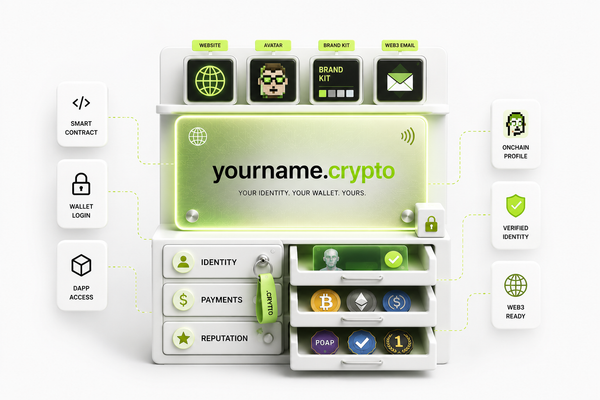
Decentralized domains aren't just addresses they're infrastructure. They can be linked to smart contracts, decentralized applications (dApps), DeFi platforms, NFT collections, and cryptocurrency payment systems. A .eth domain, for example, can serve simultaneously as your website address, your wallet address, your decentralized identity, and your entry point into blockchain-based services all under one human-readable name.
Understanding the Different Flavors of Decentralization
One thing that surprises people new to this space is that "decentralized" isn't a single thing. Blockchain systems can be decentralized in different ways, and understanding those distinctions helps you evaluate any given project more clearly.
Business decentralization
replaces centralized processors with smart contracts, allowing parties to transact directly with each other. Assets and data live in shared databases accessible to all participants rather than controlled by a single authority.
Physical decentralization
distributes blockchain servers geographically across the world, with enough redundancy that no single location going offline can take down the network. The goal is global digital infrastructure that no single entity owns.
Transactional decentralization
enables B2B networks to operate more efficiently, securely, and transparently. Business-to-business blockchain applications are already playing a critical role in establishing value chains across complex industries.
Architectural decentralization
refers to how many systems make up a blockchain network. More nodes means more decentralization and a higher tolerance for individual system failures without network disruption.
Political decentralization
focuses on how many individuals or organizations control the network's systems. A blockchain might run across many servers but still be controlled by one organization in which case it's architecturally distributed but politically centralized. Bitcoin is the classic example of genuine political decentralization.
Logical decentralization
describes how a blockchain's data structures and interfaces operate. Bitcoin, despite being politically and architecturally decentralized, functions as a single cohesive network which means it isn't logically decentralized. This distinction matters most for developers building applications on top of blockchain infrastructure.
The Bigger Vision: Decentralized Identity
Here's where things get genuinely exciting and where the potential of decentralized domains extends well beyond just replacing your .com.
We're in the early stages of a shift toward decentralized digital identity. The current model where you hand over your personal information to Facebook, Google, or some other platform every time you want to log in to a new service is increasingly being recognized for what it is: a privacy nightmare dressed up as convenience.
Decentralized identity flips that model. Instead of your identity living on someone else's servers, it lives in your own digital wallet. You control what you share, with whom, and for how long. You verify once and use that verification anywhere, rather than going through the same KYC process over and over with every new platform.
Decentralized domains are the anchor point for all of this.
Your domain as your identity.
Imagine your .eth or .sol domain functioning as your unique, self-sovereign identity across all of Web3. You connect credentials, attestations, and verifications directly to your domain, then use it to access dApps and services without depending on any centralized platform as the middleman. Your domain becomes your passport to the decentralized web.
Reputation built on-chain.
Decentralized domains can accumulate a verifiable track record over time risk profiles, creditworthiness assessments, performance histories all tied to a single, permanent identity. DeFi platforms can use this data for automated risk assessment, customized lending rates, and dispute resolution. The result is a financial ecosystem where trust is built on evidence rather than institutional approval.
Fraud prevention through accountability.
One persistent problem in decentralized systems is the Sybil attack where a single bad actor creates hundreds of fake accounts to manipulate a network. Decentralized domains make this dramatically harder, because each domain represents a distinct, traceable identity. You can't mass-produce accountability.
Decentralized Domains in DeFi: Real Use Cases
The integration of decentralized domains with decentralized finance isn't theoretical it's already being built. Here's what it looks like in practice.
Collateralized lending.
Decentralized domains can function as collateral for crypto loans. Smart contracts can automatically evaluate a borrower's risk based on their on-chain reputation their transaction history, repayment record, and other verifiable behaviors tied to their domain and execute loans accordingly. No bank, no credit score agency, no human underwriter required.
Decentralized insurance.
DeFi platforms can use domain-based identities to bring transparency to risk assessment and streamline claims processes. When every participant has a verifiable, domain-linked identity, insurance becomes more accountable and less prone to the kind of fraud that plagues centralized systems.
DAO participation.
Decentralized Autonomous Organizations require a way to identify and verify their members without relying on centralized platforms. Decentralized domains provide that infrastructure giving members a secure, verifiable identity they can use to vote in governance processes, access member-only resources, and participate in community decision-making.
Decentralized KYC and AML.
This is one of the more nuanced applications, but it's important. Traditional Know-Your-Customer (KYC) and Anti-Money Laundering (AML) processes are fundamentally at odds with decentralization they require collecting and storing personal information in centralized databases, which is exactly what decentralized finance is trying to move away from.
Decentralized KYC solves this by allowing users to store verifiable credentials on the blockchain and selectively share minimum necessary information with platforms that require it without handing over a complete personal profile to a centralized entity. For DEXes and decentralized fundraising platforms, this opens the door to compliance without sacrificing the core principles of self-custody and user control.
Soulbound Tokens: Building Reputation That Can't Be Bought or Sold
One of the most interesting recent developments in decentralized identity is the concept of Soulbound Tokens, or SBTs. Unlike regular NFTs, SBTs are non-transferable they can't be sold, traded, or passed to someone else. They represent something genuine about who you are and what you've done.
Tied to a decentralized domain, SBTs create a dynamic, verifiable reputation system that has no equivalent in the traditional web.
In a DAO, members can earn SBTs for meaningful contributions showing up, doing the work, building something valuable. Those SBTs can then influence voting rights, access to special resources, or decision-making authority within the organization. It's a meritocracy built into the infrastructure, not just stated as a value.
In gaming, SBTs can represent in-game achievements, completed levels, or rare items linked to a player's domain creating portable reputations that carry across multiple virtual worlds and games. In DeFi, SBTs tied to responsible financial behavior on-time loan repayments, sound investment patterns can influence lending terms and governance participation, creating a more trust-based and inclusive financial ecosystem.
The common thread across all of these applications is that SBTs make reputation something you earn and carry, not something you perform and abandon when you move to a new platform.
The Challenges That Still Need Solving
It would be dishonest to talk about decentralized domains without acknowledging that the space still has significant work to do.
Interoperability is a real problem.
Different domain systems ENS, Handshake, Unstoppable Domains, and others often run on incompatible technology. Moving domains between platforms or sharing data across systems is harder than it should be. The lack of shared standards creates friction that slows adoption and frustrates users who want to work across ecosystems.
The user experience gap is still significant.
Setting up a decentralized domain, managing a crypto wallet, and navigating blockchain transactions all require a level of technical comfort that most internet users don't have yet. Better interfaces, clearer onboarding experiences, and more intuitive tooling are being developed but the gap between what's possible and what's accessible to the average user is still wide.
Adoption is growing but still niche.
Blockchain domain registrations have grown by 200% year over year a remarkable number that reflects genuine momentum. But compared to the 359 million traditional domains currently registered worldwide, decentralized domains are still a small fraction of overall internet infrastructure. Critical mass takes time.
None of these challenges are insurmountable. Standardization efforts, improved user education, and continued technological development are all actively addressing them. The question isn't whether decentralized domains will overcome these hurdles it's how quickly.
Final Thoughts
Decentralized domains represent something genuinely new in the history of the internet: an infrastructure layer that puts ownership, privacy, and control back in the hands of individuals rather than corporations and governments. The technology is real, the use cases are real, and the momentum is real.
The registration numbers are growing. The major players are taking notice GoDaddy's partnership with ENS being the most prominent recent example. And the broader vision of a decentralized web, where your identity and online presence are truly yours, is coming into focus more clearly every year.
We're still early. But early is exactly when it pays to pay attention. To know more About us Visit our website.