Play-to-Earn Games or Traditional Gaming Models: Who Wins in the Long Run?
As blockchain reshapes gaming, the industry faces a choice: stick with traditional, story-driven models or shift to Play-to-Earn, where players earn real-world rewards. This blog compares the two, weighing their pros and cons, to explore which model might define the future of gaming.

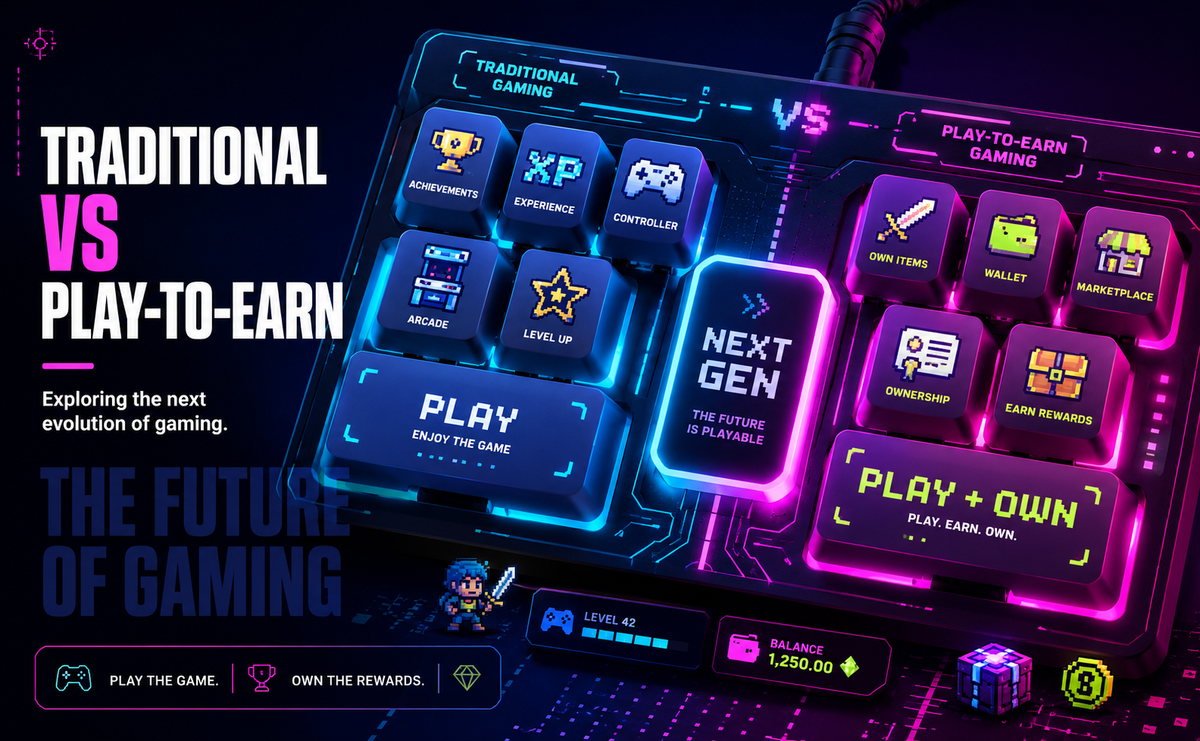
Gaming has come a long way from popping quarters into an arcade machine. Today, the industry is a multi-billion-dollar global powerhouse, and it's currently sitting at a crossroads. On one side, you have the traditional gaming model that's been refined over decades. On the other, you have a newer, bolder approach: Play-to-Earn (P2E), where logging hours in a game can actually put money in your pocket.
Neither model is perfect, and both have passionate supporters. But as blockchain technology continues to reshape how we think about ownership and value, the question of which model will define the future of gaming is more relevant than ever. Let's break it all down.
How Traditional Gaming Works
Pay-to-Play and Free-to-Play
Most people are already familiar with the two dominant formats in traditional gaming. In the Pay-to-Play (P2P) model, you pay upfront, usually somewhere between $40 and $70, for a major title, and in return, you get the full game. Blockbusters like Red Dead Redemption 2 and The Witcher 3 are textbook examples. You buy it, you own it, you play it.
Then there's Free-to-Play (F2P), where the game itself costs nothing but the developer monetizes through in-game purchases. Want a new skin for your character? That's $10. Want to skip the grind and unlock a weapon early? There's a bundle for that. Games like Fortnite and League of Legends have turned this model into an art form and a financial goldmine.
How They Make Money
Traditional gaming companies have more than one trick up their sleeve when it comes to revenue. Game sales provide an immediate, upfront source of income for pay-to-play titles. But beyond that, the industry has built out a robust ecosystem of ongoing revenue: microtransactions, expansion packs, season passes, and subscription services like Xbox Game Pass or PlayStation Plus all keep money flowing well after a game's launch. Mobile gaming has also pushed in-game advertising into the mainstream, turning free players into a monetizable audience even if they never spend a dime.
What Keeps Players Hooked
Traditional games are, at their core, entertainment products and the best ones are really, really good at what they do. Deep storylines, breathtaking graphics, competitive multiplayer modes, and the simple satisfaction of making progress keep players coming back for more. There's a reason franchises like Call of Duty and Assassin's Creed have been running for decades: they know how to build worlds people want to live in.
Engagement in traditional games is driven by narrative investment, the thrill of competition, and the dopamine hit of leveling up or unlocking new content. Community plays a huge role too from online forums to full-blown esports ecosystems, traditional gaming has mastered the art of turning players into fans.
How Play-to-Earn Gaming Works
Play-to-Earn flips the traditional model on its head. Instead of spending money on a game with no expectation of getting anything back, P2E players earn real-world value in the form of cryptocurrency or Non-Fungible Tokens (NFTs) simply by playing. It's a fundamental shift in the relationship between the player and the game.
The Role of Blockchain
Every P2E game is built on blockchain technology, and that's not just a technical detail it's the whole point. Blockchain gives P2E games three things that traditional games can't offer: transparency, security, and true decentralization.
In-game items in P2E games are represented as NFTs unique, verifiable digital assets that belong to the player, not the developer. A sword, a character skin, a piece of virtual land each one is a distinct asset recorded on a blockchain ledger that nobody can take away from you. Beyond that, most P2E games have their own native token economies, where in-game currency can be traded, sold, or converted into other cryptocurrencies. The result is a gaming ecosystem that functions more like a financial marketplace than a traditional entertainment product.
Games Leading the Way
Axie Infinity is probably the most famous P2E example to date. Players collect and battle creatures called Axies, earning cryptocurrency rewards as they play. At its peak, some players in developing countries were making more from Axie Infinity than from their day jobs a genuinely remarkable phenomenon.
The Sandbox takes a different approach, offering a virtual metaverse where players can buy, sell, and develop virtual real estate and assets using NFTs. It's part game, part digital economy and it's attracted major brands and investors who see it as a glimpse of the metaverse to come.
Monetization: Where the Money Actually Goes
Traditional Games
In Pay-to-Play, the financial relationship is straightforward: you pay once, you play. Any additional spending on DLC, expansions, or cosmetic items is optional. In Free-to-Play, the model inverts: the game is free, but the business is built on getting players to spend incrementally over time, often through carefully designed psychological nudges.
Subscription services like Xbox Game Pass have added another layer to this, giving players access to large game libraries for a flat monthly fee a model increasingly popular with both consumers and developers.
P2E Games
The revenue structure in P2E is fundamentally different. Players earn NFTs and tokens through gameplay, which they can then trade or sell on open marketplaces. Developers typically take a small cut of every transaction that happens on their platform so the more active the player economy, the more the developers earn. It's a symbiotic relationship, at least in theory.
The catch? To participate in most P2E games, you often need to invest upfront buying the NFTs or tokens required to start playing. In Axie Infinity, for example, players historically needed to purchase a team of three Axies before they could earn anything, sometimes at a cost of hundreds of dollars. That initial barrier has been one of the most significant criticisms of the P2E model.
Player Engagement and Ownership
What Drives Engagement in Traditional Games
In traditional gaming, engagement is earned the old-fashioned way: by making a game that's genuinely fun to play. Compelling characters, rich storylines, satisfying progression mechanics, and competitive multiplayer modes are the tools developers use to keep players logging in. The emotional investment players develop in a game's universe its lore, its community, its competitive scene is what turns a good game into a lasting franchise.
Esports has amplified this significantly. Games like League of Legends and Counter-Strike: Global Offensive have developed professional leagues, massive prize pools, and fanbases that rival traditional sports. That kind of ecosystem doesn't happen by accident it's the result of years of community building and gameplay refinement.
What Drives Engagement in P2E Games
P2E games add a layer that traditional games simply can't match: the potential to earn real money. That financial incentive is a powerful motivator, and for many players particularly in countries where the local economy makes even modest crypto earnings meaningful it's transformative.
But P2E engagement is also more fragile. When the financial rewards are strong, players show up in droves. When token values drop or the in-game economy becomes unbalanced, player retention can fall off a cliff. The challenge for P2E developers is building games that are compelling enough to keep players engaged even when the earnings aren't spectacular.
Who Actually Owns What
This is where P2E makes its most compelling argument. In traditional gaming, you don't really own anything. The sword you spent 20 hours grinding to unlock? It lives on a company's server. If that company shuts the game down, it's gone. You can't sell it, trade it, or take it anywhere.
P2E games change this equation entirely. Your NFTs are stored on a decentralized blockchain meaning no single company controls them. You can sell them, trade them across platforms, or hold onto them as investments. And if the game ever shuts down, your assets don't disappear with it. For players who've spent significant time and money building up their in-game portfolio, that distinction matters enormously.
Who Can Actually Play?
The Cost of Getting Into Traditional Gaming
Traditional gaming isn't as accessible as it might seem. A new AAA title costs $60–$70. A current-gen console will run you $400–$500. A gaming PC capable of running modern titles can easily exceed $1,000. For players in lower-income households or developing markets, those costs add up fast.
Free-to-play titles lower the floor considerably, but they often compensate by pushing players toward in-app purchases. The game might be free, but staying competitive sometimes isn't.
The Challenge of Getting Into P2E
P2E games have their own accessibility problem and in some ways, it's worse. The requirement to purchase NFTs or tokens just to start playing creates a financial barrier that's unique to this model. In Axie Infinity's early days, buying a competitive team of Axies could cost several hundred dollars. That effectively shut out the very demographic players in developing countries who had the most to gain from the earning potential.
On top of the cost, there's a knowledge barrier. Understanding crypto wallets, blockchain transactions, and token economics isn't intuitive for most people. Until P2E games can onboard new players with the same ease as downloading an app from the App Store, mainstream adoption will remain an uphill battle.
Can These Models Last?
The Traditional Model's Track Record
Traditional gaming has earned its durability. Franchises like FIFA, Call of Duty, and Assassin's Creed have sustained player interest through annual releases and continuous content updates. Esports leagues have created long-term ecosystems around multiplayer titles. Subscription services have made game libraries more accessible than ever.
The model isn't perfect loot boxes have drawn regulatory scrutiny in multiple countries, with Belgium and the UK moving to classify certain randomized reward systems as gambling but the infrastructure is solid, the audience is massive, and the industry knows how to keep people coming back.
The P2E Model's Growing Pains
P2E games face a more precarious sustainability challenge. Token inflation is a real and recurring problem: when developers continuously issue new in-game currency without sufficient economic controls, token values drop, and with them, the incentive to play. Axie Infinity itself experienced this firsthand, watching its token value plummet after early explosive growth.
Balancing the economy so that both early adopters and newcomers can benefit is genuinely difficult. And if the gameplay itself isn't engaging enough to hold players when the financial rewards are thin, the whole ecosystem can unravel quickly. The P2E games that will succeed long-term are the ones that manage to be great games first and financial platforms second.
The Road Ahead
Traditional Games Going Blockchain
The most interesting development on the horizon isn't the battle between these two models it's their convergence. Traditional gaming studios are already exploring ways to integrate blockchain elements: NFT-based cosmetics, token rewards for competitive play, and cross-platform asset trading. If a major AAA developer can take the depth and polish of a traditional game and layer in real player ownership, that could be the best of both worlds.
Web3 infrastructure including decentralized domains and cross-game asset compatibility could eventually make it possible for a weapon you earn in one game to be used (or sold) in another. That kind of interoperability would be a game-changer, quite literally.
P2E Growing Up
For P2E to go mainstream, it needs to stop leading with the earnings pitch and start leading with the gameplay. Casual gamers and mainstream audiences aren't going to be won over by token economics they're going to be won over by fun, accessible, visually compelling experiences that happen to reward them financially on the side.
The infrastructure is improving. Onboarding is getting easier. And as Web3 technology matures, the technical friction that currently makes P2E intimidating for newcomers will continue to decrease. The P2E games that crack the code on genuine entertainment value not just financial incentive will be the ones that shape the next era of gaming.
Final Thoughts
Traditional gaming and Play-to-Earn gaming aren't really enemies they're two different answers to the question of what players want from their games. Traditional gaming has decades of refinement behind it and a proven ability to build deep, lasting player engagement. P2E offers something genuinely new: the idea that the time you invest in a game can have real-world value, and that the assets you earn actually belong to you.
The future probably doesn't belong entirely to either model. It belongs to the developers who are smart enough to take the best of both the storytelling and engagement of traditional games, combined with the ownership and economic opportunity of P2E and build something that neither camp has fully cracked yet.
That's the game worth watching