GoDaddy and ENS Partnership Explained
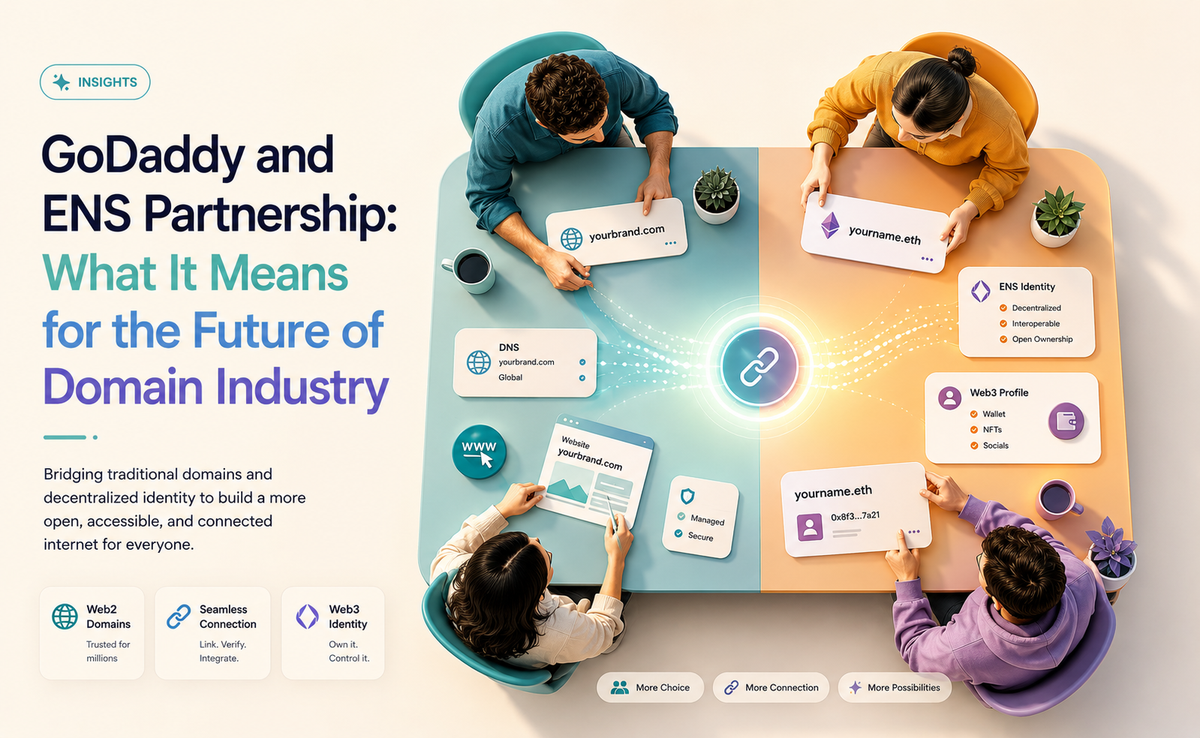
GoDaddy recently announced a partnership with ENS to allow users to register .eth domains directly from GoDaddy.

For decades, GoDaddy has been the name most people think of when they think of domain registration. Millions of businesses, creators, and individuals have walked through GoDaddy's front door to claim their corner of the internet, a .com here and a .net there, and that was pretty much the whole story.
But the internet is changing, and GoDaddy knows it.
In a move that's turning heads across both the traditional web and the blockchain space, GoDaddy recently announced a formal partnership with the Ethereum Name Service (ENS) making it the first major domain registrar to support .eth domain registration directly through its platform. For anyone paying attention to where the internet is heading, this is a significant moment. It's not just a product feature. It's a signal that the wall between Web2 and Web3 is starting to come down.
A Quick Recap: What Is ENS?
The Ethereum Name Service launched in 2017 with a straightforward but powerful idea: give Ethereum wallet addresses human-readable names. Instead of sharing a string like 0x4bE6...f92 Every time someone needs to send you crypto, you share something like yourname.eth.
It sounds simple, but the implications run deep. ENS names aren't just wallet shortcuts they're decentralized identities. They can be linked to websites, social profiles, NFT collections, payment systems, and decentralized applications. They live on the Ethereum blockchain, which means no registrar can revoke them, no government can seize them, and no platform can pull the rug out from under you.
Since launch, ENS has grown to over 1.5 million registered names a number that reflects genuine demand, not speculative noise. And now, with GoDaddy bringing ENS registration directly into its platform for over 20 million users, that number is only going to climb.
Why This Partnership Matters
The domain industry is enormous. There are currently over 359 million domains registered worldwide, the vast majority of them traditional TLDs like .com, .net, and .org. The global domain market is projected to grow at a compound annual rate of 5.18% through 2031. For most of that growth, traditional registrars like GoDaddy have been the gatekeepers.
Web3 domains have been growing alongside traditional domains, but largely in a separate lane accessible mainly to crypto-native users comfortable navigating blockchain wallets and decentralized platforms. The GoDaddy-ENS partnership changes that dynamic. It brings .eth domain registration into an interface that tens of millions of people already use and trust, removing one of the biggest friction points holding Web3 adoption back: the complexity of getting started.
This isn't just good news for ENS. It's a proof of concept for the entire Web3 domain space. If GoDaddy is willing to build this bridge, other traditional players will follow. Expect to see similar partnerships from registrars working with Arbitrum (.arb), Tezos (.tez), Binance (.bnb), and other blockchain-based domain ecosystems in the not-too-distant future. The convergence of Web2 and Web3 infrastructure is no longer a hypothetical it's actively being built.
What This Means for Businesses
If you run a business online, the case for owning a .eth domain alongside your .com is becoming harder to ignore.
Start with brand protection. The .eth namespace is growing fast, and the most valuable names your brand, your product, your name are being registered right now. Waiting until Web3 goes fully mainstream to claim your identity means paying a premium for something you could have secured cheaply today. The businesses that moved early to .com domains in the 1990s understood this instinctively. The same logic applies here.
But it goes beyond protection. A .eth domain opens up genuine technical possibilities that traditional domains simply don't offer. ENS integration allows businesses to build crypto payment functionality directly into their websites, connect their domain to decentralized applications, link to NFT collections, and participate in DAO governance structures all under a single, human-readable identity. These aren't future features. Real businesses are already using them.
As Web3 progressively moves into the mainstream and the GoDaddy partnership is one more piece of evidence that it is having a .eth domain positions your business at the intersection of where your audience is heading. Getting there before the crowd is always the smarter move.
What This Means for Everyday Users
The partnership isn't just a business story. For regular internet users, it represents a meaningful step toward making Web3 actually usable.
Right now, one of the most frustrating parts of participating in the crypto economy is the wallet address problem. Long, complex addresses are intimidating for newcomers and error-prone even for experienced users. ENS names solve that but until now, setting one up required navigating an unfamiliar ecosystem from scratch.
With GoDaddy integration, a user who already manages their traditional domain through GoDaddy can link it to an ENS name without leaving the platform they already know. That kind of seamless bridge where you don't have to choose between the old internet and the new one is exactly what mainstream Web3 adoption requires.
In the longer term, the vision is even broader. Everyone with a domain name could eventually configure their crypto wallet to resolve to a human-readable .eth address, making wallet sharing as natural as sharing an email address. The GoDaddy-ENS partnership is a meaningful step toward that reality.
Why You Should Seriously Consider a .eth Domain
Let's be direct: if you have a brand, a business, or even just a personal online presence that you care about, there are strong reasons to secure a .eth domain sooner rather than later.
It reserves your identity in a fast-growing ecosystem.
ENS is already the dominant naming system on Ethereum, and Ethereum remains the most widely used blockchain for applications, DeFi, and NFTs. A .eth domain puts you inside that ecosystem with a name that's yours permanently.
It future-proofs your online presence.
Web3 isn't a trend that's going to reverse. Decentralized finance, NFTs, DAOs, and the broader shift toward user-owned internet infrastructure are gaining momentum. Owning a .eth domain means you're not scrambling to catch up when these technologies become standard you're already there.
It opens doors that traditional domains can't.
Payment integrations, decentralized identity, NFT linking, and smart contract interactions none of these are possible with a .com. A .eth domain turns your online identity into a functional piece of Web3 infrastructure.
The window for good names is closing.
Over 1.5 million .eth names have already been claimed. The short, memorable, brand-relevant names are going fast. Registering now, while the ecosystem is still maturing, gives you access to names that will be significantly more expensive or simply unavailable once adoption accelerates.
Endless Domains: A One-Stop Solution for Web3 Identity
As the Web3 domain space expands across multiple blockchains and naming systems, keeping track of where to register, what's available, and how to manage it all can get complicated fast. That's exactly the problem Endless Domains was built to solve.
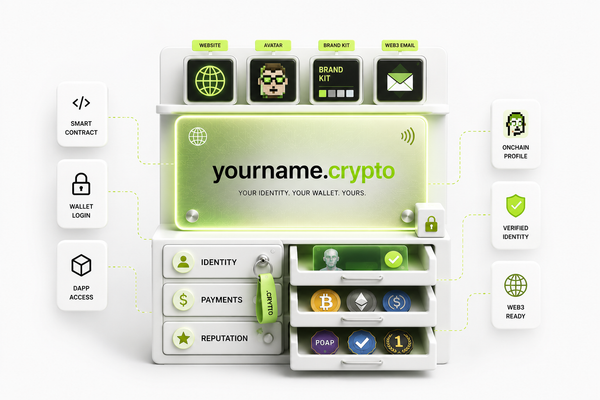
Endless Domains has established itself as a comprehensive marketplace for Web3 domain registration covering .eth and other major Web3 TLDs including .x, .crypto, and .nft, all in one place. Rather than navigating separate platforms for each blockchain ecosystem, users can search, register, and manage their Web3 domains through a single, unified interface.
Beyond basic registration, Endless Domains offers developer tools that go deeper. Their APIs are designed to simplify the process of linking ENS profiles to digital identities, social profiles, crypto wallets, and decentralized applications the kind of integration work that would otherwise require significant technical overhead. For developers building in the Web3 space, that kind of ready-made infrastructure is genuinely valuable.
As more traditional registrars follow GoDaddy's lead and the Web3 domain market matures, platforms like Endless Domains that offer cross-ecosystem coverage and developer-friendly tooling will become increasingly central to how people manage their decentralized presence.
What Comes Next
The GoDaddy-ENS partnership is the opening act, not the finale. It establishes a template that other players in both the traditional web and blockchain spaces will follow and follow quickly.
Expect to see Binance, Tezos, Arbitrum, and other blockchain networks pursue their own partnerships with Web2 domain companies. Expect traditional registrars beyond GoDaddy to add Web3 domain support as competitive pressure builds. Expect the tools for managing traditional and decentralized domains together to become significantly more sophisticated over the next few years.
The broader trajectory is clear: the internet is moving toward a model where decentralized and traditional infrastructure coexist and interoperate, rather than exist as separate, incompatible systems. Web3 domains are a foundational part of that future not a niche product for crypto enthusiasts, but a standard component of how anyone with an online presence manages their identity.
Final Thoughts
GoDaddy partnering with ENS is the kind of milestone that looks obvious in hindsight and significant in real time. It's the moment when a technology that's been developing at the edges of the mainstream gets a direct on-ramp for tens of millions of everyday users.
For businesses, it's a reminder to secure your Web3 identity before the window closes. For everyday users, it's an invitation to start exploring what the decentralized web can actually offer. And for anyone watching the broader arc of how the internet evolves, it's one more piece of evidence that Web3 isn't coming someday it's already here, and it's growing up fast.
The decentralized web has a long way to go before it's fully mainstream. But the infrastructure being built right now .eth domains, .sol domains, .polygon domains, .dao domains, and endless domains emerging across different blockchain ecosystems is laying the foundation for what comes next. The GoDaddy-ENS partnership just made that foundation a little more accessible to everyone.