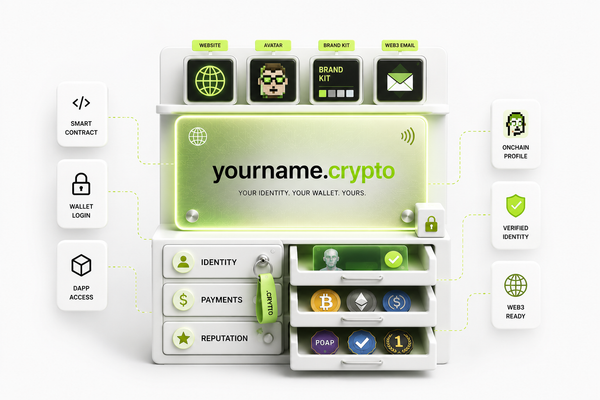
.HI Domains: A Game-Changer for Decentralized Finance (DeFi)
.hi domains: Your decentralized identity in DeFi. Own your digital presence, simplify transactions, and unlock new possibilities in the world of decentralized finance.

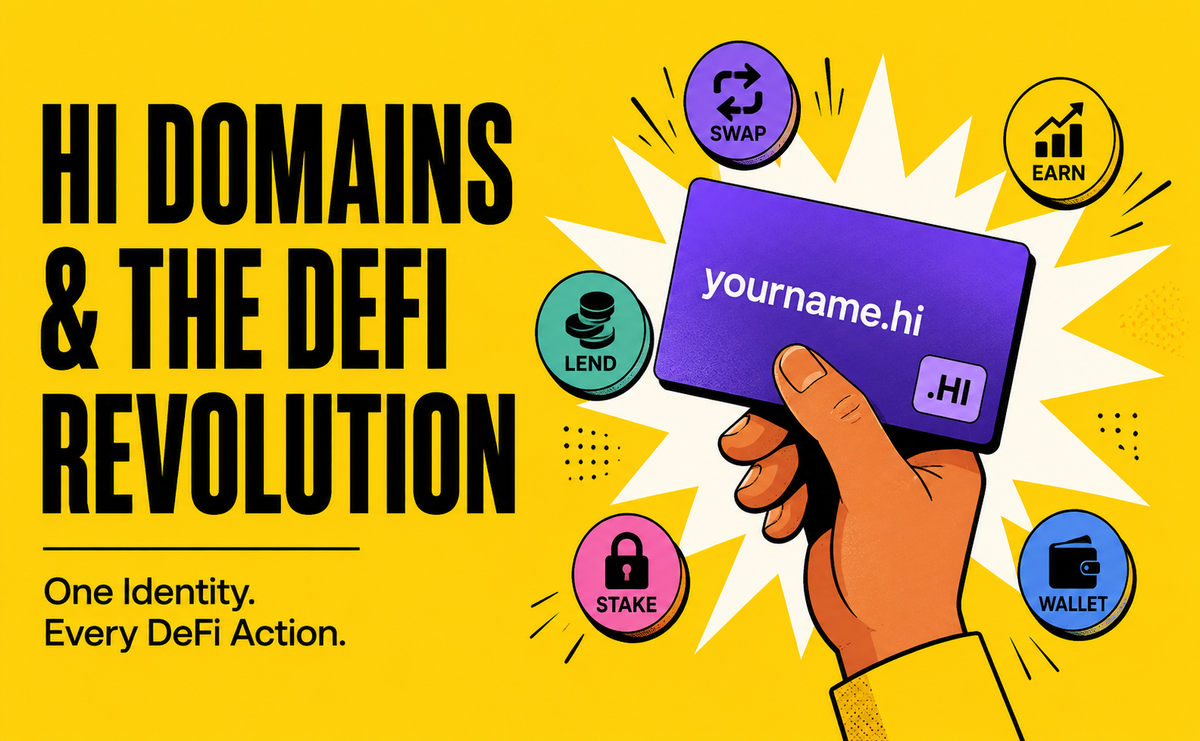
Ask anyone who's tried to use a DeFi platform for the first time what the experience was like, and you'll probably hear some version of the same story. The interface was confusing. The wallet address was a 42-character string of random characters that had to be copied perfectly or the funds would disappear forever. The whole thing felt less like financial innovation and more like a technical obstacle course.
That friction is one of the most underappreciated barriers to DeFi's growth. The underlying technology is genuinely powerful peer-to-peer lending, decentralized exchanges, yield farming, borderless transactions without a bank in the middle. But if the average person can't navigate it without fear of making an irreversible mistake, the promise of open, accessible finance stays out of reach for most people.
.hi domains are one of the more interesting attempts to close that gap. They're not a fix for every problem in DeFi no single innovation is but they address the user experience layer in a way that's worth understanding carefully. Here's the full picture.
What Is a .hi Domain?
A .hi domain is a blockchain-based digital identity tied to the hi platform. In practice, it functions similarly to other Web3 domains think .eth or .crypto but with a specific integration into the hi ecosystem that gives it some unique characteristics.
At its core, a .hi domain replaces a complex cryptocurrency wallet address with a human-readable name. Instead of sending funds to 0x4bF8c72e1a3d9F45b2CC8d7e4F1a5B63c9e2D718, you send them to yourname.hi. That's the fundamental value proposition, and it's a genuinely meaningful one.
But .hi domains do more than simplify wallet addresses. Because they're built on blockchain technology, they're owned outright by the user no annual renewal fees, no registrar that can revoke them, no central authority with the power to take them away. Once you have one, it's yours. You can use it to log into decentralized applications, connect it to social media profiles and online services, and manage your digital presence across the Web3 ecosystem under a single, consistent identity.
Think of it as your passport to the decentralized web one name that represents you across a growing range of platforms and applications.
The Real Problems in DeFi That .hi Domains Are Trying to Solve
Before understanding what .hi domains offer, it's worth being honest about how significant the problems in DeFi actually are. They're not just inconveniences they're fundamental barriers to adoption.
The User Experience Problem Is Severe
DeFi, for all its innovation, has a user experience problem that borders on hostile. Complex wallet addresses that can't be mistyped by even a single character. Multiple wallets needed for different protocols. Interfaces that assume a level of technical knowledge most people don't have. Seed phrases that, if lost, mean losing everything permanently.
This isn't a niche complaint from casual users it's a consistent theme among researchers, industry observers, and DeFi participants themselves. The learning curve is steep, and the consequences of mistakes are permanent. That combination keeps millions of potential users on the sidelines.
Security Risks Are Real and Ongoing
Smart contract vulnerabilities have cost the DeFi ecosystem hundreds of millions of dollars in exploits. Phishing attacks exploit the opacity of wallet addresses when everything is a random string of characters, it's genuinely difficult to spot a fraudulent address before it's too late. The decentralized nature of DeFi, while philosophically important, also makes coordinated security responses slower and more complicated than in traditional financial systems.
Interoperability Is Still Broken
The DeFi ecosystem is fragmented. Different protocols, different interfaces, different wallet requirements. Moving assets across platforms requires navigating multiple systems with minimal standardization. The result is a user experience that feels piecemeal rather than cohesive and it limits DeFi's potential to function as a unified financial system rather than a collection of disconnected applications.
Regulatory Uncertainty Is Holding Back Institutional Money
Institutional investors the kind of capital that could dramatically accelerate DeFi's growth have largely stayed on the sidelines, partly because the regulatory environment is unclear. Without consistent identity and accountability frameworks, compliance is difficult, and large-scale financial institutions can't participate without it.
How .hi Domains Address These Problems
Replacing Wallet Addresses With Human-Readable Names
This is the most immediate and tangible benefit. When you own yourname.hi, you can give that name to anyone who wants to send you cryptocurrency instead of a 42-character hex string. The chance of input error drops dramatically. The risk of sending funds to the wrong address because of a mistyped character essentially disappears.
For new DeFi users, this is significant. One of the most anxiety-inducing parts of using crypto for the first time is the fear of making an irreversible mistake with a wallet address. .hi domains remove that specific fear entirely.
A Unified Identity Across DeFi Platforms
One of the quieter but more powerful uses of .hi domains is as a cross-platform identifier. Rather than maintaining separate accounts and wallet addresses on every DeFi protocol you use, your .hi domain can serve as a consistent identity that follows you across platforms. This doesn't fully solve the interoperability problem different platforms still use different underlying technology but it creates a coherent identity layer on top of the fragmented infrastructure that exists today.
For developers building DeFi applications, supporting .hi domains as a login and payment identifier means offering users a dramatically simpler experience from the moment they arrive.
Reducing Phishing Risk Through Recognizable Addresses
Phishing attacks in crypto work partly because wallet addresses are indistinguishable from each other to human eyes. When you're sending to 0x4bF8c72e… versus 0x4bF8c83e…, spotting the difference requires character-by-character comparison that most users don't do.
With .hi domains, the identity is human-readable and therefore much easier to verify. Sending to john.hi is obviously different from sending to j0hn.hi the kind of distinction a person can catch at a glance. It doesn't eliminate phishing entirely, but it makes the attack significantly harder to execute convincingly.
Enhanced Privacy Without Sacrificing Usability
One of the underappreciated advantages of using a domain name instead of a raw wallet address is that it reduces the exposure of your financial information. When you share your .hi domain publicly, you're sharing a name not a wallet address that can be used to trace your entire transaction history on a blockchain explorer. The domain handles the translation behind the scenes, and users can control what gets linked to it and what remains private.
A Path Toward Decentralized Identity Verification
As .hi domains become more established, they open the door to integrating with identity verification systems a capability that could address one of DeFi's most persistent regulatory challenges. When users can voluntarily link verified identity information to their .hi domain and share it selectively with platforms that require it, it creates a compliance pathway that doesn't require surrendering the decentralization principles that make DeFi valuable in the first place.
How to Get a .hi Domain
There are two main routes to owning a .hi domain, and the process for both is relatively straightforward.
Claiming a Free .hi Domain
If you're already on the hi platform, you may be eligible to claim a .hi domain at no cost. The process involves downloading the hi app, creating or logging into your account, completing identity verification per the platform's guidelines, setting up your hi nickname, and then checking whether your desired .hi domain is available. If it is, you can claim it directly.
Purchasing a Premium .hi Domain
For domains that aren't available through the free claim process typically shorter, more memorable, or commercially appealing names you can purchase them directly through the hi app. Navigate to the .hi domains section, browse availability and pricing, select your preferred domain, and complete the purchase using supported cryptocurrencies.
A few things to keep in mind before you buy:
- Check availability first. Popular or common names get claimed quickly. Have a few backup options in mind before you start.
- Think about length and memorability. Shorter domains are generally more valuable and easier to share, but the right balance depends on your use case. A personal identity domain is different from one you're acquiring as an investment.
- Choose something relevant. Your .hi domain is a representation of your identity in the Web3 ecosystem. Whether it's your name, your brand, or a project you're building, it should reflect how you want to be recognized.
- Secure it properly. Understand how to manage your domain after purchase connecting wallets, protecting against unauthorized access, and keeping your credentials secure. The same private key responsibility that applies to crypto wallets applies here.
The Benefits, Summarized
It's worth being concrete about what owning a .hi domain actually gives you:
True ownership No annual fees, no registrar that can take it from you, no central authority with override power. It's on the blockchain, and it's yours.
Simplified crypto transactions Send and receive cryptocurrency using a readable name instead of a wallet address, eliminating one of the most error-prone parts of the current experience.
Consolidated digital identity One name that works across dApps, platforms, and services, rather than managing separate identities everywhere.
Better privacy Sharing a domain name exposes less financial information than sharing a raw wallet address.
Potential investment value As DeFi adoption grows and demand for memorable .hi domains increases, early-acquired domains could appreciate in value. This is speculative, but it's not an unreasonable expectation given how domain markets have historically worked.
Support for a more open internet By using and owning a decentralized domain, you're actively contributing to the infrastructure of a more user-owned web.
The Honest Challenges
It would be misleading to write about .hi domains without acknowledging the real obstacles they face. The potential is genuine, but so are the hurdles.
Established competition is significant. .com, .net, and .io have decades of brand recognition and user trust. .eth has a head start in the Web3 domain space. For .hi to carve out meaningful market share, it needs to offer value propositions that go beyond just being a Web3 domain and its integration with the hi platform ecosystem is the most compelling version of that argument.
User education is a genuine challenge. Most people who might benefit from .hi domains have never heard of Web3 domain names. Explaining not just what they are but why they're better than what people currently use requires sustained, accessible communication not technical documentation that only insiders will read.
Platform integration needs to be seamless. A .hi domain is only as useful as the platforms that support it. If users have to jump through hoops to use their .hi domain on popular DeFi protocols switching between apps, manually converting, or navigating workarounds the convenience advantage disappears. Deep, frictionless integration with major DeFi platforms is essential, not optional.
Security requires constant vigilance. Blockchain-based domains are more secure than traditional domains in important ways, but they're not immune to threats. Phishing schemes targeting .hi domain users, domain hijacking attempts, and social engineering attacks are real risks. The platform's commitment to security infrastructure and user education around safe practices will determine how well these risks are managed.
Regulatory clarity is still evolving. The rules governing blockchain-based digital assets, identity systems, and decentralized platforms are still being written in most jurisdictions. Uncertainty creates hesitation for both users and the businesses that might otherwise integrate .hi domains more aggressively.
Final Thoughts
DeFi's long-term success depends on solving the user experience problem. The technology works. The financial models are innovative. The potential for a more open, accessible financial system is real. But if using it requires technical confidence that most people don't have, and if mistakes are permanent and unrecoverable, the ecosystem will stay concentrated among early adopters and tech-savvy participants rather than reaching the broader population.
.hi domains are part of the answer to that problem. They're not the whole answer the DeFi stack needs improvement at multiple levels but they address the identity and usability layer in a way that makes a concrete difference for real users. Human-readable addresses, unified identity across platforms, reduced phishing risk, better privacy controls these aren't marginal improvements. They're the kind of changes that make the difference between a technology that feels accessible and one that doesn't.
As DeFi matures and the infrastructure around it improves, the role of human-readable identity systems like .hi domains will only become more central to the experience. The question isn't whether this kind of solution is needed it clearly is. The question is which implementations earn user trust and platform support over time.
.hi domains are a credible contender for that role. Whether they reach their full potential will depend on how well the platform navigates competition, drives integrations, and educates the users who would benefit most from what they offer.