How to Get Started with a Decentralized Domain?
Web3 is a term synonymous with the next generation of Internet technologies. As we delve into its realm, one of the most significant innovations we encounter is the decentralized domain, particularly those managed by Web3 domain registrars.

There's a good chance you've come across the term "Web3 domain" recently and wondered what exactly makes it different from the domain name you already have or could easily get from GoDaddy in about five minutes.
The short answer: quite a lot, actually.
Decentralized domains aren't just a rebranding of the same old system. They represent a fundamentally different model of digital ownership one where you hold the domain outright instead of renting it, where no single authority can take it from you, and where your domain does things a .com simply can't.
This guide covers what decentralized domains are, why they matter, and most importantly exactly how to register one, step by step.
What Is a Decentralized Domain?
A decentralized domain is a domain name that lives on a blockchain instead of the traditional Domain Name System (DNS). Traditional domains your .com, .net, .org addresses are managed by ICANN, a nonprofit organization that oversees the global domain name infrastructure. Underneath ICANN sits a hierarchy of registrars, DNS operators, and hosting providers, all of whom exert some level of control over your domain.
That centralized structure has real consequences. A registrar can suspend your domain for violating their terms of service. A government can order a takedown. A hosting provider can pull your content. You might technically "own" your domain name in a practical sense, but legally and structurally, you're a tenant paying annual rent to keep a name that someone else ultimately controls.
Decentralized domains break that model. When you register a decentralized domain, the record is written to a blockchain a distributed ledger maintained across thousands of independent nodes. That record is public, transparent, and cryptographically secured. No single company, government, or organization can alter it, revoke it, or take it from you without access to your private key.
Ownership is represented by an NFT (Non-Fungible Token) stored in your crypto wallet. Think of it like a title deed for your domain verifiable, transferable, and entirely in your hands.
Common decentralized domain extensions include .eth, .crypto, .nft, .wallet, .sol, and .bitcoin, with more emerging regularly as the ecosystem grows.
Why Does Any of This Matter?
If the traditional domain system mostly works fine for most people most of the time, why go through the effort of switching to something new?
Fair question. Here's why it matters:
You Actually Own It
Not rent it own it. Most decentralized domains are a one-time purchase with no annual renewal fees. Once it's in your wallet, it's yours indefinitely. No missed payment can cost you a domain you've spent years building a brand around.
No One Can Censor or Seize It
Because there's no central authority controlling your domain, there's no single pressure point for a government or corporation to target. This is especially significant for journalists, activists, NGOs, and anyone operating in environments where online censorship is a real threat.
It Doubles as a Crypto Wallet Address
This is one of the most immediately practical features. Instead of sharing a wallet address like 0x7f3A9B2e5cD8f... every time someone needs to send you cryptocurrency, you can simply use yourname.eth. It's readable, memorable, and nearly impossible to mistype which matters a lot when a typo in a wallet address means funds are gone forever.
It's the Foundation of Your Web3 Identity
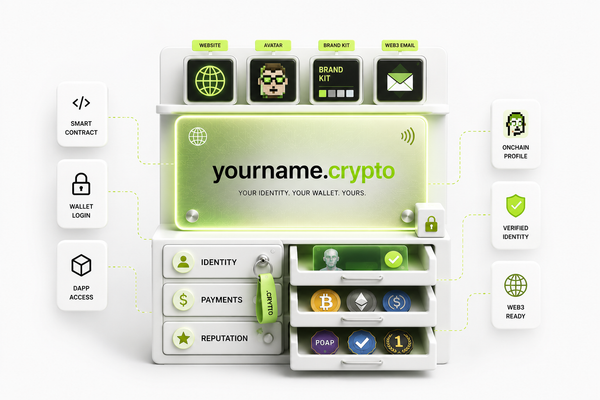
A decentralized domain can anchor your entire digital presence connecting to your crypto wallets, NFT collection, DeFi profile, blockchain gaming identity, and decentralized social media from a single readable name.
Privacy by Design
Traditional domain registration typically requires you to submit personal contact information, which goes into the WHOIS database. While WHOIS privacy protection exists, it's an add-on feature. Many Web3 domain registrars are built with privacy as the default your registration record on the blockchain contains no personally identifying information beyond your wallet address.
The Three Technologies Underneath It All
Before you register a decentralized domain, it helps to understand the three foundational pieces that make them work.
Blockchain
This is the distributed ledger that stores your domain registration. When you register a domain, a transaction is recorded across thousands of independent nodes simultaneously. That record is immutable meaning it can't be altered after the fact and public, meaning anyone can verify ownership at any time. The specific blockchain your domain lives on (Ethereum, Polygon, Solana, etc.) affects your transaction costs, confirmation speed, and which wallets and apps support it.
NFTs
Your domain is issued as a Non-Fungible Token, which is how ownership is represented on the blockchain. That NFT lives in your crypto wallet and can be transferred, sold, or traded like any other digital asset. It's your proof of ownership the blockchain equivalent of a title deed.
Cryptocurrency
Because these domains exist on blockchain networks, you pay for them using cryptocurrency rather than a credit card. The specific currency you need depends on the blockchain your registrar operates on ETH for Ethereum-based registrars, MATIC for Polygon-based ones, SOL for Solana, and so on. You'll also need to account for gas fees small transaction costs paid to the network for processing your registration.
Step-by-Step: How to Register a Decentralized Domain
Step 1: Choose a Registrar
Your first decision is which platform to register through. Different registrars operate on different blockchains and offer different domain extensions. Here are the most established options:
Ethereum Name Service (ENS) is the oldest and most widely supported decentralized domain system. It specializes in .eth domains and is deeply integrated with the Ethereum ecosystem which means your ENS domain works natively with MetaMask, most major wallets, and a huge range of dApps. If you're primarily operating in the Ethereum ecosystem, ENS is the natural starting point.
Unstoppable Domains offers a broader range of extensions .crypto, .nft, .wallet, .blockchain, .x, and more. It operates on Polygon, which means lower transaction costs than Ethereum. Unstoppable Domains also emphasizes user-friendliness and has built significant compatibility with wallets, browsers, and applications. It's a strong option for users who want variety or who are more cost-conscious about gas fees.
Endless Domains is a newer but growing platform that supports multi-chain domains and integrates with 20+ decentralized applications and protocols. It's worth exploring if you want a platform with a clean user experience and broad ecosystem integration from the start.
Bonfida is the go-to for .sol domains within the Solana ecosystem faster and cheaper transactions, but less universally supported outside of Solana-native applications.
Bottom line: If you're new to Web3, Unstoppable Domains or ENS are the most beginner-friendly starting points with the most ecosystem support. If you're already embedded in a specific blockchain ecosystem, choose the registrar that lives there.
Step 2: Set Up a Crypto Wallet
You can't register a decentralized domain without a crypto wallet it's where your domain NFT will live and where you'll pay for the transaction.
If you don't already have one, here's how to get started:
MetaMask is the most widely used Ethereum-compatible wallet and works with most major Web3 registrars. It's available as a browser extension for Chrome, Firefox, Brave, and Edge, as well as a mobile app for iOS and Android.
Phantom is the equivalent of Solana if you're registering a .sol domain through Bonfida, Phantom is the standard choice.
Coinbase Wallet is another solid option that's beginner-friendly and supports multiple blockchains.
When you set up your wallet:
- Download the official app or extension only from the official website fake wallet apps are a common scam vector.
- Write down your seed phrase (also called a recovery phrase) and store it somewhere physically secure, offline not in a screenshot, not in a cloud document.
- Enable any available two-factor authentication.
- Never share your seed phrase or private key with anyone, ever, under any circumstances no legitimate platform will ever ask for it.
Your seed phrase is the master key to your wallet. Anyone who has it has full control of everything inside. Treat it like the combination to a safe.
Step 3: Fund Your Wallet
Before you can register a domain, you need cryptocurrency in your wallet to pay for it.
You can purchase crypto through exchanges like Coinbase, Kraken, or Binance and transfer it to your wallet. For most registrations, you'll need:
- The purchase price of the domain (varies widely common names might be $5–$20; premium names can cost much more)
- Gas fees to cover the blockchain transaction cost (these fluctuate based on network demand Ethereum gas fees can be significant during busy periods, while Polygon and Solana fees are typically much lower)
One practical tip: always keep a small buffer of extra crypto in your wallet beyond the exact purchase price. Gas fees can be higher than expected, and a failed transaction due to insufficient funds can still cost you a small fee.
Step 4: Search for Your Domain Name
Head to your chosen registrar's website and use their search tool to check whether your desired domain name is available. Type in the name you want with or without the extension and the platform will tell you instantly whether it's taken.
A few things to keep in mind when choosing a name:
Keep it short and memorable. Shorter names are easier to share verbally, harder to mistype, and generally more valuable if you ever want to sell. If you wouldn't be comfortable saying it out loud to someone, it's probably too long.
Make it relevant. Your domain should connect naturally to your identity, your brand, or your primary use case. alex.eth is more useful as an identity anchor than alex-personal-crypto-wallet-2024.eth.
Think long-term. Your domain can outlast any single platform or project. Choose something versatile enough to grow with you.
Have backups ready. Popular names get registered quickly. Go in with two or three alternatives in mind so you're not starting from scratch if your first choice is taken.
Avoid trademark conflicts. Registering a well-known brand name as a blockchain domain might seem clever, but it creates real legal exposure. As trademark law catches up to blockchain domains, owning nike.crypto without Nike's authorization is the kind of thing that could get expensive fast.
Step 5: Complete Registration and Pay
Once you've found an available name, follow the registrar's checkout process. You'll connect your wallet to the platform, confirm the domain details, and approve the blockchain transaction.
Before you confirm:
- Double-check that the domain name is exactly what you want spelling, extension, everything
- Confirm the total cost, including gas fees
- Make sure the wallet you're paying from is the one you want to hold the domain
Once you click confirm and approve the transaction in your wallet, the process is irreversible. Blockchain transactions cannot be undone, refunded, or reversed. Take the extra thirty seconds to verify everything before hitting that button.
Depending on network traffic, the transaction may confirm in seconds or take a few minutes. You'll receive a notification in your wallet when it's complete.
Step 6: Verify Ownership
After the transaction confirms, check your wallet to verify that the domain NFT has arrived. You should also be able to see it in your registrar account dashboard under your registered domains.
This is your proof of ownership. The blockchain record is public anyone can verify that your wallet address controls that domain by looking it up on a blockchain explorer like Etherscan (for Ethereum-based domains) or the equivalent for your network.
Step 7: Configure and Connect Your Domain
Owning the domain is just the beginning. To actually use it, you'll need to configure it and the options here are broader than most people expect.
Link it to your crypto wallets. Most registrar platforms let you attach multiple wallet addresses to your domain your Ethereum address, Bitcoin address, Solana address, and so on. Once linked, anyone who wants to send you crypto just needs your domain name, regardless of which chain they're sending from.
Point it to a website. If you want your domain to load a website, you have two options. You can point it to a traditional website via a gateway (simpler, but relies on centralized infrastructure), or you can host your content on IPFS or Arweave and point your domain directly to that decentralized content (more complex, but fully decentralized). Most registrar platforms have step-by-step guides for both options.
Connect it to your Web3 identity. Many platforms allow you to attach your NFT avatar, social profiles, and other identity metadata to your domain. This is what transforms your domain from just an address into a full Web3 profile.
A Few Things to Keep in Mind After You Register
Understand Your Renewal Policy
Most decentralized domains are one-time purchases with no renewal fees this is one of their major advantages over traditional domains. However, some platforms and some domain types do require periodic renewals. Read the fine print for your specific registrar, so you're not caught off guard.
Browser Support Is Still Limited
Most mainstream browsers don't natively resolve decentralized domains yet. To visit a .eth or .crypto website, users typically need the Brave browser, a browser extension like MetaMask, or a centralized gateway. This is a genuine limitation of the current ecosystem keep it in mind if your goal is broad public accessibility.
Get Plugged Into the Community
The Web3 domain space moves fast. Following your registrar's official channels, joining relevant Discord servers, and participating in Web3 forums will keep you ahead of changes in supported features, new integrations, and security best practices. Communities like the ENS Discord and Unstoppable Domains' community forums are genuinely helpful, especially for beginners working through their first registration.
Don't Store Large Amounts of Crypto in Your Domain Wallet
If you're using the same wallet for both your domain and significant crypto holdings, a security compromise affects everything at once. Consider using a dedicated wallet specifically for your domain NFT.
Final Thoughts
Registering a decentralized domain is one of the most tangible ways to establish a presence in Web3 and depending on where the internet goes over the next decade, it could end up being one of the more consequential digital decisions you make.
The process is more involved than buying a .com from a traditional registrar, and the ecosystem still has rough edges. Browser support needs to improve. Gas fees can be unpredictable. And the legal landscape around blockchain domains is still catching up to the technology.
But the fundamentals are solid. You own it outright. No one can take it from you. It works as a crypto wallet address, a website, a Web3 identity, and a digital asset all at once.
That's a pretty compelling package. And it's only getting more capable as the ecosystem matures.