How Web3 Is Quietly Rewriting the Rules of Healthcare
The healthcare industry is undergoing a groundbreaking transformation with the advent of Web3 technologies. By leveraging blockchain, decentralization, and smart contracts, Web3 introduces a patient-centric model that enhances security, transparency, and efficiency. From securing medical data to ena

Healthcare has always been one of those industries where the gap between what's technologically possible and what's actually happening on the ground feels frustratingly wide. Patients still fill out the same paper forms at every new doctor's office. Medical records sit in disconnected systems that don't talk to each other. Billing processes are opaque, expensive, and riddled with errors. And data breaches at major hospital networks make headlines with depressing regularity.
None of this is a secret. Healthcare administrators know it. Doctors know it. Patients certainly know it. The problem isn't awareness it's that the systems underpinning modern healthcare are deeply entrenched, and meaningful change requires more than a better app or a faster server.
That's where Web3 comes in. Not as a silver bullet, and not as a distant science fiction promise but as a genuinely different approach to how health data is stored, shared, and controlled. Blockchain technology, smart contracts, and decentralized platforms are beginning to address problems that have stubbornly resisted conventional solutions. And while Web3's integration into healthcare is still in its early stages, the direction of travel is becoming increasingly clear.
This blog breaks down what that actually looks like in practice.
First, What's Broken in Traditional Healthcare?
Before getting into what Web3 offers, it's worth being honest about what it's trying to fix because the problems are real and consequential.
Data Silos and Fragmented Records
Walk into a new specialist's office and there's a good chance your primary care doctor's records aren't there. Your hospital visit from two years ago? Probably not there either. The information exists it's just trapped in a different system, managed by a different institution, stored on a database that doesn't communicate with the one sitting in front of your new doctor.
This fragmentation isn't just inconvenient. It's genuinely dangerous. Incomplete patient histories contribute to misdiagnoses, redundant testing, and treatment delays. In emergency situations, where every minute matters, a clinician without access to a patient's medication history or allergy records is operating blind. The data exists somewhere it just can't get to the right person at the right time.
Privacy and Security Vulnerabilities
Healthcare data is among the most sensitive information a person generates, and it's stored in systems that are, by design, centralized. Large, centralized databases are attractive targets for hackers they represent a single point of attack with an enormous potential payoff. Healthcare data breaches are not rare events. They happen regularly, affecting millions of patients, and the consequences identity theft, insurance fraud, compromised personal information can follow people for years.
The fundamental tension is that healthcare data needs to be both accessible (to the right providers at the right time) and secure (from everyone else). Traditional centralized systems struggle to achieve both simultaneously.
Cost and Administrative Inefficiency
Healthcare in the United States is extraordinarily expensive, and a surprising portion of that expense has nothing to do with actual care. Administrative costs insurance paperwork, claims processing, billing disputes, manual data entry consume a massive share of every healthcare dollar spent. Billing systems are often opaque, leaving patients with unexpected charges and little ability to understand or contest them. Intermediaries at every step of the payment chain add cost and delay without adding value. The result is a system where both patients and providers spend enormous amounts of time and money on processes that should be simple.
What Web3 Brings to the Table
Web3 isn't a single technology it's a cluster of related innovations, all built around the idea that data and value can be managed on decentralized networks rather than by centralized authorities. In healthcare, the most relevant pieces of that cluster are blockchain, smart contracts, and decentralized identity systems.
Here's how they're beginning to show up.
Taking Back Control of Health Data
Perhaps the most fundamental shift Web3 introduces is changing who actually owns and controls health data. Today, your medical records are largely controlled by the institutions that generated them hospitals, insurers, labs. You may have a legal right to access them, but the systems in which they live are not yours.
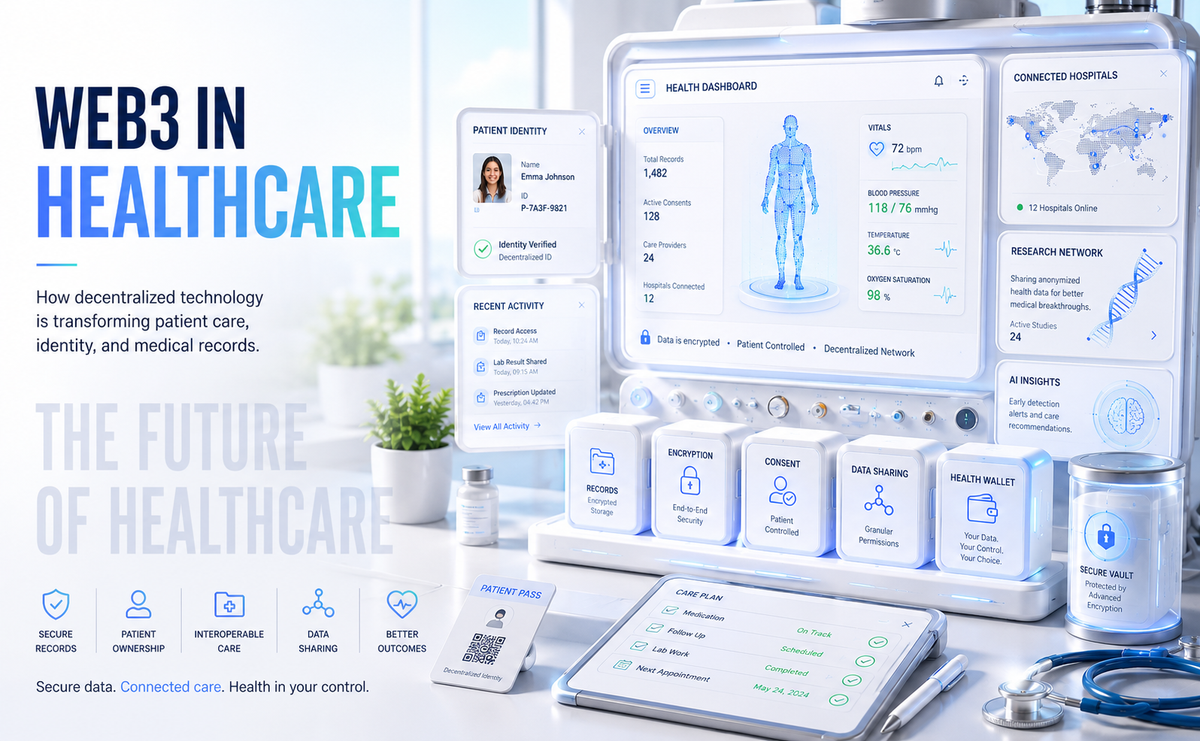
Blockchain changes this by making it technically possible for patients to hold their own health records in a secure, decentralized environment and to decide, on a granular level, who gets to see what and when. Rather than asking a hospital to share your records with a new specialist, you could grant and revoke access directly, in real time, with a verifiable record of every access event stored on the blockchain.
This isn't just a privacy improvement though it is that. It's a fundamental rebalancing of the relationship between patients and the healthcare system. When patients control their data, they also control the narrative of their own health history, and they can carry that history with them seamlessly across providers, specialties, and geographies.
Security and Privacy: Actually Solving the Problem
Encryption and Decentralization Working Together
The security argument for blockchain in healthcare rests on one key structural difference: instead of storing data in a centralized database a single point of failure blockchain distributes data across a network of nodes. There's no single target to breach. And every piece of data stored on the blockchain is encrypted, meaning that even if someone gained access to a node, the data would be unreadable without the appropriate keys.
For healthcare, where a breach can expose the most intimate details of a person's life, this architectural shift matters enormously.
Self-Sovereign Identity
Web3 also introduces a new approach to identity management that's particularly relevant for healthcare. Rather than relying on a hospital or government agency to store and verify your identity, decentralized identity systems let individuals manage their own credentials through what's known as a self-sovereign identity.
In practice, this means a patient can verify who they are to a healthcare provider without handing over their full personal information sharing only what's necessary for a particular interaction. It reduces the risk of identity theft, limits unnecessary data exposure, and gives individuals meaningful control over their personal information. The ability to revoke access at any time adds an additional layer of protection that traditional systems simply don't offer.
Smart Contracts for Consent
Managing patient consent who can access your data, for what purpose, and for how long is currently a slow, paper-heavy process. Smart contracts automate this entirely. When a patient consents to a provider or researcher accessing their medical records, that consent is recorded on the blockchain as an executable agreement. It's transparent, it's time-stamped, and it enforces itself automatically.
If a data-sharing agreement expires or a patient revokes consent, the smart contract enforces that too without requiring anyone to manually update a spreadsheet or send a follow-up email. This kind of automated, transparent consent management builds trust in a way that paper forms and verbal agreements simply cannot.
Telemedicine, Reimagined
Decentralized Platforms for Remote Care
Telemedicine took off during the pandemic and hasn't looked back but the platforms enabling it are still largely centralized, with all the privacy and security risks that entails. A teleconsultation conducted through a centralized platform means that the platform operator has access to sensitive communication between patient and provider. That's not a comfortable arrangement for anyone who takes healthcare privacy seriously.
Web3-based telemedicine platforms remove that intermediary. Using blockchain to enable peer-to-peer, encrypted communication between patients and providers, these platforms ensure that consultations, prescriptions, and medical records remain private visible only to the parties involved. The immutability of blockchain also means both the patient and provider can verify the integrity of what was said and documented during a consultation, which has real implications for trust, especially in legally sensitive contexts.
For patients in rural or underserved areas, decentralized telemedicine also removes geographic barriers without introducing new privacy risks. A patient in a remote community can consult a specialist in another country through a secure, blockchain-verified connection, with their data protected by the same standards as anyone else.
Wearables, IoT, and Real-Time Health Data
Smartwatches, glucose monitors, continuous heart rate trackers wearable health technology is already generating enormous amounts of real-world health data. The challenge is what happens to that data once it's collected. Today, it typically flows to a centralized server operated by the device manufacturer, where it's subject to their privacy policies and security practices.
Web3 offers an alternative. Blockchain can provide a secure, decentralized framework for collecting and storing data from wearable devices, ensuring that the data is encrypted and tamper-proof while remaining under the patient's control. Patients can decide to share real-time health metrics with their physician or not and revoke that access whenever they choose. For managing chronic conditions where continuous monitoring is valuable, this combination of real-time data access and patient control could be genuinely transformative.
Simplifying Billing and Insurance
Smart contracts also have a compelling application in healthcare payments. The current billing process involves multiple parties providers, insurers, clearing houses, billing departments each adding cost and delay. A smart contract can reduce this chain dramatically by automating payment verification and processing according to predetermined terms.
Imagine a telemedicine appointment where, once the consultation is complete and documented on the blockchain, a smart contract automatically triggers the appropriate payment from the patient's insurance or wallet. No claims form. No three-week wait. No billing dispute over a charge that doesn't match the service description. The transaction is transparent, verifiable, and settled in real time. For both patients and providers, the reduction in administrative overhead alone represents significant value.
Transforming Medical Research
Decentralized Clinical Trials
Clinical trials are the engine of medical progress, and they're notoriously difficult to run. Patient recruitment is slow and often limited by geography. Data collection is expensive and vulnerable to manipulation. Consent processes are cumbersome. Oversight is inconsistent.
Web3 addresses each of these pain points. Decentralized trial platforms allow patients from anywhere in the world to participate, removing the geographic constraints that currently skew trial populations toward wealthy, urban, mostly Western participants. Smart contracts handle the consent process automatically, ensuring it's transparent and enforceable. And because trial data is recorded on an immutable blockchain ledger, the integrity of the data is verifiable by regulators, researchers, and the public.
This isn't just more efficient it's more trustworthy. And in a field where data manipulation and selective reporting have historically undermined confidence in research findings, trustworthiness is enormously valuable.
Paying People to Participate
One of Web3's more creative contributions to clinical research is the use of tokenization to incentivize patient participation. Recruiting diverse, representative trial populations has always been a challenge and for good reason. Participation is time-consuming, and the benefits are diffuse and long-term. Web3 makes it possible to reward participants directly and transparently with tokens or cryptocurrency, distributed automatically by smart contract as each milestone is reached.
This isn't just a financial incentive it's a fairer model. It compensates people for the real contribution they're making to science, and it does so in a way that's transparent and verifiable. The result could be larger, more diverse trial populations and better research outcomes.
Data Integrity You Can Actually Verify
Data fraud in clinical research is a serious problem. Falsified results, selectively reported outcomes, and manipulated datasets have contributed to medical scandals and undermined public trust in scientific institutions. Blockchain's immutable ledger is a direct answer to this problem. Once data is recorded, it cannot be altered and the record of who submitted it, when, and from what source is permanently preserved.
For regulators reviewing trial data, blockchain provenance provides a level of confidence that no paper trail can match. For the public, it provides assurance that the research underpinning medical decisions is genuine.
Healthcare Payments: Faster, Cheaper, More Transparent
Transparent Billing on the Blockchain
Medical billing is one of the most opaque financial experiences most Americans will ever navigate. Charges appear weeks after treatment, descriptions are cryptic, and errors both accidental and intentional are common. Blockchain's immutable, real-time ledger changes this by creating a transparent record of every transaction associated with a medical service.
Both the patient and the provider can access the same billing information simultaneously, with no possibility of post-hoc manipulation. Disputes become easier to resolve because the record is clear. Errors are caught earlier because the data is visible. And the automated verification capabilities of blockchain mean that many billing errors can be prevented entirely rather than caught and corrected after the fact.
Crypto and DeFi Opening Up Access
For patients in parts of the world with limited access to traditional financial services, cryptocurrency-based healthcare payments offer something genuinely valuable: the ability to pay for care across borders, quickly and with lower transaction fees than conventional banking allows.
Beyond payments, decentralized finance (DeFi) protocols are beginning to explore models for healthcare financing including decentralized loans that could help patients cover major medical expenses without going through traditional financial institutions that may be unavailable or unaffordable. This is especially relevant in low- and middle-income countries where the gap between healthcare need and financial access is widest.
Cutting Out the Middlemen
Every intermediary in the healthcare payment chain the insurer, the billing department, the claims processor adds cost and delay. Web3's peer-to-peer payment infrastructure makes it possible to route payments directly from patient to provider, bypassing layers of intermediaries and settling transactions faster and more cheaply.
This isn't about eliminating insurance entirely it's about removing the unnecessary complexity and cost that's accumulated in systems that weren't designed with efficiency as a priority. Direct, blockchain-verified payments can coexist with insurance structures while dramatically reducing the administrative burden on everyone involved.
The Road Ahead: Opportunities and Honest Challenges
The Personalized Medicine Promise
One of the most exciting long-term possibilities Web3 opens up is truly personalized healthcare. When patients control their own comprehensive health data drawn from wearables, lab results, genomic information, and clinical records and can share it selectively with providers and researchers, the conditions for genuinely individualized care become possible in a way they aren't today.
Smart contracts can automate personalized treatment protocols, ensuring that care plans are followed consistently without requiring constant manual oversight. Data from wearables can trigger automatic alerts or interventions based on a patient's specific health profile. And as AI tools for analyzing health data mature, the combination of rich, patient-controlled datasets and machine learning could produce insights that centralized, siloed systems simply cannot generate.
The Challenges Are Real
None of this happens automatically, and it's important to be honest about the obstacles.
Regulation is complex. Healthcare is one of the most heavily regulated industries in the world, and for good reason. Any Web3 application in healthcare needs to navigate frameworks like HIPAA in the U.S. and GDPR in Europe, which set strict requirements for how patient data is handled. Blockchain's immutability one of its greatest strengths also creates genuine compliance challenges in jurisdictions where patients have the legal right to have their data deleted. Reconciling those requirements will require careful design and ongoing collaboration between technologists and regulators.
Integration with existing infrastructure is hard. The healthcare system runs on legacy software that was never designed to interact with blockchain networks. Building bridges between those systems without disrupting care delivery is a significant technical challenge that will take time and considerable investment to overcome.
Education and adoption take time. Blockchain is still poorly understood by most healthcare professionals and administrators. Before Web3 can deliver on its potential in healthcare, there needs to be a meaningful investment in helping the people who run these systems understand what the technology does, what it doesn't do, and how to implement it responsibly.
Final Thoughts
The long-term vision for Web3 in healthcare isn't complicated to articulate, even if it's complex to achieve: a system where patients are genuinely in control of their health data, where that data moves seamlessly and securely between providers, where administrative overhead is minimized through automation, and where the benefits of medical research reach more people more quickly because the infrastructure for conducting and verifying that research is more transparent and accessible.
That's not a utopian fantasy. It's a description of what becomes technically possible when you remove the centralized intermediaries that currently sit between people and their own health information.
Getting there will require collaboration between technologists, clinicians, regulators, and patients. It will require solving hard technical problems and navigating genuinely difficult regulatory questions. And it will take time probably more time than the most enthusiastic Web3 advocates would like to admit.
But the direction is right. And the problems Web3 is trying to solve are real enough, and consequential enough, that the effort is worth making.
Healthcare has needed this kind of rethinking for a long time. Web3 might just be the framework that finally makes it possible.