Comparing .Manga with Other TLDs: What Makes It Unique?
Level up your manga presence! A .Manga domain instantly connects you with the global manga community.

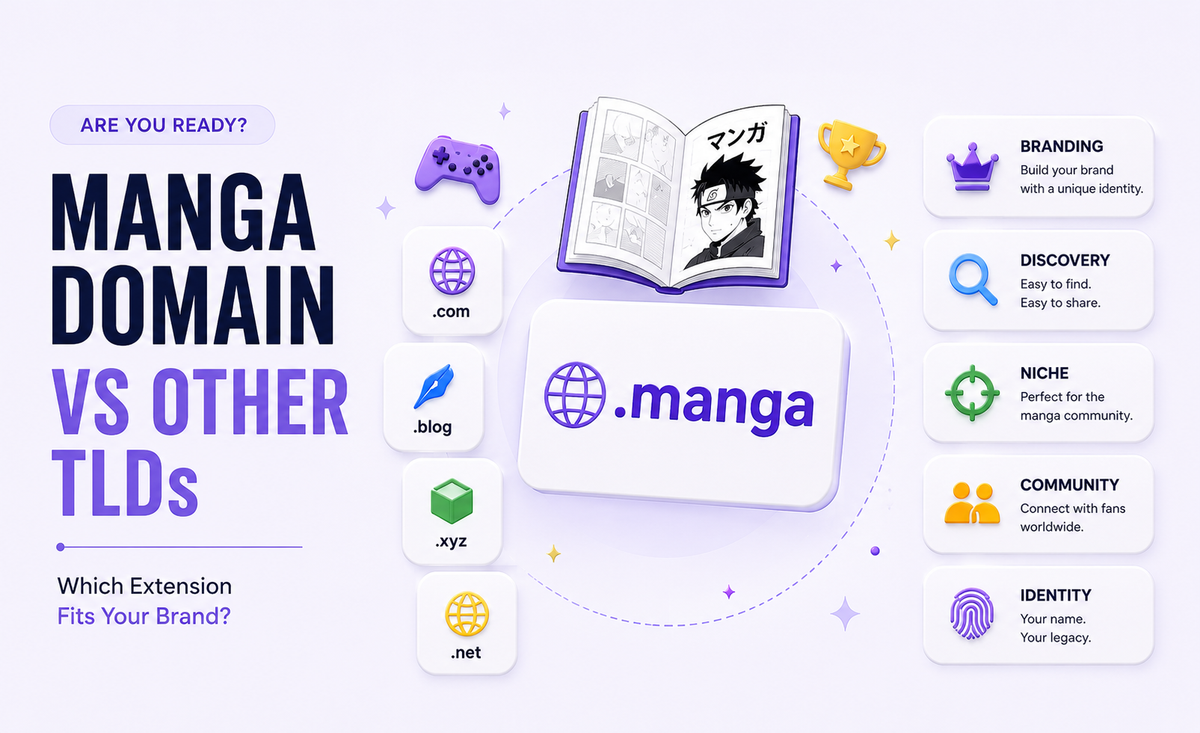
In today's crowded digital space, standing out online starts with something as simple as your web address. While most websites still default to .com, .net, or .org, a new wave of specialized domains is carving out real, meaningful corners of the internet. One of the most exciting examples? The .Manga top-level domain (TLD), built specifically for the manga world.
Whether you're a manga creator, publisher, diehard fan, or business owner in the industry, your web3 domain name matters more than you might think. So let's explore what makes .Manga different, why it's worth considering, and what you should know before making the switch.
A Little Background: The Story of Manga
Before we get into domains, it helps to appreciate just how deep manga's roots go. The word "manga" loosely translates to "whimsical pictures" in Japanese, and its history stretches back centuries. Early forms of sequential art appeared in Japan as far back as the 12th century, with illustrated animal scrolls like the Chōjū Jinbutsu Giga setting the foundation.
The term "manga" itself is widely credited to artist Katsushika Hokusai, who used it in the 19th century. By the late 1700s, manga-style storytelling had begun appearing in low-cost illustrated novels called kibyōshi, and by the early 20th century, artist Kitazawa Yasuji's work in Jiji Manga helped bring the term into popular use.
The real turning point came in the mid-1940s, when Osamu Tezuka revolutionized the medium. He introduced cinematic techniques, expressive sound effects, and deeply layered characters that transformed manga from a niche art form into a full-blown cultural force. By the 1970s, it had grown into a massive industry.
From Print to Pixels: Manga in the Digital Age
Fast forward to the 2000s, and everything changed again. Digital technology and the rise of the internet opened manga up to a global audience that earlier generations couldn't have imagined. Streaming services like Crunchyroll, Netflix, and Funimation brought anime to living rooms worldwide, and series like Naruto, One Piece, and Attack on Titan became household names far beyond Japan.
Manga followed suit. Platforms like ComiXology and Shonen Jump's digital service now give readers instant access to thousands of titles from anywhere in the world, introducing a whole new generation of fans to the medium. Webtoons have also surged in popularity, blending the manga tradition with a scroll-friendly, mobile-first format.
All of this points to a simple truth: the manga community is massive, global, and growing. And a growing community deserves its own space on the internet.
What Is a Top-Level Domain, Anyway?
If you've ever noticed the last part of a web address (.com, .org, .edu), that's the top-level domain (TLD). Think of it as the internet's way of categorizing websites, kind of like the postal code of the digital world.
There are two main types:
Generic TLDs (gTLDs) aren't tied to any location. These are the familiar ones: .com (originally for commercial use, now used by practically everyone), .net (originally for network providers), .org (for nonprofits), .edu (educational institutions), and .gov (government entities). Over time, newer gTLDs like .shop, .blog, and .app have joined the mix.
Country Code TLDs (ccTLDs) are tied to specific countries or territories. For example, .us is for the United States, .uk for the United Kingdom, .ca for Canada, and .in for India.
The TLD you choose sends signals to both users and search engines about who you are and what your site is about. That's exactly where .Manga starts to shine.
What Makes .Manga Different?
Unlike a generic TLD that could belong to just about anyone, .Manga has one job: it's exclusively designed for the manga world. That specificity is a feature, not a limitation. Here's how it plays out in practice.
Instant recognition and credibility. When someone sees a .Manga domain, they immediately know what kind of site they're visiting. There's no guesswork. For fans browsing the web or looking for their next favorite title, a .Manga address signals authenticity and focus right away.
A targeted, built-in audience. Manga fans are an engaged, passionate group. Using a .Manga domain puts your site squarely in front of that audience, whether they're searching for new releases, creator portfolios, or fan communities.
Community building. There's something powerful about shared spaces. A .Manga TLD helps create a broader ecosystem where fans, creators, and businesses all speak the same digital language. It makes connecting with like-minded people a little easier and a lot more natural.
Stronger brand identity. For businesses in the manga space, a .Manga domain isn't just an address. It's a statement. It tells your audience that you're not a general entertainment site that happens to carry some manga. You're the real deal.
SEO potential. While search engines don't directly boost rankings based on TLD alone, a .Manga domain can send meaningful signals about your content focus. Over time, that kind of alignment between your domain and your content can contribute to stronger visibility for manga-related search terms.
How .Manga Domains Actually Work
Technically speaking, .Manga works exactly like any other TLD. When someone types your .Manga address into their browser, the Domain Name System (DNS) translates it into the IP address for your server, and your site loads just like normal. There's nothing unusual or complicated on the back end.
What's different is the layer of meaning that comes with it. The mechanics are standard; the message is unique.
The Challenges Worth Knowing About
It would be incomplete to only talk about the benefits. Like any specialized tool, .Manga domains come with real trade-offs you should weigh carefully.
Limited mainstream awareness. Not everyone knows what .Manga is. A broader audience stumbling across your site may pause at the unfamiliar extension, or worse, never find you because they assumed you'd have a .com address.
Search engine considerations. While newer TLDs are increasingly accepted by search engines, established extensions like .com still carry a built-up authority advantage that takes time to overcome.
Possible misinterpretation. Some users might assume .Manga indicates a geographic location, particularly in regions where manga culture is especially prominent. That confusion can muddy your messaging.
Domain availability and cost. The most desirable .Manga domain names are already claimed, and niche TLDs sometimes carry higher registration and renewal fees than standard options.
Dependence on manga's popularity. The value of a .Manga domain is tied to the health and growth of the manga industry itself. While the outlook is strong right now, it's worth keeping in mind as a long-term investment consideration.
Competition within the TLD. As more manga-related sites adopt .Manga domains, standing out within that space, becomes its own challenge. Being in a curated niche doesn't guarantee visibility.
Security awareness. Like any TLD, .Manga domains can be misused for phishing or malicious purposes. If you own one, keeping your site secure is non-negotiable.
Is a .Manga Domain Right for You?
The answer depends on who you are and what you're building.
If your site is entirely dedicated to manga, whether you're publishing original work, running a fan community, selling merchandise, or building an informational resource, a .Manga domain is a genuinely compelling choice. It aligns your address with your identity, makes you instantly recognizable to your target audience, and contributes to a growing ecosystem of manga-focused content online.
If you're a general entertainment brand that includes manga as one of many offerings, a more versatile TLD might serve you better, at least as your primary address.
Either way, the .Manga domain isn't just a trend. It reflects how the internet is maturing: less one-size-fits-all, more purpose-built for communities that know exactly what they love.
Final Thoughts
The digital world is moving toward specialization, and .Manga is a clear example of that shift. For the right creator, brand, or community, it offers something a .com address simply can't: an immediate, authentic connection to one of the most beloved storytelling traditions in the world.
If manga is your world, your domain should say so.