How Solana Domain Names Are Changing the Game for Digital Marketers and Brands
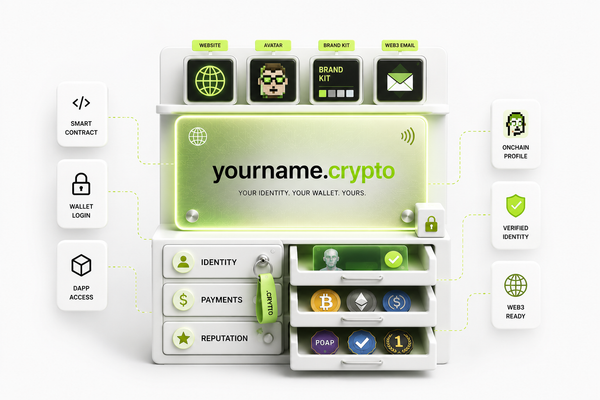
Imagine a nickname for your complex blockchain wallet address on the Solana network. That's what a Solana domain name is, typically ending in ".sol". Bonfida created it as a user-friendly alternative to sharing lengthy wallet addresses, similar to how email addresses simplify communication.

Digital marketing has always been a moving target. The platforms change, the algorithms shift, the audience behaviors evolve and the brands that survive are the ones that adapt before they're forced to. Right now, the biggest shift on the horizon isn't another social media platform or a new ad format. It's Web3. And Solana is emerging as one of the most practical on-ramps for marketers who want to get ahead of it.
Before diving into what Solana domain names can do for your marketing strategy specifically, it's worth understanding the broader context because the problems Web3 is solving for brands are very real, and they're getting worse.
The Web2 Problem That Nobody Talks About Enough
The current digital marketing landscape works, but it works on someone else's terms, and those terms keep getting less favorable.
For brands, reaching audiences today means juggling an ever-expanding stack of platforms: influencer marketing, paid social, short-form video, email lists, search ads, and more. And even after all that investment, you're still dependent on third-party platforms to actually connect with your community. Your follower count on Instagram isn't yours; it's Meta's. Your email list is the closest thing to a direct relationship most brands have, and even that lives on a provider's servers.
The data situation is just as frustrating. Platforms give brands just enough insight to justify continued ad spending, but rarely the depth of data needed to truly understand and serve a community. The relationship between brand and audience is mediated by platforms that profit from keeping both sides dependent on them.
For fans and customers, the experience is equally limiting. Engagement typically means liking a post, leaving a comment, or sharing content passive interactions that offer no real stake in the brand or community they love. Fans can't truly own anything they interact with, and they certainly can't contribute in any meaningful way to the brands they support.
Web3 changes this dynamic from the ground up. And the brands paying attention are already moving.
The Brands Already Making the Jump
This isn't theoretical. Some of the world's most recognizable companies have already launched Web3 initiatives, and the results are reshaping how brand-community relationships work.
Nike has created virtual spaces where users can co-create digital goods turning customers from passive consumers into active participants in the brand's creative process. It's a fundamentally different relationship than "buy our shoes," and it's generating genuine community investment.
Starbucks built a loyalty program around NFTs, rewarding customers in ways that go beyond punch cards and free drinks. Their Web3 loyalty model gives members ownership of their rewards tokens that have real value and can be traded, not just redeemed at a counter and forgotten.
DC Comics is letting collectors use NFTs to unlock exclusive content and even influence the direction of their stories. The audience, which has always cared deeply about the DC universe, now has a genuine stake in it. That's a level of engagement that no amount of social media spending can replicate.
These aren't experiments for PR value. They're strategic moves by companies that recognize a fundamental shift in how audiences want to engage with the brands they love. As one framework puts it: just as social media became non-negotiable for brand strategy in the 2010s, a Web3 strategy centered around NFTs and digital ownership will become the baseline expectation in the years ahead.
The numbers back this up. Over 100 brands have already launched Web3 projects. Direct-to-avatar sales within the metaverse digital goods purchased for use in virtual environments have reached $54 billion. These aren't fringe numbers. This is a market taking shape in real time.
Where Solana Domain Names Fit In
Understanding the broader Web3 marketing opportunity is one thing. Understanding the specific role that Solana domain names play is another and it's more practical than most people expect.
A Solana domain name is a human-readable address on the Solana blockchain, typically ending in .sol. Think of it as a nickname for your blockchain wallet address which, without a domain name, would be an incomprehensible string of 44 random characters that no normal person could remember or reliably type.
Bonfida created the Solana Name Service (SNS) to solve this problem. With a .sol domain, you can share your address the same way you share an email address something like yourbrand.sol or yourname.sol and anyone who wants to send you crypto, NFTs, or smart contract interactions can do so without either of you ever seeing a raw wallet address.
But for brands, a .sol domain does more than simplify transactions. It's a Web3 identity anchor, a permanent, owned presence in the Solana ecosystem that you can link to your Twitter handle, your website, your NFT collections, your decentralized applications, and your broader digital brand identity. It's the foundation on which a brand's Web3 presence is built.
How to Register Your .sol Domain: A Clear Walkthrough
Getting a .sol domain is genuinely straightforward. Here's the full process from start to finish.
Step 1: Go to Bonfida's SNS homepage. Head to bonfida.org or search "Solana Name Service" in your browser. This is the official registration platform for .sol domains.
Step 2: Connect your crypto wallet. Click "Connect Wallet" in the upper right corner. The site automatically detects compatible wallets Phantom, Solflare, Trust Wallet, and Coin98 all work. Follow the prompts to connect and authorize SNS to interact with your wallet.
Step 3: Search for your domain. Type the .sol name you want into the search bar. If it's available, great click on it to proceed. If someone else has already registered it, you have two options: buy it directly if the owner has listed it for sale, or submit an offer if it isn't listed and wait to see if they accept. Competitive or short names tend to go quickly, so if you have a specific name in mind, move sooner rather than later.
Step 4: Add it to your cart. Click "Add to Cart." You can add multiple domains in a single session one wallet can hold as many .sol domains as you want.
Step 5: Choose your storage allocation. Before checking out, you'll see a storage option the default is 1kB, which is sufficient for most standard use cases. If you're planning to host a decentralized website via IPFS or have other advanced needs, you can upgrade to 10kB by clicking "Edit." Pay attention here: this decision is permanent. You can't increase your storage allocation after registration. More storage means slightly higher registration costs and potential future fees, so think it through.
Step 6: Complete the purchase. The standard cost is 20 USDC plus approximately 0.008 SOL in gas fees for a 1kB domain. If you don't have enough crypto in your wallet, you can purchase it with regular currency, execute a token swap, or transfer from another wallet. Review your order one final time and click "Complete Purchase" your wallet will prompt you to confirm the transaction.
Once it processes, your .sol domain is registered and yours indefinitely. You can verify ownership on the Bonfida platform or by searching your wallet on Solana Explorer and clicking the "Domains" tab.
The Ownership Model That Makes .sol Domains Different
Here's something worth dwelling on, because it's genuinely different from anything in the traditional domain world.
When you register a .sol domain, you own it permanently. Not annually permanently. There are no renewal fees, no expiration dates, and no registrar who can take it back. You pay the registration fee once, and that's it. The domain is yours as long as you hold the wallet it's registered to.
This is a meaningful shift in how digital assets work. Traditional domain names are licenses you're paying for the right to use a name year after year, and if you miss a renewal, you lose it. .sol domains are owned assets. They're transferable on secondary markets, which means if you register a domain that later becomes valuable, you can sell it just like any other digital asset.
One important caveat: if you lose access to your wallet's private key, the master credential that proves you own the wallet, you lose the domain along with everything else in that wallet. Treat your private key with the same seriousness you'd treat the deed to a property. Store it securely, keep a backup in a safe physical location, and never share it with anyone.
Solana as a Marketing Platform: Beyond the Domain Name
The Solana domain name is the entry point, but the platform itself offers capabilities that are directly relevant to digital marketers dealing with some of the most persistent challenges in the industry.
Tackling ad fraud. Ad fraud costs the digital marketing industry an estimated $50 billion annually. It's one of the most expensive and least-discussed problems in the space fake views, fraudulent clicks, and bot traffic drain marketing budgets without delivering real results. Solana's blockchain infrastructure offers a meaningful response. Ad impressions can be tracked and their authenticity verified on-chain, making it possible to confirm that a real human actually saw and interacted with an ad. Smart contracts can enforce payment conditions for example, triggering payment only when a completed purchase occurs rather than a click eliminating the incentive for fraudulent activity at the contract level.
Improving data privacy and security. Consumer trust in how brands handle data is at an all-time low, and regulations like GDPR and CCPA are making data practices a legal liability as much as a PR concern. Solana's decentralized storage model spreads data across multiple nodes rather than concentrating it on centralized servers reducing the risk of the kind of large-scale breaches that have damaged brands and cost companies millions in fines and settlements. Built-in data encryption adds another layer of protection that centralized infrastructure simply can't match.
Speeding up payments. If your business model involves paying affiliates, contractors, or content creators, you know how slow and fee-heavy traditional payment rails can be. International transfers through traditional banking can take days and carry significant fees. Solana's native SOL token enables near-instant, low-cost transactions processing in under a second at fractions of a cent. For marketers running global affiliate programs or creator partnerships, that's a practical operational improvement.
Simplifying loyalty programs. Traditional loyalty programs are notoriously complex to manage points systems, expiration rules, redemption limitations, and the back-end infrastructure to run all of it. Smart contracts on Solana can automate the entire process: reward issuance, redemption, and transfer happen automatically according to pre-defined rules, without manual administration. And unlike traditional loyalty points, blockchain-based rewards can be designed to have real, tradeable value making them far more compelling to customers.
Enabling genuinely new marketing models. The possibilities that blockchain opens up for marketing go beyond solving existing problems. On-chain customer profiles verified, tamper-proof records of purchasing behavior and brand engagement could enable more accurate segmentation and personalization than anything available today. Real-time, transparent tracking of ad campaign performance across platforms could eliminate the black boxes that make it so hard to know where marketing spend is actually going. Decentralized social platforms built on Solana could give brands direct access to their communities without algorithmic interference.
Why Solana Specifically? The Technical Case
Solana isn't the only blockchain being used for Web3 marketing applications, but it has specific technical characteristics that make it particularly well-suited for the scale and speed demands of digital marketing.
Transaction speed. Solana processes roughly 50,000 transactions per second a number that puts it in a completely different performance tier from Ethereum (15-45 TPS) and most other blockchain platforms. For marketing applications that involve large volumes of microtransactions loyalty points, ad impression tracking, affiliate payments this speed advantage is operationally significant.
Transaction cost. At approximately $0.00025 per transaction, Solana's fees are low enough that previously impractical use cases become viable. Tracking individual ad impressions on-chain, for example, would be prohibitively expensive on Ethereum at current gas prices. On Solana, it's economically feasible at scale.
Scalability. The platform currently handles up to 65,000 transactions per second, with architectural plans to scale significantly beyond that. Marketing campaigns have traffic spikes product launches, viral moments, flash sales and infrastructure that can't handle those spikes becomes a bottleneck at exactly the wrong moment. Solana's capacity means that scaling your campaigns doesn't require worrying about the underlying network becoming congested.
Developer ecosystem. Solana has a growing ecosystem of developers building tools and applications on the platform which means the marketing infrastructure being built on Solana will continue to mature and expand. The more developers build on a platform, the more capable it becomes for everyone using it.
Real-World Implications for Your Marketing Strategy
Let's bring this back to the practical question: what should a brand or digital marketer actually do with all of this?
Start with a .sol domain. It's low-cost, permanent, and it establishes your brand's presence in the Solana ecosystem. Even if you're not ready to build a full Web3 marketing strategy today, securing your brand name in a growing digital namespace is the same logic that led smart companies to register their .com domains in 1995. The window for good names is open but it won't stay open indefinitely.
Think about loyalty differently. If your brand has any kind of customer rewards program, explore what a blockchain-based loyalty system could look like. The ability to give customers genuinely owned, tradeable rewards rather than points that expire and vanish creates a fundamentally different relationship between your brand and its most loyal customers.
Consider NFT-based community building. The brands generating the most genuine community engagement in Web3 aren't the ones dropping NFTs as a gimmick they're the ones using NFTs to give their communities real ownership and real stakes. Think about what your audience cares about most deeply, and how an NFT-based model could give them a genuine stake in that.
Pay attention to decentralized applications. The dApp ecosystem on Solana is growing rapidly, and brands that establish a presence there now will have first-mover advantages as those platforms mature. Whether that's a branded presence in a virtual world, a decentralized marketplace, or a community governance tool, the time to experiment is before the space gets crowded.
Final Thoughts
Digital marketing is at an inflection point. The platforms that have dominated the last decade are showing their age rising costs, declining organic reach, data limitations, and growing consumer skepticism about how their information is being used. Web3, and Solana specifically, offers a genuine alternative: faster, more transparent, more cost-effective, and built on a model where brands and their audiences can have direct, unmediated relationships.
Solana domain names are the entry point the simplest, most affordable first step into that ecosystem. But the bigger opportunity is what comes after: a marketing infrastructure built on ownership, transparency, and direct community engagement rather than platform dependence and algorithmic gatekeeping.
The brands that understand this shift early will build the most loyal communities, run the most efficient campaigns, and establish the most durable digital presences. The ones that wait will be playing catch-up paying more for names that could have been registered for $20 and scrambling to build communities that early movers already own.
The decentralized web has a long way to go before it's fully mainstream. But the infrastructure being built right now .sol domains, .eth domains, .polygon domains, .dao domains, and endless domains emerging across different blockchain ecosystems is laying the foundation for what comes next. Your brand's place in that foundation is available right now. The only question is whether you'll claim it before someone else does.