How to Build a Winning Marketing Strategy Using ARB Domains
ARB domains are booming, fueled by market growth and innovative blockchain technology. This blog will explore the power of ARB domains as a strategic tool for your marketing strategy.

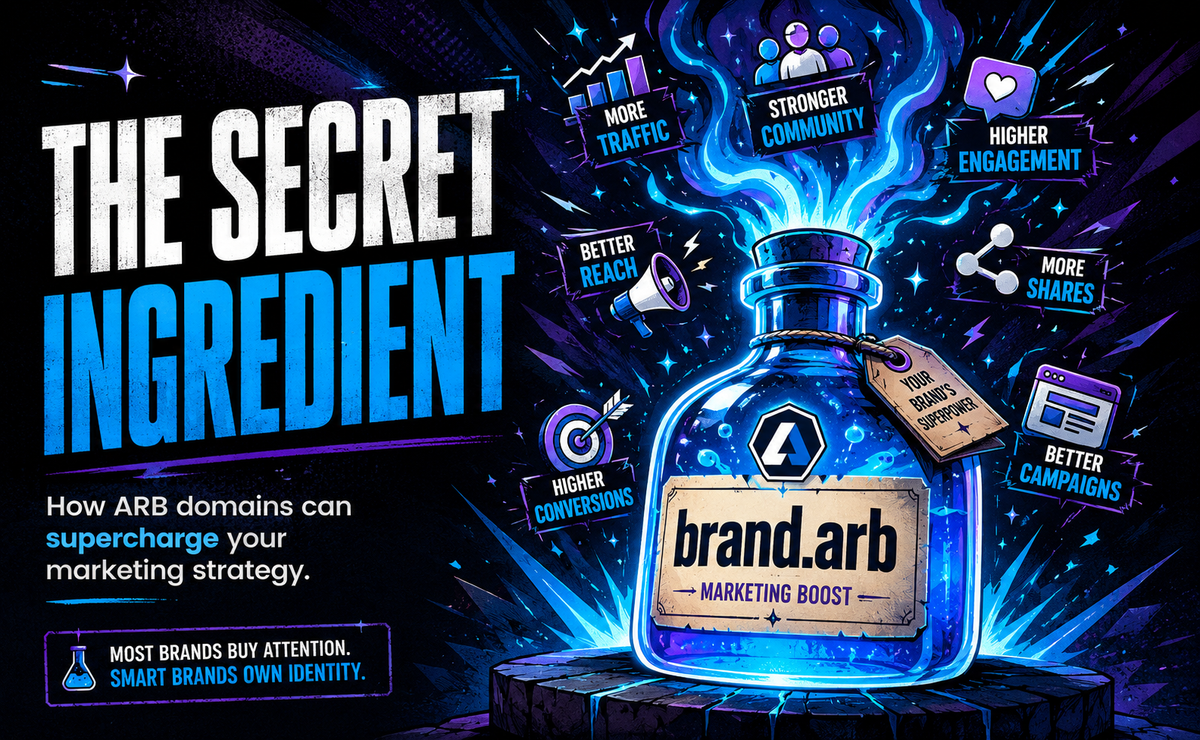
Digital marketing never sits still. The platforms shift, the algorithms change, the audience behaviors evolve, and the brands that stay ahead are the ones that recognize emerging opportunities before they become obvious. Right now, one of those opportunities is ARB domains.
The Arbitrum ecosystem has grown from an interesting Layer 2 experiment into one of the most active and financially significant blockchain networks in the world. Its total value locked peaked at $3.2 billion, and it continues to hold the highest TVL among all Layer 2 ecosystems. That's a real, active community of users, developers, and businesses and .arb domains are the identity and branding infrastructure those participants use to navigate and engage with each other.
For marketers willing to look past the surface-level "crypto" association and understand what .arb domains actually enable, there's a genuinely compelling strategic opportunity here. This blog breaks down the benefits, the expected results, and the specific marketing strategies that work best when you incorporate .arb domains into your overall approach.
Why ARB Domains Matter for Marketers
Before getting tactical, it's worth being clear about what makes .arb domains strategically interesting from a marketing perspective not just technically useful from a Web3 perspective.
They connect you to a specific, motivated community. A .arb domain isn't a generic web address. It's a signal that you're a participant in the Arbitrum ecosystem a community that's technically sophisticated, financially active, and deeply invested in the success of the platforms they use. When your brand carries a .arb domain, Arbitrum users recognize you as one of their own rather than an outsider trying to sell them something. That recognition shortcut matters enormously in a space where trust is hard-won and skepticism of outside marketing is high.
They differentiate your brand in a crowded digital landscape. The .com namespace is saturated. Finding a short, memorable, brand-relevant traditional domain is increasingly difficult and expensive. The .arb namespace is still relatively young, which means genuinely great names are available and a strong .arb domain immediately sets your brand apart from the sea of generic addresses competing for the same audience's attention.
They simplify the user experience. One of the persistent friction points in Web3 is the complexity of wallet addresses and blockchain interactions. A .arb domain replaces that complexity with a clean, human-readable identity that makes it easier for users to find your application, send payments, and interact with your services. Reducing friction at every touchpoint is a fundamental marketing principle and .arb domains do it at the infrastructure level.
They future-proof your brand positioning. As the Arbitrum ecosystem continues to expand, the value and recognition of .arb domains will grow alongside it. Brands that establish a .arb presence now are building equity in a namespace that will become more valuable and more competitive as adoption increases. Early positioning in a growing namespace is always smarter than reactive registration once the space is crowded.
What to Expect When You Market with ARB Domains
Setting realistic expectations is part of any honest marketing strategy. Here's what incorporating .arb domains into your marketing can realistically deliver.
You'll attract a more targeted audience. The .arb extension acts as a filter it naturally draws users who are already familiar with and interested in the Arbitrum ecosystem. For businesses offering Arbitrum-based products, DeFi services, NFT projects, or Web3 tooling, this pre-qualification effect means your marketing reaches people who are already partway through the consideration process rather than starting from scratch.
You'll build credibility within the ecosystem. In Web3 communities, credibility is everything. A .arb domain signals that your brand is a genuine participant, not a brand parachuting in to extract attention from a community they've never invested in. That credibility compounds over time as your presence in the ecosystem grows.
You'll gain SEO advantages within the Arbitrum network. While .arb domains don't have the same effect on traditional search engine rankings that .com domains do, they carry meaningful visibility within the Arbitrum ecosystem itself through ecosystem directories, community platforms, and decentralized application discovery tools. As Web3-native search and discovery infrastructure matures, early registrants will be better positioned.
You'll establish a long-term brand asset. A strong .arb domain is more than a marketing channel; it's a brand asset with potential appreciation in value as the ecosystem grows. The domain names you register today could be significantly more valuable tomorrow, both as active marketing infrastructure and as tradeable digital assets.
Nine Steps to Building a Marketing Plan That Actually Works
Incorporating .arb domains into your marketing strategy isn't a replacement for sound marketing fundamentals; it's an enhancement of them. Here's a step-by-step framework for building a marketing plan that works whether you're new to Web3 marketing or adding .arb domains to an existing strategy.
Step 1: Get clear on your goals before you do anything else.
The most common marketing mistake in Web3 and everywhere else is jumping to tactics before establishing clear objectives. What does success look like for your project? More brand awareness within the Arbitrum community? A larger, more engaged Discord or Telegram community? User acquisition for a specific product? Investor attention? Each of these goals requires a different strategy, a different set of channels, and different success metrics. Get specific before you start spending time and money.
Step 2: Find where your audience actually lives.
Knowing your target audience is one thing; knowing where they spend their time online is another. For Arbitrum users and Web3 participants generally, the active communities tend to live on Discord, Telegram, Twitter, Reddit (particularly crypto-focused subreddits), and increasingly on decentralized social platforms. Research which specific communities are most active in your niche, then build a presence there rather than spreading yourself thin across every possible channel.
Step 3: Communicate like a participant, not a promoter.
The Web3 community has a finely tuned radar for inauthentic marketing. Users who've been in the space for any length of time have seen countless projects show up promising revolutionary technology and disappear after the launch hype dies down. The brands that build lasting relationships in this space are the ones that engage genuinely, participating in conversations rather than just broadcasting into them; share useful information rather than just promotional content; and building relationships with community members rather than treating them as an audience to convert.
Create content that adds value to the community's conversations. Answer questions. Share honest analysis. Admit what you don't know. The trust you build through authentic participation is worth more than any paid promotion.
Step 4: Stay adaptable as the landscape shifts.
The Arbitrum ecosystem and the broader Web3 space move faster than almost any other market. Regulatory developments, technological upgrades, community sentiment shifts, and competitive dynamics can change the landscape significantly in a matter of weeks. Build adaptability into your marketing strategy from the start. Monitor what's happening across the ecosystem, track which of your tactics are actually driving results, and be willing to pivot when the evidence suggests it's time to change course.
Step 5: Prioritize authenticity above everything.
In Web3 marketing specifically, overpromising is one of the fastest ways to destroy your brand. The community has an institutional memory for projects that made claims they couldn't deliver on, and that memory is documented permanently on-chain and in community forums. Set goals you can actually meet. Communicate honestly about where your project is in its development. Celebrate genuine milestones rather than manufactured ones. Authenticity isn't just a values statement it's a competitive advantage in a space where trust is the scarcest resource.
Step 6: Build a professional online presence that earns trust.
Your website is often the first serious impression a potential user, investor, or partner will form of your project and in Web3, where the cost of a bad first impression is high, getting it right matters. A credible Web3 project website includes a clear explanation of what the project does and why it matters; an FAQ section that addresses the questions your audience is actually asking; transparent team information (Who's building this and why should I trust them?); access to your whitepaper or technical documentation, and a clean, fast design that works on mobile.
Your .arb domain is the front door to all of this. Make sure what's behind that door is worth walking through.
Step 7: Grow your network with intention.
The relationships you build within the Arbitrum and broader Web3 ecosystem compound over time. Introductions to other founders, connections with active community members, relationships with developers building adjacent products these are resources that can't be bought with an ad budget. Attend virtual and in-person Web3 events. Engage meaningfully with projects you genuinely admire. Share other people's work when it's worth sharing. Network like someone who's in this for the long term, because the community will remember both generosity and self-interest.
Step 8: Use storytelling as your primary persuasion tool.
Complex technology is hard to market with feature lists. The projects that build the strongest communities in Web3 are almost universally the ones that tell compelling stories about the problem they're solving, about the people they're solving it for, and about the vision of what the world looks like when they succeed.
Your .arb domain is the gateway to your story. Make sure the content on your platform, written, visual, and video, tells that story in a way that resonates with both technical users who want depth and newcomers who need context. Use case studies, user testimonials, and concrete examples rather than abstract claims about revolutionary technology.
Step 9: Establish genuine thought leadership.
Thought leadership in Web3 isn't about publishing generic content with your logo on it. It's about contributing real insights to conversations the community cares about, writing substantive analysis of ecosystem trends, participating in technical discussions with actual depth, and being willing to share opinions that might be unpopular if you think they're correct.
Consistency matters as much as quality. A project that publishes one brilliant piece and disappears makes less of an impression than one that shows up regularly with useful, honest, well-reasoned content. Build a publishing rhythm you can sustain, and let the accumulated body of work establish your authority over time.
Four High-Impact Marketing Strategies for ARB Domain Businesses
With the foundational framework in place, here are four specific marketing strategies that are particularly well-suited to businesses operating with .arb domains.
Strategy 1: Community Building as a Core Business Function
In Web3, community isn't a marketing channel it's the product. The most successful Arbitrum-based projects treat their communities as fundamental assets, investing in them with the same seriousness they invest in technical development.
Building a strong community around your .arb domain presence requires more than just creating a Discord server and hoping people show up. Here's what actually works:
Identify the platforms where your target audience already gathers specific subreddits, Discord servers, Telegram groups, and Twitter communities focused on Arbitrum and DeFi and build a genuine presence there before asking for anything.
Create content that educates rather than just promotes. The Arbitrum community values deep technical understanding. Tutorials, explainers, analysis pieces, and honest project updates all perform better than marketing copy in community settings.
Offer real value to community members: early access to features, exclusive insights, meaningful incentives that align with your project's values. Loyalty programs, governance participation, and co-creation opportunities all give community members a genuine stake in your project's success rather than making them feel like passive recipients of promotional messaging.
Host events AMAs, workshops, technical deep-dives, community calls that bring members together around shared interests and give them direct access to the people building the project. These events build the personal connections that transform casual followers into committed advocates.
Collaborate with DeFi influencers and respected community figures who your audience already trusts. A genuine endorsement from a respected voice in the Arbitrum community carries more weight than any amount of paid promotion.
Strategy 2: SEO Strategy Built for the Web3 Ecosystem
The SEO game looks different in Web3, but the fundamentals remain the same: create genuinely useful content, optimize it properly, build authoritative backlinks, and make your site technically excellent. Here's how to apply those fundamentals to a .arb domain context.
Target the specific language your audience uses. Arbitrum users, DeFi participants, and blockchain developers use particular terminology Layer 2 scaling, gas optimization, smart contract auditing, liquidity pools, yield farming that may not overlap significantly with broader tech audience vocabulary. Your keyword strategy should reflect how your specific audience searches, not how the average internet user would phrase related concepts.
Create long-form, technically substantive content. In a community that values depth and accuracy, superficial content doesn't build credibility or rank well. The content that earns links, shares, and sustained traffic in the Web3 space is the kind that actually helps readers understand something complex or make a better decision.
Build backlinks from respected ecosystem sources prominent crypto publications, well-known DeFi protocol blogs, community-run resource sites, and ecosystem directories. These links carry significant weight both for traditional SEO and for visibility within the Arbitrum ecosystem specifically.
Optimize for technical performance rigorously. Page speed, mobile responsiveness, clean navigation, and fast-loading media aren't optional extras they're baseline requirements for ranking well and delivering the user experience that the Arbitrum community expects from a credible project.
Monitor your performance honestly. Track organic traffic growth, keyword rankings for terms relevant to your niche, time on page, and conversion rates from organic traffic. Let the data guide your content strategy rather than producing content based on intuition alone.
Strategy 3: Airdrop and Bounty Campaigns That Build Real Engagement
Airdrops and bounty campaigns are among the most distinctly Web3 marketing tools available and when executed well, they can drive awareness, user acquisition, and community growth simultaneously. When executed poorly, they attract mercenary participants who take the tokens and disappear. The difference lies in the design.
For airdrop campaigns:
Start with clear objectives. Is the airdrop designed to reward early community members, attract new users, encourage specific user behaviors, or generate broader ecosystem awareness? Your objectives determine which NFTs or tokens you distribute, who qualifies to receive them, and what actions participants need to take to claim their rewards.
Design the participation requirements around the behaviors you actually want to drive. If you want users to try your product, make meaningful product interaction a requirement for eligibility. If you want community growth, make community actions joining a Discord, referring friends, participating in a governance vote part of the criteria.
Make the claiming process as frictionless as possible. Every additional step in the claiming flow costs you participants. Whether claims happen through a smart contract, a decentralized exchange, or a wallet integration, the user experience should be smooth, clear, and tested thoroughly before launch.
Communicate the campaign clearly and honestly who qualifies, what they need to do, when the airdrop happens, and exactly how to claim. Ambiguity creates frustration and support burden that undermines the positive community sentiment you're trying to generate.
For bounty campaigns:
Bounty campaigns turn your community into an active marketing force by rewarding participants for completing specific tasks that support your project's growth. Tasks can include social media promotion, content creation, bug identification, translation work, community management, or any other activity that creates genuine value for the project.
The key to effective bounty campaigns is ensuring that the tasks generate real value rather than just gaming metrics. Paying for retweets from accounts with no relevant following doesn't help your project but paying for quality tutorial content from respected community members creates lasting assets that continue driving awareness long after the bounty period ends.
Structure rewards to scale with effort and quality. A flat rate for all contributions creates incentives for low-effort participation. Tiered rewards based on quality and impact attract the kind of contributors who will actually move the needle.
Strategy 4: Video Marketing That Educates and Converts
Video is the most powerful content format for explaining complex technology to new audiences and Web3 is full of concepts that are genuinely difficult to communicate in text alone. A well-executed video marketing strategy can dramatically accelerate awareness, understanding, and adoption for a .arb domain project.
Here's how to build a video strategy that works specifically in the Web3 context:
Diversify your video formats to serve different stages of the user journey. Explainer animations are ideal for introducing your project to people who've never heard of it. Product demos are essential for converting interested prospects into active users. Technical tutorials serve existing users who want to get more out of your platform. Interviews with team members and industry experts build credibility and personal connection. Customer testimonials and case studies provide the social proof that skeptical new users need before committing.
Invest in production quality proportional to your audience's expectations. The Arbitrum community is technically sophisticated and has high standards for the projects they engage with. Poorly produced video signals that you're not serious which is exactly the wrong impression to create. Clear audio, competent editing, and visually coherent presentation are the baseline.
Make complex concepts genuinely accessible without dumbing them down. The best Web3 educational content manages to be rigorous enough to satisfy technical users while being clear enough that newcomers can follow along. Concrete examples, real-world analogies, and step-by-step walkthroughs are your tools. Abstract claims about revolutionary technology are not.
Partner with respected voices in the ecosystem for collaborative content. A conversation between your team and a well-known DeFi analyst, an interview with a respected Arbitrum developer, or a co-produced tutorial with a popular crypto educator all carry more credibility than anything your brand produces alone.
Optimize for the platforms your audience actually uses YouTube for long-form educational content, Twitter for clips and highlights, Discord for community-specific video updates. Distribution strategy matters as much as production quality.
Engage actively with the communities that form around your video content. Respond to comments, answer questions, acknowledge feedback, and incorporate viewer suggestions into future content. The community that forms around quality video content can become some of your most enthusiastic advocates.
Use analytics to guide your strategy. Watch time, engagement rate, comment sentiment, and conversion from video to website or product all of these metrics tell you what's resonating and what isn't. Let the data shape your content roadmap rather than producing videos based on what you think people want to see.
Putting It All Together
The four strategies above community building, SEO, airdrop and bounty campaigns, and video marketing work better together than they do in isolation. Your community produces the social proof that makes your SEO content more trustworthy. Your SEO content attracts new community members who discover your project through search. Your airdrop campaigns give those new members a reason to engage deeply with your product. Your video content explains your product clearly enough that airdrop participants become genuine users rather than one-time token claimants.
The .arb domain sits at the center of all of it a consistent, owned, blockchain-secured identity that ties your brand's presence across the Arbitrum ecosystem into a coherent whole. It's the address your community knows, the domain your SEO content lives on, the identity your airdrop participants interact with, and the brand your video content builds.
Final Thoughts
Marketing in Web3 is genuinely different from traditional digital marketing the audience is different, the trust dynamics are different, the channels are different, and the tools are different. But the fundamentals are the same: know your audience, create genuine value, build authentic relationships, and measure what matters.
ARB domains give you a strategic foundation for all of that within the Arbitrum ecosystem. They signal community membership, simplify user experience, differentiate your brand, and build equity in a namespace that's growing in importance as the Arbitrum ecosystem matures.
The decentralized web has a long way to go before it's fully mainstream. But the infrastructure being built right now .arb domains, .eth domains, .sol domains, .polygon domains, and endless domains emerging across different blockchain ecosystems is laying the foundation for what comes next. A strong marketing strategy, built on a solid .arb domain foundation, is how your brand becomes part of that future rather than catching up to it later.