The Web3 Developer's Toolkit: Essential Tools Every Developer Should Know
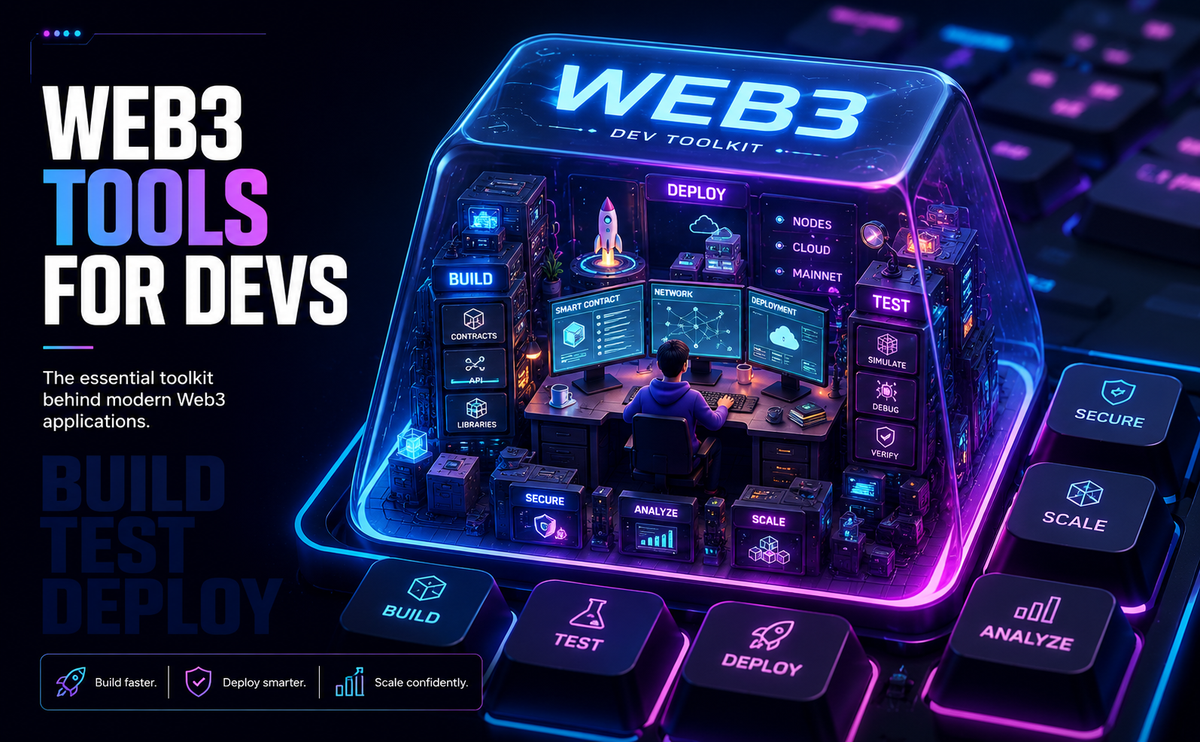
Web3 development is reshaping the internet, and developers building decentralized applications (dApps) need the right tools to navigate this complex landscape. In this guide, we highlight must-know tools—from libraries to storage solutions—that simplify the creation of secure and efficient dApps for

If you've been paying attention to where the internet is headed, you already know that Web3 isn't just a buzzword anymore. It's a genuine shift in how we think about data, ownership, and the relationship between users and platforms. And at the center of that shift are the developers actually building it the people writing smart contracts, launching dApps, and figuring out how to make decentralized systems actually work in the real world.
Here's the thing: building for Web3 is fundamentally different from building for the traditional web. The tools are different, the mental models are different, and the stakes especially around security are higher. A bug in a regular web app might break a feature. A bug in a smart contract can drain a wallet.
That's why having the right tools in your stack matters so much. This guide walks through the essential Web3 development tools every developer should know, from the libraries you'll use every day to the debugging platforms that'll save you at 2 a.m.
Web Libraries and Frameworks
1. Web3.js and Ethers.js
If you're building anything on Ethereum, you'll almost certainly encounter one of these two JavaScript libraries and for good reason. Both Web3.js and Ethers.js give developers a straightforward way to interact with the Ethereum blockchain: connecting to nodes, deploying smart contracts, sending transactions, and querying on-chain data.
Think of them as the bridge between your front-end application and the blockchain. Without them, you'd be writing raw JSON-RPC calls by hand and nobody wants that.
Web3.js has been around longer and has a massive existing user base. If you're working on an established Ethereum project or inheriting someone else's codebase, there's a solid chance it's using Web3.js.
Ethers.js, on the other hand, was built with modern dApp development in mind. It's lighter, more modular, and generally considered cleaner to work with. For new projects, most developers today lean toward Ethers.js but knowing both will serve you well.
2. Hardhat
Hardhat has become one of the most popular development environments in the Ethereum ecosystem, and once you use it, it's easy to see why. It lets you compile, test, and deploy smart contracts in a local blockchain environment meaning you can simulate real-world conditions without spending a single cent in actual cryptocurrency.
What sets Hardhat apart is its debugging experience. When something goes wrong with a contract (and it will), Hardhat's error messages are actually readable. It integrates seamlessly with Ethers.js and supports a rich plugin ecosystem, so you can extend it to fit exactly how your team works.
If you're just getting into smart contract development, Hardhat is probably where you should start. It removes a lot of the friction that used to make Ethereum development feel unnecessarily painful.
3. Truffle Suite
Truffle has been a cornerstone of Ethereum development for years. It's a full-featured framework that handles smart contract compilation, migration, and testing all in one place. Truffle supports both Solidity and Vyper, and it's designed to manage complex dApp projects across multiple environments development, staging, and production.
Where Truffle really shines is in larger, more structured projects where you need consistent deployment pipelines and automated testing workflows. It pairs naturally with Ganache (more on that later) to give you a complete local development environment right out of the box.
Smart Contract Development Tools
1. Remix IDE
If you've never written a smart contract before, Remix is probably where you're going to start and even experienced developers come back to it regularly. It's a browser-based IDE built specifically for Solidity, which means there's nothing to install. You open a browser tab and start coding.
But don't let its accessibility fool you into thinking it's a toy. Remix comes packed with serious functionality: static analysis tools that catch bugs before you deploy, a one-click deployment interface, and a plugin architecture that lets you customize your workflow. For rapid prototyping, quick contract tests, or teaching someone the basics of Solidity, Remix is hard to beat.
2. OpenZeppelin
Security is not optional in Web3. A single vulnerability in a smart contract can result in millions of dollars lost and unlike traditional software bugs, there's often no way to patch a deployed contract after the fact.
OpenZeppelin exists to help developers not make those mistakes. It's a library of audited, battle-tested contract templates that implement the most common standards in the Ethereum ecosystem: ERC-20 for fungible tokens, ERC-721 for NFTs, access control, and much more. Instead of writing these from scratch and potentially introducing subtle bugs you pull in an OpenZeppelin contract and build on top of a foundation that thousands of developers and security researchers have already scrutinized.
OpenZeppelin also supports upgradeable contracts, which lets you build in the ability to improve your dApp over time without sacrificing security. For any project handling real value, OpenZeppelin isn't optional it's essential.
3. Solidity
No list of Web3 tools would be complete without mentioning Solidity itself. It's the primary programming language for writing smart contracts on Ethereum, and by extension, on any EVM-compatible blockchain. Its syntax is deliberately similar to JavaScript, which lowers the learning curve for developers coming from a web background.
Solidity is statically typed, supports inheritance, and gives developers fine-grained control over how contracts interact with the Ethereum Virtual Machine (EVM). It's not the easiest language to master edge cases around gas optimization and security patterns can trip up even experienced developers but it remains the dominant language in smart contract development, and investing time in learning it well pays dividends across the entire Web3 ecosystem.
Decentralized Storage Solutions
1. IPFS (InterPlanetary File System)
One of the first things you realize when building dApps is that you can't store large amounts of data on-chain. It's prohibitively expensive and impractical. That's where IPFS comes in.
IPFS is a peer-to-peer file storage network that distributes data across a network of nodes rather than relying on any single server. Files on IPFS are referenced by their content a cryptographic hash of the data itself rather than by their location. This means that as long as someone on the network has a copy of the file, it's accessible, even if the original server goes offline.
For dApp developers, IPFS is most commonly used to store front-end assets, NFT metadata, and other content that needs to be decentralized but doesn't belong on the blockchain itself. It's also a natural fit for decentralized websites that need to exist independently of any hosting provider.
2. Arweave
If IPFS is about decentralized access, Arweave is about permanence. It's a storage protocol specifically designed to keep data around forever not just as long as someone's pinning it, but genuinely permanently.
The model is clever: you pay a one-time fee to store data, and Arweave uses that fee to fund storage in perpetuity through an endowment-like mechanism. For developers building applications that need a permanent, immutable record — historical archives, legal documents, or NFT metadata that can't just disappear one day Arweave is one of the most compelling options available.
3. Filecoin
Filecoin takes a marketplace approach to decentralized storage. Users can pay to have their data stored by network participants, and those participants earn Filecoin tokens in return. Smart contracts govern the storage agreements, which ensures that providers actually deliver what they promise.
Filecoin integrates naturally with IPFS, and together they form a powerful combination: IPFS handles the content-addressed retrieval layer, while Filecoin provides economic incentives that ensure data is actually stored and available over time. For large-scale or enterprise-level storage needs in a decentralized context, Filecoin is worth serious consideration.
Decentralized Identity Solutions
1. ENS (Ethereum Name Service)
Ethereum addresses are a string of 42 hexadecimal characters. They're secure, but they're completely unreadable to humans. ENS solves that problem by letting users register human-readable names like alice.eth and map them to wallet addresses, smart contracts, or dApps.
From a developer's perspective, integrating ENS into your dApp is a relatively small lift that makes a meaningful difference in user experience. Instead of asking someone to verify a 42-character address before sending a transaction, you're letting them type a name they can actually remember. In a space where confusing UX is one of the biggest barriers to adoption, that matters.
2. Sovrin Network
Sovrin takes on one of the more philosophically interesting problems in Web3: digital identity. It's a decentralized identity system built around the concept of self-sovereign identity the idea that individuals, not corporations or governments, should control their own identity data.
Sovrin uses Decentralized Identifiers (DIDs) to enable secure, verifiable interactions without any centralized intermediary. For developers building applications that need to verify user credentials without storing sensitive personal data on a central server think healthcare, finance, or credentialing applications Sovrin provides a powerful and privacy-respecting alternative.
3. uPort
uPort approaches the decentralized identity problem from a user-facing angle. It's a platform that lets users create and manage self-sovereign identities essentially a digital identity that they own and control and use those identities to authenticate with dApps without handing over sensitive information to a third party.
For developers, uPort offers a clean integration path for decentralized login and user verification. It's particularly well-suited for applications where trust and privacy are paramount but where the traditional "log in with Google" approach simply doesn't fit the ethos of what you're building.
Blockchain Development Platforms
1. Alchemy
Alchemy is the infrastructure backbone for a huge number of production dApps. It provides reliable, scalable access to Ethereum and other blockchain networks through a suite of developer APIs, along with a dashboard that gives you real insight into how your application is actually performing on-chain.
What makes Alchemy stand out isn't just reliability it's the developer experience. The tools for monitoring API usage, debugging failed transactions, and tracking dApp performance are genuinely useful, not just checkbox features. For teams building production-grade applications, Alchemy has become something close to a default choice.
2. Infura
Infura solves a deceptively simple problem: running your own Ethereum node is complicated, expensive, and time-consuming. Infura handles all of that for you, providing reliable API access to the Ethereum network (and IPFS) so you can focus on building your application instead of maintaining infrastructure.
It's one of the most widely used tools in the ecosystem for a reason it just works. From Layer 2 networks to IPFS integration, Infura has expanded well beyond its original scope and is now a comprehensive infrastructure provider for Web3 developers.
3. Moralis
If Alchemy and Infura handle the node infrastructure layer, Moralis tackles the backend. Building a fully featured dApp requires more than just smart contracts you need user authentication, real-time data syncing, cross-chain compatibility, and storage solutions. Building all of that from scratch is a significant undertaking.
Moralis provides all of these capabilities as a managed backend-as-a-service platform, supporting multiple blockchains out of the box. It dramatically reduces the time it takes to go from idea to working dApp, which is especially valuable for small teams or solo developers trying to move fast without compromising on features.
Oracles and Cross-Chain Solutions
1. Chainlink
Smart contracts are powerful, but they have a fundamental limitation: they can only see what's on the blockchain. They can't natively access real-world data stock prices, weather conditions, sports scores, or anything else that lives off-chain. Chainlink fixes this.
As the leading decentralized oracle network, Chainlink acts as a secure bridge between the blockchain and the outside world. It aggregates data from multiple sources, validates it, and delivers it to smart contracts in a tamper-proof way. In DeFi, Chainlink price feeds are practically ubiquitous used by lending protocols, automated market makers, and derivatives platforms to get accurate, reliable asset prices. Chainlink also powers parametric insurance products, where real-world events like weather data can automatically trigger contract payouts without any human intervention.
2. Band Protocol
Band Protocol is a strong alternative to Chainlink, with a particular emphasis on cross-chain compatibility. While Chainlink dominates on Ethereum, Band Protocol's architecture is designed to serve dApps across multiple blockchains, making it a compelling option for projects that aren't exclusively Ethereum-based.
Its decentralized oracle network pulls data from trusted sources, validates it, and distributes it across chains making it especially useful in DeFi applications, prediction markets, and gaming platforms where real-world outcomes need to be reflected on-chain accurately and reliably.
3. Polkadot and Substrate
Polkadot addresses one of the most fundamental limitations of the current blockchain landscape: blockchains largely can't talk to each other. Polkadot's architecture solves this through a system of interconnected "parachains" independent blockchains that can communicate seamlessly with each other through Polkadot's relay chain.
Substrate is the development framework that makes building on Polkadot accessible. It gives developers the tools to create custom blockchains tailored to their specific use case, which then plug into the broader Polkadot ecosystem. For developers building large-scale, cross-chain applications, or for teams that want to launch their own blockchain without reinventing the wheel, Polkadot and Substrate represent one of the most powerful combinations in the Web3 development stack.
Testing and Debugging Tools
1. Ganache
Before you deploy anything to a live network, you want to test it exhaustively and Ganache is the tool most developers reach for to do exactly that. It simulates a personal Ethereum blockchain on your local machine, complete with customizable accounts, gas settings, and block times.
The beauty of Ganache is control. You can rewind the blockchain, generate test accounts with preset balances, and reproduce specific edge cases that would be difficult or expensive to trigger on a live network. Whether you're using the visual Ganache UI or the command-line version, it's an indispensable part of a solid testing workflow.
2. Ethlint
Code quality in smart contract development isn't just about aesthetics poorly written, inconsistent Solidity code is also more likely to contain security vulnerabilities. Ethlint (formerly known as Solium) is a linter specifically designed for Solidity that helps enforce coding standards, catch common errors, and flag potential security issues before they become real problems.
Think of it as a safety net that runs automatically as part of your development process. It won't catch every bug, but it will consistently enforce best practices across your codebase which is especially valuable on larger teams where multiple developers are writing contracts.
3. Tenderly
Tenderly is the kind of tool you don't fully appreciate until you've spent three hours staring at a failed transaction trying to figure out what went wrong. It's a developer platform that provides real-time debugging, monitoring, and analytics for Ethereum smart contracts and it makes the process of understanding what's actually happening on-chain dramatically less painful.
With Tenderly, you get detailed transaction traces that show exactly how a contract executed, step by step. You get gas cost analysis to help optimize your contracts and avoid unnecessary fees. And you get automated error monitoring with real-time alerts, so you know the moment something goes wrong in a deployed contract rather than finding out when a user complains. For any serious Web3 project in production, Tenderly is close to essential.
Final Thoughts
Web3 development has a reputation for being complex and intimidating and honestly, it can be. The tooling is evolving rapidly, the stakes around security are high, and the mental model is genuinely different from traditional web development.
But the ecosystem has also matured enormously. The tools covered in this guide represent years of hard-won refinement from developers who built dApps, hit walls, and built better tools as a result. Libraries like Ethers.js and frameworks like Hardhat have made smart contract development more approachable than ever. Platforms like Alchemy and Moralis have abstracted away infrastructure headaches that used to eat weeks of developer time. And tools like Tenderly and OpenZeppelin have raised the baseline for what it means to build securely.
The decentralized web is still being built and the developers who invest in understanding these tools today are the ones who are going to shape what it looks like tomorrow. Start with the tools that fit your current project, go deep on the ones that matter most, and keep building.