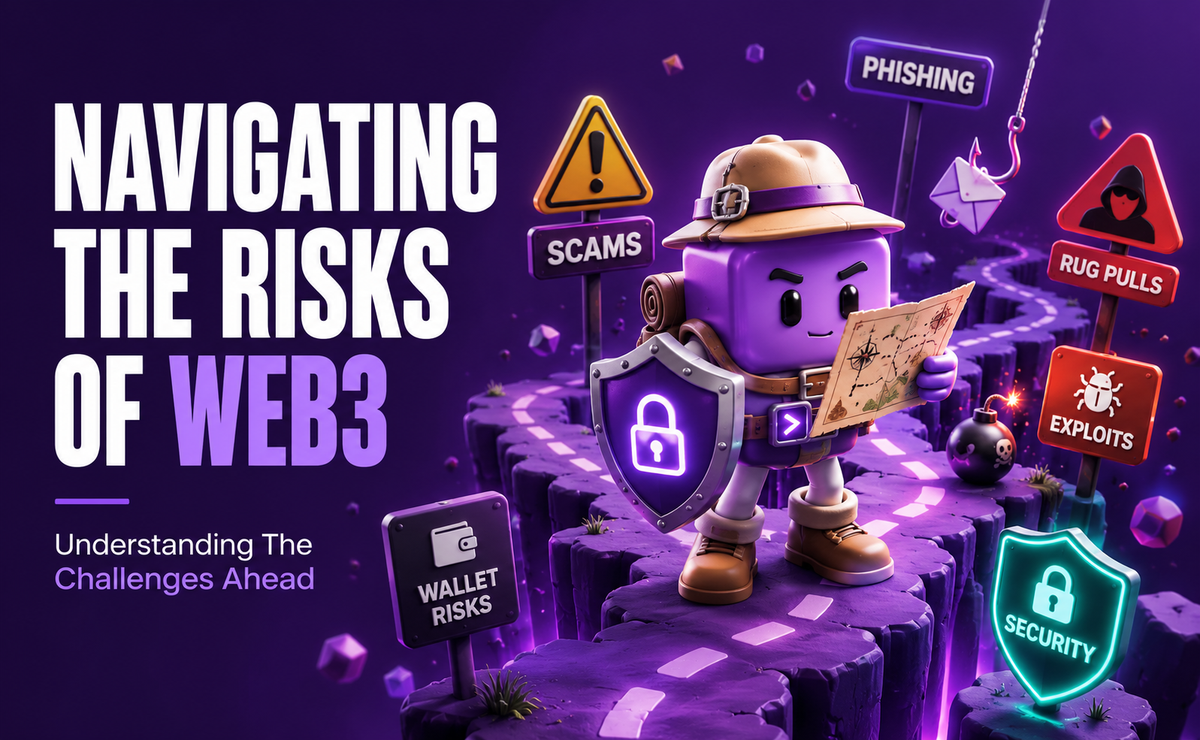
Navigating the Risks of Web3: Security, Scams, and Staying Safe
Web3: Great potential, real risks. Learn how to protect yourself from scams and security threats in the decentralized world.

The internet is changing in ways that most people have not fully wrapped their heads around yet, and that is not a criticism. Web3 is genuinely complicated, and the people building it have not always done the best job of explaining it in plain language. But here is the short version: Web3 is the next generation of the internet, one that is built on blockchain technology and designed to give control back to the people who actually use it. No more handing your data to a handful of giant corporations. No more asking for permission to participate. The promise is real, and for a lot of people, it is exciting.
The problem is that where there is excitement and money in motion, there are also people looking to take advantage of both. Web3 has produced some remarkable opportunities, but it has also produced a remarkable number of scams, exploits, and cautionary tales. And unlike the traditional internet, where a company or platform often has some responsibility for protecting you, Web3 puts that responsibility squarely on your shoulders.
That is not a reason to stay away. It is a reason to show up prepared. This blog walks through the security landscape of Web3, the most common threats you are likely to encounter, and practical steps you can take to protect yourself without needing to become a cybersecurity expert.
Understanding the Security Landscape of Web3
To understand the risks of Web3, it helps to understand what makes it structurally different from the internet most of us grew up using.
The current internet, sometimes called Web2, is built around centralized platforms. When you use Google, Facebook, or Amazon, those companies control your data, your account, and your access. That centralization creates certain risks, like large-scale data breaches, but it also provides certain protections. If something goes wrong, there is a company with a legal address and a customer service department that is at least theoretically accountable.
Web3 removes that central authority. Data is distributed across a network of computers rather than stored on a single server. Transactions are verified through cryptographic processes and community consensus mechanisms like Proof of Work or Proof of Stake rather than through a trusted intermediary. This makes Web3 more resistant to some of the attacks that have plagued traditional platforms. There is no single server to hack, no single company to compromise.
But decentralization introduces a different set of vulnerabilities. Smart contracts, which are programs written directly onto the blockchain that execute automatically when certain conditions are met, can contain coding errors that bad actors exploit for enormous gains. The infamous DAO hack of 2016 is the most cited example. A hacker found a vulnerability in a smart contract and walked away with $60 million worth of Ethereum. The code did exactly what it was written to do. It just happened to have been written badly.
The broader point is this: in Web3, there is no safety net. If you lose your private keys, your assets are gone. If you sign a fraudulent transaction, it cannot be reversed. If a project turns out to be a scam, there is usually no one to call. The technology is powerful precisely because it removes middlemen, but those middlemen were also a form of protection. Understanding that trade-off is the starting point for using Web3 responsibly.
Common Types of Web3 Scams and Exploits
The scams and exploits that circulate in Web3 are not random. They follow patterns, and once you know what those patterns look like, they become much easier to spot. Here are the ones worth knowing.
1. Phishing Attacks
Phishing is not unique to Web3, but the stakes are considerably higher here because a single mistake can wipe out everything in your wallet. The mechanics are familiar: a bad actor creates a convincing imitation of a legitimate platform, gets you to click a link or sign a transaction, and gains access to your assets.
What makes Web3 phishing particularly dangerous is how polished it has become. Fake wallet websites that look nearly identical to MetaMask or Trust Wallet. Emails that appear to come from OpenSea or a project you actually use. Social media posts and forum messages with links that install malware or direct you to credential-harvesting sites.
One widely reported example involved OpenSea users who received emails instructing them to click a link and sign a transaction to migrate their NFTs. The emails looked legitimate. The process felt familiar. But the transaction they were signing handed control of their assets to the attacker. Many people lost significant holdings before the attack was identified and publicized.
The defense here is straightforward even if the discipline required is not: always verify URLs manually before entering any information. Use official apps or browser extensions from verified sources. Never click links in unsolicited emails or messages, and never, under any circumstances, share your seed phrase or private keys with anyone.
2. Rug Pulls
A rug pull is a specific kind of exit scam that has become unfortunately common in the decentralized finance space. The setup is usually the same. A team launches a new cryptocurrency or DeFi project, generates hype, attracts substantial investment, and then disappears with the money, leaving investors holding worthless tokens.
Because anyone can create a token and list it on a decentralized exchange without regulatory oversight, the barrier to running this kind of scam is remarkably low. And the combination of social media hype, FOMO, and the genuine unpredictability of crypto prices makes investors surprisingly willing to put money into projects they have not examined carefully.
The Squid Game Token is one of the more memorable examples. Developers created a token riding the wave of interest in the Netflix series, and it attracted frantic investment as the price climbed rapidly. What investors did not know was that the developers had coded in a mechanism that prevented anyone but them from selling. Once the price peaked, the developers dumped their holdings, drained the liquidity pool, and vanished with more than $3 million. The token price dropped to essentially zero within seconds.
Before investing in any new project, look for audited smart contracts, publicly identifiable team members, a clear whitepaper, and an active community that has been around long enough to have a real track record. If a project is promising extraordinary returns and discouraging you from asking questions, that is not a buying opportunity. It is a warning.
3. Smart Contract Exploits
Smart contracts are one of the foundational technologies of Web3, but they are only as secure as the code they are written in. Errors in that code, whether introduced accidentally or left deliberately, can be exploited to drain funds from a protocol entirely.
Reentrancy attacks are one of the most common forms of smart contract exploit. In simple terms, a malicious contract repeatedly calls a vulnerable function before the original transaction is completed, effectively draining a fund before the system realizes what is happening. The 2016 DAO hack worked this way. More recently, the Poly Network hack in 2021 saw a hacker exploit a smart contract vulnerability to steal $610 million in digital assets, one of the largest thefts in the history of crypto. Most of the funds were eventually returned, but the incident was a stark reminder of what is at stake when code goes wrong at scale.
The takeaway for ordinary users is to be selective about which protocols you use and how much you trust them. Stick to platforms with publicly available audit reports from respected security firms. Treat unaudited contracts the way you would treat an unsigned legal document: with serious caution.
4. Fake NFTs and Market Manipulation
The NFT space has been particularly fertile ground for fraud. Scammers regularly upload unauthorized copies of well-known artworks to marketplaces, listing them at discounted prices to attract buyers who think they are getting a deal. Wash trading, where the same party repeatedly buys and sells an asset to inflate its apparent value and generate artificial hype, is also widespread.
Protecting yourself starts with verifying before you buy. Look for verification badges on NFT platforms. Cross-check the artist or project's official social media channels to confirm the listing is legitimate. Use tools like Etherscan to verify the smart contract address associated with any NFT you are considering purchasing, and compare it against the address listed on the creator's official website or verified accounts. If something feels off or the deal feels unusually good, it probably is.
Protecting Your Digital Assets: Best Practices
Knowing the threats is only half the equation. The other half is building habits that make you a harder target.
1. Securing Your Wallet
Your wallet is your gateway to everything in Web3, and protecting it is non-negotiable. For serious holdings, a hardware wallet from a manufacturer like Ledger or Trezor is worth the investment. These devices store your private keys offline, which means they are never exposed to the internet and therefore cannot be accessed remotely by an attacker.
For software wallets, stick to reputable options with strong community track records, and keep them updated. Use strong, unique passwords of at least 12 characters combining letters, numbers, and symbols, and use a password manager to generate and store them securely. Enable multi-factor authentication wherever it is available. And above all else, write down your seed phrase, store it somewhere physically secure, and never type it into any website or share it with any person or service, ever.
2. Safe Interaction With dApps
Decentralized applications offer some of the most compelling use cases in Web3, but they also represent a significant attack surface. Before connecting your wallet to any dApp, take the time to verify its legitimacy. Look for public audit reports, check developer credentials, and read community evaluations. Be skeptical of dApps that request more permissions than the task at hand seems to require.
After you are done using a dApp, disconnect your wallet. It sounds like a small thing, but leaving your wallet connected to an application you are not actively using increases your exposure unnecessarily. Make a habit of reviewing which dApps have wallet access and revoking permissions you no longer need.
3. Recognizing Red Flags
The most reliable protection against scams in Web3 is a healthy sense of skepticism. Promises of extraordinary returns, pressure to act quickly, anonymous or unverifiable teams, and a lack of clear documentation are all warning signs that a project may not be what it claims.
Use tools like Etherscan or BscScan to inspect smart contracts and review transaction histories before committing to any platform. Check audit reports from firms like OpenZeppelin or CertiK. Spend time in community forums and Discord servers related to the projects you are interested in. Other users are often the first to spot problems, and the collective intelligence of an active community is one of your best resources for separating legitimate projects from bad actors.
The Role of Regulation and Compliance
Regulation is one of the most debated topics in the Web3 space, and for good reason. The technology was designed in part to operate outside traditional regulatory frameworks, but the scale of the losses from fraud and exploitation has made clear that some form of oversight is necessary.
In the United States, the Securities and Exchange Commission and the Commodity Futures Trading Commission are actively working to define how different digital assets should be classified and regulated. The European Union has moved further along this path with the Markets in Crypto-Assets regulation, known as MiCA, which establishes a consistent legal framework for crypto assets across member states and imposes requirements around transparency, capital reserves, and disclosure on exchanges and wallet providers.
Other countries have taken more dramatic positions. China has banned cryptocurrency trading and mining outright. El Salvador has gone the other direction, adopting Bitcoin as legal tender. The result is a genuinely complicated regulatory landscape where the rules vary dramatically depending on where you are and what you are doing.
There are real benefits to thoughtful regulation. Clear rules can reduce fraud, attract institutional investors who require legal certainty, and give everyday users more confidence that the platforms they use are accountable to someone. But there are also legitimate concerns. Overly restrictive regulation can push development to less regulated jurisdictions, create compliance burdens that smaller projects cannot absorb, and slow down the kind of experimentation that makes Web3 interesting in the first place. The right balance is still being worked out, and it is worth paying attention to how it develops.
The Importance of Staying Informed
Web3 moves fast. New projects launch every day, new exploits are discovered regularly, and the regulatory landscape is shifting constantly. Staying informed is not just good practice; it is genuinely protective.
A few resources worth bookmarking: CoinDesk, Decrypt, and CoinTelegraph cover Web3 broadly and include security-focused reporting. CertiK and SlowMist publish more technical content specifically about blockchain security. For podcasts, Laura Shin's Unchained and The Defiant are both thoughtful and worth your time. For hands-on learning, Coursera, Udemy, and CryptoZombies all offer courses on blockchain fundamentals and smart contract development that will help you understand the underlying mechanics well enough to make better decisions.
Tools and Resources for Staying Safe in Web3
Beyond habits and awareness, there are specific tools that make navigating Web3 significantly safer.
On the wallet side, hardware options from Ledger and Trezor remain the gold standard for storing significant holdings. Software wallets like MetaMask are fine for regular use but should be treated like a physical wallet you carry daily: keep only what you need in them and not everything you own.
Browser extensions like MetaMask and PhishFort add a layer of protection by flagging suspicious sites and helping you review transactions before you sign them. Etherscan and BscScan let you look up wallet addresses, inspect smart contracts, and review transaction histories in detail. Platforms like OpenZeppelin Defender and CertiK offer real-time monitoring and auditing tools for users who want deeper visibility into the contracts they are interacting with.
For NFTs specifically, OpenSea and Rarible have both implemented verification systems that help distinguish legitimate creators from imitators, though neither is foolproof and the due diligence is still ultimately yours. In the DeFi space, platforms like Aave, Uniswap, and Compound have undergone multiple independent security audits and have long public track records, which makes them considerably safer choices than newer, unaudited alternatives.
If you do encounter a scam or suspicious activity, report it. Most major platforms have dedicated reporting channels. OpenSea, Binance, and Coinbase all have support pages specifically for flagging fraud. Community platforms like Discord, Telegram, and Reddit are also valuable for sharing information quickly when something looks wrong.
Final Thoughts
Web3 is genuinely exciting, and the opportunities it opens up across finance, content creation, and digital ownership are real. But so are the risks, and the decentralized nature of the technology means those risks land directly on the individual user in a way that the traditional internet never required.
The good news is that most of the people who get hurt in Web3 get hurt by recognizable, preventable mistakes. Clicking suspicious links. Trusting unaudited projects. Sharing seed phrases. Moving fast because someone told them they needed to. These are not failures of intelligence. They are failures of preparation, and preparation is something anyone can do.
Stay skeptical. Verify before you act. Use the security tools available to you. Spend time in communities where people are sharing honest information. The more you understand about how Web3 works and how the scams within it operate, the more confidently you can participate in what this technology makes possible. The frontier is worth exploring. Just make sure you know what you are walking into.