The Next Big Thing in the ETH Domain
Ethereum's future is bright. Let's dive into the latest developments and what they mean for the crypto world.

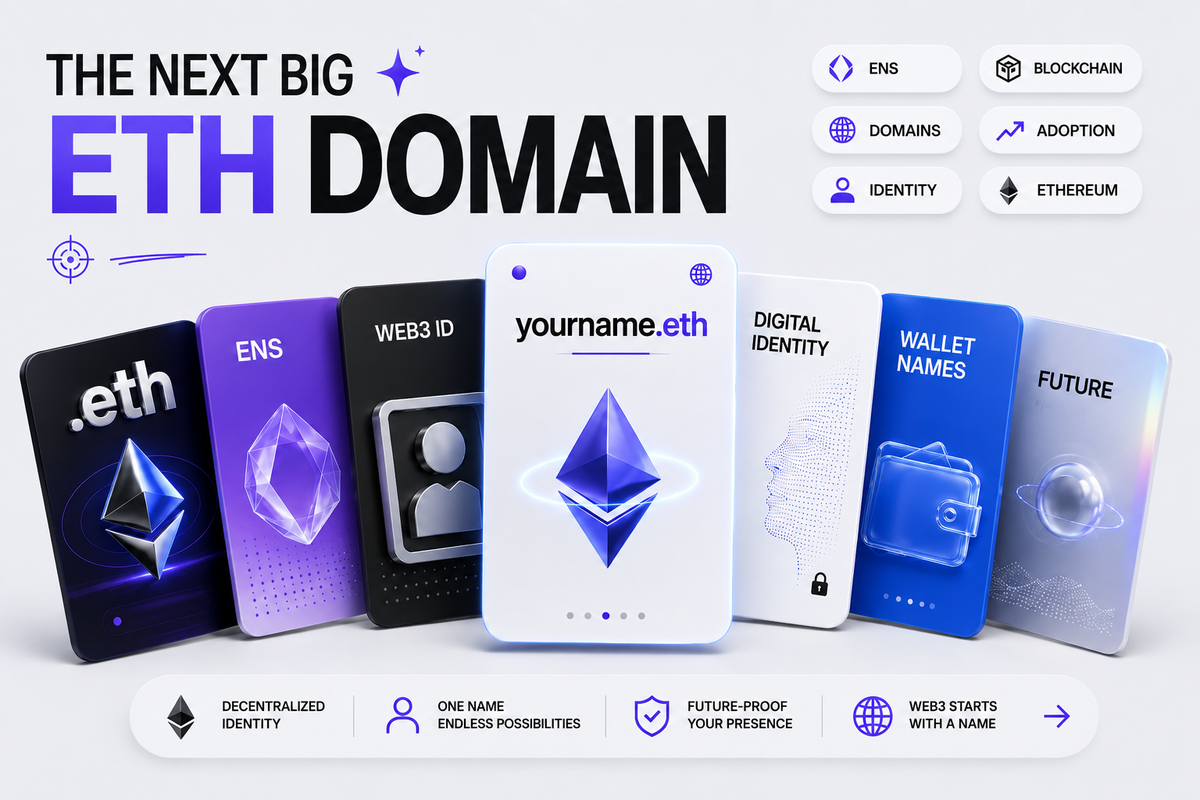
The internet has seen this story before. In the late 1990s, savvy investors who recognized the long-term value of domain names snapped up addresses like business.com and loans.com for pennies only to watch them sell for millions a few years later. Today, a strikingly similar opportunity is unfolding in the world of Web3, and Ethereum is sitting right at the center of it.
Over the past several months, Web3 domain name services most notably the Ethereum Name Service (ENS) and Unstoppable Domains have seen a sharp spike in interest and adoption. ENS alone has outperformed ETH by more than 40% over a recent three-month stretch, driven largely by a surge in .eth domain name registrations. For anyone paying attention, that's not a number to brush past.
If you believe, as many do, that Web3 domain name services will become the essential infrastructure for the next wave of internet users, there are two clear paths forward. The first is buying premium Web3 domain names now before everyone else realizes what they're worth. The second, arguably the safer play, is investing in the underlying platform tokens, like ENS. Either way, understanding what's happening on Ethereum right now is the foundation for making a smart decision.
So let's dig in.
What's Been Happening With Ethereum Lately
Before getting into domains specifically, it's worth acknowledging that Ethereum itself has been having a moment.
Franklin Templeton one of the largest asset management firms in the world, managing trillions in assets has thrown its hat into the ring to create an Ethereum spot ETF. That's not a small thing. When institutional players of that caliber start moving toward an asset, it tends to signal something. ETH's price reflected that sentiment, climbing from around $2,428 to $2,645 in response. For long-term Ethereum believers, this kind of institutional validation is exactly what they've been waiting for.
The Ethereum Merge: What Happened and Why It Mattered
To understand where Ethereum is going, you need to understand what it just came through.
On September 15, 2022, Ethereum completed what the crypto community had been anticipating for years: the Merge. Before that date, Ethereum ran on a proof-of-work model the same energy-intensive system that Bitcoin uses, where miners compete to validate transactions by solving complex mathematical puzzles. Running alongside it was the Beacon Chain, a separate proof-of-stake system that had been quietly operating in parallel.
The Merge brought those two systems together into one. Proof-of-work was permanently retired. Proof-of-stake took over completely. The practical result? Ethereum's energy consumption dropped by approximately 99.95%. That's not a rounding error it's a fundamental transformation in how the network operates.
What about "Eth2"?
You might have heard the term "Eth2" floating around. After the Merge, that term was officially retired. There is now just one Ethereum network. Under the current structure, the execution layer (formerly Eth1) handles transactions, while the consensus layer (formerly Eth2) manages proof-of-stake validation.
The reason for retiring the old terminology was partly practical and partly about user protection. Scammers had been exploiting the confusion between Eth1 and Eth2, tricking users into exchanging their real ETH for fake "Eth2" tokens. Cleaning up the language removes one more vector for that kind of fraud and makes the ecosystem safer for everyone.
What Comes After the Merge?
Completing the Merge wasn't the finish line it was the starting gun for the next phase of Ethereum's development. The roadmap going forward centers on four major upgrades, each with a very specific purpose.
The Surge The Surge is focused on scalability. Using a technique called sharding, it allows the Ethereum network to process transactions and execute smart contracts in parallel rather than sequentially. The end result is dramatically higher transaction throughput and faster speeds which matters enormously as Ethereum scales to handle millions of users.
The Verge Security is the priority here. The Verge introduces advanced cryptographic methods and improved encryption processes designed to better protect users' assets and data from attacks and intrusions. As the value stored on Ethereum grows, so does the incentive to attack it which is exactly why this upgrade exists.
The Purge If you've ever paid an Ethereum gas fee during a busy network period and watched in disbelief as a simple transaction cost you $50, the Purge is for you. This upgrade restructures the gas pricing system to reduce transaction costs and optimize how network resources are allocated. Cheaper, more predictable fees are a prerequisite for mainstream adoption.
The Splurge Last but not least, the Splurge focuses on the user experience side of things improving interfaces, development tools, and the overall usability of Ethereum-based decentralized applications (dApps). The best technology in the world doesn't matter if it's too difficult for ordinary people to use.
The Next Big Things in the Ethereum Ecosystem
Ethereum's position as the leading platform for DeFi, NFTs, stablecoins, and Layer-2 scaling solutions has created a kind of gravitational pull for developers. New projects are launching constantly, and while not all of them will stand the test of time, a handful are already showing real promise. Here are the ones worth paying attention to.
Balancer
Balancer is an automated market maker (AMM) protocol that gives liquidity providers a level of flexibility that older AMMs like Uniswap simply don't offer. While Uniswap locks you into two-token pools with a fixed 50/50 weighting, Balancer lets you create customizable pools with up to eight different tokens at variable weightings. That opens up entirely new strategies for liquidity providers who want to put their idle Ethereum-based tokens to work. Balancer has also launched a liquidity mining program that rewards providers with BAL governance tokens a smart move for bootstrapping a new protocol.
Loopring Pay
Ethereum's biggest real-world limitation has always been scalability. As the network has grown more popular, transaction costs and processing times have climbed. Loopring Pay is a direct answer to that problem. Built on zkRollups technology a Layer-2 scaling solution that handles computation off-chain while keeping data secured on-chain Loopring Pay enables instant, fee-free transfers of ETH and ERC20 tokens. The Loopring team has been building in this space for over three years, and what they've shipped here is one of the more practical demonstrations of what Layer-2 scaling can actually look like in the real world.
UMA's Synthetic Assets
UMA Protocol is doing something genuinely interesting: using synthetic assets to build decentralized financial markets that mirror real-world instruments. Their first synthetic token, ETHBTC, tracks the ETH/BTC price ratio and is backed by a smart contract that references an index rather than relying on an on-chain oracle price feed. That's a meaningful architectural distinction that makes the token more resistant to manipulation. UMA has also launched a token minting interface that lets users create synthetic tokens, manage collateral, and track deployed assets bringing a new layer of trading possibilities into the Ethereum ecosystem.
renBTC
Bitcoin holders have long wanted a way to participate in Ethereum's DeFi ecosystem without selling their BTC. Projects like WBTC addressed that need, but with a catch: the underlying Bitcoin is held in custody by a centralized party (BitGo), which reintroduces the trust problem that crypto is supposed to solve. renBTC takes a different approach. Using the RenVM network, users can mint renBTC 1:1 with real Bitcoin in a completely non-custodial, trustless way. The minted renBTC can then be used across Ethereum's DeFi landscape providing Uniswap liquidity, for example giving Bitcoin holders a way to earn yield without giving up custody of their assets.
Omen
Prediction markets have existed on the blockchain for a while, but most have struggled with liquidity problems and clunky interfaces. Omen, developed by Gnosis's DXdao group, takes a more elegant approach by using an automated market maker model (similar to Uniswap) to handle trade matching rather than relying on traditional order books. Anyone can create a prediction market for any question, and the platform's deliberately modular, open-ended design means it can evolve and expand over time. Unlike its main competitor Augur, which built its own internal oracle system, Omen relies on external oracles a design choice that gives it more flexibility.
DeversiFi
DeversiFi 2.0 is a self-custodial, high-speed exchange capable of processing over 9,000 Ethereum transactions per second. That speed is made possible by Validium technology from StarkWare a Layer-2 scaling solution that keeps data storage off-chain and uses zero-knowledge proofs to verify transactions. Validium sits alongside zkRollups and Optimistic Rollups as one of Ethereum's most promising scaling innovations. DeversiFi is one of the first exchanges to put it front and center for everyday users, and if it gains traction, expect more projects to follow its lead.
InfiNFT
The NFT space has a problem that doesn't get talked about enough: long-term preservation. Most NFTs today store their metadata off-chain, meaning that if the server hosting that data goes down, your NFT could effectively become a broken link. InfiNFT tackles this directly by enabling users to mint NFTs with fully on-chain metadata using a combination of Ethereum, the Arweave blockchain, and the IPFS decentralized storage network. The result is an NFT that is genuinely permanent and verifiable without requiring the original creator to manually maintain off-chain files indefinitely. For collectors and creators who think long-term, this matters a great deal.
The Road Ahead for Ethereum
Even through the longest crypto downturn in recent memory, Ethereum staking began gaining real momentum in 2023 and there's every reason to believe that trend continues. Staking platforms are becoming more accessible and better tailored to institutional investors, and new DeFi primitives like advanced interest rate trading on staked assets are opening up strategies that simply didn't exist a few years ago.
Nothing in crypto moves in a straight line. Anyone who tells you otherwise is either naive or selling something. But when you zoom out and look at the full picture institutional adoption accelerating, major network upgrades underway, a developer ecosystem that keeps producing genuinely innovative projects, and a domain name infrastructure that's attracting the kind of investment activity reminiscent of the early Dotcom Era the long-term case for Ethereum is hard to dismiss.
The question isn't really whether Ethereum matters. It's whether you're paying close enough attention to act on what's coming next.