NFT Domains and Everything You Need to Know
NFT domains: Your Web3 address. Discover how they're changing digital ownership and online identity.
If you've spent any time exploring the Web3 space, you've probably come across the term "NFT domain" and wondered what exactly separates it from the domain name your website already runs on. It's a fair question and the answer matters more than most people realize.
NFT domains are one of the foundational building blocks of Web3. They solve real problems with the current domain system, open up new possibilities for digital ownership, and represent a genuinely different way of thinking about your online presence. But they're also still evolving, and they're not the right fit for everyone.
This guide will walk you through everything you need to know starting from the basics of how domain names work today, moving through what NFT domains actually are and what they can do, and ending with an honest assessment of the pros, cons, and whether buying one makes sense for you.
How Web2 Domains Actually Work (And Why It Matters)
Before we get into NFT domains, it helps to understand the system they're designed to replace or at least improve upon.
Every website on the internet has an IP address: a string of numbers that functions like GPS coordinates for that particular server. When you type "yourbusiness.com" into a browser, what's actually happening behind the scenes is that a Domain Name System (DNS) server translates that human-readable name into the corresponding IP address and fetches the right content. Think of DNS servers as the phone books of the internet they look up names and return the numbers that computers actually use to communicate.
The domain name itself is your address on that map. It's the part a human being can read, remember, and type without needing a computer science degree.
That system works reasonably well, but it comes with some significant structural limitations that most website owners don't think about until something goes wrong.
The Problems With Traditional Domain Names
The traditional domain system has been running for decades, and it shows. Here are the core issues that Web3 domain technology was built to address:
You don't actually own your domain. This is the one that surprises most people. When you "buy" a .com or .net domain, you're not purchasing it outright you're paying for the right to use it for a specified period, typically up to ten years, renewable annually. Forget to renew? The domain goes back on the market, and someone else can snap it up immediately. In that sense, a traditional domain is closer to a lease than a deed.
ICANN controls everything. All traditional domain names fall under the authority of the Internet Corporation for Assigned Names and Numbers (ICANN), a U.S.-based nonprofit organization. ICANN can suspend, revoke, or seize any domain that violates its policies and its policies can change. That's a significant amount of power concentrated in one organization.
Cybersquatters and bad actors exploit the system. There's an entire industry built around monitoring domain expiration dates. The moment a registration lapses, automated systems can register the domain within seconds then sell it back to the original owner for a steep markup, or put it up for auction to the highest bidder. It's legal, it's common, and it costs businesses real money every year.
Centralized systems have centralized failure points. If ICANN's infrastructure has a serious problem, the ripple effects can be felt across the entire internet. A single point of failure is an inherent weakness in any centralized system, and the domain system is no exception.
These are exactly the problems that NFT domains were designed to solve.
What Is an NFT, Really?
Before we talk about NFT domains specifically, it's worth making sure the underlying concept is clear.
NFT stands for Non-Fungible Token. "Non-fungible" simply means unique and non-interchangeable. A dollar bill is fungible you can swap it for any other dollar bill and end up with exactly the same thing. A one-of-a-kind piece of artwork is non-fungible there's only one, and replacing it with something else changes what you have.
NFTs are digital assets stored on a blockchain that carry proof of uniqueness and ownership. They can represent virtually anything digital art, music, virtual real estate, game items, or in this case, domain names. The blockchain record establishes who owns the asset, when it was created, and every transaction it's been through. That record is public, permanent, and tamper-proof.
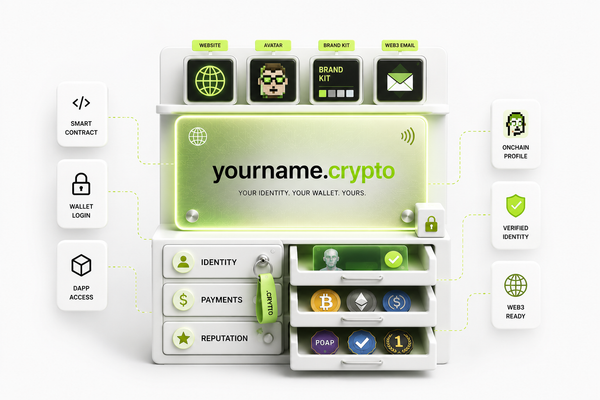
One practical capability that's particularly relevant to domains: NFTs can replace complex wallet addresses with something human-readable. Instead of sending cryptocurrency to a string of 42 alphanumeric characters, you can send it to "yourname.crypto." That's a genuinely useful improvement for everyday crypto transactions.
So What Is an NFT Domain?
An NFT domain is a domain name that exists on a blockchain rather than in a traditional centralized registry. Instead of leasing the right to use a name from a registrar that ultimately answers to ICANN, you purchase and own a token that represents that domain outright. No annual renewal fees. No central authority that can revoke your access. No expiration date.
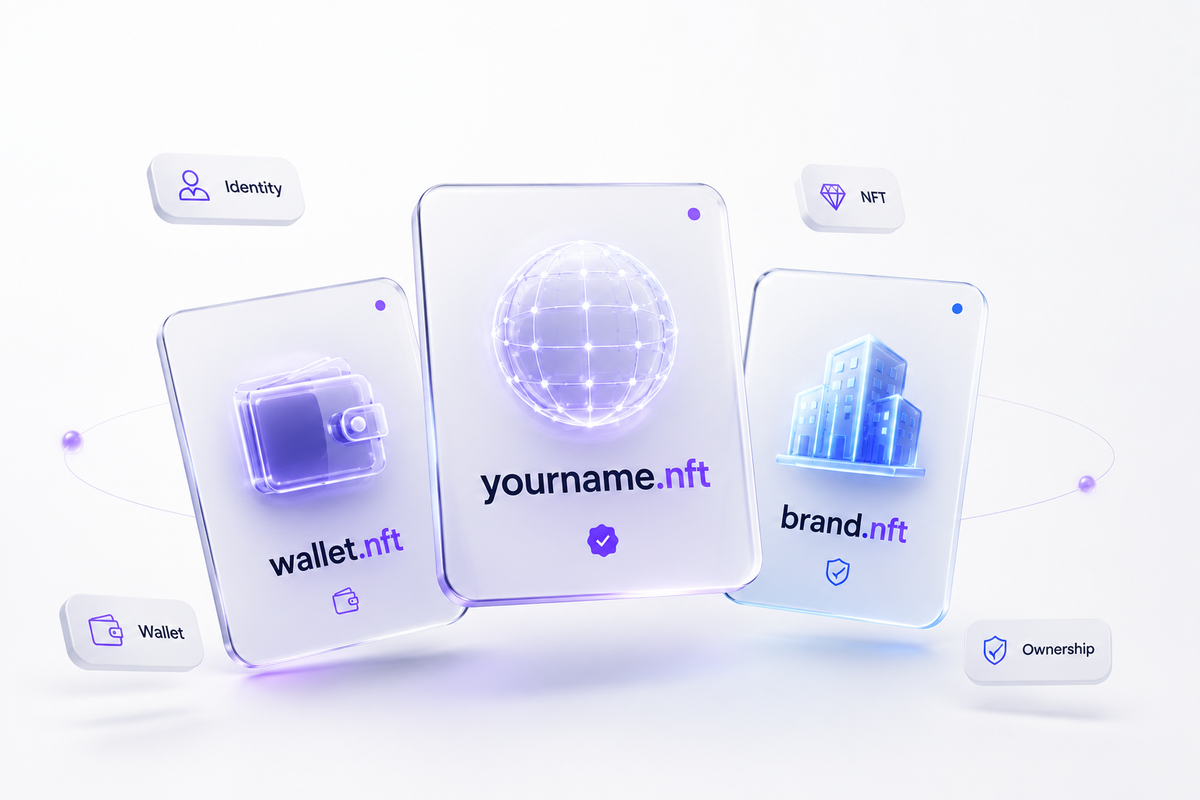
In the Web3 world, NFT domains serve a similar navigational function to regular domains in Web2 but instead of pointing browsers to websites via IP addresses, they can point wallets to cryptocurrency addresses, function as decentralized website addresses, and serve as portable digital identities across different platforms.
Common NFT domain extensions you'll encounter include .crypto, .eth, .nft, .blockchain, .bitcoin, and .x, among others. These top-level domains (TLDs) are fundamentally different from the .com and .org extensions most people are familiar with they live on the blockchain rather than in ICANN's registry.
The Three Main Things NFT Domains Can Do
This is where NFT domains get genuinely interesting they're not just web addresses. They're multifunctional digital assets.
As a crypto wallet address. Cryptocurrency wallet addresses are notoriously unwieldy. A typical Ethereum address looks something like "0x742d35Cc6634C0532925a3b844Bc454e4438f44e" a string that's nearly impossible to remember and easy to mistype. An NFT domain lets you replace that with something like "yourname.eth." Anyone who wants to send you cryptocurrency just types that instead. It's simpler, cleaner, and significantly reduces the risk of sending funds to the wrong address.
As an actual website address. Compatible browsers can use NFT domains to navigate to decentralized websites hosted on the blockchain. You type in the domain, the browser resolves it to the correct decentralized content, and you see the website. It works conceptually the same way as a traditional domain just through a decentralized infrastructure rather than a centralized one.
As a social and digital identity. This use case is still developing, but it's one of the most compelling long-term possibilities. As Web3 platforms mature, your NFT domain can function as a verified handle that links all your online presence social profiles, portfolios, wallet addresses, and more under a single, verifiable identity that you own and control completely.
The Real Benefits of NFT Domains
True ownership. When you own an NFT domain, you own it the way you own any other asset recorded on a blockchain. There's no landlord. No renewal requirement. No authority that can take it away from you for violating a terms of service agreement. It's yours.
Censorship resistance. Because NFT domains aren't managed by a centralized authority, they're significantly harder to censor or seize. For businesses operating in politically sensitive environments, for journalists, or for anyone who values the principle of a free internet, this is a meaningful advantage.
Decentralized web hosting. Websites hosted through NFT domains are distributed across a blockchain network rather than sitting on a single server somewhere. This makes them more resistant to hacking, downtime, and takedowns. It also creates a more streamlined environment for Web3 activities like trading and holding NFTs.
Simpler crypto transactions. The ability to replace a wallet address with a human-readable domain name genuinely improves the everyday experience of using cryptocurrency. Fewer errors, less friction, more confidence when sending funds.
Verifiable authenticity. Blockchain technology creates a complete, public record of every NFT domain's ownership history. That transparency makes it easy to verify that a domain is legitimate and to trace its ownership back to its original minting something traditional domain systems simply can't offer.
The Honest Downsides You Should Know About
NFT domains are genuinely promising, but they're not without real drawbacks. Anyone considering purchasing one should weigh these carefully:
Limited browser support. Traditional domain names work in every browser, on every device, without any additional setup. NFT domains currently require compatible browsers or extensions to resolve correctly. While tools like the Brave browser and MetaMask support Web3 domains natively, mainstream browsers like Chrome and Safari don't handle them the same way yet. This is improving, but it's not there yet.
Security risks still exist. Blockchain technology itself is highly secure, but the human elements around it phishing scams, fake marketplace listings, fraudulent sellers are very much real. Buying an NFT domain requires the same due diligence you'd apply to any crypto transaction: verify the platform, double-check what you're purchasing, and use reputable marketplaces.
Blockchain dependency is a real vulnerability. Your NFT domain's existence is tied to the health of the blockchain it lives on. If that blockchain is deprecated or shuts down, your domain goes with it. This is a less immediate risk for major networks like Ethereum, but it's worth understanding before you commit to a domain on a smaller or newer chain.
Scalability can affect costs and speed. As demand for NFT domains grows, blockchain networks can get congested leading to slower transaction processing times and higher gas fees. During peak periods, the cost of minting or transferring a domain can become significant.
No dispute resolution mechanism. Traditional domains have ICANN as a backstop for resolving conflicts if someone registers your trademark as a domain name, there's an established process for reclaiming it. NFT domains don't have an equivalent. If someone mints your brand name as an NFT domain before you do, your recourse options are limited and largely depend on the marketplace involved. This is a genuine concern for established businesses entering the Web3 space.
How to Actually Buy an NFT Domain
The process is more straightforward than you might expect, especially if you've already purchased other NFTs. Here's how it typically works:
Step 1: Choose a reputable marketplace. Platforms like Endless Domains, Ethereum Name Service (ENS), and Unstoppable Domains are among the most established options. Each has its own supported extensions, pricing structures, and features do a bit of research before committing to one.
Step 2: Create an account. Most marketplaces require a basic account setup. You'll also want a compatible Web3 wallet MetaMask is the most widely used to store your domain after purchase.
Step 3: Search for your desired domain. Enter the name you want and browse the available extensions. Keep in mind that pricing varies significantly based on the TLD, the length and desirability of the name, and whether you're buying from a primary marketplace or from a secondary seller.
Step 4: Complete your purchase. Many NFT domain marketplaces accept both cryptocurrency and credit card payments, making the process accessible even if you're not deeply embedded in the crypto ecosystem. Platforms like Endless Domains, for example, offer multiple payment options to accommodate different buyers.
Step 5: Mint and secure your domain. After payment, you'll go through a "minting" process this is the step that officially registers your ownership on the blockchain. Once minted, your domain is recorded as yours on the public ledger. Store it securely in your wallet, just as you would any other valuable digital asset.
Should You Actually Buy an NFT Domain?
Here's an honest answer: it depends entirely on where you are and what you're trying to do.
If you're just starting out launching a blog, building your first website, establishing a basic online presence a traditional domain name is still the more practical choice. The infrastructure around it is more mature, browser support is universal, and the learning curve is much lower.
But if you're running an established business that accepts or plans to accept cryptocurrency, wants to build a meaningful presence in the Web3 ecosystem, or is thinking seriously about long-term digital asset investment, then NFT domains are worth exploring seriously. They can simplify crypto payment processes, strengthen your brand's Web3 positioning, and give you a form of digital ownership that a traditional domain simply can't offer.
Early movers in digital real estate have historically done well. The .com land rush of the 1990s rewarded people who acted before the mainstream did. The NFT domain space feels similar still early enough that good names are available at reasonable prices, but developing fast enough that the window won't stay open indefinitely.
Where This Is All Heading
NFT domains are still in the early chapters of their story. Mainstream adoption is growing, but it hasn't arrived yet. Most organizations are still cautious about full decentralization, and browser compatibility remains a work in progress.
That said, the trajectory is clear. Developer communities are actively building out the infrastructure. AI and machine learning technologies are accelerating Web3 application development. And as younger generations who've grown up with crypto and blockchain as normal parts of their financial lives become the dominant market, the demand for decentralized digital ownership is only going to increase.
NFT domains sit right at the intersection of ownership, identity, and the future of the internet. Understanding them now puts you ahead of a shift that's already underway.