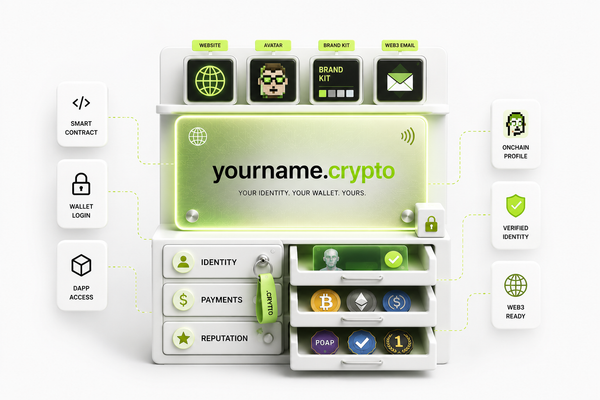
Will the NFT Domain Ever Rule the World?
NFT domains: The future of online identity? Let's explore their potential to reshape the digital landscape.

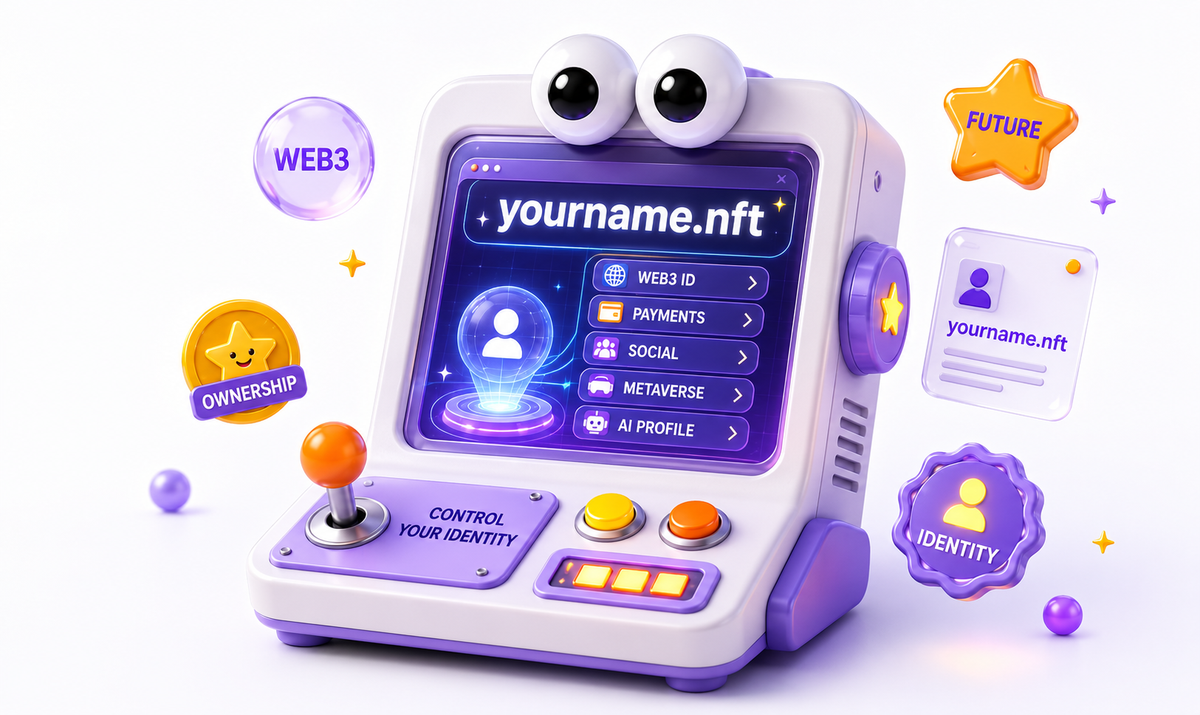
There's a line that gets thrown around in Web3 circles that NFT domains are going to "rule the internet." It sounds like classic crypto hype, the kind of breathless prediction that ages badly and ends up in screenshots on finance Twitter. But here's the thing: strip away the hyperbole, and there's something genuinely interesting underneath it.
NFT domains aren't just a gimmick. They represent a meaningful shift in how digital ownership, online identity, and internet infrastructure could work and the implications stretch well beyond the tech community. To understand where NFT domains are headed, it helps to start with the foundation: NFTs themselves, what makes them different from other digital assets, and why the domain space in particular is drawing so much attention.
NFTs vs. Cryptocurrencies: What's Actually Different?
Most people's first instinct is to lump NFTs and cryptocurrencies together, which is understandable NFTs are built on top of blockchain technology and often purchased using cryptocurrency. But they function in fundamentally different ways, and that distinction matters.
Cryptocurrencies like Bitcoin are fungible. One Bitcoin is worth exactly the same as any other Bitcoin, and you can break it into smaller units down to a satoshi, which is one hundred-millionth of a Bitcoin for smaller transactions. They're designed to work like money, interchangeable and divisible.
NFTs non-fungible tokens are the opposite. Each one is unique. You can't swap one NFT for another and end up with the same thing, because no two are identical. They can't be broken into fractions and used in pieces. Each NFT exists as a whole, singular asset with its own distinct identity on the blockchain.
This uniqueness is what makes NFTs work as a proof-of-ownership system. They function something like a digital fingerprint the blockchain can verify exactly who owns a specific token at any given moment, and that record is public and tamper-proof. Creators can even embed information directly into an NFT, such as an artist signing their work by encoding a signature into the token's metadata. And while ownership of an NFT can transfer from person to person, the original creator's identity stays embedded in the record meaning the source of a work is always traceable, even after multiple sales.
How NFTs Evolved From Trading Cards to a Multi-Billion Dollar Market
NFTs didn't arrive fully formed. The concept started relatively niche think digital trading cards, sports collectibles, and GIF animations before expanding rapidly into art, music, gaming, fashion, virtual real estate, and more.
The numbers tell a striking story. In 2020, the NFT market generated roughly $250 million in total sales. By August 2021, that figure had exploded to over $2.8 billion more than a tenfold increase in under two years. At peak activity, some of the largest NFT marketplaces were processing close to 470,000 active blockchain wallet transactions within a single 30-day window.
Along the way, NFTs upended several established industries. Digital art became a legitimate investment category. Musicians started releasing albums and exclusive content as NFTs, bypassing traditional distribution channels. Game developers began building entire economies around NFT-based in-game assets. And real estate both physical and virtual started intersecting with the NFT world in ways that would have seemed far-fetched just a few years earlier.
The through-line in all of this is ownership. NFTs gave creators and buyers a way to establish verifiable, transferable ownership of digital items that had previously been infinitely copyable and essentially impossible to own in any meaningful sense.
How to Actually Buy an NFT
Before we get into NFT domains specifically, it's worth walking through the basics of how NFT purchasing works because the process for buying an NFT domain follows the same general steps.
Set up a cryptocurrency wallet and exchange account.
These are two separate things, and the distinction matters. A cryptocurrency exchange is an online platform where you can buy and sell different cryptocurrencies. A cryptocurrency wallet is where you store the keys that give you access to your digital assets it doesn't hold the assets themselves, it holds the credentials that prove you own them. To buy NFTs, you need both: an exchange account to acquire cryptocurrency and a wallet to hold and use it.
Acquire Ethereum.
The vast majority of NFTs including most NFT domains are minted on blockchains compatible with Ethereum, which remains the dominant network for NFT activity. Ethereum (ETH) is the currency you'll use to pay for most NFT purchases. That said, alternatives like Polygon (formerly Matic), which is built on the Ethereum blockchain, have gained traction for their lower transaction fees and faster processing times. For most buyers just getting started, Ethereum is still the most straightforward path.
Transfer Ethereum to your wallet.
Once you've purchased Ethereum on an exchange, the next step is moving it to your personal cryptocurrency wallet. The exact process varies depending on which exchange and wallet you're using, but it generally involves copying your wallet address and initiating a transfer from the exchange. Double-check addresses carefully crypto transfers are irreversible.
Connect your wallet to an NFT marketplace.
With funded wallet in hand, you connect it to whichever marketplace you want to shop on. NFT marketplaces fall into a few distinct categories worth understanding before you choose one.
An open marketplace like OpenSea allows anyone to mint, buy, or sell NFTs. The barrier to entry is low, and the selection is enormous. A curated or closed marketplace has stricter standards, often requiring creators to apply and be accepted before they can list work. These tend to feature higher-quality or more exclusive offerings. A proprietary marketplace is one operated by a specific brand or company to sell its own NFT products.
Complete your purchase.
Once your wallet is connected, you can browse listings and buy. The terms of each transaction including what rights you're acquiring are determined by the specific listing and any smart contract conditions attached to it. One important thing to note: buying an NFT doesn't automatically mean you own the copyright to the underlying work. Unless the contract explicitly transfers copyright, the original creator retains it. Read the fine print.
NFT Domains and the Future of the Internet
Now we get to the part of the story that's genuinely consequential. NFT domains sit at the intersection of blockchain technology, digital identity, and internet infrastructure and the implications of that intersection are worth thinking through carefully.
True ownership of your online identity. Traditional domain names are leased, not owned. You pay an annual fee to a registrar, and they retain the technical right to revoke your access. NFT domains change that model entirely. When you own an NFT domain, it's recorded in your wallet on the blockchain no annual renewals, no registrar sitting above you in the ownership chain, no central authority that can take it away. That's a fundamentally different relationship with your own digital identity.
New creative and branding possibilities. For artists, content creators, and businesses, NFT domains open up new ways to build and protect an online brand. An artist can use their NFT domain as a portfolio address, a direct payment channel, and a unique identifier within the Web3 ecosystem all simultaneously. The domain becomes part of the creative and commercial identity, not just a technical address.
A foundation for decentralized web services. NFT domains can point to decentralized websites hosted on blockchain networks, connect to decentralized applications, and function as interoperable identities across multiple Web3 platforms. As the infrastructure of the decentralized web continues to mature, NFT domains become increasingly central to how people navigate and participate in it.
A more equitable internet architecture. Perhaps the most ambitious promise of NFT domains is what they represent at a systemic level: an internet where individuals and organizations have genuine control over their digital presence, where access isn't gatekept by a handful of centralized registrars, and where the same rules apply regardless of who you are or where you're located. Whether that promise fully materializes depends on how the technology and its governance develop but the potential is real.
The Challenges That Still Need to Be Solved
It wouldn't be honest to write about NFT domains without addressing the significant obstacles they still face. Enthusiasm in the Web3 space can sometimes outrun critical thinking, and that doesn't serve anyone well.
Environmental impact. This is probably the most frequently cited criticism of NFT technology broadly, and it's a legitimate one. Many blockchain networks particularly those using proof-of-work consensus mechanisms consume enormous amounts of energy to validate transactions. Critics argue that the carbon footprint of NFT minting and trading is difficult to justify, especially when the energy draw is concentrated in regions that still rely heavily on fossil fuels. This concern is real, even if the conversation around it is often oversimplified.
Regulatory uncertainty. The rules governing NFTs, blockchain-based assets, and digital ownership are still being written in most countries. That uncertainty creates risk for creators, buyers, and platforms alike. As the technology matures, clearer regulatory frameworks will be essential both to protect legitimate participants and to prevent fraud.
Ethical considerations. As NFT domains increasingly intersect with cultural heritage, artistic traditions, and community identities, questions of cultural appropriation and ethical use become more pressing. The technology itself is neutral, but how it's deployed is not and the community is still working through what responsible use actually looks like in practice.
Legal and Intellectual Property Issues You Can't Ignore
Anyone working with NFT domains whether as a creator, investor, or business needs to take the legal side seriously. The blockchain's decentralized nature doesn't exempt participants from intellectual property law, and some of the most expensive mistakes people make in this space involve assuming it does.
If you're minting an NFT domain based on a name, design, or concept that incorporates someone else's copyrighted work or registered trademark, you could face serious legal exposure. Rights clearance isn't just a formality it's a genuine legal requirement, and getting it wrong can be costly.
Metadata management also matters more than most people realize. The information embedded in an NFT at the time of minting contributes significantly to its legitimacy and provenance. Sloppy or inaccurate metadata can create problems down the line, both legally and in terms of market value.
The practical advice here is straightforward: if you're doing anything beyond basic purchasing in the NFT domain space creating, minting, building a business around it get legal counsel from someone who specializes in both blockchain technology and intellectual property law. The field is specialized enough that general legal advice often misses critical nuances.
Taxes: The Part Nobody Wants to Think About But Everybody Needs To
The tax treatment of NFT transactions is an area where a lot of people get into trouble through ignorance rather than intent. The rules vary significantly by country, and within countries, they can vary based on how specific transactions are structured.
In the United States, for example, the IRS generally treats NFTs as property for tax purposes, which means that buying, selling, or trading NFT domains can trigger capital gains tax obligations. Receiving an NFT as income say, as payment for services may be treated as ordinary income. The specifics depend on the details of each transaction.
Reporting requirements for NFT transactions are also still evolving and don't always map neatly onto the frameworks developed for traditional assets. Keeping detailed records of every transaction purchase price, sale price, dates, and any associated costs is essential for staying compliant and managing your tax exposure.
Tax laws in this area are being updated regularly as regulators catch up to the technology. Working with an accountant or tax advisor who has specific experience with cryptocurrency and digital assets is genuinely worth the cost for anyone transacting at any significant scale in this space.
The Environmental Question: How Green Can NFTs Actually Get?
The environmental impact of blockchain technology deserves a more nuanced look than it typically gets in mainstream coverage.
The core of the issue is energy consumption. Proof-of-work blockchains the architecture that underlies Bitcoin and historically powered Ethereum require enormous amounts of computing power to validate transactions, and that computing power draws significant electricity. At scale, the carbon footprint is substantial.
But the picture is changing. Ethereum completed its transition to a proof-of-stake (PoS) consensus mechanism in 2022 an event the community called "The Merge" reducing Ethereum's energy consumption by an estimated 99.95%. Proof-of-stake validates transactions based on the amount of cryptocurrency participants have staked as collateral rather than through energy-intensive computation. The result is a dramatically lower carbon footprint for the most widely used NFT blockchain.
Beyond Ethereum's own transition, a number of NFT marketplaces have implemented additional sustainability measures purchasing carbon credits to offset their operational footprint, investing in renewable energy sources, or migrating to more energy-efficient chains altogether. These aren't perfect solutions, but they represent genuine progress.
Comparing NFTs' environmental impact to other industries also helps put things in perspective. Traditional banking, physical art markets, streaming infrastructure, and global shipping all carry substantial environmental costs that rarely attract the same level of scrutiny. That's not a reason to ignore the NFT footprint it's a reason to be accurate about it.
Final Thoughts: An Evolving Technology Worth Taking Seriously
NFT domains sit at a genuinely interesting crossroads digital ownership, internet infrastructure, creative expression, financial opportunity, and some significant unresolved challenges, all converging in one relatively new technology.
The honest assessment is this: the potential is real, the obstacles are also real, and the outcome will depend heavily on how the technology is developed, regulated, and adopted over the next several years. The early internet went through a similarly turbulent period massive hype, genuine innovation, painful failures, and eventually a maturation that changed the world in lasting ways.
NFT domains are not guaranteed to follow that same arc. But the underlying problems they're designed to solve centralized control of digital identity, lack of true ownership in online spaces, barriers to decentralized web participation are real problems that a significant and growing number of people care about solving.
Staying informed, thinking critically, engaging with the community honestly, and approaching both the opportunities and the risks with clear eyes is the right posture for anyone operating in this space right now. This story is very much still being written.