Real-World Use Cases of On-Chain Transactions in 2024
On-chain transactions in 2024 will revolutionize industries with secure, decentralized, and transparent solutions, transforming finance, real estate, healthcare, and more.

Most people associate blockchain with cryptocurrency speculation. Buy low, sell high, watch the charts. But that's a pretty narrow view of what blockchain technology is actually capable of, and 2024 is making that clearer than ever.
At the heart of blockchain's real-world impact are on-chain transactions, exchanges of value, data, or ownership that are recorded directly and permanently on a blockchain network. No banks are processing the payment overnight. No lawyers verifying the deed transfer. No middleman taking a cut and adding days to the timeline. Just a secure, transparent, tamper-proof record that anyone with access can verify in seconds.
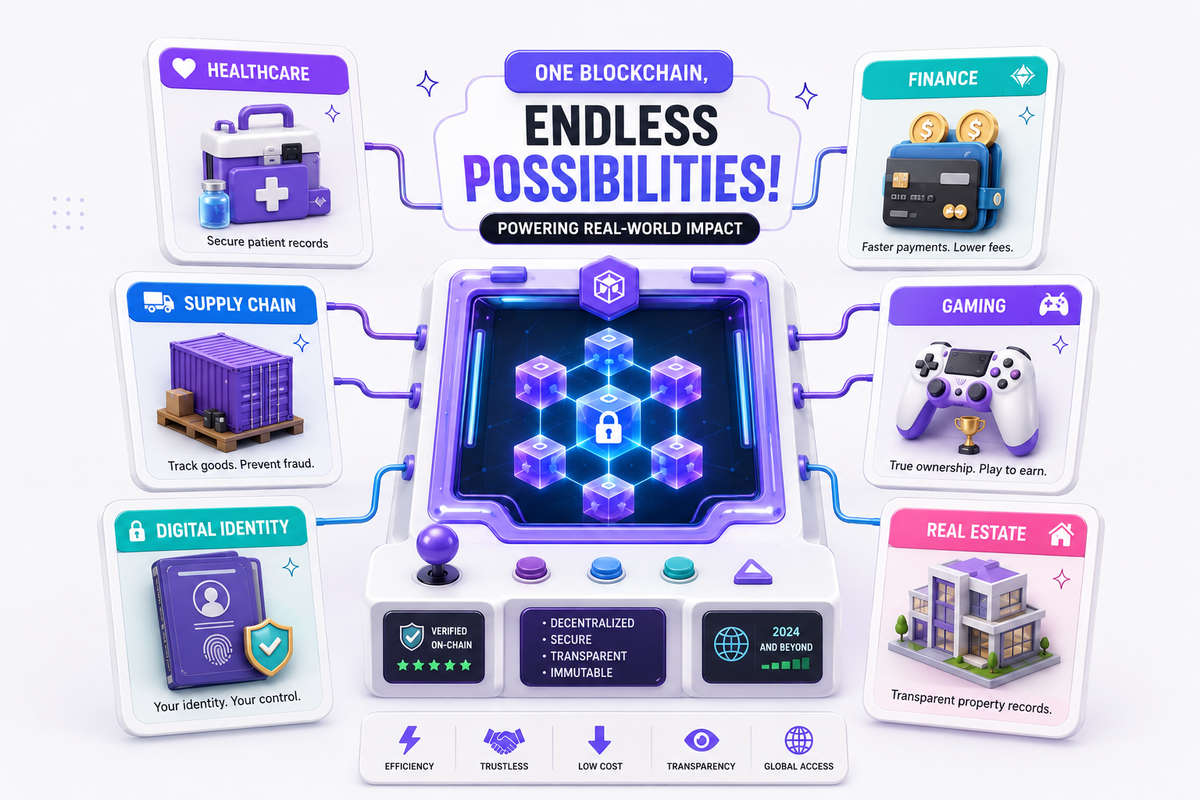
Industries that have historically struggled with fraud, inefficiency, and lack of transparency are discovering that on-chain transactions solve problems they've been working around for decades. This blog walks through the most compelling real-world applications, from supply chains and real estate to healthcare and renewable energy, and shows why this technology is proving to be far more than a financial experiment.
Supply Chain Management
Global supply chains move trillions of dollars worth of goods every year, and they do it with a surprising amount of guesswork. When something goes wrong, whether a shipment gets lost, a product turns out to be counterfeit, or a supplier misrepresents their practices, tracing the problem back to its source is slow, expensive, and often inconclusive.
On-chain transactions change that by creating a permanent, verifiable record of every step a product takes from origin to destination. Every handoff, every quality check, every shipment update gets recorded on the blockchain. Nothing can be altered after the fact, which means accountability is built into the system rather than enforced after problems arise.
In agriculture, farmers and distributors use blockchain to document the journey of crops like coffee and rice, verifying fair trade practices and quality standards at every stage. In pharmaceuticals, the stakes are even higher. Counterfeit medicines kill hundreds of thousands of people every year, and on-chain traceability gives hospitals and pharmacies a reliable way to verify that the drugs they're dispensing are genuine. Companies are tracking vaccines from manufacturing facilities all the way to the patient, creating a chain of custody that's nearly impossible to falsify.
Luxury goods manufacturers face a similar challenge. Brands use blockchain to issue digital certificates of authenticity tied to individual products, giving buyers a way to confirm they're purchasing the real thing rather than a convincing copy.
Beyond fraud prevention, on-chain transactions reduce the operational friction that makes supply chains so expensive to run. Smart contracts can automatically trigger payments the moment goods are verified as delivered, cutting out the manual approval steps that add days and costs to every transaction. The result is a supply chain that's faster, cheaper, and more trustworthy for everyone involved.
Real Estate Transactions
Buying or selling property is one of the most significant financial decisions most people ever make, and the process is notoriously painful. Multiple attorneys, brokers, title companies, and lenders are all involved, each adding their own fees and their own timelines. A transaction that should logically take a few days routinely takes weeks or months.
On-chain transactions are cutting through that complexity in several meaningful ways.
The most fundamental change is in how property records are stored and verified. When ownership history lives on a blockchain, it's transparent, permanent, and accessible to anyone who needs to check it. The need to dig through physical records, contact multiple agencies, or wait for manual verification largely disappears. The information is just there, accurate and up to date.
Smart contracts take this further by automating the actual transfer process. When a buyer sends payment, the smart contract verifies it and automatically transfers the title. No manual approval required, no waiting for a closing agent to process paperwork. The whole exchange can happen in minutes rather than weeks.
Tokenization is another development worth paying attention to. On-chain transactions make it possible to divide ownership of a property into digital tokens, which can then be bought and sold like shares. This opens up real estate investment to people who couldn't otherwise afford to buy a whole property, and it creates a level of liquidity in the market that traditional real estate simply doesn't have. A commercial building that would previously require a single large investor can now have dozens of partial owners, each holding a verifiable on-chain stake.
The benefits add up quickly. Transactions are faster, fees are lower because fewer intermediaries are involved, and the security of blockchain means the risk of title fraud or forgery drops dramatically.
Gaming and Virtual Economies
The gaming industry generates over $180 billion annually, and a significant portion of that comes from in-game purchases. Skins, weapons, characters, virtual currency, and players spend real money on digital items every day. But under the traditional model, those items don't really belong to the player. They belong to the game developer. If the game shuts down or changes its terms, your investment disappears with it.
On-chain transactions are fixing this by establishing true, verifiable ownership of digital assets. When you purchase an item in a blockchain-based game, that transaction is recorded on the blockchain, and the item belongs to you in a meaningful sense. You can sell it, trade it, or, in some cases, use it in other compatible games. The developer shutting down doesn't wipe out your ownership because your ownership isn't stored on their server.
The practical implications are significant. Axie Infinity built an entire play-to-earn economy around blockchain assets, allowing players to earn real income by buying, breeding, and selling digital creatures called Axies, each of which is a unique NFT with verified on-chain ownership. Decentraland and The Sandbox have done the same with virtual land, creating real estate markets in digital spaces where ownership is transparent and transactions are secure.
Interoperability is the next frontier. As more games build on compatible blockchain standards, assets purchased in one game may eventually be usable in others, creating a genuinely open digital economy rather than a collection of isolated corporate ecosystems.
For players, this means their time and money invested in games can build actual value. For developers, it creates new economic models that align player incentives with the health of the overall ecosystem. The whole dynamic of gaming shifts when ownership is real rather than conditional.
Financial Services and Payments
This is the application most people are at least partially familiar with, but it's worth going deeper than the surface-level narrative.
Cross-border payments are one of the clearest wins for on-chain transactions. Sending money internationally through traditional banking channels is slow and expensive. Wire transfers can take days and carry fees that eat into the amount being sent, a particularly painful reality for people in developing countries who rely on remittances from family members working abroad.
On-chain transactions process the same transfer in minutes, at a fraction of the cost, because there's no network of correspondent banks, each taking a slice of the transaction. Platforms like Ripple have built entire businesses around this use case, enabling financial institutions to settle cross-border transactions almost instantly.
Stablecoins are critical to making this practical. Cryptocurrencies like Bitcoin can swing dramatically in value, which makes them impractical for everyday payments. Stablecoins like USDC and DAI are pegged to the US dollar, which means their value stays consistent. You can send $200 worth of USDC across the world, and the recipient gets $200 worth of value, not $180 because the price dropped during transmission.
Decentralized finance platforms add another dimension by enabling peer-to-peer lending and borrowing without traditional banks. On Aave or Compound, a user can lend their stablecoins and earn interest, while a borrower accesses funds instantly without a credit check or a lengthy approval process. Smart contracts handle the terms, the collateral, and the repayment automatically, removing the need for a bank to sit in the middle of the relationship.
For individuals who have historically been underserved by traditional banking, whether because of geography, income level, or lack of credit history, this access represents a genuine shift in financial inclusion.
Healthcare and Pharmaceuticals
Healthcare has some of the most complex data management challenges of any industry. Patient records are fragmented across hospitals, clinics, and specialists. Sensitive information gets lost in transfers. Billing is riddled with errors and delays. And the pharmaceutical supply chain, as mentioned earlier, is vulnerable to counterfeiting in ways that cost lives.
On-chain transactions are addressing each of these problems in practical ways.
For patient records, blockchain provides a single, tamper-proof source of truth that patients actually control. Instead of your medical history living on half a dozen different hospital systems that don't talk to each other, it can live on a blockchain where you decide who has access. A new doctor can pull up your complete history in seconds with your permission, rather than waiting days for records to be transferred through fax machines, which, unbelievably, is still common practice in many healthcare systems.
Platforms like MediBloc are building this infrastructure now, giving patients genuine control over their health data while making that data more useful and accessible for the providers treating them.
For pharmaceutical companies, on-chain traceability of drug batches from manufacturing through distribution to dispensing creates accountability at every step. Moderna has used blockchain to track vaccine distribution, and the model is spreading across the industry as the benefits become clear. A pharmacist who can verify the chain of custody for a medication before dispensing it is in a fundamentally better position than one who has to take authenticity on faith.
Billing automation through smart contracts is another area with significant potential. Healthcare billing errors cost the system billions of dollars annually. Smart contracts that trigger payments automatically when services are rendered and verified could cut a substantial portion of that waste.
Crowdfunding and Fundraising
Traditional crowdfunding platforms have a transparency problem. Backers hand over money and largely hope it gets used the way the campaign promised. Fees are high, accountability is limited, and in cases where campaigns underdeliver or collapse entirely, contributors often have little recourse.
On-chain crowdfunding changes the accountability equation dramatically. Every contribution is recorded on the blockchain, visible to anyone. Smart contracts can hold funds in escrow and release them only when specific conditions are met, which means backers have real protection against funds being misused.
Decentralized Autonomous Organizations are taking this further by creating community-driven funding models where contributors don't just give money but also get a say in how it's spent. Gitcoin has used this model to raise millions for open-source software projects, with contributors able to see exactly how their money is being deployed and vote on future allocations.
Global charities are finding real value here, too. Platforms like Giveth enable donations that go directly to recipients without fees being extracted at multiple points along the way. For donors who want confidence that their contribution actually reaches the cause they care about, blockchain-based transparency is a significant improvement over the status quo.
Token-based crowdfunding adds another layer by giving backers something tangible in return for their support. Tokens can represent voting rights, early access, or financial returns if a project succeeds. This alignment of incentives between founders and backers creates a healthier dynamic than traditional crowdfunding, where backers have no ongoing stake in the outcome.
Emerging Trends Worth Watching
Beyond the established applications, several newer use cases are showing real promise.
Micropayments for digital content are becoming viable for the first time. Traditional payment systems make tiny transactions impractical because the fees are disproportionate to the amount being transferred. On-chain micropayments make it possible for a reader to pay a few cents for a single article or a viewer to tip a creator a small amount directly, creating revenue models for digital content that don't rely entirely on advertising or subscriptions.
Renewable energy tokenization is an interesting development in sustainability. Solar farms and wind energy producers can issue tokens representing units of clean energy output, which buyers can purchase, trade, or redeem. This creates a transparent, decentralized market for clean energy credits that makes sustainable purchasing more accessible and verifiable.
Carbon credit trading is a related area where on-chain transparency is solving a real credibility problem. The voluntary carbon market has historically been difficult to audit, with questions about whether credits represent genuine emissions reductions. Blockchain-based platforms like KlimaDAO are creating verifiable, tamper-proof records of carbon credits, making it harder to sell the same credit twice and easier for companies to demonstrate genuine environmental accountability.
Digital identity management is perhaps the broadest emerging trend, and in many ways it ties together everything discussed in this blog. Platforms like Civic and BrightID are building blockchain-based identity systems that let users verify who they are without handing over excessive personal data. As more transactions, services, and interactions move on-chain, having a secure, portable digital identity becomes foundational infrastructure rather than a nice-to-have feature.
Final Thoughts
On-chain transactions are not a single technology solving a single problem. They're a foundational shift in how trust, ownership, and value exchange work in a digital world.
Every industry discussed in this blog shares a common thread: processes that were slow, expensive, opaque, or vulnerable to fraud are becoming faster, cheaper, more transparent, and more secure when they move on-chain. That's not a coincidence. It's what happens when you remove the need for a trusted intermediary and replace it with a system where trust is built into the architecture itself.
For businesses looking to operate in this new environment, establishing a presence in the Web3 ecosystem is a practical first step. Platforms like Endless Domains make it straightforward to secure a Web3 domain and begin building a decentralized digital identity that positions you for the direction things are heading.
The adoption curve is still early. The businesses and individuals who understand what on-chain transactions actually make possible, and move accordingly, are the ones who will be best positioned as this technology continues to mature.