Should you get a Polygon Domain in 2025?
Polygon Domains: Worth it in 2024? Delve into the advantages and considerations before securing your decentralized identity.

With so many blockchains now offering their own domain names, it's a fair question: why pick Polygon over everything
else out there? Our short answer is that if you value simplicity, real ownership, interoperability, and long-term potential, a Polygon domain is a genuinely solid choice. Here's the fuller picture.
The Polygon Story So Far
Polygon, originally launched as Matic Network, has come a long way since its 2017 debut. It set out to solve one specific problem: Ethereum's scalability bottleneck, which made transactions slow and expensive as the network grew popular. As a layer-2 scaling solution, Polygon processes transactions faster and more cheaply, then settles back to Ethereum for security. Along the way, it leaned hard into NFTs, positioning itself as one of the more NFT-friendly networks in the space.
So What Is a Polygon Domain?
Simply put, a Polygon domain is a domain name that lives on the Polygon blockchain, minted as an NFT which is true of basically every blockchain domain, regardless of which chain it's on. One detail worth knowing: Polygon Labs itself doesn't run domain registration. That's handled by outside teams (Unstoppable Domains being the best-known example), who build the registration and minting infrastructure on top of Polygon's network.
Who's Behind Polygon?
Polygon was founded in 2017 by four people: Jaynti Kanani, Anurag Arjun, Sandeep Nailwal, and Mihailo Bjelic. When the project rebranded from Matic Network to Polygon in 2021, it brought on a group of well-known advisors from the Ethereum world, including Hudson Jameson (Ethereum Foundation), Anthony Sassano (EthHub), Ryan Sean Adams (Bankless), and Pete Kim (Coinbase), to help steer its direction.
It's worth noting that the founding team has changed quite a bit since then. Kanani and Arjun both stepped back from day-to-day involvement a few years ago, and Bjelic left the Polygon Foundation board in 2025. Sandeep Nailwal is now the only original co-founder still actively involved, and he stepped into the CEO role at the Polygon Foundation that same year. Backing for the project has come from major names like Coinbase and Binance, among others, and over the years the team has built partnerships with companies across gaming, prediction markets, and entertainment.
What Is Polygon Actually Trying to Do?
At its core, Polygon wants to be an Ethereum-compatible, multi-chain network meaning developers can build apps that talk to Ethereum without paying Ethereum's fees or waiting on Ethereum's congestion. Like Ethereum, it runs on a proof-of-stake consensus model. Its native token has gone through a rebrand of its own: what used to be called MATIC is now POL, following an upgrade Polygon rolled out to unify its growing family of chains under one token. DeFi platforms, DAOs, and NFT projects all run on top of this infrastructure.
How Polygon's Architecture Actually Works
Polygon's network is built around three layers, each handling a different job:
- The Ethereum layer a set of smart contracts on Ethereum itself that handle staking, dispute resolution, and "checkpointing" (the process that locks in Polygon's transaction history on the Ethereum chain).
- The Heimdall layer Polygon's proof-of-stake validation layer, where validators stake tokens, monitor the network, and bundle transaction batches into checkpoints sent over to Ethereum.
- The Bor layer the layer that actually produces blocks and processes transactions, optimized for speed since it doesn't need to handle consensus itself.
This division of labor is what lets Polygon offer Ethereum's security guarantees while running noticeably faster and cheaper which, again, is exactly why something like free domain minting is even possible.
What Makes a Polygon Domain Worth Having
A few things stand out:
It's part of a real ecosystem. Polygon has the infrastructure, tooling, and developer community to actually build on top of and it shares a lot of that community with Ethereum itself.
It plays nicely with Ethereum. Because Polygon works as both a Layer-2 extension of Ethereum and a standalone chain, it's effectively treated as part of the broader Ethereum ecosystem, which keeps it relevant to a large existing user base.
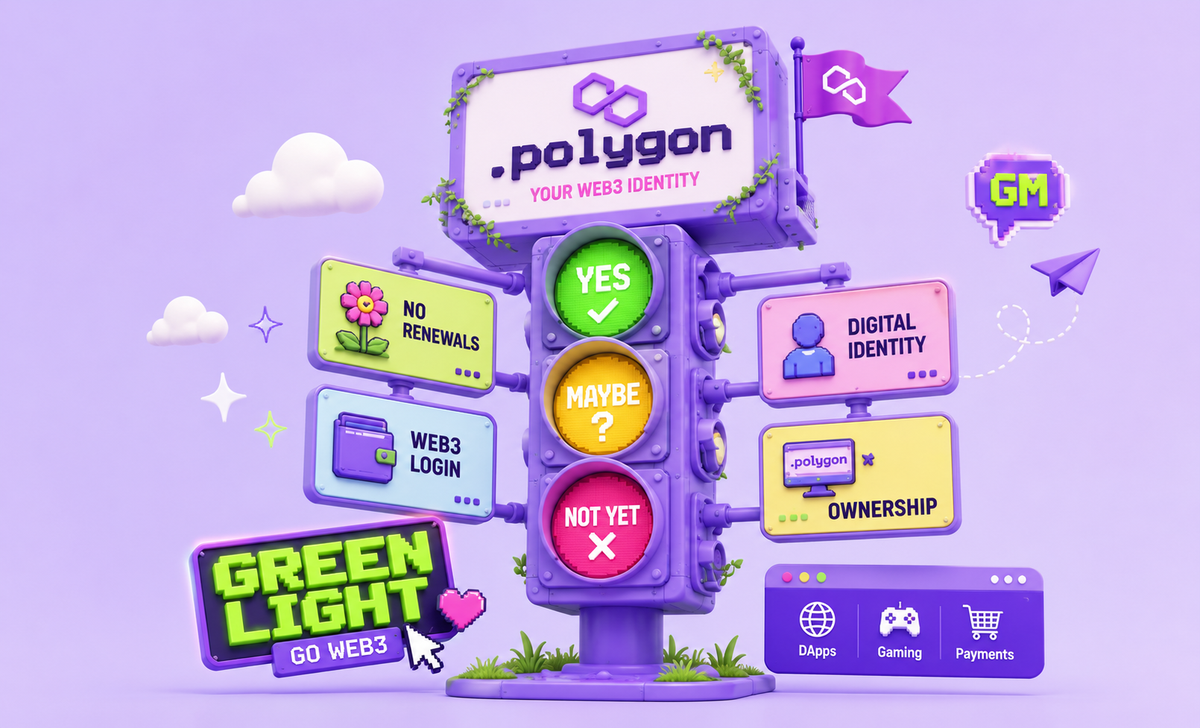
Minting is free (or close to it). Unlike minting directly on Ethereum, which can get expensive when the network is busy, Polygon domains typically mint with no gas or transaction fees. If you already own an Ethereum-based domain through Unstoppable Domains, you can usually convert it to a Polygon domain rather than starting over.
You actually own it. Domains converted to Polygon through Unstoppable Domains drop the annual renewal fee entirely so it feels much closer to owning something outright than renting a name year after year.
It runs on proof-of-stake. Validators stake tokens to participate, which sidesteps the energy demands of mining-based networks.
Why Choose Polygon Over a Different Chain?
Polygon's pitch has always been about applying solid engineering to Ethereum's scaling problem while staying genuinely easy to use. Big brands like Adidas and Instagram have used Polygon to introduce mainstream audiences to NFTs and digital collectibles though it's worth noting that not every corporate experiment in this space has stuck around long-term; Reddit's own NFT-based avatar marketplace, for instance, ran on Polygon for a few years before the company wound it down in 2025.
Still, Polygon's broader NFT-first positioning has paid off in terms of adoption, and its emphasis on scalability and cross-chain compatibility (it interoperates with chains like BNB Chain and Optimism) gives it a reasonable case for staying relevant as the space evolves. Unstoppable Domains has estimated that moving its domain business to Polygon has saved users somewhere around $100 million in gas fees compared to minting the same names on Ethereum a meaningful number if you're trying to get more people comfortable registering a Web3 identity in the first place.
What to Think About Before You Buy
A few practical things worth weighing before you register:
- Market conditions. Crypto markets move fast, and demand for any kind of blockchain domain tends to track the broader mood around Web3 and NFTs. It's worth getting a read on where things stand before you buy, rather than assuming today's conditions will hold.
- The technical side. Make sure you're comfortable with what owning and maintaining a blockchain domain actually involves wallet security, how (and whether) you'll point it at a website, and so on.
- Risk and diversification. Treat a domain purchase like any other crypto-adjacent spending: understand that values can swing, and don't put in more than you're comfortable potentially losing.
- A second opinion never hurts. If you're on the fence, it's reasonable to talk to people who are already active in the space before committing.
The Honest Challenges
Polygon has real strengths, but it's not without legitimate concerns:
Competition. Polygon's most direct competitors are other Ethereum Layer-2 networks Arbitrum, Optimism, Base, and zkSync Era chief among them all fighting over the same developers and users with different trade-offs around speed, cost, and security. (Chains like Solana and Avalanche compete for similar use cases too, but technically they're standalone Layer-1 networks rather than direct Layer-2 rivals.) Ethereum itself is also continuing to roll out its own scaling improvements, which could chip away at the need for Layer-2 networks like Polygon altogether.
Centralization concerns. Despite running on proof-of-stake, Polygon's validator set is smaller and more concentrated than some of its competitors, which has drawn fair criticism about how decentralized the network really is. Core developers also retain the ability to push network updates without a lengthy community approval process a trade-off for speed and agility, but one that some users find uncomfortable.
None of this means Polygon is a bad bet every Layer-2 network has its own version of these trade-offs but it's worth going in with eyes open.
Where This Could Be Headed
A few reasons Polygon domains have real staying power, at least directionally:
Web3 adoption keeps growing, slowly but steadily, and a portable, user-owned identity becomes more valuable the more apps and platforms someone interacts with.
The ecosystem is already large. Polygon supports hundreds of dApps, games, and metaverse projects, and a domain that works across that entire footprint is a lot more useful than one tied to a single platform.
Interoperability is the whole point. Unlike a traditional domain that only works in one context, a Polygon domain can move with you across different chains and applications which is exactly the kind of flexibility a fragmented Web3 landscape rewards.
Final Thoughts
As the blockchain space matures, there's a growing appetite for projects that connect different chains rather than compete in isolation and that shift toward cooperation is part of why something like a Polygon domain has real appeal. It's a practical way to plant a flag for your Web3 identity, and if the broader market trends in a sane direction, there's a reasonable case that a recognizable domain name could hold or grow its value over time. Just go in with realistic expectations, do your own homework on the risks, and you'll be in good shape either way.