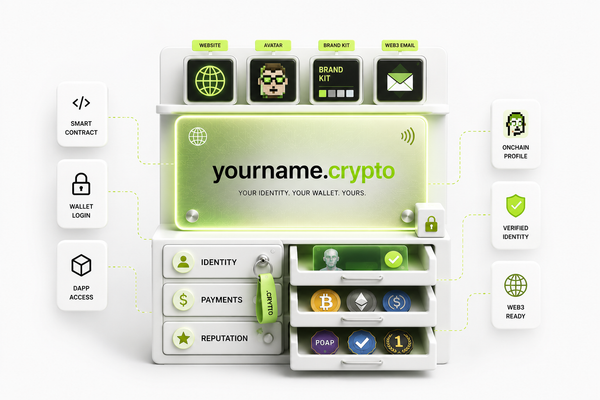
Purpose and Benefits of Blockchain Domains
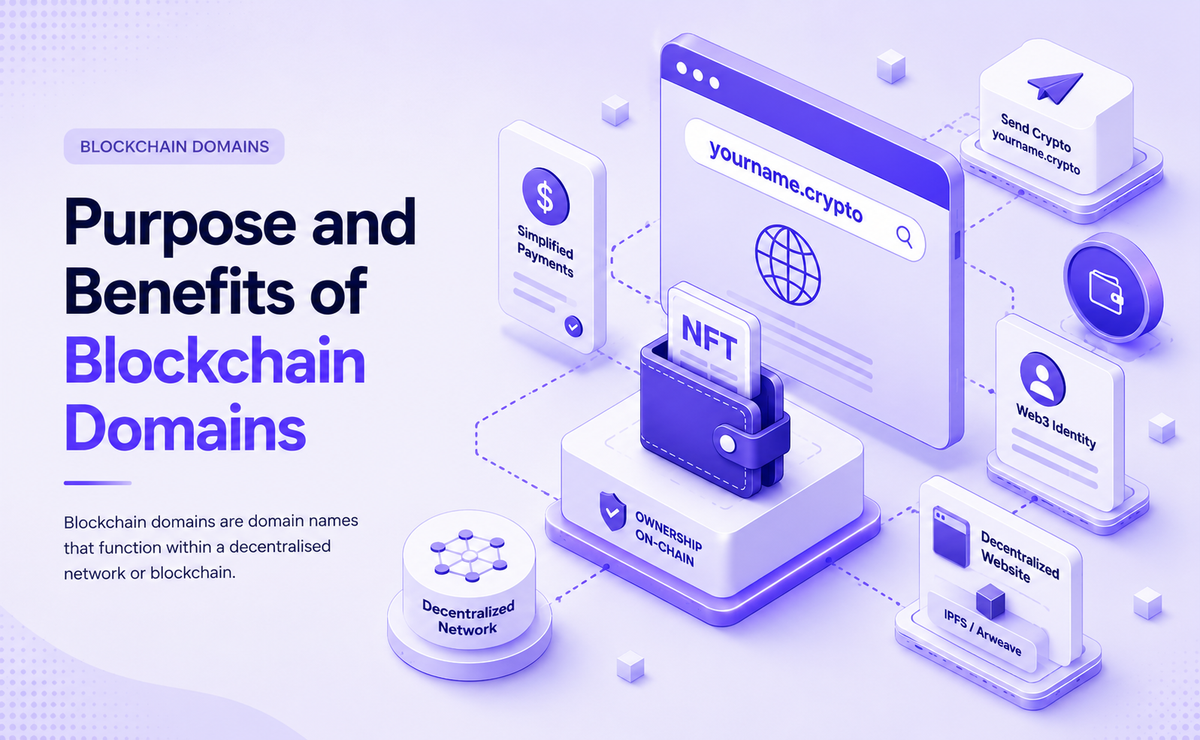
Blockchain domains are domain names that function within a decentralised network or blockchain.
You've probably typed ".com" into a browser thousands of times without thinking twice. But what if your web address could also be your crypto wallet, your Web3 username, and your digital identity all in one? That's the promise of blockchain domains, and it's starting to catch on.
Blockchain domains are one of the most talked-about concepts in the Web3 space right now. But like most emerging technologies, they come with a fair share of hype and a fair share of real limitations that often get glossed over. This blog breaks down what blockchain domains actually are, how the technology works under the hood, what you can do with them today, and what's still holding them back from going mainstream.
What Is a Blockchain Domain?
A blockchain domain is a domain name that lives on a blockchain network instead of the traditional internet infrastructure managed by ICANN and standard DNS providers.
Traditional domain names, such as ".com", ".org", or ".net", are leased through registrars and depend on a centralized system of DNS servers to function. Blockchain domains, by contrast, are stored on decentralized blockchain ledgers. Ownership is typically represented through an NFT (Non-Fungible Token), meaning the domain sits directly inside the owner's crypto wallet.
Common blockchain domain extensions include:
One of the most practical use cases is simplifying crypto payments. Instead of sending funds to a complex wallet address like
0x7f3A9B2e5cD8...
A user can simply send it to:
yourname.crypto
That's a meaningful improvement in usability, especially for everyday users who aren't comfortable copying and pasting 40-character strings.
How Blockchain Domains Actually Work
Most articles mention blockchain domains without explaining the mechanics. The reality is that different blockchain domain systems operate on different networks and protocols. Most blockchain domains function through smart contracts. Here's a simplified breakdown of the process:
1. Domain Registration A user purchases a blockchain domain from a Web3 naming service provider.
2. NFT-Based Ownership The domain is minted as an NFT on a blockchain. This NFT serves as proof of ownership and is stored in a compatible crypto wallet like MetaMask or Phantom.
3. Wallet Mapping The domain is linked to one or more cryptocurrency wallet addresses, allowing others to send payments using a readable name instead of a raw wallet string.
4. Decentralized Resolution When someone types the blockchain domain into a supported browser or wallet, the system queries blockchain records to resolve the destination. Unlike traditional DNS, this data is verified across a decentralized network of nodes, and no single server controls it.
How Blockchain Domains Differ from Traditional Domains
Both domain types help users navigate online systems, but their infrastructure is fundamentally different.
Ownership: Traditional domains are leased; you pay annually, and if you miss a payment or violate policies, your domain can be suspended or revoked. Blockchain domains, in most cases, are owned outright through an NFT. Many providers offer permanent ownership after a one-time purchase, though terms vary by provider.
Infrastructure: Traditional domains rely on DNS servers controlled by central authorities. Blockchain domains rely on decentralized blockchain networks and smart contracts.
Transfers of traditional domains require registrar involvement for many transfer operations. Blockchain domains can often be transferred directly between crypto wallets, peer-to-peer, without a middleman.
Compatibility: Traditional domains work universally across every browser and device. Blockchain domains currently require supported browsers, extensions, wallets, or gateways to function. This is one of their biggest limitations today.
Real-World Uses of Blockchain Domains
Blockchain domains aren't just theoretical. Several Web3 communities are already using them actively across multiple use cases.
Crypto Payments ENS domains are widely used in the Ethereum ecosystem to simplify wallet transactions. Users send crypto directly to readable names like:
- alex.eth
- artist.crypto
- trader.sol
Decentralized Websites. Some blockchain domains host websites through decentralized storage systems like IPFS (InterPlanetary File System) and Arweave. Because files are distributed across a network instead of a single server, these websites are significantly harder to take down.
Digital Identity Blockchain domains are increasingly being used as Web3 usernames. Users connect them to NFT profiles, crypto wallets, gaming identities, decentralized social media platforms, and metaverse environments, creating one unified digital identity across the Web3 ecosystem.
NFT and Community Branding NFT projects and DAOs often use blockchain domains to establish branding and community identity, with names like projectname.eth or creator.crypto.
The Benefits of Blockchain Domains
When used within the Web3 ecosystem, blockchain domains offer several real advantages.
1. Simplified Crypto Transactions Long alphanumeric wallet addresses are difficult to memorize and easy to mistype. Blockchain domains dramatically reduce that friction, making crypto payments more accessible to everyday users.
2. Greater User Control Because users hold blockchain domains directly in their wallets not through a registrar they have more direct ownership and control over their digital identity.
3. Seamless Web3 Integration Blockchain domains can connect with crypto wallets, NFT marketplaces, decentralized finance (DeFi) platforms, blockchain games, and dApps. This makes them a useful foundation for a unified Web3 identity.
4. Censorship Resistance (With Caveats) Decentralized websites hosted on systems like IPFS are harder to shut down than traditionally hosted sites. That said, censorship resistance is not absolute governments can still restrict access through internet regulations, browser controls, or gateway blocking.
5. Investment and Branding Potential Some users acquire blockchain domains as digital assets for trading or long-term brand building. Premium names are sometimes resold in ways similar to traditional domain investing, though the market is far less mature.
The Limitations Most Blogs Ignore
Blockchain domains get a lot of enthusiastic press coverage, but there are real challenges that are frequently understated or omitted entirely.
1. Most Browsers Don't Support Them This is arguably the biggest barrier to mainstream adoption right now. Google Chrome, Apple Safari, and Microsoft Edge do not natively support most blockchain domains. Users typically need a browser extension, a special gateway, a compatible wallet, or a Web3-enabled browser just to visit a blockchain website. For the average internet user, this is a non-starter.
2. The User Experience Is Still Complicated Despite marketing that emphasizes simplicity, blockchain domains still require familiarity with crypto wallets, gas fees, private keys, NFTs, and blockchain transactions. For non-technical users, the learning curve remains steep.
3. Privacy Isn't Guaranteed Blockchain domains are sometimes marketed as offering complete privacy. In reality, blockchain transactions are publicly visible on-chain. Wallet activity connected to a domain can still be traced publicly. While users may not share personal information during registration, blockchain transparency creates its own privacy trade-offs.
4. Security Risks Fall on the User Blockchain systems have strong security properties, but individual users are entirely responsible for protecting their own wallets and private keys. If someone loses wallet access or gets hacked, recovering a blockchain domain can be impossible. Unlike traditional registrars, there's no customer support team that can restore ownership.
5. Legal and Regulatory Uncertainty This is an often-overlooked area with significant implications:
- Trademark Disputes: What happens if someone registers a well-known brand name as a blockchain domain before the company does? Traditional domains have established dispute-resolution processes like UDRP. Blockchain domains lack universal legal frameworks for handling these conflicts.
- Illegal Content: If a decentralized website hosts illegal or harmful content, removing it is far more difficult because files are distributed across multiple nodes.
- Government Regulations: Countries may eventually introduce rules around digital identities, crypto-linked domains, decentralized hosting, taxation, and intellectual property. This legal uncertainty creates real risk for anyone making long-term decisions around blockchain domains.
Are Blockchain Domains Replacing Traditional Domains?
Not anytime soon and possibly not ever in the way some enthusiasts predict.
Blockchain domains are best understood as complementary to traditional domains, not competitive with them. Traditional domains still dominate because they're universally supported, accessible to average users, legally established, and deeply integrated into the global internet infrastructure.
Blockchain domains are growing mainly within the Web3 ecosystem. The more realistic picture for the near future is that both systems coexist: traditional domains for mainstream web usage and blockchain domains for decentralized identity, crypto ecosystems, and Web3 applications.
Final Thoughts
Blockchain domains represent a meaningful step toward decentralized digital identity and Web3 infrastructure. They simplify crypto transactions, support decentralized applications, and give users more direct ownership over their online presence all genuinely useful things.
At the same time, the technology is still early. Limited browser support, technical complexity, regulatory uncertainty, and unresolved legal questions remain serious obstacles to mass adoption.
Projects like the Ethereum Name Service, Unstoppable Domains, and Endless Domains are helping move the industry forward. But as with any emerging technology, it's worth understanding both the strengths and the limitations before drawing conclusions about what blockchain domains mean for the future of the internet.
If you're building in Web3, exploring crypto-native identity, or just curious about where decentralized infrastructure is headed, blockchain domains are worth paying attention to. The ecosystem is still forming, and the decisions made now about standards, ownership, and governance will shape how it develops for years to come.