Why a Polygon Domain Might Be the Smartest Web3 Move You'll Make This Year
Securing a polygon domain could be wise as it empowers you to navigate the decentralized web with greater ease, control, and innovation.


With dozens of blockchains now supporting Web3 domains, choosing where to plant your flag can feel overwhelming. Ethereum, Solana, Binance Smart Chain they all have their advocates, their trade-offs, and their communities. So why should Polygon be the one you look at first?
Here's our honest take if you care about low costs, real ownership, broad compatibility, and a network that major brands are already betting on, Polygon deserves serious consideration. This isn't about hype it's about practical advantages that make a real difference when you're actually building or investing in the decentralized web.
Let's dig in.
The Polygon Story: From Matic to Mainstream
Polygon didn't start as a domain platform. It started as a solution to one of Ethereum's most persistent problems: scalability.
Originally launched as Matic Network, Polygon was designed as a Layer 2 scaling solution for Ethereum a way to process transactions faster and cheaper without abandoning Ethereum's security and developer ecosystem. Over time, it evolved into something more ambitious: a full multi-chain infrastructure platform that doesn't just sit on top of Ethereum but actively extends what Ethereum can do.
More recently, Polygon made a deliberate strategic move to position itself as an NFT-first network. That decision opened the door to Web3 domains and to the mainstream brands, developers, and users that followed.
The four co-founders Jaynti Kanani, Anurag Arjun, Sandeep Nailwal, and Mihailo Bjelic built something that attracted serious advisors, including Pete Kim from Coinbase, Anthony Sassano from EthHub, and Hudson Jameson from the Ethereum Foundation. Coinbase, Binance, and MIH Ventures all back the protocol. This isn't a scrappy side project it's infrastructure with institutional support.
What Is a Polygon Domain, Exactly?
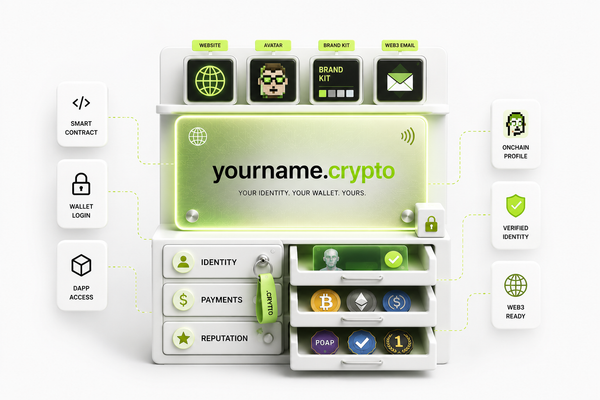
Think of a Polygon domain as the Web3 equivalent of a .com address but with a few important upgrades baked in.
Technically, Polygon domains are a type of Web3 domain that lives on the Polygon blockchain. Like all blockchain-based domains, they exist as NFTs which means they're owned assets, not rented names. When an outside project or team decides to build domain services on Polygon, they're working within Polygon's ecosystem, using its infrastructure and smart contract capabilities to create and manage those domains.
In practical terms, a Polygon domain replaces the long, unwieldy crypto wallet addresses that make Web3 confusing for newcomers. Instead of sending funds to something like 0x4bE6...f92A, you send them to yourname.polygon. Simple, human-readable, and far less prone to the kind of copy-paste errors that have cost people real money.
What's Under the Hood: Polygon's Technology
Polygon runs on a multi-layered architecture, and each layer plays a specific role:
The Ethereum base layer handles the foundational stuff interoperability between Polygon and Ethereum, dispute resolution, staking, and checkpointing. This is where Polygon's deep connection to Ethereum lives.
The security layer runs concurrently and provides an additional level of protection through a "validators as a service" model. Networks built on Polygon can tap into this shared security layer rather than bootstrapping their own from scratch.
The Polygon network layer is where developers launch and operate their specific blockchains and applications. Polygon uses a Proof-of-Stake (PoS) consensus mechanism, which means validators stake MATIC tokens to secure the network rather than burning through energy-intensive mining. MATIC, the network's native token, is an ERC-20 token meaning it works seamlessly with the broader Ethereum ecosystem.
The result is a network that gives developers the best of Ethereum its security, its community, its compatibility without Ethereum's current limitations, like high gas fees and congestion-driven slowdowns.
Why Polygon Domains Are Worth Your Attention
Here's where things get practical. Let's talk about what Polygon domains actually do for you.
They make crypto transactions genuinely easy. Sending cryptocurrency to a Polygon domain address is about as intuitive as sending an email. No long addresses to triple-check, no formatting errors, no anxiety about whether you sent funds to the right place. For onboarding people who are new to crypto, this usability improvement is significant.
They're built on a network developers already trust. Polygon shares a large portion of its developer base with Ethereum. If you're building a project, that means you have access to a massive pool of developers, tools, and resources that are already comfortable with the ecosystem. You're not starting from zero.
They're compatible with Ethereum domains. If you already own an Ethereum domain through Unstoppable Domains, you can convert it to a Polygon domain. That kind of interoperability is rare and genuinely useful for people who've already invested in Web3 identity on another chain.
Minting is free and that's a big deal. One of the most frustrating parts of working on Ethereum is gas fees. When the network gets congested, those fees can make even simple transactions prohibitively expensive. Polygon eliminates that problem for domain minting. Zero gas fees, zero transaction costs. For a user trying to register their first domain, that removes a meaningful barrier to entry.
No renewal fees ever. This is arguably the most underrated advantage of Polygon domains. Traditional domains require annual renewal payments, and forgetting to renew can mean losing your name entirely. Polygon domains, once minted, are yours permanently. No yearly bills, no expiration risk, no administrative overhead. Unstoppable Domains has estimated that this shift has saved users roughly $100 million in gas costs alone and the elimination of renewal fees adds even more long-term value on top of that.
Real ownership, not a license. With a traditional domain, you're renting. With a Polygon domain, you own. It's recorded on the blockchain, lives in your wallet, and can't be taken from you by a registrar, a platform, or a centralized authority. You can sell it, transfer it, or hold it as a long-term digital asset all on your terms.
The Brands Already Betting on Polygon
One of the clearest signals that Polygon is on the right track is who's building on it.
Adidas, Reddit, and Instagram have all used Polygon to introduce their audiences to digital collectibles and NFTs. These aren't experimental pilots from teams with something to prove these are global brands with hundreds of millions of users, making deliberate platform choices based on cost, scalability, and user experience.
Polygon's NFT-first positioning made it the natural choice. When a mainstream brand wants to give its audience an accessible entry point into Web3 without asking them to navigate expensive gas fees or complex wallet setups, Polygon provides the infrastructure to make that happen smoothly.
That mainstream adoption matters for domain holders too. As more users enter the Polygon ecosystem through brand-driven NFT Domain experiences, the demand for Polygon-based identity including domains grows alongside them.
Things to Think Through Before You Buy
Polygon domains make a compelling case, but like any investment, they deserve careful consideration. Here's what to keep in mind:
Market context. The crypto landscape shifts quickly. Before buying a Polygon domain as an investment, take time to understand current trends, where the market is heading, and how demand for blockchain-based domains is evolving. Don't buy based on hype alone.
Technical fit. Are you a developer building dApps, or an individual looking for a simple Web3 identity? Polygon domains serve both use cases, but your specific needs should drive your decision. Make sure the infrastructure aligns with what you're actually trying to build or accomplish.
Portfolio diversification. Crypto investments carry real risk. Polygon domains shouldn't be your only position. Think about how they fit into a broader strategy that balances exposure across different asset types and risk levels.
Talk to people who know. The Web3 space moves fast, and what's true today may shift significantly in six months. Seek out experienced voices developers, investors, community members who can give you grounded perspective rather than promotional enthusiasm.
The Challenges Worth Knowing About
Polygon is strong, but it's not without competition or criticism. Being honest about the challenges is part of making a good decision.
The Layer 2 space is crowded. Polygon isn't the only scaling solution vying for developers and users. Fantom, Avalanche, and Solana each offer their own set of trade-offs around speed, cost, and security. Ethereum itself is continuing to develop native scaling solutions that could, over time, reduce the need for external Layer 2 infrastructure.
Centralization concerns. While Polygon uses Proof-of-Stake, the network is currently secured by a relatively small group of validators. Some users and developers have raised concerns about how decentralized Polygon truly is especially given that the core development team can push network updates without requiring broad community approval. For those who prioritize maximum decentralization, this is worth weighing seriously.
Neither of these challenges is a dealbreaker, but they're real factors that any thoughtful buyer should understand before committing.
Where Polygon Domains Are Headed
Predicting the future in crypto is always a risky business, but the signals around Polygon domains are genuinely encouraging.
Web3 adoption is accelerating globally. As more of everyday life commerce, social interaction, creative work migrates to blockchain-powered platforms, the need for intuitive, user-owned identity solutions will only grow. Polygon domains are purpose-built to meet that need.
The Polygon ecosystem itself is expanding rapidly. Over 750 dApps are already integrated into the network, spanning gaming, DeFi, the metaverse, and beyond. A domain that works seamlessly across that ecosystem and is interoperable with other blockchains becomes more valuable as the ecosystem grows, not less.
And unlike traditional domains that are locked to specific platforms, Polygon domains are built for interoperability. They work across different blockchains and applications, which means they're not dependent on any single platform surviving or succeeding. That flexibility is exactly what "future-proof" actually looks like in practice.
Final Thoughts
The blockchain space is maturing. The early days of isolated networks and siloed communities are giving way to a more interconnected, collaborative ecosystem one where bridges between chains matter and user-friendly identity is becoming a prerequisite for mainstream adoption.
Polygon domains sit squarely at that intersection. They're low-cost, genuinely owned, broadly compatible, and backed by a network that real brands and real users are already choosing. If you're looking for a way to establish your Web3 identity or to make a considered, strategic investment in where the internet is going a Polygon domain is a very reasonable place to start.
And if the domain you pick is instantly recognizable? Even better.