How Web3 Is Transforming the Way We Showcase, Own, and Monetize Digital Assets
The blog will discuss the transformative impact of Web3 technology on showcasing digital assets. It will cover various aspects of Web3, including blockchain technology, NFTs (Non-Fungible Tokens), smart contracts, etc.

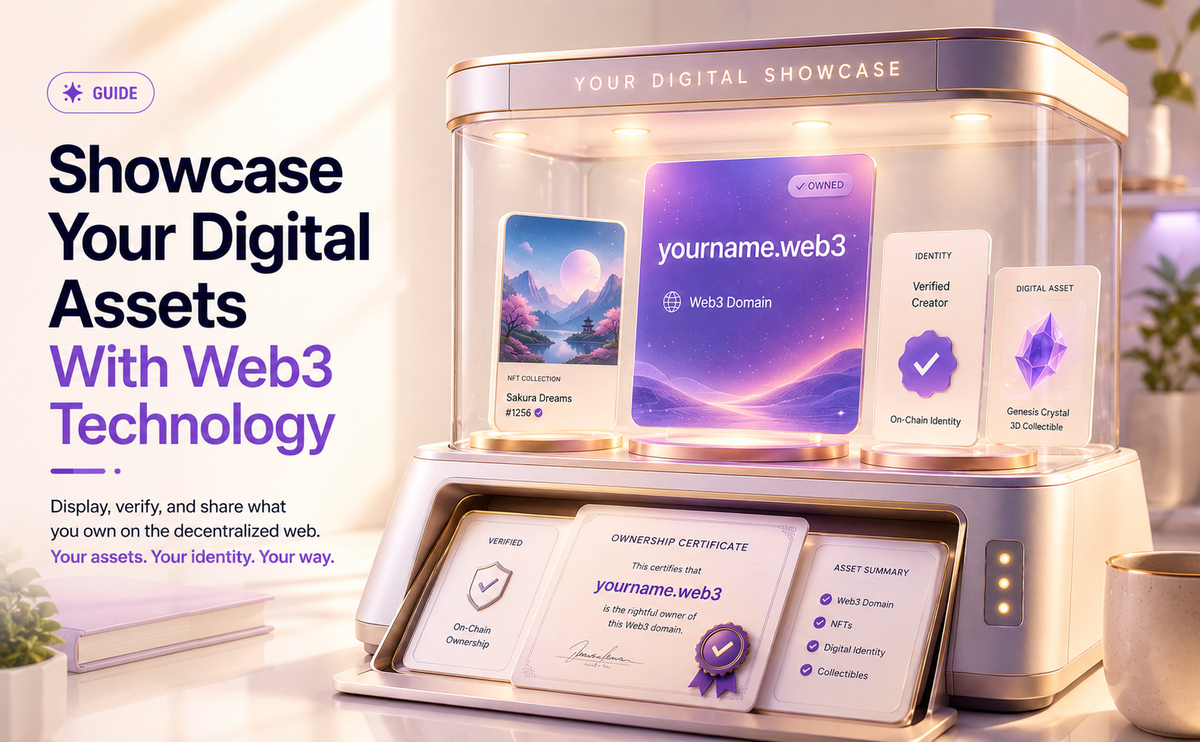
The internet has always been a place where creativity thrives but for most of its history, the creators haven't been the ones in control. Platforms took the cut, algorithms decided who got seen, and "ownership" of digital work was more of a legal gray area than a real, enforceable thing. Web3 is changing all of that.
At its core, Web3 is built on blockchain technology a system that makes digital ownership verifiable, transparent, and permanent. But the real story isn't just about the technology. It's about what that technology makes possible: a creative economy where artists keep control of their work, communities have a genuine say in what gets celebrated, and the line between creator and collector has never been thinner.
This blog explores how Web3 is reshaping the way digital assets are showcased, owned, and monetized and what that means for creators, collectors, and anyone building a presence in the decentralized web.
NFTs: What They Actually Are and Why They Matter
Before anything else, it helps to understand NFTs because they're the foundation on which most of Web3's creative economy is built.
NFT stands for Non-Fungible Token. "Non-fungible" just means it's unique and can't be swapped one-for-one with something identical, the way a dollar bill can be swapped for another dollar bill. An NFT is a digital certificate of ownership recorded on a blockchain a permanent, tamper-proof ledger that tracks every transaction.
Think of it like this: if you've ever owned a limited-edition print signed by an artist, you understand the concept intuitively. The signature and the certificate of authenticity are what make it valuable they confirm that this specific copy is the real thing. An NFT does the same job, but digitally and with far more reliability. There's no question of forgery, no risk of a lost certificate. The blockchain record is the proof.
This matters enormously for digital creators. Before NFTs, a digital painting could be copied infinitely with no way to distinguish the original from the duplicate. NFTs fix that problem. They create authenticated scarcity in a world where everything can technically be reproduced. An artist can now create a digital work, mint it as an NFT, and sell it with the same confidence that a sculptor sells a bronze casting.
But here's where it gets even more interesting: artists can embed royalties directly into their NFTs. That means every time the work changes hands every resale on a secondary market the original creator automatically receives a percentage of the sale. No middlemen, no contracts to enforce, no chasing down buyers. The payment is built into the asset itself. For musicians, visual artists, writers, and other creators, this represents a genuinely new model for long-term income that simply didn't exist before.
Smart Contracts: The Engine Running Everything
If NFTs are the ownership layer of Web3, smart contracts are the operational layer the automated logic that makes everything run without human intermediaries.
A smart contract is a self-executing program that lives on the blockchain. You set the conditions, and when those conditions are met, the contract executes automatically. No approval needed, no delays, no back-and-forth. The "if this, then that" logic is baked directly into the code.
In practice, this has some powerful applications for digital asset showcasing and sales. On an marketplace, a smart contract can instantly transfer ownership and pay the seller the moment a buyer hits the purchase button at a set price no manual processing, no waiting for a platform to approve the transaction. For subscription-based content or premium memberships, smart contracts can automatically grant or revoke access based on whether a payment has been made. For collaborative projects, they can split revenue among multiple creators according to pre-agreed percentages, every single time.
Smart contracts also function as escrow agents. Funds can be held in a contract until specific conditions are met a useful safeguard for high-value transactions between parties who don't know each other. Both sides are protected by code rather than by trust, which is a significant improvement over how most online transactions currently work.
The bottom line: smart contracts remove the friction and the third parties from digital commerce, putting creators and collectors directly in contact with each other and letting the agreed-upon terms enforce themselves.
Decentralized Storage: Keeping Your Assets Safe for the Long Haul
Here's a problem that doesn't get talked about enough in the Web3 space: where does the actual content live?
An NFT on the blockchain is a record of ownership but the image, audio file, or video it represents has to be stored somewhere. If that "somewhere" is a centralized server and that server goes down, gets hacked, or shuts down, your NFT could end up pointing to nothing. That's a real vulnerability in the current system.
Decentralized storage solutions address this directly. The InterPlanetary File System (IPFS) distributes data across a global network of computers rather than storing it on a single server. Your file doesn't live in one place it's spread across thousands of nodes, making it resistant to censorship, server failures, and single points of failure.
Filecoin takes this a step further by creating a marketplace for decentralized storage. Users can rent out spare storage space on their computers in exchange for cryptocurrency, creating a self-sustaining global network of storage providers. For creators storing large files high-resolution artwork, music albums, video content this opens up affordable, secure alternatives to traditional cloud services.
Beyond individual creators, decentralized storage has broader implications. Cultural archives, scientific datasets, and historical records that might otherwise be lost to platform shutdowns or institutional neglect can be preserved indefinitely across a distributed network. For the long-term health of digital culture, that's a meaningful development.
DAOs: When the Community Owns the Gallery
One of the most genuinely novel ideas in Web3 is the DAO a Decentralized Autonomous Organization. And when it comes to showcasing digital assets, DAOs introduce a model of community ownership and governance that has no real precedent in the traditional art world.
A DAO is essentially an organization run by its members, with decisions made through on-chain voting rather than by a board of directors or a single owner. Members typically hold governance tokens that give them voting rights proportional to their stake. Every major decision what gets featured, how revenue is distributed, which artists are spotlighted is put to a vote.
For digital asset curation, this means the community itself determines what has value and what gets seen. Token holders can vote on which artists and creators are highlighted, what themes drive upcoming exhibitions, and how the proceeds from sales are reinvested into the community. The result is a creative ecosystem where the audience isn't passive they're participants with real skin in the game.
This model also creates a stronger sense of belonging. When people have a genuine stake in a creative community when their vote actually changes outcomes they engage more deeply, advocate more enthusiastically, and contribute more meaningfully than they ever would as passive consumers. DAOs turn digital art from a transaction into a shared experience.
Virtual Real Estate: Building in the Metaverse
It sounds abstract until you see what people are actually doing with it. Virtual real estate parcels of digital land in metaverse platforms like Decentraland and Cryptovoxels has become one of the more creative ways to monetize digital assets in the Web3 era.
The concept mirrors physical real estate in most of the ways that matter. Location and size affect price. What you build on your land determines its draw. And development creates value over time. The difference is that what you build can be literally anything a virtual art gallery, a concert venue, a gaming space, a social hub, a branded experience for a company.
For digital creators, this is an underexplored opportunity. A musician could build a virtual concert hall where fans buy tickets with cryptocurrency to attend exclusive shows. A visual artist could develop a gallery space that hosts rotating exhibitions and charges admission. A brand could set up an interactive experience that introduces customers to its products in an immersive, entirely digital environment.
Getting started is more straightforward than it sounds. Choose a platform that fits your audience and goals, purchase a parcel of virtual land, develop it with experiences that are genuinely engaging, and then monetize through ticket sales, rentals, advertising, or exclusive NFT drops. The creative ceiling is high, and the early movers in compelling virtual spaces are already building real audiences.
Metaverse Galleries: The Future of Art Appreciation
The traditional gallery model white walls, printed placards, opening night with cheap wine isn't going anywhere. But it's no longer the only way to experience art, and for digital creators in particular, it was never the right fit to begin with.
Metaverse galleries give artists a space that matches the nature of their work. Three-dimensional environments where visitors explore as avatars, interact with pieces, and experience art in ways that a flat screen or a physical wall can't replicate. Collaborative exhibitions where multiple artists contribute to a unified theme. Live events performances, auctions, artist talks that bring a community together inside a curated space.
The monetization potential is real too. Metaverse galleries can generate revenue through admission fees, live auction events, exclusive NFT releases tied to the gallery experience, partnerships with brands, and rental of space to other creators or events. For artists who've always been frustrated by the economics of traditional gallery representation, this model offers a far more direct relationship between creative output and financial return.
Digital Identity in the Web3 World
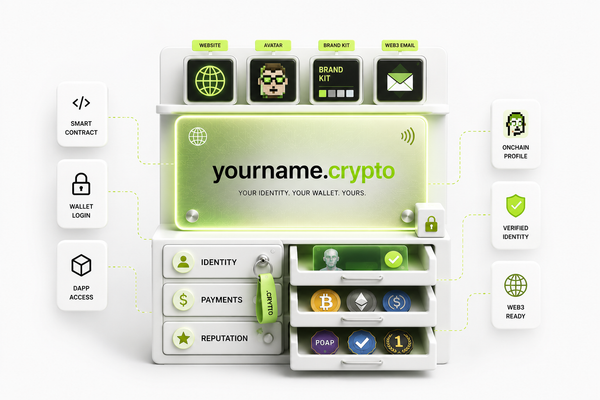
Your Web3 domain isn't just an address it's the foundation of your digital identity in a decentralized world. And Web3 takes identity far more seriously than the traditional web ever did.
Several key concepts define how identity works in Web3. Decentralized Identifiers (DIDs) are permanent, unique identifiers recorded on the blockchain that you create and control not a platform, not a company. Self-Sovereign Identity (SSI) means you decide what personal data you share, with whom, and when. No more handing over your information to Facebook to log into a third-party app.
Private key cryptography ensures that your digital identity is accessible only to you. Verifiable credentials think digital versions of licenses, certifications, or degrees can be issued by trusted sources and stored in your Web3 wallet, cryptographically verifiable by anyone without requiring a call to the issuing institution.
Together, these features create a digital identity layer that's more secure, more private, and more genuinely owned by the individual than anything the traditional web has offered.
The Real Challenges (And What's Being Done About Them)
Web3 is genuinely exciting, but it would be dishonest not to acknowledge that widespread adoption still faces real obstacles.
Complexity is probably the biggest one. Blockchain, wallets, gas fees, private keys, DAOs for someone new to all of this, the learning curve is steep. The solution isn't to dumb things down, but to build better interfaces, clearer onboarding experiences, and educational resources that meet people where they are.
Scalability remains an active engineering challenge. Ethereum, the most widely used blockchain for Web3 applications, has historically struggled with slow transaction speeds and high fees during periods of high demand. Layer 2 solutions like Polygon, rollups, and sidechains are already making significant progress here, and continued development of alternative consensus mechanisms like Proof-of-Stake is reducing both costs and energy consumption.
Security is always a concern in any financial system, and Web3 is no exception. Smart contract exploits and phishing scams have caused real losses. Rigorous code audits before deployment, better user education around security practices, and community-driven governance over security decisions are all part of the ongoing response.
Awareness is the quietest challenge but maybe the most important. Most people still have no clear picture of what Web3 is or why it might matter to them. Targeted outreach, community building, and mainstream media engagement are gradually changing that but there's still a long way to go.
Final Thoughts
Web3 isn't just a new set of tools it's a fundamentally different relationship between creators, their work, and the audiences who value it. NFTs make digital ownership real. Smart contracts make agreements self-enforcing. Decentralized storage makes content permanent. DAOs make communities genuinely collaborative. And Web3 domains tie all of it together under an identity that belongs entirely to you.
The gap between creators and collectors built up over decades of platforms taking cuts and algorithms controlling reach is closing. Web3 is doing the closing.
If you're a creator, the invitation is to explore, experiment, and build something that reflects your vision without asking anyone's permission. If you're an investor or a collector, the opportunity is to get close to where creative value is actually being generated. And if you're just curious, there's never been a better time to start paying attention.
The decentralized web is being built right now, and the people who understand it earliest will have the most say in what it becomes.