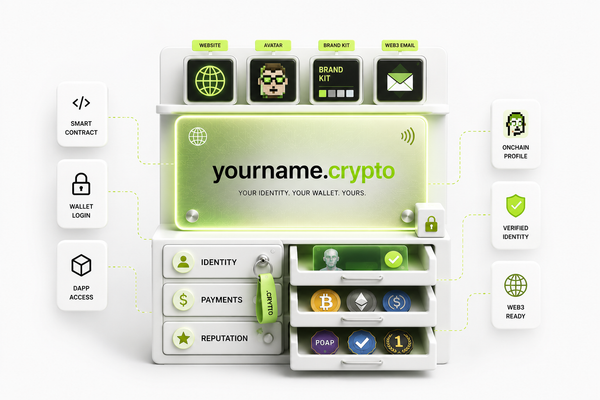
Comparison between Traditional and Web3 Domains
Web2 or Web3 domains? Understand the key differences and choose the right one for your needs.
If you've been hearing a lot about Web3 lately but aren't entirely sure what it actually means for something as practical as your domain name, you're not alone. Most conversations about Web3 tend to get abstract fast blockchains, decentralization, smart contracts and it can be hard to connect those concepts to real decisions you might need to make about your online presence.
So let's bring it back to earth. This guide breaks down the difference between Web2 and Web3 domains in plain language, explains how each system works, compares them across the factors that matter most to everyday users and business owners, and walks you through what registering a Web3 domain actually involves. By the time you're done reading, you'll have a clear picture of which option makes sense for your situation and why.
What Are Web2 Domains?
Web2 domains are the domain names most of us have been using for our entire lives online. They're the URLs you type into a browser "yourbusiness.com," "mynewspaper.org," "localrestaurant.net" that take you to a specific website.
Behind the scenes, these domain names are managed by centralized domain registrars (companies like GoDaddy, Namecheap, or Google Domains) and governed by an overarching authority called ICANN the Internet Corporation for Assigned Names and Numbers, a U.S.-based nonprofit that essentially runs the rulebook for how domain names work globally.
When you "purchase" a Web2 domain, you're not actually buying it in the traditional sense of ownership. You're renting the right to use that name for a set period usually one year at a time and renewing it annually to keep it active. During that period, you control how the domain is used, but the registrar remains the technical owner. If you forget to renew, stop paying, or violate the registrar's terms of service, you can lose access to a domain you may have built an entire business around.
That's the model most of the internet has run on for decades. It works well enough but it comes with structural vulnerabilities that Web3 domains were specifically designed to fix.
What Are Web3 Domains?
Web3 domains are a fundamentally different kind of domain name system, built to operate on decentralized blockchain networks rather than through centralized registrars. Instead of being governed by ICANN and administered by a company you're renting from, a Web3 domain is registered directly on a blockchain networks like Ethereum, Solana, Algorand, or Aptos and owned outright by whoever holds the corresponding token.
Because they're built on blockchain infrastructure, Web3 domains are classified as non-fungible tokens (NFTs), which is why you'll often hear them referred to as NFT domains. Each one is unique, verifiably owned, and recorded permanently on a public ledger that no single company or government controls.
Functionally, a Web3 domain does what a traditional domain does it establishes a route to a website or decentralized application but the ownership model, the security infrastructure, and the range of things you can use it for are all significantly different. More on that in a moment.
Web2 vs. Web3 Domains: A Side-by-Side Comparison
The differences between these two systems go deeper than just which technology they run on. Here's how they compare across the dimensions that actually matter to users:
Ownership
This is the most fundamental difference between the two systems, and it's worth taking a moment to really sit with it.
With a Web2 domain, you are a tenant. You pay for the right to use a name, and a centralized organization holds the actual ownership. If you miss a renewal payment, switch registrars improperly, or run afoul of ICANN's policies, you can lose a domain you've spent years building credibility around. That's not a hypothetical risk it happens to businesses regularly.
With a Web3 domain, you are the owner. The domain is minted as an NFT and stored in your crypto wallet. There are no annual renewals, no registrar sitting above you in the ownership chain, and no central authority that can revoke your rights. You can hold it indefinitely, transfer it to someone else, or sell it entirely on your own terms.
If you've ever felt uneasy about the fact that your business's web address is ultimately controlled by someone else, Web3 domains are worth a serious look.
Access and Control
Traditional Web2 domains function as your address on the internet they point browsers to your website and that's largely it. You manage DNS settings through your registrar's dashboard, you're bound by their policies, and your level of control ultimately stops at the boundaries they set.
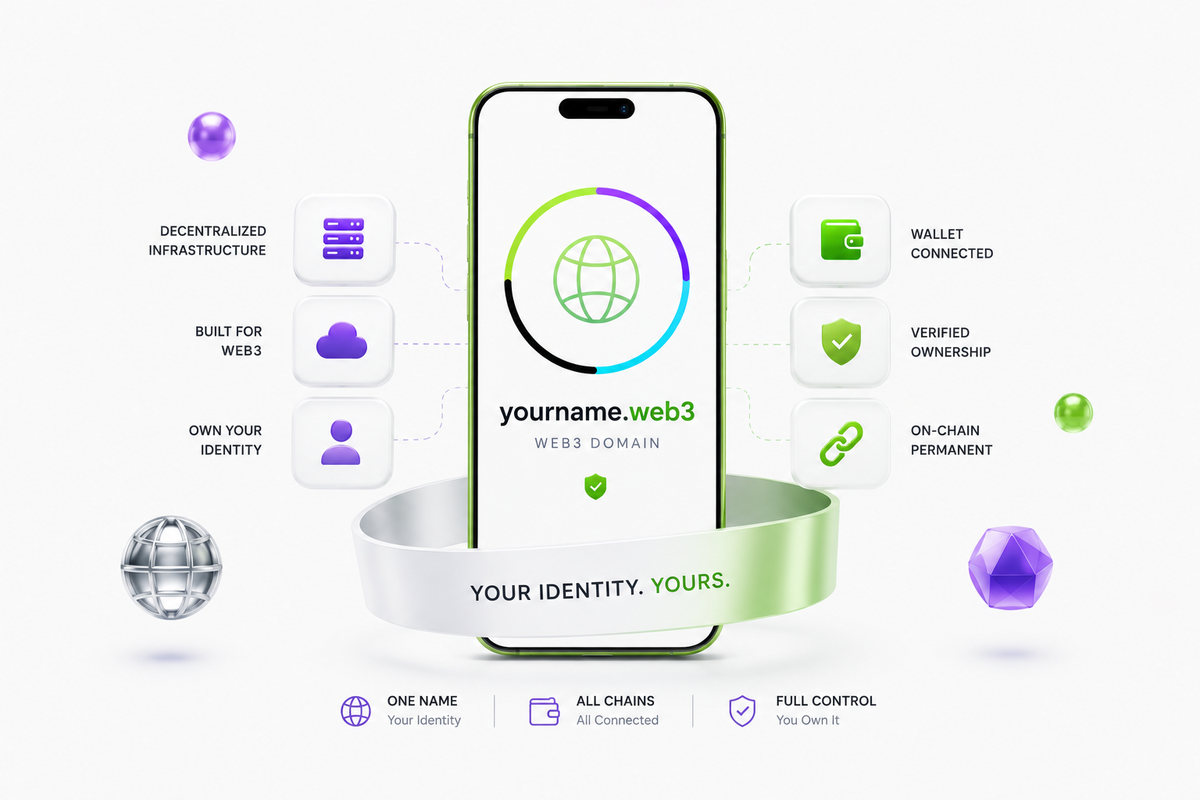
Web3 domains offer a different kind of control. Once you own one, you can retain it for as long as you like, transfer it freely to another wallet, sell it on any compatible marketplace, and use it in ways that go well beyond just pointing to a website including as a cryptocurrency wallet address and a digital identity layer across Web3 platforms.
Censorship Resistance
With traditional domains, your registrar holds significant power over your domain's fate. If a government agency or legal body puts pressure on a registrar to take down a domain, the registrar typically has to comply. ICANN can also intervene and revoke domains that violate its regulations. For most everyday websites, this never becomes an issue but for journalists, activists, businesses in politically sensitive industries, or anyone publishing content that powerful interests might want silenced, centralized control is a genuine vulnerability.
Web3 domains operate outside that system entirely. Because they're managed on a decentralized network rather than through a central authority, no single entity has the power to take them down. Only the owner of the domain the wallet holder can transfer or modify it. This makes Web3 domains inherently censorship-resistant in a way that no traditional domain can match.
User-Centered Design
This connects to the censorship point but goes further. Traditional domain registrars can be compelled by legal or political pressure to revoke or transfer a domain, even against the owner's wishes. The registrar, not the user, ultimately has the final say.
Web3 domains flip that dynamic. The decentralized structure means the platform can't be pressured the same way. Your domain follows the rules of the blockchain network it lives on, not the rules of any government or corporation. For anyone who values genuine control over their online presence, that's a meaningful distinction.
Interoperability
Traditional domains were designed for one primary purpose: directing browsers to IP addresses. They don't natively integrate with blockchain networks, cryptocurrency wallets, or decentralized applications. If you want to accept crypto payments or interact with Web3 platforms through a traditional domain, you need third-party tools and workarounds to make it happen.
Web3 domains were built from the ground up with interoperability in mind. They can communicate natively with different blockchain ecosystems and decentralized applications (dApps), function as cryptocurrency wallet addresses, and serve as a unified identity across Web3 platforms. They're designed for the infrastructure of the future, not just the infrastructure of today.
Cost Structure
Traditional domains vary widely in price depending on the extension and how desirable the name is. A basic .com might cost $10 to $15 per year, while a premium domain can run into thousands or even millions of dollars. And no matter what you pay up front, you'll face annual renewal fees in perpetuity.
Web3 domains typically involve a one-time purchase price with no ongoing renewal fees. Premium Web3 domain names can still be expensive up front, but the long-term cost structure is more predictable and transparent. Once you've bought it, it's yours no recurring bills, no risk of accidentally losing it because an auto-renewal failed.
Built-In Crypto Integration
Traditional domains have no native cryptocurrency functionality. If you want your website to accept crypto payments, you need to integrate external payment processors and tools adding complexity and fees to the process.
Web3 domains frequently come with built-in cryptocurrency wallet functionality. Your domain name can serve directly as your wallet address, making it possible to send and receive digital currencies as simply as sharing a URL. Instead of handing someone a 42-character Ethereum address, you just say "send it to yourbrand.crypto." That's a meaningful quality-of-life improvement for anyone transacting regularly in crypto.
How Do Web3 Domains Actually Work?
Under the hood, Web3 domains rely on three key components working together: registrars, registries, and resolvers. Understanding how each one functions helps demystify how this system manages to work without any central authority pulling the strings.
Registrars in the Web3 world serve a different role than their traditional counterparts. Rather than just selling you access to a name in a centralized database, Web3 registrars enable you to claim a domain on a decentralized network functioning independently of any central server. This independence is what enables the privacy and security advantages that Web3 domains offer.
Registries are the databases where Web3 domain ownership information and associated blockchain addresses are stored. Crucially, they're implemented as smart contracts on a blockchain network rather than maintained on servers owned by a company. This means the registry itself is decentralized and transparent anyone can verify who owns what, and the records can't be secretly altered. Some registries also incorporate governance mechanisms that allow network participants to vote on proposed changes or new features, giving the community a voice in how the system evolves.
Resolvers are the software layer that translates between human-readable domain names and blockchain addresses the Web3 equivalent of the DNS servers that power traditional domain navigation. When you or a browser needs to figure out which blockchain address a Web3 domain points to, the resolver does that translation. Resolvers also handle address routing and use caching techniques to reduce the load on the registry, keeping the system efficient even as traffic grows.
Together, these three components create a domain system that functions without any single controlling authority distributed, transparent, and owned by its users rather than its administrators.
Web2 or Web3: Which One Is Right for You?
The honest answer is that it depends on what you're trying to accomplish.
If you're building a straightforward website for a local business, a personal blog, or any context where universal browser compatibility matters above all else, a traditional Web2 domain is still the most practical choice. The infrastructure is mature, every browser supports it without any additional setup, and the process of buying and managing it is well-understood.
But if you're building a presence in the Web3 ecosystem, accepting or planning to accept cryptocurrency payments, concerned about censorship or centralized control over your online presence, or interested in digital assets as a long-term investment, a Web3 domain offers advantages that traditional domains simply can't replicate. True ownership, censorship resistance, built-in crypto functionality, and interoperability with decentralized applications are real, practical benefits not just theoretical ones.
The two systems aren't necessarily mutually exclusive, either. Many businesses and individuals maintain a traditional domain for their main website while also securing a Web3 domain to establish their presence in the decentralized ecosystem. Getting in early before premium Web3 domain names are all claimed is a strategy that an increasing number of forward-thinking businesses are already pursuing.
Final Thoughts
Web2 and Web3 domains share the same basic function they give websites and online resources a human-readable address but they differ significantly in almost every other respect. Ownership, control, censorship resistance, crypto integration, cost structure, and interoperability all look fundamentally different across the two systems.
Web2 domains have decades of infrastructure behind them and work seamlessly in today's internet. Web3 domains are built for the internet that's coming one where users own their data, control their digital identities, and don't have to ask anyone else's permission to maintain their online presence.
Understanding both puts you in a much stronger position to make smart decisions about where and how you build your digital presence going forward.