10 Ways Web3 Domains Can Transform Your Online Experience
Web3 domains: More than just addresses. Unlock 10 ways they're shaping the future of the internet and digital ownership.

If you've been paying attention to what's happening in the internet space over the past few years, you've probably noticed that something is shifting. The centralized, corporation-controlled model of the web that most of us have taken for granted is starting to show its cracks data breaches, censorship, platform bans, and the uncomfortable reality that most of what we think we "own" online, we're really just renting from someone else.
Web3 domains are one of the most practical and immediate ways that a different kind of internet is starting to take shape. They're not just a technical novelty or a cryptocurrency side project. They're a fundamentally different approach to how we identify ourselves, transact, and build presence online and the implications for everyday users, creators, and businesses are worth taking seriously.
This guide breaks down exactly what Web3 domains are, how they work, where the market is headed, and most importantly the ten concrete ways they can change how you experience the internet.
What Are Web3 Domains, and How Do They Actually Work?
A Web3 domain is a domain name that lives on a blockchain rather than in a traditional centralized registry. Instead of being managed by ICANN and rented through registrars like GoDaddy or Namecheap, Web3 domains are registered and owned directly on decentralized networks including Ethereum, Solana, Aptos, and others.
The practical difference shows up in something as simple as your web address. Instead of "www.yourbrand.com," a Web3 domain might be "yourbrand.crypto" or "yourbrand.eth." That difference in extension reflects a completely different underlying system one where ownership is recorded permanently on a public blockchain, no annual renewals are required, and no central authority can revoke your access.
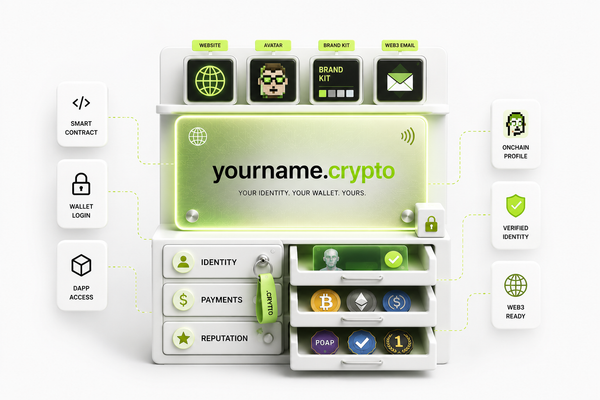
Beyond being a website address, Web3 domains are classified as non-fungible tokens (NFTs), meaning each one is unique, verifiably owned, and tradeable like any other blockchain-based asset. They can serve as wallet addresses, digital identities, and entry points to decentralized applications all simultaneously.
The system that makes all of this work relies on three interconnected components:
Registrars are the platforms through which users search for, purchase, and claim their Web3 domain names. They handle the front-end experience of acquiring a domain and ensure that the name you choose is unique within the network.
Registries are the underlying databases implemented as smart contracts on the blockchain that store all registered domain names along with their associated ownership information and blockchain addresses. Because they live on the blockchain rather than on servers owned by a company, they're transparent, tamper-proof, and not controlled by any single entity.
Resolvers are the technical layer that translates a human-readable domain name into the blockchain address it points to. When you type a Web3 domain into a compatible browser or application, the resolver looks up the corresponding address and directs you to the right content functioning similarly to the DNS servers that power traditional internet navigation, but operating within a decentralized infrastructure.
Together, these three components create a domain system that is more secure, more transparent, and more genuinely user-owned than anything the traditional web has offered.
The Market Behind the Movement
The growth numbers in the Web3 space help illustrate why this isn't just a fringe interest. The global Web3 market was valued at approximately $3.2 billion in 2021, and the trajectory since then has been consistently upward, driven by the expanding adoption of blockchain technology, the proliferation of decentralized applications, and the maturation of the broader crypto ecosystem.
Major institutions are paying attention too. The World Economic Forum has noted that Web3 is progressing from its experimental early stages toward a point of meaningful convergence where policy frameworks, decentralized applications, asset tokenization, and mainstream consumer adoption all come together in practical, everyday use.
The signs of that convergence are already visible. Starbucks launched an NFT-based loyalty rewards program, signaling that traditional consumer brands are actively integrating Web3 mechanics into their customer experience strategies. Helium, a decentralized wireless network, demonstrated that Web3 infrastructure can power real-world telecommunications at scale. These aren't proof-of-concept experiments anymore they're deployed products with real users.
The expectation is that the next few years will be a turning point, as regulatory clarity improves, user-friendly tooling makes Web3 more accessible to non-technical audiences, and more industries discover practical applications for decentralized technology. Web3 domains sit at the center of that shift they're the human-readable layer that makes the rest of the ecosystem navigable for everyday people.
10 Ways Web3 Domains Can Change How You Experience the Internet
1. Simplified Cryptocurrency Transactions
If you've ever tried to send someone cryptocurrency, you know the experience is not particularly user-friendly. A standard Ethereum wallet address is a 42-character string of letters and numbers that's nearly impossible to memorize and easy to mistype. One wrong character and your funds go somewhere you didn't intend with no way to recover them.
Web3 domains solve this problem cleanly. Instead of sharing "0x742d35Cc6634C0532925a3b844Bc454e4438f44e," you share "john.crypto" or "yourbrand.eth." The domain maps directly to your wallet address, and anyone sending you funds just types in the name. No copying and pasting, no scanning QR codes, no anxious double-checking of character strings.
For anyone who transacts in crypto regularly whether for business, freelancing, or personal use this improvement in usability is genuinely significant. It also lowers the barrier for people who are new to cryptocurrency and find the technical friction of traditional wallet addresses discouraging.
2. A Unified Digital Identity You Actually Own
In today's internet, your digital identity is scattered across dozens of platforms and none of them belong to you. Your Twitter handle, your Instagram profile, your LinkedIn page all of them are controlled by companies that can suspend your account, change their policies, or disappear entirely, taking your online presence with them.
A Web3 domain gives you a single, blockchain-recorded identity that you own outright and that no platform can take away. You can link your social media profiles, NFT collections, decentralized applications, portfolio, and wallet addresses to a single domain that serves as your unified online presence in the Web3 ecosystem.
That unified identity also makes it easier for people to find and connect with you across multiple platforms, since everything points back to one verifiable, owner-controlled address. As Web3 platforms continue to develop, this kind of portable, self-sovereign identity is likely to become increasingly valuable.
3. Easier Access to Decentralized Applications
Decentralized applications dApps are one of the most exciting categories of software being built right now. But navigating to them through traditional browser infrastructure can be clunky, and complex URLs or wallet connection prompts create friction that discourages casual users.
Web3 domains make accessing dApps significantly more intuitive. Instead of hunting for a contract address or a long URL, you can configure your domain to point directly to your favorite applications. Addresses like "art.nft" or "play.game" give decentralized applications the same kind of memorable, brandable presence that traditional websites have had for decades making the overall Web3 user experience feel considerably more polished and approachable.
4. Decentralized Website Hosting
Traditional websites are hosted on centralized servers, which means they're subject to the decisions of hosting providers, cloud platforms, and government regulators. A hosting company can take your site down for violating terms of service. A government can order it blocked. A server failure in one location can make your content inaccessible globally.
Web3 domains enable a different model: hosting your website directly on a blockchain network, where the content is distributed across multiple nodes rather than sitting on a single server. This approach provides genuine resistance to censorship and takedowns, keeps your data under your control rather than a hosting provider's, and eliminates single points of failure that can bring traditionally hosted sites down unexpectedly.
For journalists, activists, independent creators, or any business that has ever worried about platform dependency, decentralized website hosting through a Web3 domain is a meaningful upgrade in control and resilience.
5. Streamlined NFT Portfolio Management
If you own NFTs across multiple collections and platforms, you know how scattered the experience of managing them can be. Different collections live in different marketplaces. Tracking bids, transfers, and community activity across all of them requires juggling multiple interfaces simultaneously.
Your Web3 domain can serve as a centralized hub for your entire NFT portfolio a single, publicly accessible address where your collections are displayed, where people can make offers, and where you can manage transfers and community engagement without bouncing between platforms. For serious collectors and creators, this kind of consolidated management saves real time and makes the overall experience considerably less chaotic.
6. Universal Login Across Web3 Platforms
Password fatigue is real. Most people are managing dozens of usernames and passwords across different websites and applications, which creates both a convenience problem and a significant security risk. Reusing passwords is dangerous; managing unique ones for every service is exhausting.
Web3 domains offer an elegant solution: a single, cryptographically secure identity that you can use to authenticate yourself across multiple platforms. Instead of creating a new account with a new password on every Web3 application you use, you sign in with your domain using your wallet a process that's both simpler for the user and more secure than traditional password-based authentication. It reduces the attack surface for identity theft and removes the cognitive load of managing multiple credentials.
7. Earning Income From Your Domain
Premium domain names have always had real monetary value the early .com land rush created fortunes for people who understood that simple, memorable web addresses would become scarce and sought-after. The same dynamic is playing out in Web3 domains, with the added dimension that NFT domains can be leased, sold, and traded like any other blockchain asset.
If you own a valuable Web3 domain a short name, a recognizable keyword, or something aligned with a growing category in the Web3 ecosystem you have options. You can lease it to a business that wants the address without committing to a purchase. You can enable microtransactions on a domain-linked website. Or you can simply hold it as a digital asset and sell when the market price aligns with your expectations. For early movers who identify and secure the right names, Web3 domains represent a genuine passive income opportunity.
8. Building Community Around a Shared Domain
One of the more underappreciated possibilities for Web3 domains is what they enable at the community level. A shared domain can become the home base for a group organized around common interests hosting events, running discussions, coordinating collaborative projects, and creating a collective online identity that's owned by the community rather than a platform.
In a Web3 context, this kind of community infrastructure can be governed by its members rather than by a corporation. Decisions about how the domain is used, what it points to, and how it evolves can be made collectively through decentralized governance mechanisms. For communities that have experienced the consequences of platform dependency having their home pulled out from under them when a company changes its rules or shuts down this model of community-owned infrastructure is genuinely compelling.
9. Investing in the Internet's Next Chapter
There's a reasonable historical parallel to consider here. In the mid-1990s, before most people understood what the internet would become, domain names like "business.com" and "loans.com" were available for registration fees measured in dollars. The people who recognized early that those addresses would become scarce, valuable digital real estate made extraordinary returns as the web went mainstream.
The Web3 domain market is at a comparably early stage. Premium names short, memorable, keyword-rich, or connected to growing Web3 categories are still available at prices that may look very reasonable in hindsight as the ecosystem matures and adoption accelerates. As with any investment, there are no guarantees, and the market is volatile. But the structural case for Web3 domain value increasing over time driven by genuine scarcity, growing demand, and expanding utility is sound.
10. Claiming Your Stake in the Decentralized Web
There's something that goes beyond the practical advantages a principle worth stating plainly. Owning a Web3 domain is a way of participating in and contributing to a different vision of what the internet can be. One where individuals own their identities rather than borrowing them from platforms. Where data is controlled by users rather than harvested by corporations. Where access is governed by open protocols rather than corporate terms of service.
Every person or business that registers a Web3 domain that builds something real under a decentralized address makes that vision slightly more concrete and slightly more likely to succeed. It's the kind of bottom-up infrastructure development that has driven every meaningful shift in how the internet works, and it's happening right now.
Choosing a Web3 domain that reflects your identity, your values, or your work is a small act with potentially large implications for your own online experience and for the broader direction of the internet.
Final Thoughts
Web3 domains aren't a distant future concept. They're available today, they solve real problems that exist in the current internet, and the ecosystem around them is growing at a meaningful pace. From simplifying cryptocurrency transactions to enabling true digital ownership, from building unified online identities to investing in the next generation of internet infrastructure, the use cases are concrete and the benefits are practical.
Whether you're a creator looking for more control over your online presence, a business exploring new ways to engage with the crypto economy, an investor looking for early-stage digital assets with genuine upside, or simply someone who is tired of renting your online identity from companies that don't have your best interests at heart Web3 domains are worth exploring seriously.
The decentralized web is being built right now. The question is whether you'll be part of building it.