How Web3 Domain Names Impact Your Website's SEO and Search Rankings
The differences between Web2 and Web3 SEO reach beyond the technical; they reflect a fundamental shift in how the internet operates and how users interact. Let's dive into the key areas where we'll see the biggest changes:

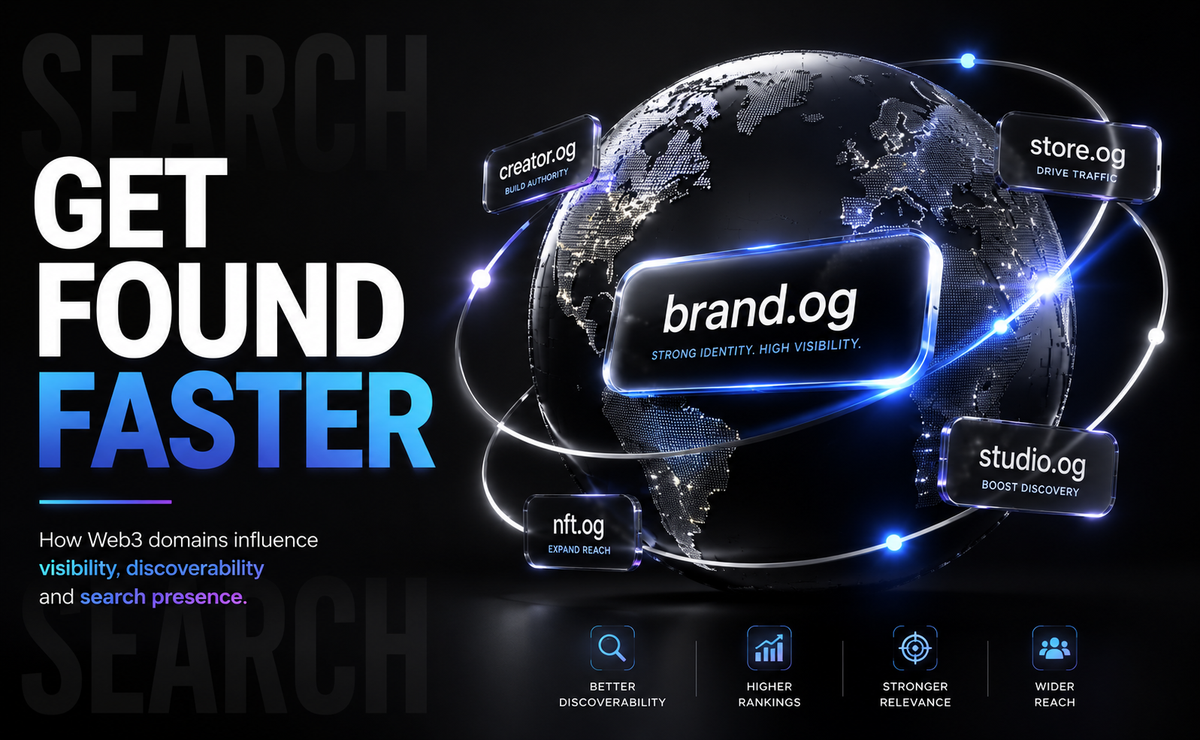
The global blockchain market is projected to hit $48.84 billion by 2028. That's not a niche number that's mainstream infrastructure money. And as blockchain-based projects, decentralized applications, and Web3 companies multiply to fill that market, the competition for visibility is going to get fierce.
Here's the thing most Web3 founders and marketers don't want to hear: building something genuinely innovative isn't enough. If the right people can't find you, your project doesn't grow. And in an environment where paid advertising is expensive, often restricted by platform policies around crypto, and increasingly ignored by the audiences you're trying to reach, organic search isn't just a marketing channel it's a survival strategy.
This blog is about why SEO matters more in Web3 than most people realize, how it's different from what you've done before, and what a practical, effective Web3 SEO strategy actually looks like.
Web3 Isn't Just a New Technology It's a New SEO Environment
Before getting into tactics, it's worth understanding what's actually different about SEO in Web3. Because while the fundamental mechanics of search crawling, indexing, ranking haven't changed, the context around them has shifted significantly.
Your audience is more complex. In Web2, you generally knew who you were writing for. In Web3, your audience spans a wide spectrum from highly technical developers who understand smart contract architecture to complete newcomers who just heard the word "NFT" for the first time and aren't sure what it means. A Web3 SEO strategy has to serve both ends of that spectrum without alienating either. That's harder than it sounds, and most projects get it wrong by defaulting to one extreme or the other.
Keywords matter less; brand authority matters more. Web2 SEO was largely a keyword optimization game find what people are searching for, optimize your pages for those terms, rank higher, get traffic. That still matters in Web3, but the emphasis has shifted. In a space where trust is hard to establish and skepticism is high understandably, given the number of scams and failed projects the space has seen brand authority is what converts traffic into users, investors, and community members. Creating content that genuinely educates and informs is what builds that authority.
Trust-building works differently. In the traditional web, Google reviews and star ratings do a lot of the trust-building work. In Web3, trust is built through a different set of signals: transparent team information, AMA (Ask Me Anything) sessions where founders answer hard questions publicly, clear communication about how a project works and what risks it carries, and a consistent track record of delivering on commitments. These aren't just PR tactics they're SEO signals, because the platforms and communities that host them generate the backlinks and mentions that affect your rankings.
Link-building is harder and more important. In Web2, getting backlinks was a manageable process outreach, guest posting, directory listings. In Web3, high-quality backlinks from respected crypto and blockchain publications, project blogs, and community platforms are significantly more valuable and significantly harder to earn. The competition for placement in authoritative Web3 publications is real, and the cost of paid placements on major crypto media sites can be substantial.
Website architecture is more complicated. Many Web3 projects operate across multiple products, communities, and use cases each of which might warrant its own subdomain or section. A DeFi protocol might have a main marketing site, a documentation site, a governance portal, a blog, and a community forum all running simultaneously. Keeping the SEO architecture coherent across all of these properties requires deliberate planning that most Web2 companies never had to think about.
Why Paid Ads Aren't the Answer (And Why SEO Is)
This is where a lot of Web3 projects make their first big mistake: they pour budget into paid advertising and wonder why it's not working.
The problem isn't the execution it's the channel. Paid advertising for crypto and blockchain projects faces restrictions on every major platform. Google has loosened some of its crypto advertising policies, but significant restrictions remain. Meta's policies around crypto advertising are notoriously inconsistent, with legitimate projects getting their ads rejected or accounts banned for reasons that are never fully explained. Twitter's policies shift with the wind.
Even when you can run ads, the crypto audience is highly skeptical of them. Years of scam projects using flashy paid campaigns have conditioned the most valuable Web3 users the ones you actually want to distrust paid promotion. The people clicking on crypto ads are often not the people you want to reach.
SEO sidesteps all of these problems. Organic content doesn't get restricted by platform policies. It doesn't get scrolled past by users conditioned to ignore ads. And it compounds over time a well-written piece of content that ranks well in 2024 can still be driving traffic in 2026, long after whatever paid campaign you ran in Q1 has been forgotten.
Here's the fuller picture of why SEO is worth the investment for Web3 companies specifically:
Consistent, sustainable growth. Paid campaigns produce traffic spikes that disappear when the budget runs out. SEO builds a foundation that keeps generating traffic regardless of what you're spending on advertising in any given month. In a market as volatile as crypto, that consistency is genuinely valuable.
Audience quality. Someone who finds your project by searching for information about the problem you solve is a fundamentally different prospect than someone who saw a banner ad. They're already interested, already partially educated, and already looking for a solution. That's a higher-quality lead at every stage of your funnel.
Thought leadership at scale. The Web3 space rewards expertise. Projects that consistently publish accurate, useful, well-researched content become the reference points that the community turns to and being the reference point is one of the best positions you can occupy in any competitive market.
Credibility with investors. This one gets overlooked: a strong organic search presence signals to potential investors that a project is legitimate, serious, and building for the long term. A project with ten pages of content and zero organic traffic looks very different from one with a robust content library that's attracting tens of thousands of monthly visitors from relevant searches.
Future-proofing. Search engines are actively working on better indexing of decentralized content. Building strong SEO foundations now means your project will be well-positioned as those capabilities mature and the Web3 search landscape evolves.
Voice Search and the Future of Web3 SEO
There's a dimension of Web3 SEO that most people aren't talking about yet but will need to think about soon: voice search.
Voice search is already reshaping how people find information, and the trend is accelerating. The key implication for content strategy is the shift from keyword optimization to natural language optimization. Someone typing a search query writes differently than someone speaking one. A typed query might be "web3 SEO strategy" a voice query for the same information might be "Hey Google, how does SEO work differently for Web3 companies?"
These are fundamentally different phrases that require different content approaches to rank for. The written query favors concise, keyword-dense content. The spoken query favors conversational, question-answering content that mirrors how people actually talk about the topic.
For Web3 companies, this means a few practical things:
Long-tail keywords become more important, not less. As voice search grows, generic short-tail keywords become harder to optimize for and less aligned with how people actually search. The specificity of long-tail queries "how to build a decentralized website using ENS" rather than "web3 domains" is exactly what voice search amplifies.
Personalization matters more. Voice queries are inherently more personal and contextual than typed queries. A user asking a voice assistant for a recommendation is providing much richer intent signals than someone typing two or three keywords. Content that addresses specific user needs, pain points, and contexts rather than generic information performs better in this environment.
Multimedia optimization becomes necessary. As voice and audio interfaces grow, optimizing only text content isn't sufficient. Podcast transcripts, video descriptions, audio content, and visual media all need to be part of a comprehensive Web3 SEO strategy that reaches users across different consumption formats.
A Practical Web3 SEO Strategy: What Actually Works
Enough context let's get specific. Here's what a well-constructed Web3 SEO strategy actually looks like in practice.
Start with audience-first keyword research. The keyword landscape in Web3 is unusual. You have highly technical terms that a small number of developers search for regularly, broad terms that newcomers search for in massive volumes, and everything in between. The goal isn't to rank for everything it's to rank for the terms that your specific target audience is actually using.
Start by mapping your audience segments: Who are the technical users? What do they search for? Who are the newcomers? What questions are they asking? Use tools like Ahrefs, SEMrush, or even simple Google autocomplete to find the actual language your audience uses then create content that answers their questions in that language. Naturally integrating those keywords into high-quality content is always more effective than stuffing them in mechanically.
Build credibility through contextual backlinks. In Web3, not all backlinks are created equal. A link from a respected blockchain research publication, a well-known DeFi protocol's blog, or a major crypto media outlet carries vastly more weight than a link from a generic directory or a low-quality content farm.
Earning these links requires producing content worth linking to original research, data-driven analysis, genuine thought leadership on contested questions in your space and then doing the outreach to get it in front of the people and publications that might reference it. It takes time and consistent effort, but the SEO value of a handful of high-authority backlinks in your niche can exceed the value of hundreds of low-quality ones.
Create content that actually educates. This is the point that most Web3 content strategies get wrong. They produce content that markets announcements, feature highlights, price predictions rather than content that informs. The most effective Web3 content genuinely teaches its audience something: how a technology works, what a concept means, how to evaluate a project, what questions to ask before investing.
Long-form content that goes deep on a topic 1,500 words and up consistently outperforms shallow content in search rankings, especially for competitive terms. It also does more to establish brand authority, because depth signals expertise in a way that surface-level content simply can't.
Cover the topics your audience cares about: the mechanics of DeFi protocols, how NFTs actually work, what makes one blockchain different from another, how to evaluate security in a smart contract, what decentralized governance means in practice. If you're the site that clearly explains hard things, you become the site people trust.
Nail the technical fundamentals. All the great content in the world won't rank if your website has technical SEO problems. The basics matter:
Page speed is non-negotiable. Google uses Core Web Vitals as ranking signals, and slow-loading pages get penalized regardless of content quality. This is especially important for Web3 projects, which often have complex, JavaScript-heavy frontends that can load slowly if not optimized carefully.
Mobile responsiveness is essential. More than half of all web traffic comes from mobile devices. A site that looks or functions poorly on mobile is leaving rankings and users on the table.
Site architecture needs to be logical and internally linked. For Web3 projects with multiple products or a large content library, clear internal linking helps search engines understand the relationship between different pages and distributes ranking authority efficiently across your site.
Compelling title tags and meta descriptions matter. These are what users see in search results before deciding whether to click. Write them as if you're writing ad copy because functionally, you are.
Use calls to action that match user intent. One of the most common Web3 content mistakes is creating educational content and then failing to convert that interest into action. Every piece of content should have a clear, relevant next step: sign up for a newsletter, join a community, try a product, read a related piece of content. The call to action should feel natural given what the user just read not like a jarring interruption.
Build community and social proof into your SEO strategy. In Web3, community is infrastructure. The conversations happening in Discord servers, Telegram groups, Reddit threads, and Twitter spaces generate signals that affect how authoritative your project appears to both search engines and human evaluators. Engaging actively in those spaces not just broadcasting, but genuinely participating builds the kind of social proof that converts skeptics into believers.
Testimonials, case studies, and documented success stories are particularly valuable in a space where trust is hard-won. If your protocol has helped users achieve meaningful results, documenting those stories creates content that builds trust while also giving you something worth ranking for.
Collaborate with thought leaders and complementary projects. Guest posting on respected Web3 blogs, co-creating content with complementary projects, participating in AMAs hosted by influential community figures these activities generate backlinks, build brand awareness, and signal to both search engines and users that your project is a serious participant in the ecosystem rather than an outsider trying to extract value from it.
The SEO Mindset Shift Web3 Companies Need
Here's the reframe that makes everything else click: in Web3, SEO isn't a marketing tactic it's a trust-building system.
Every piece of content you publish is a signal. It tells users what you know, what you care about, and whether you're building something real or just trying to capture attention. It tells search engines whether your site is an authoritative resource in your niche or just another low-quality page competing for clicks. It tells potential investors and partners whether your project is run by people who understand their audience and are committed to serving them over the long term.
The Web3 projects that dominate organic search in three years will be the ones that started building that trust today consistently, patiently, and with genuine commitment to creating value for their audience rather than just extracting attention from it.
Final Thoughts
Web3 is a noisy space. New projects launch every day, each one claiming to be the next breakthrough. In that environment, the signal-to-noise ratio is terrible and most users know it. They've been burned before, and they approach new projects with healthy skepticism.
SEO, done well, is how you cut through that noise. Not by shouting louder, but by consistently demonstrating that you know what you're talking about, that you're committed to your audience's success, and that you're building something worth paying attention to.
The global blockchain market is heading toward $49 billion. The projects that capture a meaningful share of that market won't necessarily be the ones with the biggest ad budgets they'll be the ones with the strongest organic presence, the most trusted brands, and the most engaged communities.
Building that starts with SEO. And the best time to start is always right now.