Web3 Domains - What Are They and How They Work
Web3 domains are an essential step for reshaping the internet into a more decentralized, secure, and user-centric space.

The internet has gone through a lot of reinventions. From static HTML pages to social media platforms to mobile-first experiences each shift changed how we interact online. Web3 is shaping up to be the next major one, and at the centre of it is a concept that doesn't get nearly enough plain-English explanation: Web3 domains.
If you've heard the term thrown around but aren't entirely sure what it means or why it matters, you're not alone. This guide walks through everything what Web3 domains actually are, how they work under the hood, what advantages they offer, and what real challenges still stand in the way of mainstream adoption.
A Quick Primer on Why This Matters
Before we get into Web3 domains specifically, it helps to understand the problem they're solving.
Right now, the domain name system that powers the internet is centralized. When you register yourbusiness.com, you're not really owning it you're renting it from a registrar, which operates under rules set by ICANN, a nonprofit organization that oversees the global domain name system. That registrar can suspend your domain. Governments can issue takedown orders. Hosting providers can pull the plug on your content.
For most people, most of the time, none of this is a problem. But for journalists, activists, businesses in politically unstable regions, or anyone who's ever had a domain wrongly suspended, the fragility of centralized control becomes very real very fast.
Web3 domains are built on a fundamentally different model one where you actually own your domain, no landlord required.
What Are Web3 Domains?
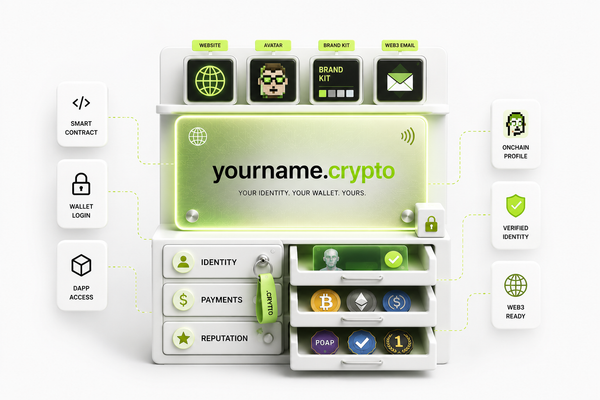
Web3 domains also called decentralized domains or blockchain domains are domain names that live on a blockchain instead of on centralized DNS servers. They're registered not through a traditional registrar, but through a blockchain-based smart contract. Ownership is represented by an NFT (Non-Fungible Token) stored directly in your crypto wallet.
Common extensions you'll see include .eth, .crypto, .nft, .wallet, .sol, and .bitcoin though the list is growing as more blockchain naming systems launch.
Unlike a traditional domain, which is tied to your registrar account and subject to their rules, a Web3 domain is controlled by whoever holds the private key to the wallet it's stored in. That's you. Not a company. Not a government. You.
Beyond just routing web traffic, Web3 domains also function as readable wallet addresses. Instead of sharing a 42-character string like 0x7f3A9B2e5cD8f... every time someone wants to send you crypto, you can simply use yourname.eth. It's the same concept as an email address replacing an IP address simpler, more human, harder to mess up.
How Do Web3 Domains Actually Work?
This is where most articles either gloss over the details or get way too technical. Let's find a middle ground.
Blockchain-Based Registration
When you register a Web3 domain, the domain name is recorded on a blockchain as an NFT. That NFT is stored in your crypto wallet and serves as proof of ownership. There's no renewal process in most cases it's a one-time purchase, and the domain is yours as long as you hold that NFT.
The blockchain that hosts your domain depends on the platform. Ethereum Name Service (ENS) runs on Ethereum. Unstoppable Domains uses Polygon. Bonfida runs on Solana. Each comes with its own transaction costs, speeds, and ecosystem compatibility.
Ownership Through Private Keys
Ownership of a Web3 domain is tied to a private cryptographic key the same key that controls your crypto wallet. This is what makes Web3 domains genuinely yours. Without your private key, no one can transfer, alter, or revoke your domain. Not the platform you bought it from, not a government agency, not a registrar.
This is also why protecting your private key is so critical more on that in the challenges section.
Content Hosting on IPFS
Traditional websites live on centralized servers. If that server goes down, your site goes down. Web3 domains pair with a decentralized storage system called IPFS the InterPlanetary File System to host content in a fundamentally different way.
Instead of storing your website on a single server, IPFS distributes it across a peer-to-peer network of nodes. Each piece of content is identified by a cryptographic hash rather than a server location. When someone visits your Web3 domain, the system retrieves that content from wherever it's available on the network not from a single point that can be switched off.
The result is a website that's significantly harder to take down, tamper with, or censor.
How Resolution Works
When someone types your Web3 domain into a compatible browser or wallet, here's what happens behind the scenes:
- The browser queries the relevant blockchain to find the record associated with your domain.
- That record returns an IPFS content address essentially the location of your website on the decentralized network.
- The browser retrieves the content from IPFS and displays it.
The whole process happens in seconds and bypasses the traditional DNS system entirely. No central server is involved at any point.
The Advantages of Web3 Domains
You Actually Own It
This is the big one. With a traditional domain, you're a tenant. Miss a renewal, violate the terms of service agreement, or get caught in a legal dispute, and your domain can be taken from you. With a Web3 domain, ownership is tied to your private key it's yours until you decide to sell or transfer it.
Censorship Resistance
Because domain records are stored across a decentralized blockchain and website content is hosted across a distributed IPFS network there's no single point of control that can be targeted for a takedown. A government or corporation can't just send a cease-and-desist to a hosting provider and watch your site disappear. This is particularly significant for people living under authoritarian governments, or anyone whose content is politically or culturally sensitive.
That said, it's worth being honest: censorship resistance is a spectrum, not an absolute guarantee. Governments can still restrict access through ISP-level blocking or by pressuring browser developers to deny resolution of certain domains. The bar is significantly higher than with traditional hosting, but it's not impenetrable.
Stronger Security
Traditional domains are vulnerable in ways that Web3 domains simply aren't. DNS hijacking where an attacker redirects your domain to a malicious site is a well-documented attack vector. Because Web3 domain ownership is secured by cryptographic keys on a blockchain, an attacker would need access to your private key to make any changes. That's a much harder target than a registrar's account login.
Immutable Ownership Records
Every registration, transfer, and update to a Web3 domain is recorded permanently on the blockchain. That record is public, auditable, and impossible to alter retroactively. If ownership of a domain is ever disputed, the blockchain is the ground truth no he-said-she-said, no opaque registrar records.
Portability
With traditional domains, switching registrars is possible but often clunky involving authorization codes, waiting periods, and occasional headaches. Web3 domains live in your wallet. Transferring one is as simple as sending an NFT. No paperwork, no third-party approval, no waiting.
A New Asset Class
Web3 domains trade on NFT marketplaces, which means they have real market value. Premium domains short names, dictionary words, recognizable brands have already sold for significant sums. For investors and early adopters, that secondary market is a genuine opportunity, much like early .com domain investing was in the 1990s.
A Foundation for Digital Identity
This one is easy to underestimate. A Web3 domain can serve as the anchor for your entire online identity linking to your crypto wallets, NFT collection, DeFi activity, gaming profiles, and decentralized social media presence from a single readable name. As Web3 applications multiply, having a portable, self-sovereign identity layer becomes increasingly valuable.
The Challenges You Should Know About
Web3 domains are genuinely promising but anyone telling you they're a solved technology is getting ahead of themselves. Here are the real obstacles.
Browser Support Is Still Limited
This is the most immediate friction point. Chrome, Safari, Firefox, and Edge don't natively resolve most Web3 domains. To visit a .eth or .crypto site in a mainstream browser, you typically need a browser extension, a dedicated Web3 browser like Brave, or a centralized gateway which partially defeats the purpose of decentralization. Until major browsers add native support, Web3 domains will remain inaccessible to most internet users without extra steps.
The User Experience Is Complex
Managing a Web3 domain requires a working understanding of crypto wallets, private keys, blockchain transactions, and often gas fees. For someone who's never touched crypto before, that's a steep hill to climb before they can even register a domain. The tooling is improving, but the gap between Web3 and mainstream usability is still significant.
Private Key Responsibility Cuts Both Ways
The same feature that makes Web3 domains so powerful that only you control your private key is also a significant risk. If you lose your private key, you lose your domain. Permanently. There's no "forgot your password" option, no customer support team that can restore access. Self-custody is empowering, but it demands a level of care and technical discipline that most people aren't used to.
Front-Running Is a Real Problem
In some Web3 domain systems, when you submit a transaction to register a domain, that transaction is publicly visible in the mempool the queue of pending blockchain transactions before it's confirmed. Bad actors monitor this queue and can submit competing transactions with higher fees to "jump the line" and register the domain before you do. This is called front-running, and it's an ongoing issue that different platforms are handling with varying degrees of success.
User Errors Can Be Costly
Blockchain transactions are irreversible. If you accidentally send your domain NFT to the wrong wallet address or make a typo in a transaction, there's no undo button. The unforgiving nature of on-chain transactions means that mistakes even small, accidental ones can result in permanent asset loss.
Interoperability Between Blockchains Is Inconsistent
ENS domains work seamlessly in the Ethereum ecosystem. Bonfida domains work in Solana. But getting a .eth domain to work smoothly with a Solana-based application, or vice versa, isn't always straightforward. The Web3 ecosystem is fragmented across multiple blockchains, and while cross-chain interoperability is an active area of development, it hasn't been solved yet.
Regulatory and Legal Uncertainty
What happens when someone registers nike.crypto before Nike does? Traditional DNS has the UDRP a well-established dispute resolution process for trademark conflicts. Blockchain domain systems don't have an equivalent universal legal framework yet. As these domains become more valuable, that gap is going to create friction and potentially costly legal battles for both domain holders and brands.
Web3 Domains vs. Traditional Domains: A Direct Comparison
Traditional DomainsWeb3 Domains
Ownership Rented from a registrar Owned outright via NFT
Control Registrar can suspend or revoke control entirely by private key
Security Vulnerable to DNS hijacking Secured by blockchain cryptography
Censorship Subject to takedowns Significantly more resistant
Portability is possible but cumbersome. Simple wallet-to-wallet transfer
Renewals Annual fees required One-time purchase (typically)
Browser support Universal Requires extension or Web3 browser
Legal framework UDRP and established law, still evolving
User complexity Low very accessible High requires crypto knowledge
Neither system is strictly better across the board. Traditional domains win on accessibility and universal support. Web3 domains win on ownership, security, and censorship resistance. The right choice depends entirely on your use case.
Where Is This All Heading?
Web3 domains are not going to replace traditional domains overnight and anyone claiming otherwise is overstating where the technology currently stands. But the trajectory is clear.
As blockchain technology matures and mainstream browsers begin natively supporting decentralized domain resolution, the friction of using Web3 domains will drop significantly. When that happens, adoption will likely accelerate well beyond the current crypto-native user base.
The more interesting shift is what Web3 domains enable as a foundation. As decentralized social media, blockchain-based gaming, and DeFi applications grow, the need for a portable, user-controlled digital identity layer becomes more urgent. Web3 domains are the most natural candidate to fill that role.
Final Thoughts
Web3 domains represent a genuine and meaningful shift in how digital ownership works online. The idea that you can own a domain the way you own physical property with a verifiable title deed, no middleman, and no one who can take it from you is a significant departure from the current model.
But we're still early. Browser compatibility needs to improve dramatically. The user experience needs to become far more accessible. Legal frameworks need to catch up. And the average person needs a practical reason to make the switch before it becomes mainstream.
If you're building in Web3, working in crypto, or simply interested in owning a piece of the decentralized internet before it goes mainstream, Web3 domains are worth exploring seriously. Just go in with both eyes open understanding not just the promise, but the limitations that are still very much part of the picture.