Web3 Domains and AI Integration: Unlocking New Possibilities in 2025
Web3 domains and AI are shaping 2025, driving innovation through enhanced personalization, seamless automation, and cutting-edge decentralized technologies. Discover how they’re changing the game.

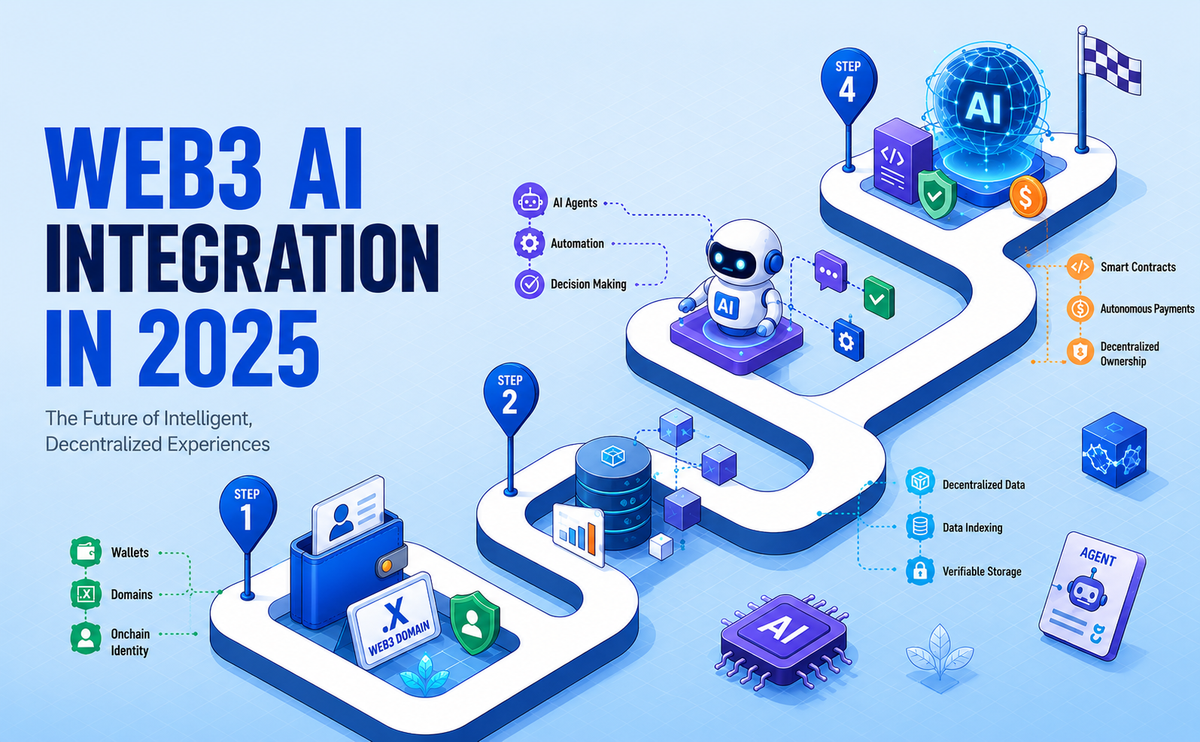
Two of the most significant technological shifts of the past decade are happening at the same time, and they're starting to work together in ways that are genuinely changing how the digital world operates.
Web3 is rewriting the rules of internet ownership. Blockchain-based domains are giving individuals and businesses true control over their digital identities, their data, and their transactions, without depending on centralized platforms that can change their terms, get hacked, or simply decide to shut down their access.
Artificial intelligence, meanwhile, is transforming how we process information and make decisions. Its ability to analyze enormous datasets, identify patterns, and deliver actionable insights in real time has already reshaped industries from healthcare to finance to logistics.
Put these two technologies together, and something interesting happens. The decentralized, transparent data stored in Web3 domains becomes raw material for AI analysis. And AI becomes the engine that makes Web3 ecosystems smarter, more responsive, and more useful for the people operating within them.
In 2025, this combination is moving from theoretical to practical across a growing number of industries. This blog explores how it works, what it looks like in practice, and what the challenges and opportunities are for businesses ready to engage with it.
Why Web3 Domains and AI Work Well Together
The synergy here isn't accidental. It comes from the fact that each technology addresses a limitation of the other.
Web3 domains store data on the blockchain in a way that is secure, transparent, immutable, and verifiable. Transaction histories, wallet addresses, smart contract interactions, and user behaviour are all recorded in a structured, tamper-proof format. This is exactly the kind of high-quality, reliable data that AI systems need to generate meaningful insights. Unlike the messy, inconsistent data that AI often has to work with in traditional environments, blockchain data has integrity built into its architecture.
AI, in turn, addresses one of the practical limitations of blockchain systems: they produce enormous amounts of data but don't inherently interpret it. A blockchain faithfully records every transaction, but it doesn't tell you what those transactions mean, what patterns they reveal, or what decisions you should make based on them. AI fills that gap, turning the raw record of blockchain activity into actionable intelligence.
A concrete example makes this clearer. An AI system integrated with a Web3 domain like FinanceHub.crypto can analyze the payment patterns and asset flows associated with that domain, identify market trends, and deliver personalized investment insights to users, all while the blockchain's encryption ensures that the underlying data remains secure and user-controlled.
The addition of decentralized identity (DID) systems makes this even more powerful. When users have blockchain-verified identities linked to their Web3 domains, AI can deliver personalized recommendations and automate onboarding processes across platforms, using verified preference data without requiring users to expose sensitive personal information. The result is personalization that feels smart and relevant without the privacy tradeoffs that centralized personalization systems typically demand.
What AI-Powered Personalization Looks Like in Decentralized Ecosystems
Personalization has been a buzzword in digital marketing for years, but in centralized systems, it usually comes with a catch: to get a personalized experience, you have to hand over your data to a company that then uses it however it sees fit. Web3 domains combined with AI offer a different model, one where personalization is powered by data you own and control.
Here's how it plays out across different industries.
In e-commerce, AI systems can analyze purchasing history, browsing behavior, and preference data linked to a customer's Web3 domain to deliver genuinely relevant product recommendations, targeted promotions, and loyalty rewards. A platform operating under GreenGoods.crypto can personalize its homepage for returning customers based on their blockchain-stored purchase history, surfacing the eco-friendly products they're most likely to want without relying on third-party tracking cookies or invasive data collection practices.
In education, the combination of AI and Web3 identity data creates opportunities for truly personalized learning paths. A platform like SkillUp.eth can analyze a learner's progress, completed courses, and stated goals stored in their blockchain identity to recommend the specific tutorials, certifications, and learning sequences most likely to help them achieve what they're working toward. The result is a learning experience that adapts to the individual rather than forcing everyone through the same generic curriculum.
In gaming and entertainment, AI can use data from a player's blockchain-linked domain to curate game recommendations, in-game experiences, and content suggestions that reflect their actual preferences and history. A platform like GameHub.crypto that knows what a player has achieved, what they enjoy, and how they play can deliver a far more engaging experience than one that treats all users as identical.
The common thread across all of these examples is that the personalization is grounded in data the user actually owns, verified on the blockchain, and analyzed by AI in a way that adds value without compromising privacy.
Automation and Smart Contracts: Where AI Gets Practical
One of the most tangible ways AI and Web3 domains are working together is in automating processes that previously required significant manual effort or that were bottlenecked by the limitations of static smart contracts.
Smart contracts are self-executing agreements coded directly onto the blockchain. They're powerful because they remove the need for intermediaries, executing automatically when predefined conditions are met. But traditional smart contracts are relatively rigid. They execute the logic they were programmed with, and adapting that logic to changing conditions requires manual updates.
AI changes this by adding adaptability. An AI system monitoring the blockchain activity associated with a Web3 domain can identify patterns and conditions that a static smart contract couldn't anticipate, then adjust the contract's behavior accordingly.
Some concrete examples show how this works in practice.
Automated domain management is one of the simpler but genuinely useful applications. AI can monitor Web3 domain expiration dates and process renewals automatically, ensuring that businesses never lose access to critical domains because of an overlooked deadline. It can also analyze demand trends in domain marketplaces and recommend optimal pricing for buying or selling, helping domain investors make better decisions with less research.
Payment automation is another area where AI adds real value. By tracking payment patterns linked to Web3 domains like ShopSecure.wallet, AI can enable recurring transactions without manual intervention, identify anomalies that might indicate fraud, and optimize payment routing across blockchain networks.
Token management and issuance benefit from AI's ability to monitor market conditions in real time. An AI system can recommend the optimal timing and method for token issuance or distribution based on current market dynamics, which is valuable for DeFi projects trying to manage liquidity and user incentives effectively.
Regulatory compliance is perhaps the most practically important application for businesses operating in regulated industries. AI can automate KYC and AML checks within smart contract workflows, helping platforms meet compliance requirements without building a manual review process that adds time and cost to every transaction. Tools like Chainlink's oracles, which integrate real-world data with smart contracts, and platforms like Dune Analytics, which provide real-time blockchain data analysis, are already enabling this kind of AI-driven compliance automation in production environments.
Real-World Applications Worth Paying Attention To
The theoretical case for Web3 domains and AI working together is compelling. The real-world applications that are already emerging make it even more concrete.
AI-powered decentralized marketplaces are using Web3 domains as the foundation for smarter commerce. A marketplace like DecentralShop.crypto can use AI to analyze what individual customers have purchased, what they've browsed, and what similar users have bought, then deliver personalized product recommendations that increase conversion rates and customer satisfaction. On the vendor side, AI-driven demand analysis can automate pricing strategies, ensuring that products are competitively priced without requiring constant manual adjustment. The result is a marketplace that scales globally without the centralized infrastructure that traditional e-commerce platforms depend on.
Dynamic NFT platforms represent one of the more creative applications of this technology combination. A platform like ArtFusion.crypto can use AI to generate unique NFT artwork that's personalized to a user's Web3 identity and blockchain activity. The idea of an NFT that's literally created based on who you are on the blockchain, what you've done, and what you prefer is a genuinely new kind of digital asset, one that couldn't exist without both blockchain identity and AI working together. For collectors, this creates assets that are meaningful and exclusive in a way that mass-produced NFTs never could be.
Blockchain-powered customer service is a more immediately practical application that businesses can implement today. An AI support bot linked to a Web3 domain like HelpDesk.crypto can access a customer's transaction history and account details stored on the blockchain, then use that information to provide fast, accurate, personalized assistance without requiring the customer to explain their situation from scratch. Response times drop, operational costs decrease, and customers get the kind of responsive, knowledgeable support that builds genuine loyalty.
The Challenges That Need to Be Addressed Honestly
The combination of Web3 domains and AI is genuinely promising, but it would be misleading to present it without acknowledging the real challenges that still need to be worked through.
Data privacy is the most nuanced challenge. Blockchain data is transparent by design, which is part of what makes it so useful for AI analysis. But transparency creates tension with privacy. Determining how AI systems can use blockchain data to deliver value without exposing more about users than they're comfortable sharing requires careful design and, in some cases, new cryptographic approaches like zero-knowledge proofs that allow data to be verified without being revealed.
Technical complexity is a genuine barrier to adoption. Building AI systems that integrate smoothly with blockchain infrastructure is significantly harder than building AI systems for centralized environments. The decentralized architecture, the consensus mechanisms, and the wallet integrations all of these require specialized expertise that isn't widely available yet. This complexity is one of the primary reasons adoption has been slower than the technology's potential would suggest.
Multi-chain compatibility is an increasingly important challenge as the blockchain ecosystem fragments across Ethereum, Solana, Polygon, and a growing number of other networks. An AI system that only analyzes data from one blockchain provides an incomplete picture for users who operate across multiple networks. Building AI tools that aggregate and interpret data across chains requires solving meaningful interoperability problems that the industry is still working through.
These challenges are real, but they're the kind of challenges that get solved as the technology matures, developer talent accumulates, and tooling improves. There are reasons for patience and thoughtfulness, not reasons to dismiss the overall direction.
Final Thoughts
The intersection of Web3 domains and artificial intelligence is one of the most interesting spaces in technology right now, and the reason is simple: these two technologies genuinely make each other better.
Web3 domains provide AI with the kind of secure, transparent, structured data it needs to generate meaningful insights. AI provides Web3 ecosystems with the intelligence they need to be adaptive, personalized, and automated in ways that blockchain alone cannot achieve. The combination creates decentralized systems that are smarter, more user-centric, and more capable than either technology could build independently.
For businesses thinking about where to position themselves in the next phase of the digital economy, this convergence is worth taking seriously. The platforms and organizations that understand how to leverage Web3 identity data with AI-driven analysis will be able to build experiences and operational efficiencies that their competitors simply can't match using traditional infrastructure.
Getting started is more accessible than it might seem. Securing a Web3 domain through a platform like Endless Domains is the first practical step toward participating in this ecosystem. From there, the range of AI tools and blockchain integrations that can build on that foundation is growing quickly.
The future of decentralized technology isn't just about ownership and security. It's about making those properties genuinely useful for the people and businesses that depend on them. Web3 domains and AI, working together, are the clearest path toward that goal.