Web3 for Good: How Blockchain is Being Used for Social Impact and Sustainability
Web3 for Good: Blockchain's potential for social and environmental change. Explore how decentralized tech is driving transparency, sustainability, and positive impact around the world.

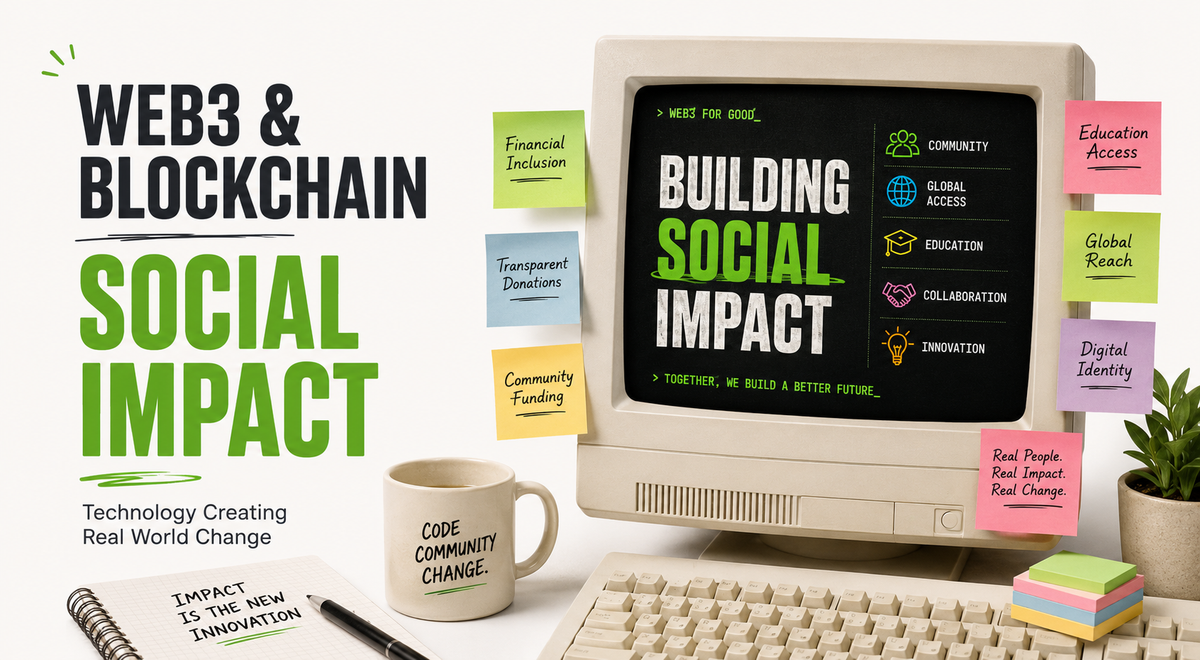
Most conversations about Web3 start and end with money.
Crypto prices. NFT valuations. DeFi yields. Token launches. The financial applications of blockchain technology have dominated the narrative for so long that it's easy to forget the technology itself is neutral a tool that can be pointed at any problem that benefits from decentralization, transparency, and immutable record-keeping.
Some of the most interesting applications of that tool have nothing to do with getting rich. They have to do with getting aid to people who need it, verifying that the coffee you're drinking was grown under fair labor conditions, giving a refugee a portable identity they can't lose, and building carbon markets that actually work.
This is the side of Web3 that doesn't get nearly enough attention and it may turn out to be the side that matters most.
Why Blockchain Is a Natural Fit for Social and Environmental Problems
Before getting into specific applications, it's worth being clear about why blockchain is particularly well-suited to social impact and sustainability work.
Three core properties do most of the work.
Transparency means that every transaction recorded on a public blockchain is visible and verifiable by anyone. In contexts where accountability matters charity, supply chains, carbon credits, public funds that verifiability is enormously valuable. You can't quietly redirect money or falsify records when the ledger is public and permanent.
Decentralization means no single entity controls the system. In communities that have historically been underserved or exploited by centralized institutions banks, governments, large corporations a system that doesn't require trust in any central authority is genuinely empowering. People can access services, verify transactions, and participate in governance directly.
Immutability means that once data is recorded on the blockchain, it can't be changed or deleted. For supply chain records, donation trails, carbon credit registries, and identity verification, that permanence is a feature, not a bug. The record of what happened doesn't depend on anyone's willingness to maintain it honestly.
Traditional approaches to social impact and sustainability work often suffer from exactly the problems these three properties address: opacity about how funds are used, dependence on intermediaries who extract value or introduce inefficiency, and records that can be manipulated or lost. Blockchain doesn't solve every problem, but it addresses these structural weaknesses in a way that no other technology does as cleanly.
Web3 in Action: Social Impact Use Cases
Charitable Giving That You Can Actually Track
Ask most donors what happened to their last charitable contribution, and they can't tell you. It went somewhere. They got a tax receipt. They hope it did some good. That uncertainty is one of the consistent barriers to charitable giving and one of the things that makes fraud and mismanagement in the nonprofit sector so persistent.
Blockchain changes the accountability structure of charitable giving in a fundamental way.
GiveDirectly, a nonprofit focused on direct cash transfers to people in extreme poverty, has integrated blockchain to create a traceable record of every donation. When you contribute, you can verify on the blockchain that your money reached the intended recipient not that it went into an organizational overhead fund, not that it was allocated to a program budget, but that specific individuals in specific communities received specific amounts. That kind of direct accountability is unprecedented in traditional philanthropy.
Binance Charity Foundation takes a similar approach, recording every donation on the blockchain so that donors can trace the path of their contribution from the moment they give to the final beneficiary. The result is a system where charitable organizations can't hide behind vague impact reports the record is public, permanent, and independently verifiable. That doesn't just protect against fraud; it builds the kind of genuine confidence in charitable systems that encourages more giving.
Giving Identity Back to People Who Don't Have It
Over a billion people worldwide lack any form of official identification. No passport, no national ID, no birth certificate. In the systems we've built, identity is the key to almost everything banking, healthcare, education, voting, legal protection. Without it, people are effectively invisible to formal institutions.
For refugees and displaced populations, the problem is compounded. Whatever identification they had may have been left behind, destroyed, or confiscated. Rebuilding identity documentation through traditional bureaucratic channels in a new country is a slow, uncertain process that leaves people vulnerable for years.
ID2020, a blockchain-based digital identity initiative, is working to solve this by creating portable, self-sovereign digital identities stored on the blockchain. Unlike traditional government-issued IDs, these identities aren't controlled by any single institution that can revoke them or lose them. They're held by the individual, verifiable by anyone with the right credentials, and portable across borders and systems.
A refugee with a blockchain-based digital identity can verify who they are in a new country without waiting for paper documents to be processed. They can open a bank account, access healthcare, enroll children in school, and build the kind of documented history that allows them to participate in formal economic systems. What sounds like a technical innovation is, in practice, a restoration of basic human dignity and opportunity for some of the world's most vulnerable people.
Blockchain-based identity also creates financial inclusion pathways for the unbanked more broadly. Someone who has never had a bank account because they lack formal identification can use a blockchain-based ID to open one, receive money transfers, and start building a credit history accessing the financial infrastructure that most people in developed countries take completely for granted.
Supply Chains That Tell the Truth
When you buy a product labeled "ethically sourced," "fair trade," or "conflict-free," how confident are you that it's true? The honest answer for most people is: not very. Traditional supply chains are opaque by design there are too many steps between raw material and finished product, too many hands involved, and no reliable mechanism for verifying claims that are made primarily for marketing purposes.
Blockchain creates that verification mechanism.
Provenance, a blockchain-based supply chain platform, tracks products from their origin through every step of the supply chain to the consumer. For products like coffee, chocolate, and diamonds industries with well-documented histories of labor exploitation and environmental damage that traceability is transformative. A consumer can scan a QR code on a bag of coffee and see where the beans were grown, who grew them, what they were paid, and how the product moved through the supply chain to reach the shelf. Every claim is backed by a blockchain record that can't be retroactively altered.
In the diamond industry specifically, Everledger uses blockchain to track individual stones from mine to market. This creates a verifiable chain of custody that makes it possible to confirm a diamond is genuinely conflict-free not just labeled that way, but provably traceable to a mine where ethical standards were met. For an industry that has struggled with the "blood diamond" problem for decades, blockchain-based verification represents a genuine structural solution rather than another certification that depends on trusting someone's word.
The broader implication is that blockchain can make the ethics of consumption verifiable rather than theoretical. Consumers who care about where their products come from can actually know, rather than hoping.
Web3 for Environmental Sustainability
Carbon Markets That Actually Work
Carbon credits are supposed to create financial incentives for reducing emissions a company that reduces its emissions below a target can sell credits to a company that exceeds its target, creating a market mechanism that rewards emissions reductions. In theory, it's an elegant solution. In practice, traditional carbon markets have been plagued by fraud, double counting, lack of transparency, and the issuance of credits that don't represent real emissions reductions.
Blockchain addresses these problems at the structural level.
Toucan Protocol brings carbon credits onto the blockchain by tokenizing them, creating digital representations of verified carbon offsets that can be bought, sold, and retired on a transparent public ledger. Because every credit is tracked from issuance to retirement, double counting is impossible a credit that's been used to offset emissions is permanently marked as retired and can't be sold again. Buyers can verify that the credits they're purchasing represent real, verified emissions reductions, not accounting tricks.
KlimaDAO builds on this infrastructure by creating a decentralized carbon economy. It aggregates carbon credits into a treasury backed by its native token, $KLIMA, and uses token economics to drive up the price of carbon credits over time. Higher carbon credit prices create stronger financial incentives for emissions reductions across the economy which is exactly what climate policy has been trying to achieve through traditional regulatory mechanisms, with limited success. KlimaDAO offers a market-based approach that doesn't depend on government enforcement to function.
Peer-to-Peer Energy Trading
The traditional energy market is centralized in a way that creates real inefficiencies. Homeowners with solar panels who generate more electricity than they use typically have to sell the excess back to the grid at rates set by utilities rates that are often much lower than what the same homeowner pays to buy electricity. The utility captures the margin; the solar panel owner gets a fraction of what their energy is worth.
Powerledger uses blockchain to enable direct peer-to-peer energy trading, allowing households to sell excess solar energy directly to their neighbors at market-determined rates without going through a utility intermediary. This makes solar power more economically attractive for households, accelerates rooftop solar adoption, reduces pressure on centralized energy infrastructure, and moves electricity production closer to the decentralized, renewable model that the energy transition requires.
Grid+ extends this model by using smart contracts to automatically adjust energy pricing based on real-time supply and demand, allowing consumers to buy renewable energy directly from producers at prices that reflect actual market conditions. The result is a more efficient, more transparent, and more renewable-friendly energy market than the regulated utility model allows.
Circular Economy and Waste Reduction
One of the less visible sustainability applications of blockchain is in tracking materials through their entire lifecycle supporting the kind of circular economy models that reduce waste by ensuring materials are recovered, recycled, and reused rather than discarded.
Circularise provides supply chain transparency specifically for plastics and other materials, using blockchain to track substances from production through use and into recycling. This serves multiple purposes: it helps businesses verify compliance with environmental regulations, it ensures that recycled material claims are verifiable, and it gives consumers access to "digital product passports" that show the environmental history and recyclability of products.
The practical impact is a system where materials don't disappear into an opaque waste stream their origin, composition, and recyclability are tracked and verifiable, creating the data infrastructure that efficient recycling requires.
DAOs: Decentralized Organizations for Collective Good
One of the more structurally interesting Web3 innovations for social impact is the Decentralized Autonomous Organization, or DAO. A DAO is a community-governed organization whose rules and decision-making processes are encoded in smart contracts on the blockchain transparent, automatic, and not subject to manipulation by any individual or small group.
For social impact and sustainability work, the implications are significant. DAOs allow communities to collectively govern projects, allocate resources, and make decisions in ways that are transparent to all participants and not subject to capture by any central authority.
Giveth DAO applies this model to philanthropy, creating a community-governed funding ecosystem where donors can see exactly how contributions are being used and where smart contracts automate the distribution of funds to minimize administrative overhead. It's a model that addresses two of the chronic problems in traditional charity: opacity and the high percentage of donations consumed by organizational overhead rather than reaching beneficiaries.
KlimaDAO applies DAO governance to climate action, using community decision-making to manage its carbon credit treasury and coordinate climate-positive economic activity at scale. Participants vote on how the treasury is used, what carbon credits are accepted, and how the broader system evolves ensuring that the organization's direction reflects the community's values rather than a small leadership team's priorities.
The broader potential of DAOs for sustainability is in community-governed resource management. Imagine a DAO established to manage a community renewable energy project: local stakeholders vote on investment decisions, smart contracts automatically distribute energy revenues, participation is transparent to all members, and no single entity can redirect resources for personal benefit. That governance model isn't just more democratic it tends to produce better outcomes because it aligns the incentives of decision-makers with the interests of the community.
The Challenges That Need Honest Acknowledgment
The potential here is real, but the challenges are equally real, and pretending otherwise doesn't serve anyone.
Access and Infrastructure
The communities that stand to benefit most from blockchain-based solutions people in low-income countries, remote regions, conflict zones are often the same communities that lack the basic infrastructure required to use them. Reliable electricity, internet access, smartphones, and digital literacy are prerequisites that can't be assumed. Building blockchain-based solutions without addressing the access gap risks creating tools that work beautifully for people who already have options and fail to reach the people who need them most.
This is a genuine design challenge, not just a deployment problem. Solutions that require a smartphone and high-speed internet to function exclude a significant portion of their intended beneficiaries from the start.
Regulatory Complexity
Blockchain-based projects that operate across borders run into a patchwork of regulatory environments that are often inconsistent, sometimes contradictory, and frequently uncertain. Some countries Estonia with its digital governance model is a prominent example have embraced blockchain technology at an institutional level. Others have restricted or prohibited specific applications entirely.
For organizations trying to deploy blockchain solutions for cross-border charitable giving, identity verification, or supply chain transparency, navigating these regulatory environments is a real operational challenge. The lack of clear international frameworks creates uncertainty that can discourage investment and slow deployment of projects that could otherwise have significant impact.
The Energy Question
It would be intellectually dishonest to write about blockchain's environmental applications without acknowledging its environmental costs. Proof of Work consensus mechanisms the system underlying Bitcoin require enormous amounts of computational energy and carry a significant carbon footprint. This is a genuine contradiction for projects using blockchain to advance environmental sustainability.
The good news is that the industry has moved substantially toward Proof of Stake and other energy-efficient consensus mechanisms. Ethereum's transition to Proof of Stake in 2022 reduced its energy consumption by over 99%. Most newer blockchain networks are designed with energy efficiency as a core constraint. But the legacy of energy-intensive blockchain is real, and the environmental calculus of any specific blockchain application needs to be evaluated honestly rather than assumed to be positive.
Where This Is All Heading
Several emerging trends suggest where the intersection of Web3 and social impact is moving.
Decentralized Science (DeSci) is applying blockchain to research funding and publication, creating systems where scientific research is funded by communities rather than grant committees, published on open platforms rather than behind paywalls, and peer-reviewed through transparent processes that are visible to all participants. VitaDAO, which funds longevity research through community governance, is an early example of a model that could democratize access to scientific funding and knowledge at a global scale.
Regenerative Finance (ReFi) represents an attempt to redesign the financial system itself around social and environmental value rather than pure profit extraction. Projects like Celo and Commons Stack are building decentralized financial ecosystems that explicitly prioritize climate action, biodiversity, and community well-being not as externalities to be managed, but as core objectives of the financial system. The ambition is large, and the execution is early-stage, but the directional intent is a meaningful departure from how financial systems have traditionally been designed.
Social tokens are creating micro-economies around communities, causes, and creators enabling artists, activists, and community organizers to build sustainable economic models around their work without depending on advertising revenue or institutional funding. The ability to issue tokens that give supporters a stake in a project's success creates alignment between creators and communities that traditional patron models don't achieve.
Final Thoughts
The story of Web3 is still being written, and the loudest chapters so far have been about financial speculation. But the quieter work happening at the intersection of blockchain technology and social impact may end up being more durable and more significant.
Transparent charitable systems that donors can actually trust. Portable identities for people who've been made invisible by document requirements. Supply chains that tell the truth about where things come from. Carbon markets that work as intended. Energy systems that distribute production and value more equitably. Community governance that gives affected people real decision-making power over things that matter to their lives.
None of this is fully realized yet. The challenges are real access gaps, regulatory uncertainty, energy costs, the persistent difficulty of deploying technology in the places that need it most. But the direction is clear, and the infrastructure is being built by people who are serious about the outcomes, not just the technology.
Web3's most important contribution to the world may not be a new financial instrument. It may be the infrastructure for a more accountable, more transparent, and more equitable approach to the problems that actually matter.