How Web3 is Empowering Content Creators: From NFTs to Decentralized Platforms
Web3: Rewriting the rules for content creators. Own your work, connect with your audience, and unlock new revenue streams in the decentralized world.

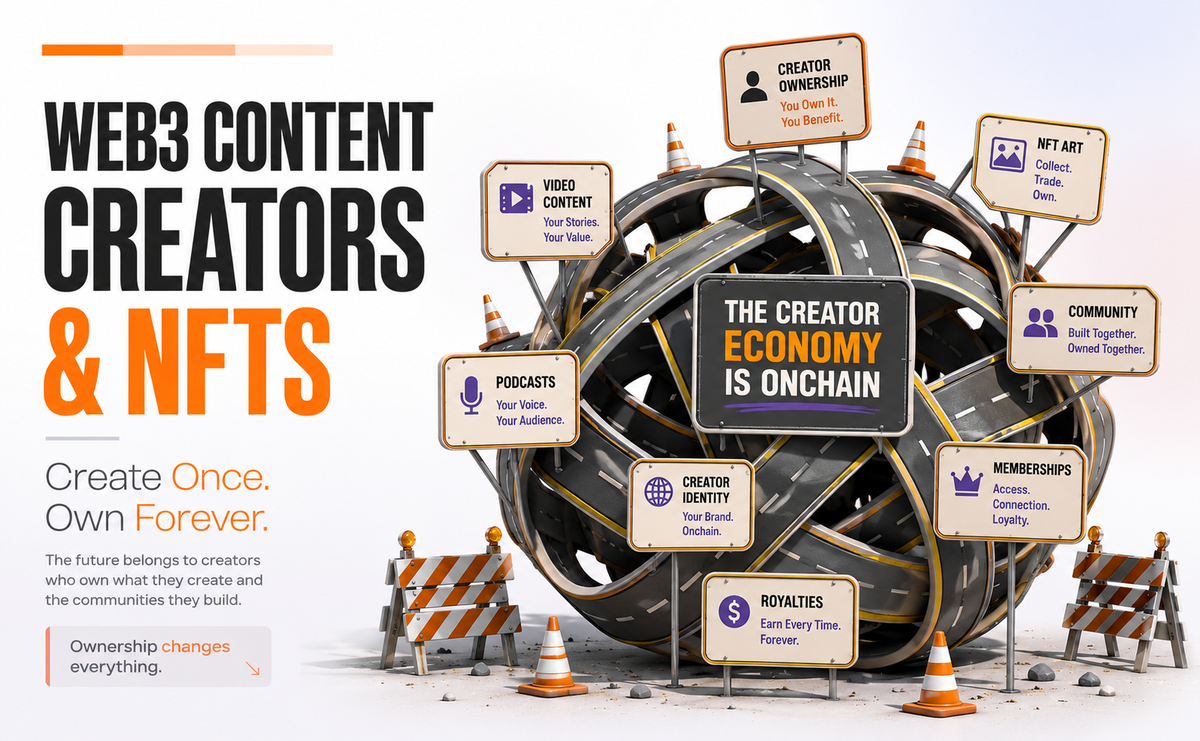
If you've spent any time creating content professionally or trying to you know how the current system works.
You make something. You publish it on a platform someone else owns. That platform decides who sees it, takes a cut of whatever it earns, and collects data about your audience that you never get to access. If the algorithm changes, your reach changes. If the platform changes its policies, your business model changes. If you get banned for any reason, with whatever level of due process the platform feels like extending your audience is gone.
The platforms didn't build this arrangement out of malice. They built it because they owned the infrastructure and the infrastructure was expensive. Someone had to pay for the servers, the bandwidth, the moderation teams. Advertising became the business model, and the business model shaped everything else: what content gets promoted, whose voice gets amplified, who earns money and how much.
Web3 changes the infrastructure assumption. And when you change the infrastructure, you change everything downstream from it.
Here's what that actually means for content creators artists, musicians, writers, and anyone else who makes things for a living.
What Web3 Actually Is (and Why It Matters for Creators Specifically)
Web3 is the version of the internet built on decentralized blockchain infrastructure rather than centralized corporate servers. Three technologies do most of the heavy lifting.
Blockchain is a distributed ledger that records transactions across many computers simultaneously. No single party controls it, and no one can alter records once they're written. This makes it possible to verify ownership and transfer value without needing a bank, a platform, or any other middleman to confirm the transaction.
Smart contracts are agreements written directly into code on the blockchain. When conditions are met a payment comes through, a sale is completed, a royalty threshold is reached the contract executes automatically. No one needs to approve it, process it, or take a fee for administering it. For creators who've watched platforms and labels take their percentage on every transaction, the implications are significant.
Decentralized applications (dApps) are platforms and tools that run on blockchain networks rather than on centralized servers. Users interact with them directly, own their data, and aren't subject to the policies of a corporation that can change the terms at any time.
The practical difference between Web2 and Web3, for a creator, comes down to three things:
- Who owns your data and audience in Web3, you do
- Who keeps the revenue in Web3, most of it goes directly to you
- Who decides what gets seen in Web3, community governance replaces platform algorithms
None of this is fully realized yet. But the direction is clear, and the tools are already being used by real creators earning real money on fundamentally different terms.
NFTs: What They Are and Why They Matter Beyond the Hype
NFTs Non-Fungible Tokens became a cultural phenomenon during the 2021 crypto boom, which did them some disservice. The spectacle of JPEG prices and celebrity cash-grabs obscured something genuinely important about what the technology enables.
An NFT is a unique digital asset on the blockchain that verifiably represents ownership of a specific item. Unlike Bitcoin or Ethereum, which are fungible (one unit is interchangeable with another), each NFT is distinct. You can't replace one with another. This makes NFTs ideal for representing ownership of creative works a piece of digital art, a music track, an article, a video where the original is what holds value.
Three specific capabilities make NFTs genuinely transformative for creators.
Direct Sales Without the Middleman
When a digital artist sells work through a traditional gallery online or physical the gallery takes a commission. When a musician sells through a streaming service or label, the label captures the majority of the revenue. When a writer publishes through a traditional outlet, the publisher sets the terms, the timeline, and the pay rate.
NFTs allow creators to sell directly to collectors and fans, removing every layer of intermediary between the creative act and the economic reward. An artist can mint their work on a platform like OpenSea or Foundation and sell it to a buyer anywhere in the world, with the transaction recorded on the blockchain and the payment flowing directly to the artist's wallet. No gallery. No label. No publisher.
Royalties That Keep Paying
This is perhaps the most significant economic innovation NFTs introduce. When a traditional artist sells a painting, they receive payment once. Every subsequent sale of that painting as it appreciates in value, changes hands, gets resold for multiples of the original price generates value for everyone except the artist. The secondary market has historically been a one-way door for creators.
NFTs reverse this. Smart contracts can be programmed to automatically send a percentage of every resale typically 5% to 15% back to the original creator. Forever. A musician who sells an NFT album today continues earning from it every time a collector resells it in 2027 or 2035. A digital artist whose work becomes collectible receives a cut of every transaction in the secondary market, indefinitely.
For artists whose work has historically appreciated significantly after their careers peak often long after they've been paid their one-time fee this structural change is profound.
Proof of Authenticity That Can't Be Faked
In a world where digital files can be copied infinitely, the question of what makes an original valuable is genuinely complicated. NFTs solve this through the immutability of the blockchain. The record of which token was minted first, by whom, and who currently owns it is public, permanent, and unchangeable. You can copy a digital image; you can't copy the NFT that certifies the original.
This creates the foundation for digital art, music, and writing to function as collectibles in ways that weren't previously technically possible not just aesthetically desirable but cryptographically verifiable.
Decentralized Platforms: What's Already Running
The platforms where Web3 content creation is actually happening aren't hypothetical. Several are already operating with real user bases and real economic activity.
Mirror For Writers
Mirror is a decentralized publishing platform built on blockchain infrastructure that gives writers something traditional publishing has never offered: actual ownership of what they publish.
When a writer publishes on Mirror, the post can be minted as an NFT and sold directly to readers. Crowdfunding campaigns allow writers to raise money for projects by selling tokens that represent ownership stakes or early access a fundamentally different relationship with funding than pitching editors or applying for grants. Subscriptions can be token-based, with readers holding verifiable proof of their membership rather than a database entry on a platform that can be revoked at any time.
The economic model is simple but radical: the writer owns the work, sets the terms, and keeps the revenue. No publisher's advance with strings attached. No platform algorithm deciding whether the piece gets promoted.
Audius For Musicians
Audius is a decentralized music streaming platform that was built specifically to address the economics of streaming an industry where Spotify pays artists between $0.003 and $0.005 per stream, with most of that going to labels and distributors before reaching the actual musician.
On Audius, musicians upload directly, set their own terms, and earn far more per stream than any traditional platform offers. There are no record labels, no licensing administrators, no distribution deals required. The platform is governed by its community, which means policy changes reflect the needs of musicians and listeners rather than corporate shareholders.
Artists like Deadmau5, Chance the Rapper, and RAC were early adopters, which gave the platform credibility within the music industry at a critical early stage. RAC's 2020 limited-edition NFT album release where fans could purchase exclusive ownership rights and collectible content demonstrated what a Web3 music distribution model can look like at a commercially meaningful scale.
Decentraland For Virtual World Creators
Decentraland is a virtual reality platform built on the Ethereum blockchain where creators can build, own, and monetize virtual spaces and experiences. Land in Decentraland is sold as NFTs, meaning ownership is verifiable and transferable just like any other blockchain asset. Creators build games, art installations, virtual stores, and social spaces and earn from visitors, from selling virtual goods, and from the appreciation of virtual real estate they've developed.
It's an unusual context for content creation if you're thinking in traditional terms, but the economics are real: some virtual land parcels in Decentraland have sold for hundreds of thousands of dollars, and the virtual goods and experiences created within those spaces represent a genuine creative economy.
The Success Stories That Make the Case
Case studies help make the abstract concrete.
Beeple's $69 million sale is the most cited example, for good reason. In March 2021, digital artist Mike Winkelmann known as Beeple sold "Everydays: The First 5000 Days" at Christie's for $69.3 million, making it the third most expensive work ever sold by a living artist at that time. The piece was a collage of 5,000 digital images created over 13 years, sold as a single NFT. For the first time, a major auction house sold an entirely digital artwork with a blockchain-based certificate of authenticity.
The significance wasn't just the price. It was the demonstration that digital art previously dismissed as infinitely copyable and therefore valueless as a collectible could achieve museum-grade valuations when provenance and ownership were verifiable through blockchain technology. That legitimacy opened the door for thousands of digital artists who followed.
RAC's music NFTs demonstrated the model at a smaller but more replicable scale. The Grammy-winning artist used NFTs not just to monetize his music differently but to build a closer, more financially direct relationship with his most dedicated fans. Collectors who bought his NFT releases got something they could genuinely own not a streaming license but actual digital property and RAC kept significantly more of the revenue than any traditional label deal would have allowed.
Mirror's writer community has produced numerous examples of writers funding projects through crowdfunding campaigns that raised tens or hundreds of thousands of dollars directly from readers, without a publisher's involvement or editorial control. The model is still developing, but the proof of concept is established: readers will pay directly for writing they value, and the economics for writers who can find those readers are dramatically better than traditional publishing offers.
The Challenges Creators Actually Face
Being honest about the barriers matters as much as being excited about the opportunities.
The Technical Learning Curve Is Real
Web2 publishing is approachable by design. Creating an Instagram account, uploading to Spotify, or publishing on Medium requires no technical knowledge that's deliberate. Platforms optimized for creator acquisition by making entry as frictionless as possible.
Web3 is not there yet. Creating a digital wallet, understanding private keys and what happens if you lose them, navigating gas fees, understanding the difference between blockchains and which platforms run on which chain these are genuine barriers for creators who don't have a technical background. And the consequences of mistakes are more severe than on Web2: there's no customer support to recover a lost wallet or reverse an accidental transaction.
This is improving steadily as the tooling matures and more user-friendly interfaces are built. But anyone who claims the onboarding experience is comparable to signing up for Instagram isn't being straight with you.
Gas Fees Can Eat Into Small Transactions
Minting an NFT on Ethereum requires paying a "gas fee" a transaction fee that compensates the network for processing the transaction. These fees are dynamic, fluctuating with network congestion, and can range from a few dollars to hundreds of dollars during peak periods. For a creator trying to mint a $20 piece of art, a $50 gas fee makes the economics impossible.
Layer 2 solutions like Polygon and alternative blockchains with lower transaction fees are addressing this problem, and platforms like Manifold and Zora have built tools that make minting more economical. But gas fees remain a real consideration that creators need to understand before committing to a particular platform.
Market Volatility Creates Real Income Uncertainty
NFT values are denominated in cryptocurrency, which means they're subject to the volatility of the broader crypto market. A piece of digital art valued at $5,000 when Ethereum is at $4,000 may be worth $1,500 when Ethereum drops to $1,200 even if the piece itself hasn't changed. For creators who need predictable income, building a business on assets whose value fluctuates 50% in either direction within a year is genuinely challenging.
The speculative dimension of the NFT market has also produced boom-bust cycles where prices inflate beyond any reasonable relationship to artistic value, then crash, leaving both creators and collectors feeling burned. Sustainable income in Web3 requires thinking beyond the speculation cycle toward building genuine collector communities around work that has lasting value.
The Regulatory Environment Is Still Being Written
Tax treatment of NFT sales, securities classification of governance tokens, and compliance requirements for platforms that facilitate cryptocurrency transactions are all areas where regulations are actively evolving and where the answers vary significantly by country.
The sale of an NFT is a taxable event in many jurisdictions. The receipt of cryptocurrency as payment generates income that may be taxable at ordinary income rates. These aren't surprising principles they're the same rules that apply to selling anything or earning money from anything but the specifics are complex, the record-keeping requirements are demanding, and the rules are changing fast enough that working with an accountant who understands digital assets is genuinely important advice, not just a hedge.
Where Web3 for Creators Is Going
A few developments are worth watching as this space matures.
Social tokens are becoming an increasingly sophisticated tool for creator-fan relationships. The model a creator issues tokens that fans can purchase, hold, and use to access exclusive content and experiences creates a direct economic alignment between the creator's success and the fan's investment. Platforms like Rally have demonstrated that this can work at scale, and future iterations will likely be more seamlessly integrated into existing creative workflows.
Interoperability across platforms is improving. The vision of a Web3 creator moving their audience, their content portfolio, and their economic relationships seamlessly between platforms without starting from zero on each one is becoming more technically achievable as standards develop and cross-chain infrastructure matures.
Decentralized social media is extending the Web3 model to the platforms where most content discovery currently happens. Rather than building on Instagram's algorithm and hoping for favorable treatment, creators on decentralized social platforms own their social graphs and can move them between applications making the value of the audience they build genuinely portable.
DAOs as creative collectives are enabling new forms of collaborative creation and revenue sharing. A group of musicians, artists, or writers can form a DAO, collectively produce work, govern decisions about how that work is used, and distribute revenue transparently based on predefined rules. This enables creative collaboration at a scale and with an economic fairness that traditional creative partnerships struggle to achieve.
Final Thoughts
Web3 doesn't solve every problem creators face. The technical barriers are real. The market volatility is real. The regulatory uncertainty is real. Anyone who tells you this is a straightforward upgrade is either not paying attention or selling something.
But the fundamental shift it enables from platforms owning the value that creators generate to creators owning it themselves is not incremental. It's structural. And structural shifts, even when they happen slowly and unevenly, tend to be permanent.
The creators who are thriving in Web3 right now are the ones who approached it as a new set of tools to understand and experiment with, rather than either the salvation of the creative economy or a speculative casino. They built collector communities patiently. They chose platforms based on their specific needs rather than hype. They learned the technical basics well enough to make informed decisions. And they took the ownership and revenue advantages on offer while managing the volatility with enough financial discipline to build something durable.
That's achievable for any creator willing to put in the learning curve. The tools exist. The infrastructure is there. The question is what you want to build on top of it.