Why Web3 Domain Auctions are Changing the Landscape of Domain Investment
Web3 is revolutionizing domain investment by eliminating middlemen and adding transparency. This blog explores how blockchain-powered domain auctions work and their key benefits.

Picture an internet where you not Google, not Facebook, not some government registry actually own your online identity. Where buying and selling web addresses doesn't require paying middlemen, trusting opaque bidding systems, or hoping a centralized platform doesn't change its rules on you.
That's not a distant sci-fi scenario. It's what Web3 domain auctions are already making possible, right now.
If you've been watching the Web3 space from the sidelines, trying to figure out whether it's relevant to you as an investor or business owner, this is a good place to start. Domain names have always been valuable digital real estate. Web3 is changing how that real estate gets bought, sold, and owned and the implications are significant.
First, a Quick Primer on Web3
Before diving into domain auctions specifically, it's worth making sure we're on the same page about what Web3 actually means.
The internet most of us use today sometimes called Web2 is largely controlled by a small number of powerful companies. When you use Gmail, Instagram, or Google Drive, you're trusting those platforms to store your data, manage your identity, and play by the rules they set. They can change those rules at any time. They can shut down your account. They own far more of your digital life than most people realize.
Web3 is built on a fundamentally different premise. Instead of routing everything through centralized servers owned by corporations, it uses blockchain technology to distribute data across a wide network of computers. No single company owns the network. No single party can unilaterally change the rules or shut things down.
Three features define this shift:
Decentralization means decisions get made collectively across the network rather than handed down from a central authority. There's no single point of control and no single point of failure.
User ownership means you actually own your data and digital assets, rather than just being granted permission to use them by a platform that could revoke that permission at any time.
Interoperability means different applications and platforms can communicate with each other seamlessly, so your assets and data aren't locked inside one company's ecosystem.
What Are Web3 Domains, Exactly?
Think of a Web3 domain the same way you think of a regular web address something like "yourbusiness.com" except that instead of being managed by a traditional domain name registry, it lives on the blockchain.
Regular domain names are governed by organizations like ICANN, which means you're ultimately renting your domain from a centralized authority that sets the terms of ownership. Web3 domains flip that model. When you own a Web3 domain, you own it outright. No renewal fees to a registrar. No risk of your domain being seized or revoked by a central authority. No permission required.
Common Web3 domain extensions include:
- .crypto one of the most recognized Web3 domain extensions, managed on the Ethereum blockchain
- .eth native to the Ethereum Name Service (ENS), widely used for crypto wallet addresses and decentralized identities
- .dao associated with Decentralized Autonomous Organizations, the governance structures native to Web3
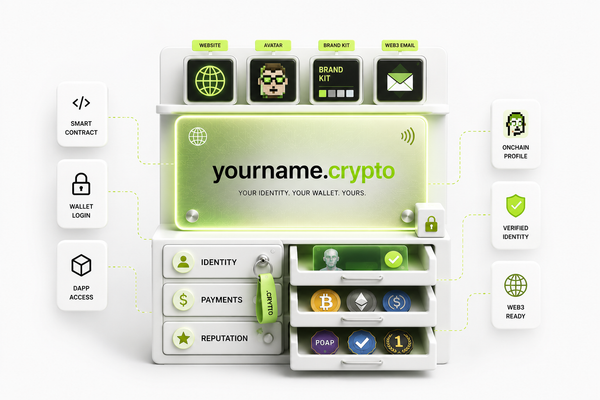
And here's what makes Web3 domains more interesting than traditional ones: they aren't just web addresses. Because they're built on blockchain infrastructure, they can serve as digital identities, act as receiving addresses for cryptocurrency payments, power decentralized websites, and eventually be used as collateral in decentralized finance applications. A Web3 domain is, in many ways, a multifunctional digital asset rather than just a URL.
Traditional Domain Auctions vs. Web3 Domain Auctions
To appreciate what Web3 domain auctions actually change, it helps to understand how traditional domain auctions have always worked and where they fall short.
How Traditional Domain Auctions Work
The process is fairly straightforward on the surface. A domain owner lists their address on a marketplace like GoDaddy or Sedo. Buyers place competing bids over a set period. The highest bidder at the close of the auction wins, pays, and eventually receives the domain after the platform processes the transfer.
The keyword in that last sentence is "eventually." Traditional auctions rely on intermediaries at every step the auction platform, the registrar, sometimes a broker. Each one takes a cut. Each one adds time and friction to the process. And each one introduces a degree of opacity: you're often taking it on faith that the bidding is legitimate and that the transfer will actually happen as promised.
What works: Established platforms with large buyer audiences, dispute resolution services, and support for sellers who need hand-holding through the process.
What doesn't: High fees that eat into returns, bidding processes that aren't always transparent, and centralized control that leaves buyers and sellers dependent on the platform's goodwill and competence.
How Web3 Domain Auctions Work
Web3 domain auctions replace the intermediaries with code. Here's what that looks like in practice:
Domains get listed on blockchain-based platforms where the entire auction is publicly visible and verifiable. Buyers place bids using cryptocurrency. The terms of the auction reserve prices, bid increments, duration, transfer conditions are written directly into a smart contract. When the auction concludes, the smart contract automatically transfers the domain to the winning bidder and releases the funds to the seller. No platform approval required. No waiting on a registrar. No trust required beyond the code itself, which anyone can review.
The differences this creates are meaningful:
Transparency: Every bid, every transaction, every transfer is recorded on the blockchain and visible to anyone. There's no black box.
Security: Blockchain records are tamper-proof by design. Once a transaction is confirmed, it cannot be altered or reversed.
Lower costs: Without auction platforms and registrars taking their cuts, fees drop substantially.
Decentralization: Nobody is in charge of the auction in the traditional sense. The process runs exactly as programmed, without any single party able to interfere with or manipulate the outcome.
Why Investors Are Paying Attention
Web3 domain auctions aren't just a philosophical improvement over the old system. For investors, they offer some concrete, practical advantages.
The security and fraud-prevention case is strong. Smart contracts eliminate the human element from the transaction itself. Once your bid wins, the domain transfers automatically. There's no seller who can back out, no platform that can freeze the transaction, and no dispute about whether the agreed terms were honored. The code enforces everything.
You actually own what you buy. Traditional domain ownership is, legally speaking, more like a lease. You pay annual renewal fees, and if you stop paying or if the registrar decides to revoke your access you lose the domain. Web3 domain ownership is recorded on the blockchain and recognized across the network regardless of what any individual company decides. That's a fundamentally different and stronger form of ownership.
The market is genuinely global. Anyone with internet access and cryptocurrency can participate in a Web3 domain auction. There are no geographical restrictions, no currency conversion headaches, no need to have a relationship with a particular national registrar. For investors, this means access to a far larger pool of potential buyers when it comes time to sell.
The barriers to entry are lower than traditional auctions. High fees and complex intermediary relationships have historically made domain investing a game for well-capitalized players. Web3 auctions cut through much of that overhead, opening the market to a broader range of investors.
The return potential is real but so is the risk. Domains like "crypto.eth" and "nft.crypto" have already sold for substantial sums, and early adopters in this space have seen significant appreciation. Several factors drive value: scarcity (there's only one "banking.eth"), growing demand as more businesses and individuals move into Web3, and the expanding utility of these domains within the broader blockchain ecosystem. That said, valuations in this market can swing dramatically, and investors should go in with clear risk tolerance and realistic expectations.
The Technology That Makes It All Work
You don't need to be a software engineer to invest in Web3 domains, but having a basic understanding of the underlying technology helps you make smarter decisions.
Blockchain is the foundation. Think of it as a digital ledger that's maintained simultaneously by thousands of computers around the world. Every transaction every bid, every transfer of ownership gets recorded in a block, chained to the previous block, and verified by the network. Once it's recorded, it can't be changed. This is what makes the entire system trustworthy without requiring anyone to trust any individual party.
Smart contracts are the engine that powers the auction process. They're self-executing programs stored on the blockchain that automatically carry out actions when predetermined conditions are met. In the context of a domain auction, a smart contract might hold a bidder's funds in escrow during the auction, automatically release them to the seller if the bid wins, and transfer domain ownership to the buyer all without any human intervention. This removes error, delay, and the potential for bad faith from the equation.
Interoperability with the broader Web3 ecosystem is what gives these domains their versatility. A Web3 domain isn't just a website address. It can serve as a unified digital identity across multiple platforms, a receiving address for dozens of different cryptocurrencies, the address of a decentralized website hosted directly on the blockchain, or even collateral for a DeFi loan. As the Web3 ecosystem continues to build out, the utility and therefore the value of well-chosen domain names is likely to increase.
The Challenges You Should Know About Before Diving In
Web3 domain auctions offer genuine advantages, but they're not without real hurdles. Any investor considering this space should go in with eyes open.
The learning curve is steep. Participating in a Web3 domain auction requires understanding how to use cryptocurrency, how to interact with a blockchain-based platform, and at least a basic grasp of how smart contracts work. For someone who's never owned crypto before, the onboarding process can feel overwhelming. The technology is genuinely new, and user-friendly interfaces are still catching up to the underlying capability.
The regulatory environment is unsettled. Different countries are taking wildly different approaches to cryptocurrency and blockchain regulation. Some are welcoming; others are actively hostile. Anti-money laundering (AML) and know-your-customer (KYC) requirements vary by platform and jurisdiction. If you're investing meaningful capital in this space, getting competent legal advice that's specific to your location is worth the cost.
Market volatility is a real factor. Web3 domain values are tied, to varying degrees, to the broader cryptocurrency market which is known for dramatic swings in both directions. A domain worth a significant amount today might be worth considerably less in six months if the broader market pulls back. Investors accustomed to more stable asset classes may find this level of volatility uncomfortable. Position sizing and diversification matter here more than in most traditional investment categories.
Final Thoughts
Web3 domain auctions represent a genuine evolution in how digital real estate gets bought, sold, and owned. The elimination of intermediaries, the transparency of blockchain-based transactions, the security of smart contracts, and the global accessibility of these markets all represent real improvements over the traditional domain auction model.
For investors, the opportunity is real but so are the complexities. The technology is still maturing. The regulatory landscape is still taking shape. And the market, while exciting, is volatile in ways that require discipline and informed risk management.
The investors who will benefit most from this shift are the ones who take the time to understand the technology, approach the market with a clear strategy, and get involved early enough to establish positions before the mainstream catches on. That window exists right now. Whether you take advantage of it is up to you.