Web3 Domains: What They Mean for Individuals, Businesses, and the Future of the Internet
Web3 domains: Own your online identity. Explore the benefits for individuals and businesses in this new digital era.

Do you remember the first time someone mentioned Bitcoin to you? Maybe it was a coworker throwing around terms you didn't fully understand, or a headline that made you scroll past because it sounded too technical. Back then, cryptocurrency felt like a fringe experiment. Today, it's a household conversation and the technology underneath it all, blockchain, is quietly reshaping the internet in ways most people haven't noticed yet.
That reshaping has a name: Web3. And at the center of it sits something surprisingly practical Web3 domains.
In this article, we're going to break down what Web3 domains actually are, why they matter, and what they could mean for everyday users and forward-thinking businesses alike.
What Are Web3 Domains, and Why Should You Care?
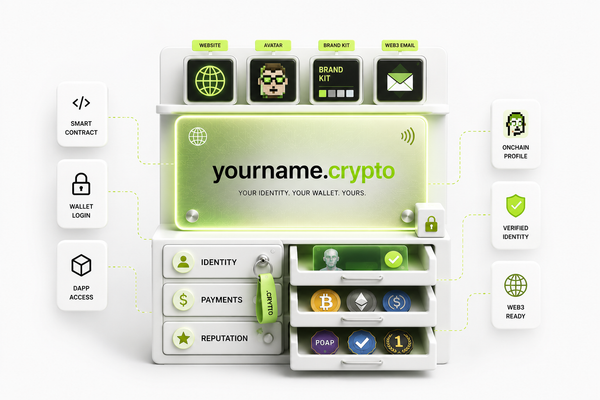
Think of a Web3 domain the way you'd think of a traditional web address except instead of being registered through a company like GoDaddy and stored on a centralized server somewhere, it lives on a blockchain. Nobody owns it but you. No middleman. No renewal fees that can be yanked away. No single company deciding whether your domain stays live.
That's a pretty big deal.
Here's why Web3 domains are gaining real traction:
- You own it outright. Your domain, your data, your digital identity all controlled by you, not a registrar.
- Decentralization means resilience. Because there's no central server to take down, Web3 domains are far harder to censor or manipulate.
- They plug into the broader Web3 ecosystem. Web3 domains work seamlessly across decentralized apps (dApps), letting you move through the new internet with a single, unified identity.
- Blockchain keeps it honest. Every transaction and ownership record is transparent, permanent, and publicly verifiable.
- The possibilities are wide open. From gaming to finance to supply chain management, the programmability of Web3 domains is already sparking real innovation across industries.
The Core Principles Behind Web3 Domains
Web3 domains aren't just a technical upgrade over traditional ones they represent a fundamentally different philosophy about how the internet should work. Here are the principles driving them:
Decentralization sits at the foundation. Traditional domains rely on central authorities that can fail, be compromised, or make decisions that hurt users. Web3 domains distribute that control across a network, making them more robust and resistant to single points of failure.
Blockchain as the backbone ensures that records of ownership and transactions are immutable and transparent. You can verify who owns what without trusting any one company to tell you the truth.
User empowerment is the point of all of this. Web3 domains return control to the person actually using them not the platform, not the registrar, not a government body.
Interoperability means your Web3 domain isn't locked into one blockchain or one application. Whether you're on Ethereum, Solana, Algorand, or Aptos, the goal is a seamless experience across all of them.
Transparency and trust come built in. Because everything is recorded on a public blockchain, credibility doesn't depend on a company's word it's baked into the infrastructure itself.
NFTs, decentralized finance (DeFi), and social tokens are just a few examples of how these principles are already playing out in the real world.
What Web3 Domains Mean for Individuals
Let's get personal for a moment. If you're an individual navigating the internet today, you're probably used to handing over your data to platforms in exchange for access. You agree to terms of service you don't fully read, you let companies monetize your identity, and you hope they don't get hacked.
Web3 domains flip that relationship.
You hold the keys literally. With a Web3 domain, ownership is cryptographic. No company can revoke it, no registrar can let it expire on you, and no platform can lock you out of your own digital identity.
Security improves significantly. Because your data isn't sitting on a centralized server, there's no honeypot for hackers to target. Your information is distributed across a network, making breaches far more difficult.
Navigating dApps becomes seamless. Rather than logging into a dozen different platforms with different credentials, your Web3 domain can act as a universal passport across the decentralized web.
Trust is built in. Every interaction tied to your Web3 domain is logged on the blockchain verifiable and tamper-proof. That's a level of accountability that traditional web infrastructure simply can't offer.
You become part of the innovation. Whether you're into gaming, creative work, or financial tools, Web3 domains open doors to applications that don't even exist yet built on blockchain technology that's still in its early chapters.
What Web3 Domains Mean for Businesses
If you're running a business, Web3 domains aren't just a tech novelty they're a strategic consideration. Here's what companies are discovering when they make the move:
Security gets a serious upgrade. Traditional domains can be hijacked, spoofed, or taken down by centralized registrars. Web3 domains, recorded on blockchain with distributed ownership, are significantly harder to tamper with or breach.
Payments and transactions get simpler. One of the most practical benefits? Replacing long, error-prone cryptographic wallet addresses with a clean, readable domain name. Instead of sending funds to 0x4f3a..., you send them to xyzcorp.crypto. Less friction, fewer mistakes.
Your brand gets a modern identity. A Web3 domain signals to clients and partners that your business understands where the internet is heading. It also gives you more control over how your brand exists online independent of third-party platforms.
You can host censorship-resistant websites. For businesses operating in sensitive industries or across international borders, decentralized hosting means your site stays up regardless of outside pressure or centralized takedown requests.
You gain flexibility across blockchain ecosystems. Web3 domains are being built to work across multiple blockchains Ethereum, Solana, Algorand, Aptos, and more so you're not betting everything on a single network.
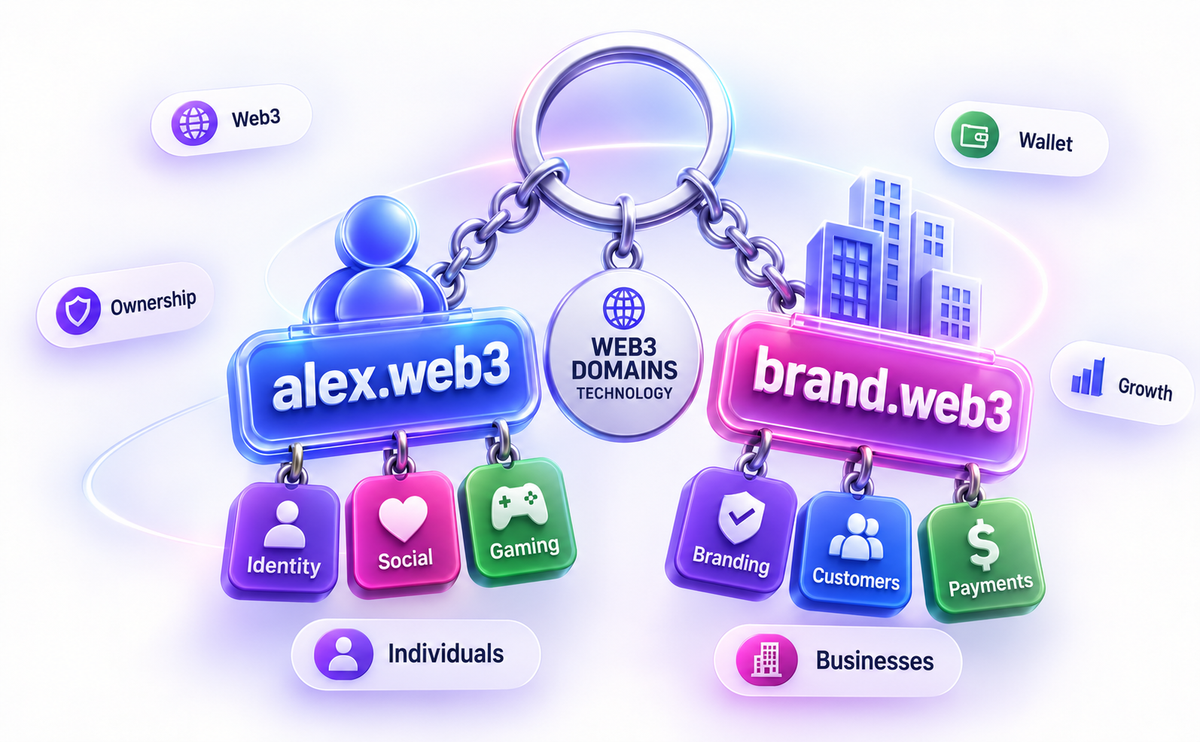
Take a company like "XYZ Corporation" as an example. By registering xyzcorp.crypto, they could enable direct, secure transactions via smart contracts, create transparent records that build customer trust, and streamline cross-border payments all without relying on a bank or payment processor as an intermediary.
So Who Is This Really For Individuals or Businesses?
Honestly? Both.
For individuals, Web3 domains are about reclaiming something the traditional internet quietly took away: ownership. Someone like Jay Kapoor could own jaykapoor.eth and use it to receive cryptocurrency, host a decentralized website, or establish a verified online identity all without going through a single gatekeeper.
For businesses, Web3 domains are a practical infrastructure play better security, cleaner transactions, and branding that positions the company as future-ready.
The common thread is control. Web3 domains give both individuals and businesses the ability to operate online on their own terms.
The Honest Challenges (Because Nothing Is Perfect)
It would be misleading to talk about Web3 domains without acknowledging the real obstacles standing between where we are now and widespread adoption.
Scalability is still a work in progress. Decentralized networks can struggle under load. The technology is improving, but it hasn't yet reached the performance levels most mainstream users expect.
Most people don't know this exists. Adoption is slow because awareness is low. The learning curve is steep, and without better education and more intuitive interfaces, Web3 domains will remain a niche tool for a while longer.
Regulations are murky. Many jurisdictions haven't figured out how to handle Web3 assets legally. That ambiguity creates compliance headaches for businesses trying to operate across borders.
Interoperability between blockchains is still messy. Different blockchains speak different languages. Getting them to work together seamlessly requires standardization that the industry is still working toward.
Smart contracts can have bugs. The code running Web3 applications isn't infallible. Vulnerabilities in smart contracts have led to real losses, and this remains an area where the technology needs to mature.
The user experience needs work. Managing private keys, navigating dApps, and understanding decentralized systems is genuinely complicated for people who aren't technically inclined. Until that changes, widespread adoption will be limited.
Where Does This Leave Us?
Web3 domains represent one of the more tangible expressions of a bigger idea: that the internet doesn't have to be controlled by a handful of powerful companies and governments. It can be an open, user-owned infrastructure where individuals and businesses operate with real autonomy.
We're not fully there yet. The challenges are real, and the road to mainstream adoption will require serious collaboration between developers, regulators, and everyday users. But the direction is clear, and the momentum is building.
Whether you're an individual who's tired of handing your data to Big Tech, or a business looking for a more secure and flexible digital infrastructure, Web3 domains are worth paying attention to. The internet is changing and this time, you have a chance to actually own a piece of it.