How Web3 Domains Are Empowering Decentralized Communities in 2025
Web3 domains empower decentralized communities in 2025 by enabling secure identities, governance, and innovative community-driven collaboration and economies.

The internet was built on the idea of open connection. But somewhere along the way, a handful of corporations ended up controlling most of it. Your data, your identity, your platform access, all of it sits on servers owned by companies whose priorities don't always match yours. For communities trying to organize, collaborate, and build something meaningful online, that kind of centralized control creates real problems.
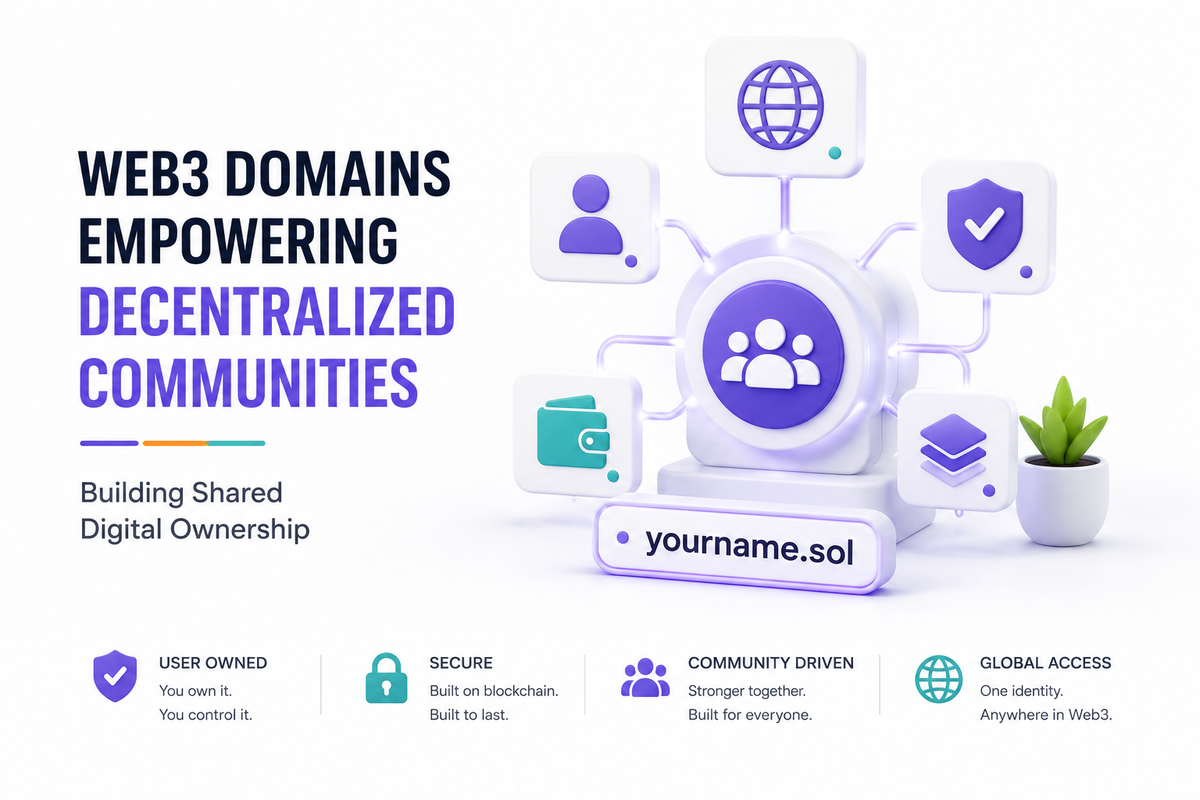
Web3 domains are one of the most practical responses to those problems. They're blockchain-based identifiers that go far beyond a simple website address. They give individuals and communities genuine ownership of their digital presence, the ability to host content that can't be taken down, tools for transparent governance, and the foundation for entirely new economic models.
In 2025, decentralized communities are putting all of this into practice. This blog walks through how, covering everything from digital identity to cross-platform collaboration, and why Web3 domains are quickly becoming essential infrastructure for any community that wants to operate on its own terms.
Building Decentralized Identities for Communities
Every community runs on trust. Before members can collaborate, vote, share resources, or make decisions together, they need a reliable way to know who they're dealing with. In decentralized spaces, where there's no central administrator verifying accounts, that trust has to come from somewhere else. Web3 domains provide it.
A domain like JohnDoe.eth or GreenInitiative.crypto is more than a name. It's a verifiable, tamper-proof digital identity linked directly to a blockchain wallet connect. It can connect to credentials, personal profiles, or community memberships, and because it lives on the blockchain, nobody can alter or revoke it without the owner's consent.
This changes how communities operate in some very practical ways.
A community group can assign members individual Web3 domains, like EcoActivist.eth, making it simple to identify verified participants and distinguish them from outsiders. A charity organization can adopt an official domain like HelpForAll.eth, giving donors and partners a trustworthy, verifiable point of contact. A hobby community like a book club can rally around a shared domain like ReadersClub.eth, creating a single, reliable home for its members.
Governance benefits too. When votes and resource access are tied to verified Web3 domains rather than usernames on a platform, the process becomes more secure and harder to game. Members prove who they are through their blockchain identity, not through a password that can be shared or stolen.
What makes this especially valuable is the privacy component. Traditional identity verification usually requires handing over sensitive personal information to a third party. Web3 domains let communities verify membership without that exposure. Members prove their identity through their blockchain address, and they control exactly what information gets shared and with whom.
In a world where online communities increasingly span borders, industries, and time zones, having a shared identity layer that everyone can trust, without depending on a central platform to manage it, is a genuinely big deal.
Hosting Censorship-Resistant Platforms
Free expression isn't just a philosophical value. For a lot of communities, it's a practical necessity. Activists sharing information in restrictive regions, independent journalists publishing stories that powerful interests would rather suppress, and social movements trying to organize without their platforms being pulled out from under them these groups need more than good intentions. They need infrastructure that can't be shut down.
Web3 domains, combined with decentralized hosting solutions like IPFS (InterPlanetary File System), provide exactly that.
Here's how it works. IPFS stores content across a distributed network of computers rather than on a single central server. There's no one machine to target, no single company to pressure, and no central switch to flip. Web3 domains serve as a simple, memorable address that links users to that distributed content. The result is a website that anyone can reach, but nobody can easily take down.
The use cases here are both important and diverse.
A human rights organization hosting sensitive documentation can use a domain like JusticeForAll.crypto to keep that information accessible even in countries where it might otherwise be blocked. An independent media outlet can publish under FreePress.eth, ensuring that stories stay alive regardless of advertiser pressure or government interference. A climate advocacy group can build its organizing hub on GreenFuture.crypto, running events, sharing resources, and engaging supporters without worrying about platform policy changes pulling the plug.
Traditional websites are vulnerable in ways most people don't fully appreciate. A hosting provider can terminate a contract. A domain registrar can revoke a name. A government can issue a takedown order that a centralized company has no choice but to comply with. Decentralized platforms don't have a single point of failure, which means they don't have a single point of attack either.
For communities working on sensitive issues, this resilience isn't a luxury. It's the whole point.
Simplifying Governance in DAOs
Decentralized Autonomous Organizations, or DAOs, are communities that make collective decisions through transparent, blockchain-based processes rather than through a central leadership structure. The idea is compelling, but the execution can get complicated fast. Verifying who gets to vote, tracking proposals, preventing manipulation, and keeping everything auditable are real operational challenges.
Web3 domains make all of this significantly cleaner.
When each member of a DAO has a domain like MemberName.eth tied directly to their blockchain wallet, that domain becomes their credential for everything. Voting, submitting proposals, accessing shared resources, all of it flows through a single verified identifier. There's no separate authentication system to manage, no risk of someone voting twice under different usernames, and no ambiguity about who said what or when.
The transparency benefits are just as important. Every vote cast through a blockchain-linked domain is recorded on-chain, visible to any member who wants to verify it. That kind of open auditability builds genuine confidence in the process, which in turn encourages broader participation.
Real communities are already using this. DeFi governance DAOs use Web3 domains to confirm which stakeholders are eligible to vote on protocol changes. Community funds managing pooled resources for social causes use domains to authenticate members during allocation decisions. Creative collectives in art and music use blockchain identities to ensure that only verified contributors have a say in how the group operates.
The broader impact is that Web3 domains lower the barrier to meaningful participation in decentralized governance. When the process is clear, verifiable, and easy to navigate, more people engage. And more engagement means better decisions and stronger communities.
Enabling Community-Centric Economies
One of the most exciting things happening in decentralized communities right now is the development of their own economic systems. Not just using existing financial infrastructure, but building new ones from the ground up, tailored to their specific needs and values.
Web3 domains sit at the center of a lot of this activity.
A neighborhood community can issue local tokens under a domain like LocalMarket.eth, creating a circular economy where members exchange value for goods and services within their own ecosystem. A music collective can distribute royalties and track ownership through BeatDAO.eth, cutting out intermediaries and ensuring that creators get paid fairly and transparently. A nonprofit can collect donations through SupportKids.eth, with every transaction recorded on the blockchain so donors can see exactly where their money goes.
NFT marketplaces are another area where Web3 domains are making a real difference. An artist hosting their gallery on ArtByJane.crypto can connect directly with buyers without going through a platform that takes a significant cut of every sale. The domain becomes a storefront, a portfolio, and a brand identity all at once, fully owned by the creator.
Gaming communities are using Web3 domains to trade virtual assets securely, with verified ownership baked into every transaction. Social impact organizations are using them to raise funds with a level of transparency that traditional fundraising platforms simply can't match.
The common thread across all of these use cases is ownership. Web3 domains put communities in control of their own financial activity, removing the dependency on centralized platforms that set the rules, take the fees, and hold the keys. That kind of economic autonomy is new, and it's proving to be genuinely transformative for the communities that embrace it.
Enhancing Cross-Platform Collaboration
Decentralized communities rarely exist in a single place. They span apps, platforms, social media channels, and blockchain networks. Managing all of that without a unifying layer creates real friction. Members end up juggling multiple usernames, different login credentials for each platform, and no clean way to establish a consistent identity across all of them.
Web3 domains solve this by acting as a universal identifier that works everywhere.
A member with Alice.eth can use that single identity to log into decentralized applications, verify their credentials on blockchain platforms, and interact with Web2 services, all without creating new accounts or managing separate passwords. The domain travels with them, carrying their verified reputation and credentials wherever they go.
For communities operating across platforms, this creates something genuinely useful: a single point of access for communication, data, and resources. A global DAO managing health initiatives can link HealthDAO.crypto to its apps, websites, and shared documents, giving members one reliable entry point regardless of which tool they're using. A creative collective can manage NFTs, coordinate projects, and share work through CollabStudio.eth, keeping everything connected under one domain. A research network studying climate change can use GreenResearch.eth to bridge blockchain-based data storage with public-facing websites, making findings accessible to both technical and general audiences.
The Web2 to Web3 bridge is particularly important right now. Most communities can't flip a switch and move entirely to decentralized infrastructure overnight. They need hybrid solutions that let them keep working with the tools their members already know while gradually incorporating the benefits of decentralization. Web3 domains make that transition practical rather than theoretical.
Final Thoughts
What Web3 domains are doing for decentralized communities isn't just a collection of useful features. It's a shift in the underlying relationship between communities and the internet.
Right now, most online communities exist at the discretion of platforms they don't control. The rules can change. The fees can increase. The algorithm can bury its content. The platform can shut down. In each of these scenarios, the community has no recourse because they never owned their digital presence in the first place.
Web3 domains change that. They give communities ownership of their identity, their content, their governance processes, and their economic activity. Not in a symbolic way, but in a real, blockchain-enforced way that no company can override.
That's a meaningful shift. And in 2025, the communities that understand it are already building things that simply weren't possible before.
If you're a community leader, organizer, or individual ready to establish a presence that you actually own, securing a Web3 domain is the most practical first step. Platforms like Endless Domains make the process straightforward, with a range of options to help you find the right domain for your community and get started quickly.
The decentralized future isn't a distant concept. It's being built right now, one community at a time.