How Web3 Domains are Driving Institutional Adoption of DeFi in 2025
In 2025, Web3 domains will be pivotal in institutional DeFi adoption, offering businesses seamless integration, enhanced security, and user-friendly access.

Decentralized finance started as a retail phenomenon. Early adopters, crypto enthusiasts, and independent traders were the ones experimenting with lending protocols, liquidity pools, and yield farming strategies while traditional financial institutions watched from a distance, alternating between skepticism and cautious curiosity.
That distance is closing fast. In 2025, institutions including banks, investment firms, and large corporations are taking DeFi seriously, not as a speculative curiosity but as a legitimate component of financial strategy. The promise is real: higher yields than traditional fixed-income products, greater transparency through blockchain-based records, and meaningfully lower operational costs by removing the intermediaries that traditional finance depends on.
But institutional adoption comes with requirements that the early DeFi ecosystem wasn't built to meet. Security at scale, regulatory compliance, operational simplicity, and infrastructure that can handle high transaction volumes are all non-negotiable for organizations operating under fiduciary obligations and regulatory oversight. The gap between what DeFi offers and what institutions need has been one of the primary reasons adoption has moved more slowly than the technology's potential would suggest.
Web3 domains are one of the most practical tools for closing that gap. By replacing complex wallet addresses with human-readable, blockchain-verified identifiers, integrating decentralized identity systems for compliance, and enabling seamless multi-chain operations, Web3 domains are making institutional DeFi not just possible but genuinely workable. This blog explores how.
What Institutions Actually Need from DeFi Infrastructure
Before looking at how Web3 domains help, it's worth being specific about what institutions require that typical retail DeFi users don't.
Security and compliance sit at the top of every institutional priority list. A retail user experimenting with a DeFi protocol accepts a certain level of risk as part of the experience. An institution managing client funds or operating under regulatory oversight cannot. Every transaction needs to be traceable, every counterparty needs to be verifiable, and the entire operation needs to be defensible to regulators. DeFi's pseudonymous nature, which is a feature for retail users who value privacy, becomes a compliance liability for institutions that need to demonstrate adherence to KYC and AML requirements.
Simplified asset management is the operational reality that institutions face. Managing multiple wallets across multiple blockchain networks, each with its own address format and each requiring careful verification before every transaction, creates enormous operational complexity. The risk of a costly error, sending funds to the wrong address, or interacting with the wrong protocol, is not a theoretical concern. It's a genuine operational hazard at scale.
Scalable infrastructure is the third fundamental requirement. An institution participating in DeFi isn't making occasional individual transactions. It's managing ongoing positions across multiple protocols, processing high transaction volumes, and needing all of that to function reliably and efficiently. Infrastructure that works for individual retail users often doesn't hold up under institutional-scale demands.
Web3 domains address each of these requirements in concrete, practical ways.
The Specific Advantages Web3 Domains Bring to Institutional DeFi
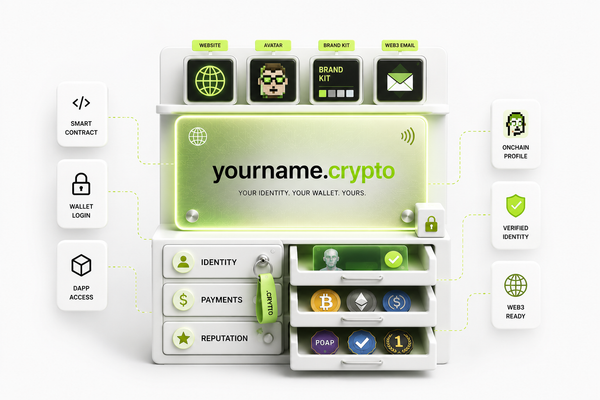
Simplified wallet management is the most immediately obvious benefit. Instead of maintaining a directory of complex wallet addresses and carefully verifying each one before every transaction, an institution can link its wallets to branded, human-readable domain names. A financial institution using CapitalGroup.defi as its primary domain creates a consistent, verifiable identifier for all of its DeFi operations. The risk of transaction errors drops dramatically, operational efficiency improves, and the overall experience of managing assets across DeFi protocols becomes significantly more manageable for staff who aren't blockchain developers by background.
Enhanced security comes from several directions. Web3 domains use blockchain-based encryption that protects transactions against phishing attacks and fraud, which are significant concerns at an institutional scale where the potential payoffs for attackers are much larger. The integration of decentralized identity features adds another security layer, enabling institutions to implement robust identity verification and access management without depending on centralized systems that create their own security vulnerabilities. Institutions can control who has access to which operations, maintain clear records of all activity, and demonstrate compliance to regulators through blockchain-verified records.
Interoperability across chains is increasingly important as the DeFi ecosystem fragments across Ethereum, Solana, Polygon, and a growing number of other networks. An institution that wants to access the best protocols regardless of which chain they're built on needs infrastructure that works across all of those networks without requiring a separate management approach for each one. Web3 domains act as a unified interface, providing a consistent entry point to cross-chain services and enabling institutions to manage assets across multiple blockchains through a single, coherent operational framework.
Scalability supports the long-term growth of institutional DeFi involvement. As participation expands, institutions need infrastructure that can accommodate increasing transaction volumes and evolving operational requirements without requiring a complete rebuild. Web3 domains support the integration of diverse DeFi functionalities, including staking, trading, yield farming, and lending, into custom dashboards that can be adapted as institutional needs change. This flexibility means organizations aren't locked into a static setup that becomes a constraint as their DeFi operations mature.
How Institutions Are Actually Using Web3 Domains in DeFi
The practical applications across different institutional use cases show how these benefits translate into real operational value.
Asset management across multiple chains is one of the clearest examples. A financial firm managing diverse portfolios across Ethereum, Polygon, and other networks can use a domain-linked dashboard to consolidate tracking and reporting across all of those positions. Instead of navigating separate interfaces for each chain and manually reconciling data across them, everything is accessible through a unified view tied to the institution's Web3 domain. The operational efficiency gains are significant, and the reduction in manual error risk is equally important.
Tokenized assets represent one of the most promising areas of institutional DeFi activity. Real estate, bonds, equity stakes, and other traditional financial instruments are increasingly being represented as blockchain tokens, enabling more efficient issuance, trading, and custody. An investment firm using its branded Web3 domain to issue tokenized bonds creates a trustworthy, verifiable distribution mechanism that stakeholders can interact with confidently. The domain provides a clear, branded entry point to the issuance and trading process, which matters for the institutional investors and corporate clients that are the likely participants.
Cross-border transactions are another area where Web3 domains deliver immediate practical value. A multinational bank facilitating remittances between countries can replace the slow, expensive process of international wire transfers with near-instant blockchain payments routed through domain-linked wallets. The human-readable domain addresses eliminate the error risk associated with complex wallet addresses, the elimination of intermediaries reduces fees substantially, and the blockchain record provides the transparency and traceability that compliance requirements demand.
Compliance and reporting may be the use case where Web3 domains provide the most distinctive institutional value. KYC and AML compliance are non-negotiable for regulated financial institutions, and the pseudonymous nature of traditional DeFi interactions creates genuine compliance challenges. Web3 domains integrated with decentralized identity systems provide a practical solution. Identity verification happens through blockchain-based credentials that are secure, tamper-proof, and auditable without exposing sensitive user data unnecessarily. Compliance reporting becomes more automated and more reliable, and the risk of data breaches that could compromise the personal information of verified users drops significantly.
To make this concrete, consider a global corporation that has integrated Web3 domains across its DeFi operations. It uses a branded domain for centralized tracking of multi-chain assets. It issues tokenized bonds through that domain, attracting global investors who can verify the issuer's identity and the terms of the offering on-chain. It executes real-time international transactions with minimal fees, and it maintains KYC and AML compliance through decentralized identity integration that preserves user privacy while satisfying regulatory requirements. That's not a hypothetical future state. It's a description of what's already becoming possible for institutions that have made the investment in Web3 infrastructure.
Overcoming the Barriers That Have Held Institutions Back
Despite growing interest, several barriers have slowed institutional DeFi adoption. Web3 domains address each of them directly.
Regulatory concerns have been the most significant barrier. Institutions operating under regulatory oversight can't participate in systems that don't support KYC and AML compliance, and traditional DeFi protocols weren't designed with those requirements in mind. Web3 domains with integrated decentralized identity features change this equation by providing secure, verifiable identity authentication that creates tamper-proof records for auditing while preserving user privacy. A lending platform using DID-enabled Web3 domains can verify user identities for compliance purposes without building the kind of centralized data repository that creates its own security and privacy risks.
Technical complexity has been the second major barrier. Blockchain technology has a steep learning curve, and asking institutional staff who are not blockchain developers to navigate raw wallet addresses and complex protocol interfaces is not a realistic path to adoption. Web3 domains lower this barrier by abstracting away the complexity that creates the steepest part of that curve. Human-readable domain names replace intimidating wallet addresses. Intuitive tools for wallet setup and domain linking reduce the technical knowledge required to get started. And the reduction in transaction errors builds confidence among staff who are new to decentralized systems.
Integration with existing systems is the third barrier. Institutions have existing technology infrastructure that they've built over years or decades, and asking them to abandon that infrastructure to adopt blockchain-based systems is not a viable proposition. Web3 domains support integration through APIs and middleware tools that allow blockchain functionality to connect with legacy systems rather than replace them. Multi-chain compatibility ensures that the integration works across the blockchain networks the institution needs to access. And customizable dashboard options mean that the interface institutions use for their DeFi operations can fit into their existing workflows rather than requiring a complete operational redesign.
The Trends Shaping Where This Goes Next
Several developments are accelerating institutional DeFi adoption and making Web3 domains increasingly central to how institutions participate.
Decentralized identity systems are maturing rapidly and becoming more interoperable across platforms. As more DeFi protocols integrate DID support, the compliance benefits that Web3 domains provide through identity integration become available across a wider range of institutional use cases. Banks using Web3 domains to establish verifiable on-chain identities can interact across a growing ecosystem of compliant DeFi platforms using credentials that are recognized universally.
AI integration is creating new capabilities for institutional analytics and risk management. AI tools connected to Web3 domain-linked dashboards can provide predictive analytics for investment decisions, real-time risk assessment across complex portfolios, and automated identification of opportunities and threats in DeFi markets. Asset managers using these AI-powered dashboards can make more informed decisions faster, with better data and less manual analysis than the current generation of tools requires.
DeFi insurance protocols are addressing one of the legitimate risk concerns that has deterred institutional participation. Smart contract failures and protocol exploits are real risks in DeFi, and institutions managing significant assets need protection against those risks. Web3 domains simplify access to decentralized insurance solutions, enabling seamless claims processing and transparent policy management through domain-linked dashboards. As these protocols mature, they're removing a significant risk barrier to institutional participation.
Institutional custody solutions are evolving to meet the specific needs of large-scale investors in DeFi. Web3 domains that link to multi-signature wallets provide enhanced security for high-value asset management. Portfolio management across multiple blockchain networks becomes more coherent through domain-unified dashboards. And the scalable infrastructure that Web3 domains support ensures that custody operations can grow alongside the institution's DeFi involvement without running into the limitations of early-stage blockchain infrastructure.
A Practical Roadmap for Institutions Getting Started
For institutions ready to begin integrating Web3 domains into their DeFi strategy, the path forward is more straightforward than the technical complexity might suggest.
The first step is researching and securing a Web3 domain that aligns with the institution's brand and operational requirements. This means choosing a memorable domain, clearly associated with the institution's identity, and capable of scaling to accommodate multiple wallets and growing asset management needs. Security features and compatibility with the blockchain networks the institution plans to use should be primary considerations in this evaluation.
The second step is linking the domain to blockchain wallets and integrating with the DeFi platforms the institution plans to use. Platforms like Uniswap, Aave, and Compound are the obvious starting points for many institutional use cases, and the process of connecting a Web3 domain to these protocols through Web3-compatible wallets is increasingly well-documented and supported.
The third step is building out the analytics and management infrastructure. APIs that connect Web3 domains to DeFi platforms enable real-time data tracking and automated reporting. Analytics dashboards provide the asset performance visibility, transaction history, and risk assessment capabilities that institutional decision-making requires. These tools transform a Web3 domain from a simple identifier into the center of a comprehensive institutional DeFi management system.
The fourth step, and the one that's most often underinvested, is staff training and security implementation. The technology is only as effective as the people operating it. Staff need to understand how to use Web3 domains, manage digital assets, and interact with DeFi protocols securely. Multi-signature wallet requirements, encryption protocols, and decentralized identity management all need to be part of standard operating procedures. Ongoing education about regulatory developments ensures that the institution's DeFi operations remain compliant as the regulatory environment continues to evolve.
Final Thoughts
The case for institutional DeFi adoption is strong, and it's getting stronger as the ecosystem matures. Higher yields, greater transparency, lower operational costs, and access to financial instruments that don't exist in traditional finance are all real advantages that institutions are increasingly motivated to capture.
Web3 domains are one of the most practical tools for making that adoption work at an institutional scale. They address the specific barriers that have held institutions back, simplifying the operational complexity, supporting regulatory compliance, enabling cross-chain interoperability, and providing the scalable infrastructure that large-scale DeFi participation requires.
For institutions evaluating their Web3 strategy, securing a domain through a platform like Endless Domains is a concrete and accessible first step. The platform's straightforward registration process and robust domain options provide the foundation for building out a DeFi strategy that's both ambitious and operationally sound.
The decentralized financial system is being built right now, and the institutions that establish their presence within it early will be the ones best positioned to lead when participation becomes the standard rather than the exception.