How Web3 Domains Are Shaping E-Commerce in 2025
Web3 domains are revolutionizing e-commerce by enabling secure transactions, decentralized identity systems, and personalized branding. Explore their transformative and exciting impact on the e-commerce landscape in 2025.

Online shopping has come a long way from its early days of clunky checkout flows and limited payment options. Today, e-commerce is a multi-trillion-dollar global industry, and the competition for customer trust, seamless experiences, and secure transactions has never been more intense.
But the infrastructure underneath most e-commerce platforms is still fundamentally centralized. Your store lives on someone else's servers. Your payment processor takes a cut and adds delays. Your customer data sits in databases owned by companies with their own interests. And when any of those centralized systems experience problems, whether through outages, policy changes, or data breaches, your business feels it.
Web3 domains are offering a genuinely different model. Built on blockchain technology, they give businesses true ownership of their digital presence, enable crypto payments without intermediaries, and create a foundation of verifiable trust that centralized systems struggle to match. In 2025, forward-thinking e-commerce businesses are discovering that this isn't just a technological upgrade. It's a strategic advantage.
This blog walks through how Web3 domains are changing e-commerce, from payments and security to personalization and real-world applications, and what businesses need to know to stay ahead of where this is heading.
What Web3 Domains Bring to E-Commerce
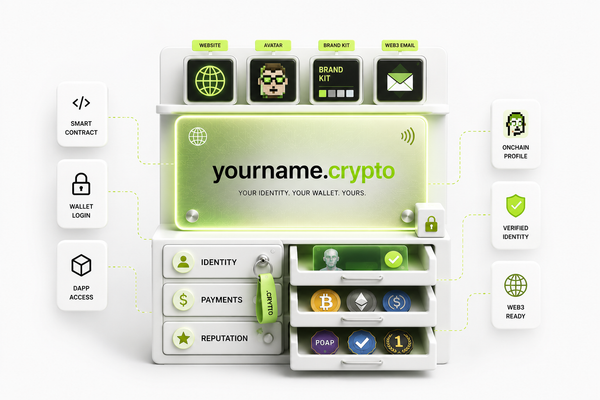
The most immediate practical contribution Web3 domains make to e-commerce is straightforward: they replace complicated blockchain wallet addresses with human-readable names that anyone can use comfortably.
Sending a crypto payment to a wallet address that looks like a random 42-character string of letters and numbers is intimidating and error-prone. One typo means permanent loss. That friction has been one of the significant barriers to cryptocurrency adoption in retail contexts. A domain like ShopCrypto.wallet removes that friction entirely. Customers send payment to a name they can read, verify, and remember. The technical complexity disappears into the background where it belongs.
Beyond payments, Web3 domains allow businesses to host decentralized websites through platforms like IPFS (InterPlanetary File System). Unlike traditional hosting, where your store lives on a company's servers and can be affected by outages, policy changes, or censorship, a decentralized storefront operates across a distributed network with no single point of failure. Your store stays up, your data stays yours, and no hosting provider can pull the plug on you.
The third major contribution is trust. Web3 domains integrate with decentralized identity (DID) systems that allow businesses to verify their authenticity through blockchain-backed credentials. In a digital marketplace full of anonymous vendors and counterfeit goods, the ability to demonstrate blockchain-verified legitimacy is a meaningful competitive advantage. Customers who can independently verify that VerifiedStore.wallet is who it claims to be are customers who feel comfortable completing a purchase.
And finally, Web3 domains give businesses a customizable, branded identity in the decentralized ecosystem. A domain like EcoFashion.eth or YourStore.crypto isn't just a payment address. It's a brand statement that signals innovation, builds recognition, and appeals to the growing segment of consumers who care about decentralization and data ownership.
Security and Trust: Where Web3 Domains Change the Game
Security is the issue that keeps e-commerce business owners up at night. Fraud, phishing attacks, identity theft, and data breaches are constant threats in the centralized web, and the solutions most platforms offer amount to adding more locks to a fundamentally vulnerable architecture.
Web3 domains approach security differently. Because transactions made through a domain like YourStore.crypto are recorded on the blockchain, they create a permanent, tamper-proof record that no one can alter after the fact. Every payment, every ownership transfer, every contract execution is logged in a way that is transparent and independently verifiable. The risk of unauthorized alterations or retroactive fraud drops dramatically.
Phishing is one of the most damaging threats in online commerce, and it typically works by impersonating legitimate businesses to trick customers into sending payments or credentials to fraudulent addresses. Web3 domains make this significantly harder. Because each domain is tied to a unique, verifiable blockchain record, customers can confirm they're dealing with the real business rather than a convincing imitation. A retailer operating under EcoFashion.eth has a blockchain-verified identity that no impersonator can replicate.
Decentralized identity integration adds another layer of trust that traditional e-commerce platforms genuinely struggle to match. When businesses link their Web3 domains to verified blockchain identities, they can display certifications, reputation data, and transaction histories that customers can check independently. This is particularly valuable in markets where trust is especially critical, including luxury goods, high-value collectibles, and any category where counterfeiting is a problem.
For customers, the privacy benefits are equally important. Decentralized identity systems give users control over their personal data, allowing them to verify their identity for a transaction without exposing information beyond what that specific transaction requires. The contrast with centralized systems that collect, store, and often monetize customer data is significant, and it's something that a growing number of consumers actively care about.
Personalization Without Compromising Privacy
Personalization has become a core expectation in e-commerce. Customers expect recommendations that reflect their actual interests, offers that are relevant to their history, and experiences that feel tailored rather than generic. The challenge is that most personalization systems achieve this by collecting and analyzing massive amounts of customer data in ways that raise legitimate privacy concerns.
Web3 domains offer a different approach: personalization grounded in data that customers own and control.
When a customer's purchase history, preferences, and activity are stored in their blockchain-linked Web3 identity, businesses can use that data to deliver genuinely relevant experiences without taking custody of sensitive personal information. The customer controls what gets shared, the blockchain ensures the data hasn't been tampered with, and the business gets the signals it needs to personalize effectively.
A clothing retailer using EcoFashion.eth can personalize its storefront for returning customers based on their verified purchase history, surfacing the sustainable products they're most likely to want without relying on third-party tracking or invasive data collection. The customer gets a better experience. The business gets better conversion rates. And nobody has to compromise on privacy to make it happen.
NFT-based loyalty programs are another personalization opportunity that Web3 domains enable uniquely. A gaming platform using MetaQuest.wallet can reward customers with NFT perks, exclusive access, or tradeable digital assets based on their activity, creating loyalty incentives that have real, verifiable value rather than the generic points and discounts that traditional loyalty programs offer.
Decentralized storefronts hosted through Web3 domains can be customized to reflect a business's identity with a level of control that centralized platforms rarely allow. Unique branding, curated product layouts, wallet-linked customer experiences, and direct integration with decentralized payment systems all become possible when the store operates on infrastructure the business actually owns.
Decentralized Payments: Faster, Cheaper, and Global
The payment infrastructure powering most e-commerce today is expensive and slow, particularly for businesses operating across borders. Credit card processors charge fees that add up quickly. International transfers involve multiple intermediaries, each taking their share. Settlement times measured in days create cash flow challenges. And the whole system excludes customers in regions with limited access to traditional banking.
Web3 domains address all of these problems simultaneously by enabling direct crypto payments between customers and businesses.
When a customer pays to FashionHub.eth, that payment goes directly from their wallet to the business without passing through a payment processor, a bank, or any other intermediary. Transaction fees drop substantially. Settlement is near-instant regardless of where in the world the customer is located. And the transaction is recorded on a transparent blockchain ledger that both parties can verify independently, reducing the friction and disputes that traditional payment systems generate.
The integration with popular wallets makes this practical rather than theoretical. Web3 domains connect seamlessly with MetaMask, Trust Wallet, Phantom, and other widely used wallets, enabling payments in Ethereum, Solana, and a growing range of other cryptocurrencies. For businesses, this means accepting crypto payments doesn't require building complex new infrastructure. It means linking your Web3 domain to your existing wallet and making that address available to customers.
For cross-border commerce specifically, the advantages are particularly compelling. A digital goods platform using GlobalShop.wallet can serve customers in any country without worrying about exchange rates, international transfer fees, or banking system delays. The payment arrives in minutes, the blockchain confirms it instantly, and the business can focus on serving its global customer base rather than managing payment logistics.
Real Businesses Using Web3 Domains Right Now
The applications of Web3 domains in e-commerce aren't hypothetical. They're being put into practice across multiple sectors.
NFT marketplaces like OpenSea and Rarible have demonstrated how Web3 domains can serve as branded storefronts for digital creators. An artist using DigitalArtistry.crypto can showcase their entire collection through a domain-linked storefront, receive payments directly through their wallet, and build a recognizable identity in the NFT space without depending on a centralized platform that controls their relationship with collectors.
Decentralized e-commerce platforms like Zora and Origin Protocol are enabling businesses to set up fully decentralized storefronts powered by Web3 domains. A sustainable clothing retailer using EcoGoods.eth gets a censorship-resistant store that operates independently of any single hosting provider, with complete control over customer data and supply chain transparency that traditional e-commerce platforms simply can't offer.
Cross-border crypto payment solutions built on Web3 domains are expanding access to global commerce for businesses that traditional payment systems underserve. A digital services platform using GlobalShop.wallet can accept payments from customers worldwide in their preferred cryptocurrency, bypassing the fees and delays that make traditional cross-border commerce so frustrating for both sides of the transaction.
These examples point to a broader trend: the businesses that are adopting Web3 domains now aren't doing it as an experiment. They're doing it because it solves real problems that traditional e-commerce infrastructure creates.
The Challenges That Are Still Being Worked Through
An honest assessment of Web3 domains in e-commerce requires acknowledging the obstacles that currently limit broader adoption.
Awareness is the most immediate barrier. Most business owners and consumers haven't encountered Web3 domains in a practical context, and the terminology around blockchain technology can feel intimidating to people who haven't spent time in the space. Education and accessible onboarding are essential for broader adoption, and the industry is still working on both.
Regulatory uncertainty creates hesitation for businesses that operate in heavily regulated industries or jurisdictions. Many countries still lack clear guidelines for cryptocurrency payments and blockchain-based business operations, which makes compliance planning difficult. As regulatory frameworks develop and clarify, this barrier will decrease, but it's a real consideration for businesses evaluating Web3 domain adoption today.
Technical requirements can be challenging for smaller businesses without dedicated technical teams. Setting up a decentralized storefront, integrating wallet connectivity, and managing blockchain-based payments all require capabilities that many small and medium-sized businesses don't have in-house. Platform improvements and better tooling are gradually reducing this barrier, but it hasn't disappeared yet.
Where This Is All Heading
The trajectory for Web3 domains in e-commerce is toward deeper integration with technologies that are already reshaping the industry.
AI integration is one of the most promising near-term developments. By combining AI's analytical capabilities with the verified, blockchain-stored data associated with Web3 identities, businesses will be able to deliver personalization that is both more relevant and more privacy-respecting than what centralized systems offer today.
Metaverse commerce is expanding the canvas entirely. As virtual environments develop into genuine commercial spaces, businesses using domains like MetaStore.crypto will be able to establish immersive virtual storefronts where customers browse, experience, and purchase in fully interactive environments that bear little resemblance to the flat web pages that current e-commerce runs on.
Multi-chain compatibility is becoming increasingly important as the blockchain ecosystem fragments across Ethereum, Solana, Polygon, and other networks. The ability to manage payments and customer interactions across multiple chains through a single Web3 domain will make it possible for businesses to reach the broadest possible audience without the complexity of managing separate presences on each network.
Taking Control of Your E-Commerce Future
The businesses that thrive in the next phase of e-commerce will be the ones that understand the direction things are heading and position themselves accordingly. Web3 domains are a meaningful part of that positioning, offering genuine advantages in security, payment efficiency, customer trust, and brand ownership that traditional infrastructure simply can't replicate.
For businesses ready to take that step, Endless Domains provides a practical starting point. The platform makes it straightforward to explore, acquire, and manage Web3 domains across a range of blockchain-based extensions, with an interface designed for accessibility, whether you're new to the space or already operating in the Web3 ecosystem.
The shift toward decentralized commerce is underway. The businesses that move with intention now, rather than waiting for mainstream adoption to force the issue, will be the ones that look back on 2025 as the year they got ahead of the curve.