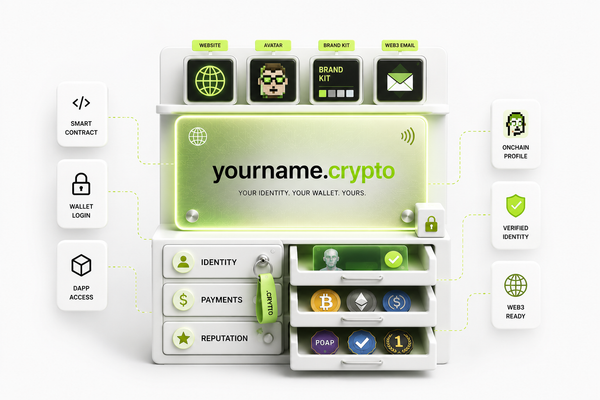
Top Use Cases for Web3 Domains: Beyond Just Crypto Addresses
Web3 domains are redefining the way we interact with the internet, offering simplified crypto transactions, decentralized identities, and more. Join the revolution and unlock the full potential of the decentralized web.

The internet is going through one of the biggest shifts in its history. Web3 technologies are quietly, and not so quietly, rewriting the rules of how we connect, communicate, and transact online. And at the centre of a lot of this change? Web3 domains.
What started as a simple fix to a complicated problem, giving crypto wallet addresses a human-readable name, has grown into something much bigger. Domains like yourname.eth or brand.crypto aren't just shortcuts for blockchain transactions anymore. In 2024, they're shaping how we build digital identities, own our online presence, communicate privately, and participate in the decentralized web.
Whether you're a tech enthusiast, a business owner curious about what Web3 actually means for you, or just someone who keeps hearing the term and wants a straight answer, this guide covers the most important real-world use cases for Web3 domains today and why they matter.
Simplified Crypto Transactions
Let's start with the most practical application, because it's the one that gets people through the door.
Blockchain wallet addresses are a mess. A typical address looks something like 0x4e5d3...7f8c, a long, confusing string of letters and numbers that's easy to misread and even easier to type wrong. One small mistake, and your funds can end up somewhere they shouldn't. There's no undo button on a blockchain.
Web3 domains solve this cleanly. Instead of copying and pasting an intimidating wallet address, you just type a name. Sending crypto to someone becomes as easy as sending them a text. You just use their domain, like john.eth, and you're done.
This matters a lot for newcomers. One of the biggest reasons people hesitate to use cryptocurrency is that it feels technically overwhelming. Web3 domains significantly lower that barrier, making blockchain transactions feel as normal and intuitive as sending a Venmo payment.
Here's what this looks like in practice:
Better user experience, because human-readable names make transactions faster and far less stressful. Reduced errors, since there's no more manually entering long wallet addresses and hoping you got every character right. Enhanced security, as domains verified on the blockchain help users avoid phishing scams that rely on fake or slightly altered addresses. Cross-platform compatibility, meaning Web3 domains work across a wide range of wallets and platforms, including MetaMask, Coinbase Wallet, and Trust Wallet.
Platforms like Ethereum Name Service (ENS), Unstoppable Domains, and Endless Domains are leading this space. Endless Domains, in particular, makes it straightforward for users to register personalized blockchain domains without needing a technical background. Even major exchanges like Binance have adopted Web3 domain compatibility, which is a strong signal that mainstream integration is well underway.
The bottom line: Web3 domains are making crypto usable for regular people, and that's no small thing.
Decentralized Identity (DID)
Here's where things get genuinely interesting.
Right now, your digital identity is scattered across dozens of platforms, each with its own username, password, and privacy policy. You don't really own any of it. The platforms do. They can suspend your account, change their terms, get hacked, or go out of business. Your identity online exists at their discretion, not yours.
Web3 domains flip this completely. Through Decentralized Identity (DID), a Web3 domain becomes your universal, blockchain-based identifier, one that you fully control, can't be taken from you, and works across multiple platforms without needing to create new accounts everywhere.
Think of JohnDoe.eth or MyBusiness.crypto not just as a name, but as a trusted, verifiable digital passport. Here's what you can do with it:
Build a professional profile by linking your Web3 domain to a blockchain-based portfolio, resume, or credentials, essentially a decentralized LinkedIn alternative that you own outright. Establish personal branding for entrepreneurs, creators, and influencers who want a single, trustworthy hub for their content, partnerships, or products. Use it as a digital passport that lets you log in to decentralised finance platforms, games, and metaverse environments without juggling a different password for each service.
The key benefits here are privacy, since you decide what data to share and when, along with security backed by blockchain's tamper-resistant architecture, and interoperability that lets a single domain work seamlessly across many platforms.
We're still in the early days of decentralized identity, but the direction is clear. People want more control over who they are online, and Web3 domains are one of the most practical tools for getting there.
Web3 Email Addresses
If you thought email was too established to be disrupted, think again.
Web3 domains are now powering a new generation of blockchain-based email addresses. An address like yourname@yourdomain.eth or contact@business.crypto might look similar to what you're used to, but the way it works under the hood is fundamentally different and a lot more secure.
Traditional email runs on centralized servers. Those servers can be hacked, surveilled, or sold. Your inbox isn't really private. It's hosted somewhere that a company, government, or bad actor can potentially access. Web3 email addresses operate on decentralized infrastructure, meaning no central server to target and no third party sitting between you and your messages.
The practical security advantages are significant. Spam drops dramatically because Web3 email systems can restrict incoming messages to verified blockchain addresses only. Phishing becomes much harder because blockchain authentication makes it nearly impossible to convincingly impersonate someone. Large-scale data breaches, the kind that expose millions of email addresses at once, become a non-issue when there's no central database to breach in the first place.
On the professional side, a business using support@mybusiness.crypto isn't just making a branding statement. It's offering clients genuinely encrypted, confidential communication. For individuals who care about privacy, Web3 email is simply the most secure option available today.
This isn't just a tech upgrade. It's a philosophical shift toward communication that puts users back in control.
Tokenized Assets and NFTs
For anyone operating in the NFT space, the gaming industry, or virtual real estate, Web3 domains are quickly becoming a foundational tool.
The challenge with managing tokenized assets has always been visibility and organization. Your NFTs, in-game items, and virtual properties exist on the blockchain, but navigating to them or sharing them with others requires dealing with complex wallet addresses and transaction hashes. Web3 domains fix this by giving your assets a clear, memorable, and shareable identity.
An NFT artist using ArtByAlex.eth can direct collectors straight to their portfolio with a simple, branded link. A gaming platform can assign personalized player IDs that let users display and trade in-game assets, including rare skins, weapons, and collectables, with verifiable ownership baked in. Virtual property owners in the metaverse can assign Web3 domains as actual addresses for their digital land, making navigation and branding far more intuitive.
What makes this especially powerful is the combination of authenticity and transparency. Every transaction, every ownership record, is logged immutably on the blockchain. There's no ambiguity about who owns what, and no centralized authority that can revoke or dispute it.
For creators and collectors alike, Web3 domains are becoming the standard way to present, manage, and build value around digital assets.
Decentralized Social Media Handles
Social media has a trust problem. Accounts get hacked. Usernames get taken or reassigned. Platforms suspend users without warning. And there's no real way to prove that the account you're following actually belongs to the person it claims to be.
Web3 domains address all of this in one shot.
By using a blockchain-linked handle like CryptoChef.eth or ArtByElla.crypto on decentralized social platforms, creators and users get something traditional social media has never been able to offer: a handle that is verifiably yours, immutable, and completely in your control. No platform can take it from you, and your audience always knows they're engaging with the real you.
This matters across a range of use cases. Content creators and influencers can build audiences on decentralized platforms like Lens Protocol or DeSo with handles that are permanently tied to their identity, not just their account on one platform. DAO members can use Web3 domains as unique identifiers for governance activities, including voting, submitting proposals, and participating in community decisions, with full transparency. Anyone tired of fragmented online identities can consolidate everything under one Web3 handle that works across multiple decentralized platforms.
The bigger picture here is a social media experience that actually belongs to the people using it. That's a significant departure from where we are today.
Bridging the Gap Between Web2 and Web3
One of the most underrated capabilities of Web3 domains is something that doesn't get talked about enough: you don't have to choose between the old internet and the new one.
For most businesses and individuals, going all-in on Web3 overnight isn't realistic. You have existing websites, customer relationships, and workflows built around Web2 infrastructure. Web3 domains make it possible to start incorporating decentralization into what you already have, without starting from scratch.
Here's what this looks like in practice. A business running Brand.com can also secure Brand.crypto and link it to decentralized content hosted on platforms like IPFS (InterPlanetary File System), giving visitors a censorship-resistant alternative that runs alongside the traditional site. An e-commerce platform can use a Web3 domain to accept cryptocurrency payments in addition to regular credit card transactions, opening the door to a new customer base without alienating the existing one. Web2 platforms can gradually incorporate blockchain-powered features, such as smart contracts, decentralized identities, and tokenized assets, through their Web3 domains, building Web3 capabilities into their existing tech stack over time.
This hybrid approach is probably the most realistic path for widespread Web3 adoption. Not a hard cutover, but a gradual, practical integration that lets businesses and users move at their own pace.
Final Thoughts
Web3 domains are doing something genuinely rare: they're making a complex, technical shift in internet infrastructure feel approachable and useful to real people in real situations.
They simplify crypto transactions. They give users ownership of their digital identity. They make communication more private and secure. They create clearer frameworks for managing digital assets. They give creators and businesses more control over how they show up online. And they offer a practical, non-disruptive way to start transitioning from Web2 to Web3.
None of these is a small thing. Taken together, they represent a meaningful shift in the relationship between people and the internet, away from platforms that own your data and toward infrastructure that works for you.
If you've been curious about getting started, 2024 is a good time to do it. Platforms like Endless Domains make the process straightforward, whether you're a business looking to expand your digital footprint or an individual who just wants to stake a claim in the decentralized web before the best names are gone.
The internet is changing.Web3 domains are one of the clearest signs of where it's headed.