Interoperability in Web3: Connecting Blockchains for a Seamless Decentralised Future
Interoperability in Web3 bridges the gaps between isolated blockchains, empowering users to interact, transfer assets, and access services across multiple networks without restrictions. By leveraging advanced cross-chain technologies, Web3 is evolving into a more unified and efficient decentralized

Web3 promises a fundamentally different kind of internet, one where you own your data, control your assets, and don't have to rely on a corporation to be the middleman. Unlike Web2, where a handful of tech giants hold the keys to your digital life, Web3 is built on blockchain technology, giving individuals real autonomy over their finances and online interactions through tools like decentralized applications (dApps) and smart contracts.
But here's the thing: none of that vision fully works if blockchains can't talk to each other.
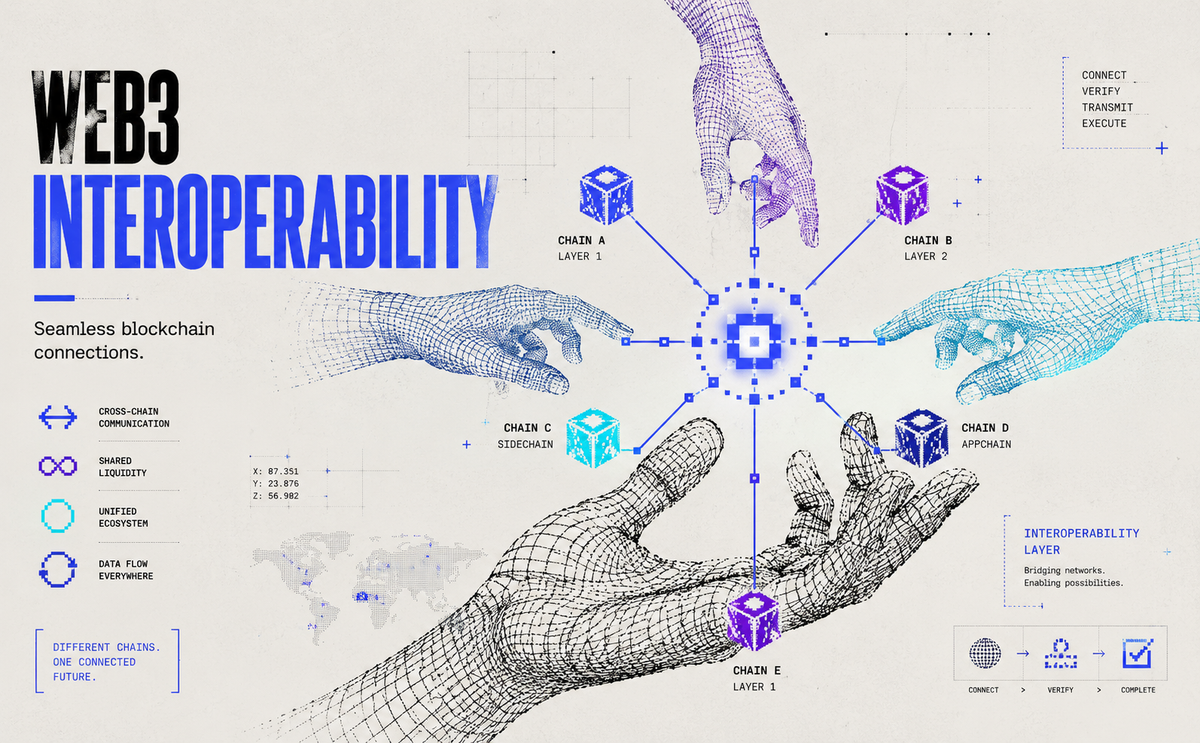
That's where interoperability comes in. It's the ability of different blockchain networks to communicate, share data, and move assets between platforms without friction. Without it, each blockchain is essentially its own island, powerful on its own, but cut off from the rest. Interoperability is what turns a collection of isolated networks into a genuine, connected Web3 ecosystem.
So, What Exactly Is Interoperability in Web3?
At its core, interoperability means that separate blockchain networks, each with its own rules, protocols, and architecture, can work together. Think of it like international phone lines: different countries built their own systems, but they all agreed on standards that let you call someone across the world.
In practical terms, interoperability lets users move assets, access dApps, and participate in decentralized finance (DeFi) across different blockchains. Without it, someone holding tokens on Ethereum who wants to use them on Solana would have to go through a centralized exchange to make it happen, which kind of defeats the whole point of decentralization. With interoperability, you can move freely between networks without needing an intermediary.
Why Does This Actually Matter?
Right now, most blockchain networks operate in isolation. Ethereum has its own ecosystem. Binance Smart Chain has its own. Each one has its own user base, assets, and rules. While this independence is great for security and innovation, it creates what are often called blockchain silos, and silos are a problem.
If you want to move assets from Ethereum to Binance Smart Chain, you need a specialized bridging solution. That friction slows everything down, limits the user experience, and caps the scalability of the entire decentralized space.
Interoperability tears down those walls. In a truly interoperable Web3, you could move assets between blockchains as easily as sending an email. That kind of fluidity unlocks real benefits: better liquidity, faster innovation, smoother DeFi experiences, and a blockchain space that actually lives up to its potential.
The Technologies Making It Possible
Cross-Chain Bridges
Cross-chain bridges are essentially gateways between blockchains. They let users transfer assets from one network to another by locking tokens on the source chain and minting equivalent tokens on the destination chain. If you want to reverse the process, the tokens on the destination chain are burned, and the originals are released back.
Bridges like Avalanche, Polygon, and Wormhole have become critical infrastructure for the Web3 space. They reduce fragmentation between blockchain ecosystems and open the door for cross-chain activity in gaming, DeFi, and beyond.
Atomic Swaps
Atomic swaps take things a step further by letting two people exchange tokens across different blockchains directly, no centralized exchange, no middleman. The swap either completes fully or doesn't happen at all (that's the "atomic" part), which is enforced through cryptographic tools called Hashed Time-Lock Contracts (HTLCs).
For example, if you want to trade Bitcoin for Ether, an atomic swap lets you do it peer-to-peer. If the conditions of the trade aren't met within a set time window, the transaction cancels automatically, and everyone gets their tokens back. It's a cleaner, more secure way to trade across chains, and it keeps decentralization intact.
Interoperability Protocols
Several protocols have been designed specifically to build bridges between blockchain ecosystems:
- Polkadot functions as a multichain network where independent blockchains (called parachains) can coexist and communicate through a central Relay Chain. Each parachain can specialize DeFi, NFTs, identity, whatever, while still being able to interact with others.
- Cosmos takes a similar approach with its Inter-Blockchain Communication (IBC) protocol, which enables data and token transfers between different blockchains within its network. It's often described as the "Internet of Blockchains."
- Chainlink is a decentralized oracle network that allows smart contracts to access off-chain data and enables cross-chain data transfers. Its Cross-Chain Interoperability Protocol (CCIP) is designed to facilitate seamless token and data movement between networks.
The Real Benefits
A Better User Experience
Without interoperability, you're stuck. You can only use the dApps on your specific chain, and moving assets anywhere else is a headache. With cross-chain interoperability, you can store assets on Ethereum and move them to Binance Smart Chain to take advantage of lower transaction fees, all without losing your mind in the process. The experience becomes fluid rather than fragmented.
More Room for Innovation
Developers working in siloed environments are limited. They can only build on one chain at a time. With interoperability, they can mix and match using Ethereum's security alongside Binance Smart Chain's speed and low fees, for instance. It also opens the door for cross-chain collaboration, shared liquidity, and multi-platform token integrations. That's a recipe for genuine creativity.
Stronger DeFi Liquidity
DeFi runs on liquidity. When it's trapped on individual chains, it's inefficient. Interoperability allows platforms to pull liquidity from multiple networks, giving users better pricing, broader markets, and a more functional DeFi experience overall.
The Challenges That Still Need to Be Solved
Interoperability isn't a solved problem, not by a long shot.
Technical Complexity
Different blockchains use different consensus mechanisms. Bitcoin uses Proof of Work. Ethereum uses Proof of Stake. Getting these systems to communicate reliably requires serious engineering, and keeping those solutions fast, secure, and affordable as networks scale is an ongoing challenge.
Security and Trust
Cross-chain bridges are attractive targets for hackers because they hold a lot of value and often act as intermediaries. The Wormhole Bridge hack, where millions of dollars were stolen due to a vulnerability in the system, is a stark reminder of what's at stake. Smart contracts that aren't properly audited add another layer of risk. Users have to trust that these systems work correctly, and earning that trust requires rigorous testing, auditing, and transparency.
Regulation and Standardization
There's no global rulebook for cross-chain transactions. Different countries regulate blockchain, crypto, and DeFi differently, which makes it difficult to build compliant cross-chain solutions. Beyond legal issues, the lack of technical standardization means each interoperability solution tends to reinvent the wheel. Common standards would make cross-chain communication faster, safer, and easier to audit.
Where Is This All Headed?
New Protocols Leading the Way
Projects like LayerZero and ThorChain are pushing interoperability forward. LayerZero is designed for omnichain interoperability, allowing dApps to work across multiple blockchains through a single unified framework. ThorChain enables native asset swaps between chains like Ethereum, Bitcoin, and Binance Smart Chain without wrapped tokens or centralized exchanges. These solutions are making cross-chain interactions faster, safer, and more accessible.
Interoperability in the Metaverse
As virtual worlds expand, interoperability will be essential for giving users true digital freedom. Imagine buying an avatar or an NFT on Decentraland and being able to take it with you into The Sandbox or any other blockchain-based platform. That kind of portability of assets, identity, and experience is what makes a metaverse feel real. Without interoperability, you're just locked into whatever walled garden you started in.
Enterprise Adoption
Many businesses are interested in blockchain but struggle because their internal systems don't connect with external networks. As interoperability matures, companies will be able to link private blockchains with public networks, making cross-border payments simpler, supply chain tracking more transparent, and DeFi integration more practical. That's a significant unlock for enterprise-level blockchain adoption.
Real-World Examples Worth Knowing
- Polkadot lets parachains specialize in different functions while sharing security and communicating freely through its Relay Chain.
- Cosmos connects diverse blockchains through IBC, supporting everything from DeFi to identity management without forcing chains into a single mold.
- Chainlink's CCIP extends the power of smart contracts by letting them pull in real-world data and interact across multiple blockchains seamlessly
Final Thoughts
Interoperability isn't a nice-to-have feature for Web3; it's the foundation that holds the whole vision together. A decentralized internet where blockchains can't talk to each other isn't really decentralized; it's just a collection of smaller, separate centralized systems.
The technologies are improving fast. Cross-chain bridges, atomic swaps, and protocols like Polkadot, Cosmos, and Chainlink are making real progress. And emerging solutions like LayerZero and ThorChain are pushing the boundaries even further. The more these systems mature, the closer we get to a Web3 domains that's genuinely open, connected, and built for everyone.